Publisher’s note: This is the first of three stories looking at the past, present and future of Lake Tahoe Airport.
By Joann Eisenbrandt
South Lake Tahoe wants commercial airline service to return to Lake Tahoe Airport. This isn’t news, but it’s moved to the forefront with the expiration this October of the 1992 Lake Tahoe Airport Master Plan Settlement Agreement ― a complex document that has formed the regulatory framework of commercial service at the airport for the last 20 years.
The answer to why this is significant today lies in the past.
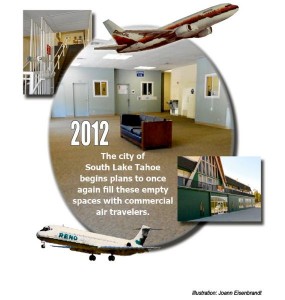 The 1992 Lake Tahoe Airport Master Plan Settlement Agreement’s goal was to put to rest a swarm of counterpunching lawsuits and years of acrimonious fighting over the levels, value of and right to control commercial air service at the Lake Tahoe Airport during the mid-1980s and early-90s. At a settlement conference on Sept. 21, 1992, the warring stakeholders ― South Lake Tahoe, California Attorney General’s Office, Tahoe Regional Planning Agency, League to Save Lake Tahoe and Federal Aviation Administration ― symbolically buried the well-bloodied hatchet.
The lawsuits were dismissed and replaced with the minutely-detailed three-stage Settlement Agreement establishing tightly-controlled parameters for commercial service including: the allowed decibel levels of incoming and departing flights; enforcement of a list of presumptively-banned aircraft which could not meet those noise standards; annual noise level averages surrounding the airport; a tiered increase in the number of allowed yearly enplanements; environmentally-focused facility improvements; ongoing studies to determine traffic counts and vehicle miles traveled; a list of environmental mitigations and public education the city must perform; limits on and fees for rental cars; and an upgraded noise monitoring, reporting and complaint system, to name just a few.
On the surface, this was a fight over commercial airline service, but at its heart it was part of the larger struggle to answer the quintessential Tahoe question, “To whom does Tahoe belong?” and its corollary, “Who should be in charge of crafting the blueprint for its future?”
Scheduled jet service into the Lake Tahoe Airport ended in August 2000 when Allegiant Air, the last of a string of commercial and commuter airlines flying under the guidelines of the Settlement Agreement, ceased service. Then, as now, the city viewed the airport as an integral component of Tahoe’s economic survival. Mayor Pro Tem and Airport Commission Chairman Tom Davis, an active participant throughout the airport’s troubled history, realizes, “There’s valid skepticism in town about this airport, but we have a vision. I challenge the naysayers who don’t have a solution. There’s now a whole generation behind us that knows we need a balance…. We have the airport. We have the asset. We just need an airline.”
City Manager Nancy Kerry agrees, “We have this facility. What is its best and highest use? A general aviation airport is just a waste of space. We need to invest now so we’re ready when the economy recovers. It will have very minimal impact on the environment, but have a great impact on the economy.”
Not everyone has seen it quite that way. In a 2006 Lake Tahoe Airport Impacts Report, the League to Save Lake Tahoe asked, “Is the Lake Tahoe Airport, particularly commercial air service, part of the solution or part of the problem in terms of meeting the widely-supported goal of transporting people to and from the Lake Tahoe Basin in ways that have fewer environmental impacts? Do the economic and transportation benefits from the Lake Tahoe Airport outweigh the costs to the environment, such as air and water pollution, and community, such as noise and tax subsidies?”
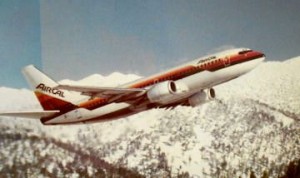
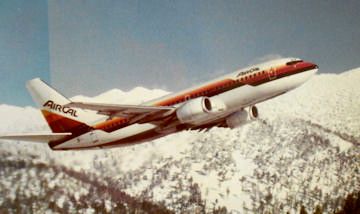
AirCal was one of several commercial airlines that used to have regular flights into Lake Tahoe Airport. Photo/Provided
But who should speak for Tahoe? In 1989, Tom Martens, then executive director of the League to Save Lake Tahoe, told this reporter, “Tahoe belongs to the people of the United States and of the states of California and Nevada, more than to the local people unfortunately … because Congress and the states of California and Nevada declared it a national resource. They did that because of local mismanagement, so what may once have belonged to the local folks, doesn’t anymore, and probably never will. Without regulation from outside, Tahoe would have been gone.”
Taking a look back
In the 1940s, Lake Tahoe was a sparsely populated, quiet summer getaway. There was no city of South Lake Tahoe, no TRPA, no League to Save Lake Tahoe, few year-round residents, no visible conflict between economy and environment, and no commercial-service airport.
Following World War II, the lake’s population began to expand, and with the 1960 Squaw Valley Winter Olympics, everything changed. A building boom to accommodate the influx of visitors brought a spurt of residential and commercial development, especially on parcels fronting Highway 50. Motels and shopping centers began to dot the landscape. Highways 50 and 80 were built and improved. In late summer 1959, with funding assistance from the FAA, El Dorado County built and began operation of Lake Tahoe Airport.
In 1965, residents of the Al Tahoe, Bijou, Tahoe Valley and Stateline areas, concerned over excessive urbanization and the lack of land-use controls or a formal local government, voted to incorporate South Lake Tahoe. Other residents, worried that the new city was “owned” by developers, looked outside the basin for regional controls, beginning the path to today’s TRPA. In December 1965, the League to Save Lake Tahoe was formed.
The battle lines were drawn. The real fight for Tahoe began, and the fundamental question, “To whom does Tahoe belong?” took its place as the unseen but powerful “elephant in the room” in every subsequent discussion regarding Lake Tahoe’s future.
From its beginnings in 1959, the airport was served by myriad charter, commuter and commercial air service. The initial 5,900-foot runway was expanded to its current 8,541 feet in late 1962. The airport hit its peak service levels in the late 1970s, reaching close to 300,000 enplanements in 1978.
But the rumblings of trouble to come had begun. In 1977, AirCal (later American Airlines) first began scheduled commercial service to the then county-run airport. The California Attorney General’s Office, the chief law enforcement office of the state, sued AirCal, the Public Utilities Commission and the Civil Aeronautics Board on behalf of CTRPA (California Tahoe Regional Planning Agency – TRPA’s precursor) for their failure to comply with the requirements of the California Environmental Quality Act.
CEQA is the California statute, originally enacted in 1970 as a corollary to the federal NEPA (National Environmental Policy Act). Unlike the TRPA Regional Plan, CEQA does not set specific environmental thresholds to be met. Instead, it requires public decision-makers consider and define the environmental impacts before approving a “project,” such as commercial air service, and if significant, build in ways to mitigate them.
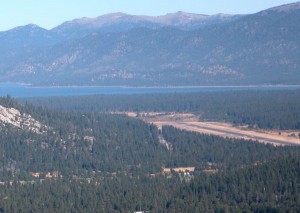
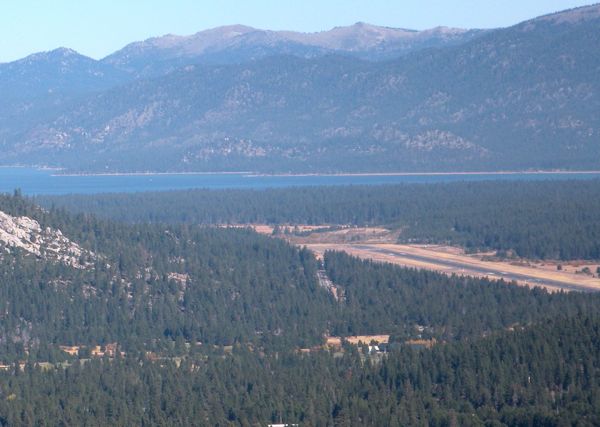
South Lake Tahoe took over operations of the airport from El Dorado County in 1983. Photo/LTN file
Further complicating things, in1978 the federal Airline Deregulation Act was passed, eliminating the control of the Civil Aeronautics Board over domestic air routes after Dec. 31, 1981, giving air carriers the right to provide, or stop providing, service on any routes they chose. In December 1980, a restructured bi-state TRPA enacted its Regional Plan.
City steps in
By then, feeling the effects of airline deregulation, yearly enplanements at the county-run airport had dropped to just more than 33,000, the physical plant was deteriorating and the airport was costing the county much more than it provided in revenue. Viewing the airport as a vital link to the outside world, and fearing that under the county it would not be maintained, the city began negotiations to take it over.
On Oct. 5, 1983, the city assumed operation of the airport from El Dorado County and with it the obligation to complete the county’s stalled master plan. The AG’s Office agreed to a 90-day exemption for the county’s completion of the CEQA-mandated documents, partly due to the earlier massive landslide on Highway 50.
On Oct. 11, the city approved a six-month lease with AirCal at their existing flight levels, telling the AG’s Office that within that timeframe they would have a completed Airport Master Plan. The CEQA process requires preparation of either a negative declaration or an environmental impact report, saying in the first case that the project creates no negative environmental consequences, or in the second, that if it does, sufficient mitigation measures will be in place to adequately offset them. The third option, a mitigated negative declaration, affirms that even though a project creates some impacts that cannot be fully mitigated, the project is so necessary for the larger public good that it still must go forward.
In March 1984, the city filed a negative declaration for the AirCal flights. TRPA noted concerns over noise, offsite parking impacts, traffic, and the danger of fuel spills in a stream environment zone, among others.
The lawsuits started whizzing. The AG’s Office sued the city over perceived inadequacies in the environmental document. The California AG’s Office had already sued TRPA stating that certain elements of its Regional Plan were inadequate. The city contended the Federal Airline Deregulation Act took away the power from any agency except the federal government, specifically the FAA, or the city to impose environmental thresholds, and sued TRPA saying it had no jurisdiction over the Lake Tahoe Airport, and even if it did, its standards, specifically those in relation to aircraft noise, were arbitrarily arrived at.
In May 1984, Judge Edward Garcia of the U.S. District Court, Eastern District of California filed a restraining order halting development in the basin in response to the AG’s lawsuit, preventing TRPA from approving “projects” such as AirCal’s flights. That December, the city prepared a draft EIR for an increase in weekly AirCal flights to 35, again finding the flights created no significant environmental impacts. The AG’s Office then sued the city stating this environmental document was also inadequate.
Progress stalls
Lake Tahoe Airport was now securely entangled in the “who speaks for Tahoe” debate. Attempts to settle the overlapping lawsuits individually were unsuccessful. Work on the Airport Master Plan ticked on, but slowly. Caught in the meat grinder of remarkably bad timing, a small Bay Area startup airline, Westates, began the complex and expensive environmental process to serve Lake Tahoe, but was blown out of the air by cost overruns and never began service.
In spring 1986, an Airport Consensus Group was formed in hopes of resolving the issues, and agreed to an Interim Service Agreement (ISA) for short periods during the summer and winter peak seasons of 1987, to monitor and evaluate the noise levels and other impacts of the expanded airline service. Pending litigation was put on hold. The suits over TRPA’s Regional Plan had been dropped, a revised Regional Plan approved and the building moratorium lifted.
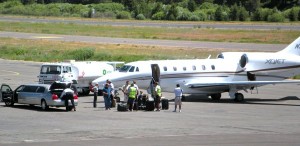
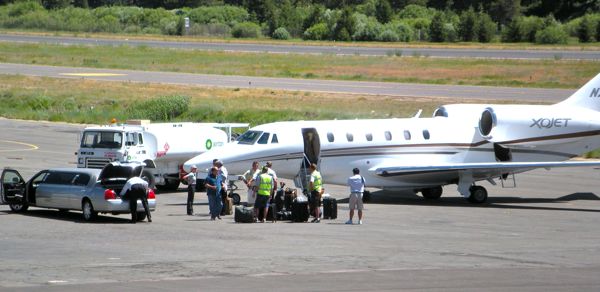
Today it is mostly private jets that use Lake Tahoe Airport. Photo/LTN file
In July 1987, during the ISA’s summer segment, the FAA wrote a letter to the city expressing its concerns that in striving to “beat the box” … “Aircraft pilots attempting to reduce the noise levels of their aircraft as they fly over a monitoring station may engage in maneuvers which are not consistent with the highest order of safety.” The parties to the ISA, while denying any safety issues, became spooked by the prospect of liability. No winter ISA segment was held.
In 1987, AirCal became part of American Airlines. American terminated service to the Lake Tahoe Airport in 1991, with the smaller commuter American Eagle continuing. The Settlement Agreement was signed in September 1992 and American Eagle suspended service in November of that year. In the years that followed, a cavalcade of attempts at reinstituting commercial and commuter service had short-lived success: United Air and Alpha Air-Trans World Express in 1992, Reno Air from December 1994 to September 1995 under a $1 million privately-funded subsidy by the Tahoe Airline Guarantee Corporation; Sierra Expressway from 1995 to 1996; Allegiant Air from June-October 1999 and briefly in August 2000; and Tahoe Air from June-November 1999.
Soon after, questions arose over continued funding for air traffic control services at the airport tower. In 1997, the FAA had determined Lake Tahoe Airport had fallen below the critical 1 percent service level required for FAA funding. With a lack of commercial service, the airport had scored a 0.1. The city struggled to retain the tower and its air traffic control services through various combinations of FAA funding, state grants and city contributions, but in 2004 it closed.
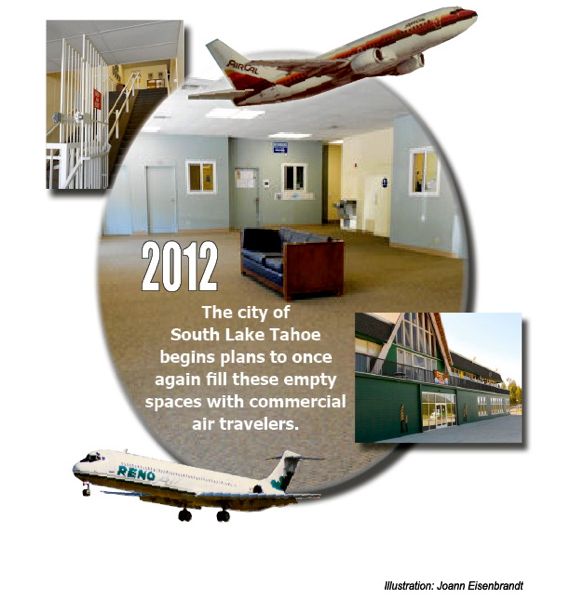
Today there is no scheduled commercial service and the tower sits empty. General aviation services are provided by the fixed-base operator, Mountain West Aviation, helicopter flights by Reno Tahoe Helicopters, flight training by Lake Tahoe Flight School and food by the Flight Deck Restaurant. South Lake Tahoe administrative offices now quietly occupy much of the space previously overrun with the noisy jostling of arriving and departing passengers and the whining of a large, shiny metal baggage carousel.
The city has continued to contend during the 20-year term of the Settlement Agreement, that commercial service is a vital part of the airport’s reason for being. For 20 years, many have just as strongly disagreed. Now, as the expiration of the 1992 Settlement Agreement this fall comes clearly into focus, a blast of fresh air has reignited the long-smoldering debate over this polarizing issue and the questions that lie beneath it, “To whom does Tahoe belong?” and “Who should be in charge of crafting the blueprint for its future?”
Part two on July 6: The issues that have made reaching a consensus on commercial airline service so difficult.
 • Robin Williams will be at MontBleu in Stateline July 20-21.