Airport agreement expires in 3 months and there is no plan
Publisher’s note: This is the final installment of the three-part series looking at the past, present and future of Lake Tahoe Airport.
By Joann Eisenbrandt
The 29 years since South Lake Tahoe assumed operation of the Lake Tahoe Airport from El Dorado County have proved to be a bumpy ride, peppered with aborted takeoffs and emergency landings. After almost a decade of accusations and heated debate over the appropriate configuration and levels of commercial service, and who should make those determinations, a web of entangled lawsuits had stalled negotiations. In 1992, the contending agencies accepted the Lake Tahoe Airport Master Plan Settlement Agreement to end the litigation. That highly structured agreement provided the framework for commercial service at the airport for the next 20 years.
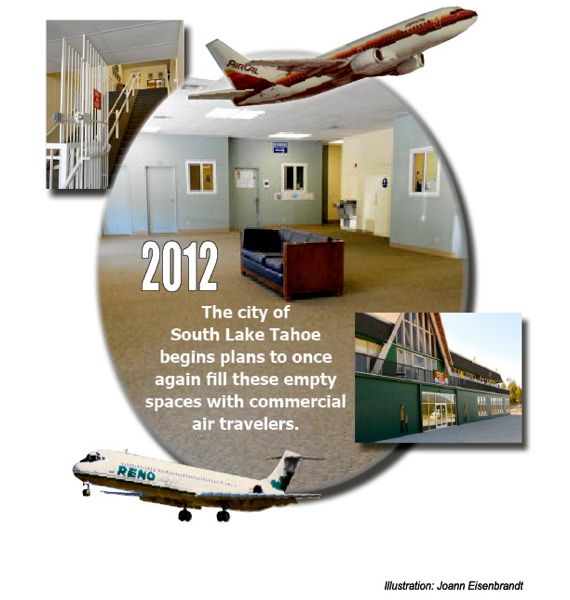 South Lake Tahoe is already looking forward, literally and figuratively, to its expiration this fall, and has made clear its intention to bring commercial service back to Tahoe. When asked for specifics on the city’s plans for moving forward on this quest, Lake Tahoe Airport Director Sherry Miller said, “We’re still peeling the onion.”
How much crying will be involved in that process depends on three factors: What course the city chooses to follow and when; what things are the same as 20 years ago; and, and what things are different.
According to Miller, the city has three possible paths: Reinstitute commercial service prior to the expiration of the 1992 Settlement Agreement this October and attempt to comply with all its existing provisos; attempt to renegotiate some terms of the Settlement Agreement and then bring in commercial service under those guidelines; or wait until the Settlement Agreement expires and then bring in commercial service outside its confines.
If the city secured a commercial air service provider prior to the expiration of the Settlement Agreement, they would be, Deputy City Attorney Nira Feeley explains, “Confined to what’s in there. The city would need to show compliance with all the mitigation measures in the Settlement Agreement.” If such commercial service continued after the Settlement Agreement expired, the City Council would then, “take discretionary action to authorize commercial service above the decibel levels of the Settlement Agreement and then do a full CEQA (California Environmental Quality Act) analysis of this commercial service.”
If the city attempted to renegotiate the Settlement Agreement and bring in commercial service under amended terms, it would necessitate the involvement and sign-off regarding any changes by all the signatories to the original 1992 agreement – the city, TRPA, League to Save Lake Tahoe and the California Attorney General’s Office.
Lynda Gledhill, spokeswoman for the state Department of Justice, refused to comment and then wouldn’t explain why even though her office was a major player in all of this 20 years ago.
The FAA would also be involved. In 1992, that agency stipulated that the Airport Noise and Capacity Act of 1990 (ANCA) ― which requires all airport operators who have taken federal funding not discriminate with regard to airport access or hinder interstate commerce ― did not apply. They would want to revisit that issue under any revised agreement.
Apart from the ANCA issue, TRPA Associate Counsel Scott Lichtig told Lake Tahoe Newshe believes renegotiating the existing Settlement Agreement would be problematic. “The city could go forward if they met the requirements, but probably not at this stage of the master plan. They are still at Stage 1 instead of Stage 3. The permits were issued for Stage 1 20 years ago. No permit was issued for Stage 2 because they never got there. If the city has a plan for how they could substantially comply and get a Stage 2 permit … but I have a hard time thinking how that would happen. It would be pretty tough to reactivate a Settlement Agreement that for the last 10 years has just been laying fallow on both ends.” (The 1992 Settlement Agreement had three stages spanning its 20-year term, with different allowed enplanement levels, noise restrictions and mitigation measures for each. Commercial service never got past the Stage 1 level.)
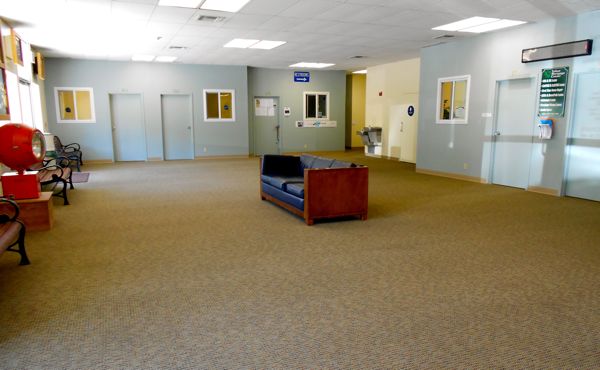
Without a plan, Lake Tahoe Airport may remain sleepy. Photo/Joann Eisenbrandt
The third option would be for the city to let the Settlement Agreement expire and then move forward to bring back commercial service. In that case, as City Attorney Patrick Enright explained to Lake Tahoe News, the city would, “Have to negotiate with TRPA to meet all the requirements regarding noise, air pollution and VMT to get a TRPA permit.” Under this scenario, Feeley adds, the city would have one additional decision to make, “whether we do a new master plan or bring in service under the existing master plan – which is the 1992 Master Plan Settlement Agreement. TRPA regulations appear to require a master plan. We are currently looking into whether that requirement is trumped by FAA regulations.”
TRPA External Affairs Chief Julie Regan explains, “If the current plan expires before a new plan is in place, the status quo would continue, i.e., the city would continue to operate the airport as a general aviation facility until a new plan is developed and put in place.”
Not everyone agrees with that assessment, largely because of those things that remain the same as they were 20 years ago.
What remains the same is the core question whose answer forms the foundation for the answers to all other questions at the lake, “Who should speak for Tahoe.”
The list of those who wish to fill that role to one degree or another also remains the same: the city of South Lake Tahoe, Tahoe Regional Planning Agency, California Attorney General’s Office, League to Save Lake Tahoe, Federal Aviation Administration, and of course, the residents of Lake Tahoe themselves.
Airport – good or bad?
The “airport as benefit or liability” debate also lives on. It goes something like this — Does the airport provide a needed and significant economic stimulus to the local Tahoe economy, serve as an effective marketing tool not just for the airport but for the larger community as well, reduce VMT and thereby positively impact air and water quality as part of an coordinated basinwide transportation system, provide local residents and business owners accessible air service in summer and winter, and give the community an irreplaceable lifeline in medical and wildfire emergencies?
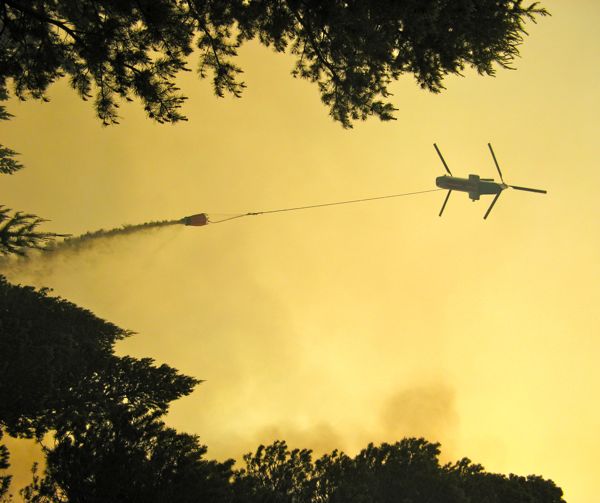
Lake Tahoe Airport was vital to the air assault on the Angora Fire in 2007. Photo/Lake Valley Fire
Or, can the disruptive single-event and cumulative noise levels generated by commercial service never be sufficiently mitigated; is such service patently inappropriate in Tahoe’s rural environment; are any VMT reductions insignificant and overshadowed by the air and water quality degradation from aircraft emissions and on-ground fueling services; are there serious safety and quality of life issues for residents living in the flight path; and, do any monetary benefits derived from commercial service go overwhelmingly to the ski, lodging and casino industries without removing the ongoing airport subsidies draining the city’s general fund?
Each of the mix of local, state, regional and federal Tahoe stakeholders has a role in determining what happens in Tahoe generally and at the airport specifically – it’s deciding who is at the top of the legal-environmental pecking order that has proven to be the sticking point. Problems arise when it is perceived, as George Orwell phrased it so well in “Animal Farm” that, “All animals are equal, but some animals are more equal than others.” It was the inability to replace this perception with a meaningful consensus on how to move forward that led to the lawsuits over the airport in the late 1980s, and the eventual creation of the 1992 Settlement Agreement.
In December 1980, the federal Compact establishing the bi-state Tahoe Regional Planning Agency was enacted. That Compact gave TRPA, “The power to establish environmental threshold carrying capacities and to adopt and enforce a regional plan and implementing ordinances.” The Compact also mandates that with minimal exceptions, no project “may be developed in the region without obtaining the review and approval of the agency and no project may be approved unless it is found to comply with the regional plan and the ordinances ….” The Compact goes on to say, “The agency shall seek the cooperation and consider the recommendations of counties and cities and other agencies of local government, of State and Federal agencies … and of civic groups and private persons.”
Working out the kinks of how power and cooperation can work effectively together has remained challenging, often producing mixed messages. For example, the Noise Element of the draft EIS for the 2012 Regional Plan update states, “Although local jurisdictions have established noise-level standards, such policies are not described in detail here because, for all projects with the Lake Tahoe Region, the TRPA-adopted noise threshold standards and code take precedence over local jurisdictions’ noise ordinances.”
The city believes it’s been at the bottom of the environmental pyramid for a long time. At the Feb. 7, 2012, City Council meeting, Mayor Pro Tem and Airport Commission Chairman Tom Davis expressed his frustration with TRPA, “In their quest to protect us, they’ve made us obsolete.”
City Manager Nancy Kerry says of the bi-state agency, “They have authority because of the bi-state Compact, but environmental concerns shouldn’t shut down a functioning airport. I don’t think TRPA regulations will stop commercial service. … We’re not going to ignore the goals of the Settlement Agreement. We don’t believe there are any thresholds that can’t be met. The goal is to bring commercial service back here.”
FAA will have a loud voice
Because the facility involved in this regulatory matrix is an airport, partially funded and maintained with federal money, the FAA becomes a key player, further destabilizing the hierarchy.
“The FAA controls the actions that go on at an airport,” Kerry explained. “Whether we want to use it for an air show, what we do with the hangars … it’s an airport. Its uses and functions are governed by the FAA.”
“FAA is involved in airport planning,” Advisory Circular 150/1570 notes, “to ensure that proposed airport development is safe, has utility, and meets airport design standards, and identifies obvious issues that could become environmental concerns.”
Fernando Yanez, planner at the FAA’s San Francisco Airports District Office, explains that once Airport Improvement Program (AIP) money is used, the FAA wants to, “be sure our federal investment is a wise investment.”
According to FAA guidelines, the city does not have to prepare a new master plan before reinstituting commercial service, even though given all the circumstances that may be the best choice.
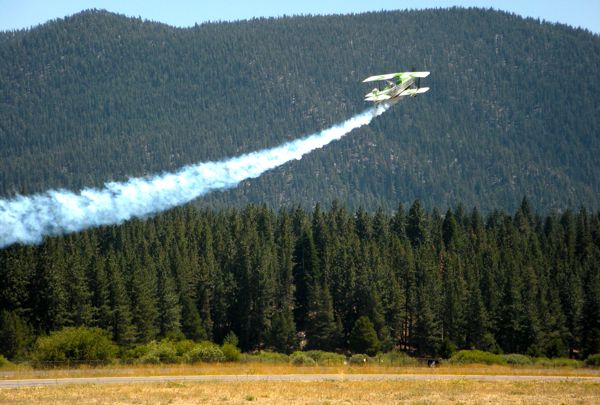
The August air show and this month's celebrity golf tournament are when the airport gets the most use. Photo/LTN file
“A master plan shows where the operator wants the facility to go. There hasn’t been such a planning document at Tahoe in a while,” Yanez told Lake Tahoe News. “They could choose to do a new one since things have changed – the economy and the social economy. It can be an update or a narrative report in more depth, and then there’s the master plan, a full-scale planning document.”
The airport sponsor is primarily responsible for airport master planning, and the actual master plan components represent the airport sponsor’s views, not the FAA’s. The elements and complexity of the master planning process will vary depending on the circumstances of each individual airport.
FAA review and approval are required for only two master plan components – the Forecast of Demand and the Airport Layout Plan. The Forecast of Demand predicates future levels of service (operations) and the type(s) of aircraft providing that service.
“It’s statistical,” Yanez explains. “It’s up to the airport to convince us that the data they’re using is reasonable and their premises are realistic.”
The second required federal approval is of the Airport Layout Plan, which shows existing airport facilities, provides a blueprint for future airport development and shows that consistency with safety requirements and community land use plans are maintained.
The next step is the NEPA (National Environmental Protection Act) process, which in California, would run concurrently with CEQA. At the conclusion of this environmental process, a preferred master plan alternative is selected and then federal grant funding for project design kicks in, followed the next year with funding for the actual project implementation. According to Miller, the cost of a full master plan is between $450,000 and $500,000, with the financial split generally being FAA 90 percent and the airport operator 10 percent. The airport receives yearly federal “entitlement” funding of $150,000 and can also seek additional “discretionary” AIP funds for such projects.
TRPA has a different perspective. “The key to the process is the update of the master plan.” Julie Regan said. “If there is a substantial change in operations, the city would do an update of the master plan. … That has been our discussion for many years with the city … looking at where we are today in the 21st century.”
The League to Save Lake Tahoe also sees a new Airport Master Plan as essential, as expressed in its 2006 review of the airport’s positives and negatives, “The forum to address such trade-offs and questions as part of a reassessment of the Lake Tahoe Airport and surrounding land is an update of the Airport Master Plan.”
“TRPA regulations appear to require a master plan,” attorney Feeley agrees, but adds, “We are currently looking into the issue of whether that requirement is trumped by FAA regulations. ANCA says that any restrictions placed on an airport by an entity other than the operating entity (the city) are pre-empted by the standards set forth in ANCA. It’s never a clear question of where TRPA law is pre-empted by other federal laws and regulations because TRPA is a federal agency. It is the city’s position that ANCA trumps TRPA’s regulations, but at this point it’s premature to say what the FAA’s position is.”
Differing definitions
The problem centers on TRPA’s maximum permitted single-event decibel levels for commercial aircraft that are more restrictive than the FAA’s. TRPA’s RPU goals for noise require an Airport Master Plan to include, “Implementation and enforcement of the single event noise thresholds for aircraft.”
ANCA requires that an operator receiving federal funding must “make its airport available as an airport for public use on reasonable terms and without unjust discrimination to all types, kinds, and classes of aeronautical activities, including commercial aeronautical activities offering services to the public at the airport.”
Which noise and/or access restrictions mandated by an agency other than the FAA or the city could prove discriminatory is the issue.

CalStar -- the air ambulance -- is based out of the South Lake Tahoe airport. Photo/LTN file
“Ultimately the courts decide if we get to that point of who trumps who,” Regan affirms. “The bi-state Compact was agreed to by Congress. We have this framework. … We have to work underneath that framework. If there’s a conflict about the regional role of TRPA, the courts will decide as they have over the last 40 years. But we can work together to find compromise. When we have issues, we try to work it out without involving the court system.”
TRPA Associate Counsel Scott Lichtig adds, “Those are questions that we litigated for years in the ’80s and could spend years litigating again. That’s not the best use of time. TRPA would argue that the 80 dBA standard is currently applicable, but we are hoping to engage with the city to see what they need for dBA threshold standards and what technology is today, to come up with a regulatory framework that allows them to have commercial service without disturbing the environment. We can sit down with all the different stakeholders in the basin and come forward with something that doesn’t lead to litigation.”
League Executive Director Darcie Goodman-Collins believes some things are the same and some are different. “Our primary role has always been to speak up for the environment, so that this factor is not lost or forgotten in planning discussions. What will change is the way we do this. We are aiming to build a more mutually respectful and collaborative communication process with all stakeholders … we are now more committed to listening to alternative viewpoints, and doing our part to tone down the bickering.”
In the city’s press release following the settlement of the League’s lawsuit against the city’s General Plan update, Councilman Davis commented, “It’s time to put an end to lawsuits as environmental policy and direct our resources to real improvements.”
The city believes its willingness to consider and engage the Tahoe community in the airport planning process, along with the improvements in aircraft technology, will prove to be important in avoiding a repeat of the airport’s lawsuit-ridden history.
Miller explains, “The largest difference is that the city is a different city and the airport is a different airport. Technology has changed with quieter airplanes that cause less pollution. Airport managers used to operate them like this is our airport and we’re going to do what we want, when we want. It’s different today. We need the community’s buy in and support to make this successful.”
Economics plays a role
The change in the economic climate and its devastating impacts on Tahoe is recognized by everyone, but how big a role commercial air service might play in reversing that depends on who you ask. When asked, Kerry answered, “I used to hear people in our town say they’re not impacted by the tourist trade. Today nobody says that. The great recession leveled that discussion in the community. We need to create a sense of demand and be a choice. One piece is commercial air service. There are so many vacation choices today. The ones that do well have a close by airport. Promoting Tahoe flights is actually promoting Tahoe.”
As Davis puts it, “This town’s dying a slow death. We need a better mousetrap.”
TRPA recognizes the need to revitalize the Tahoe economy, but tempers it with their environmental perspective. “TRPA is part of this community. We need to pick up the economy of our community today. We’re in a world of hurt,” Regan says. “We’re supportive of programs that help the economy, but with an economic boost that is also compatible with the special environment we live in.”
The expiration of the 1992 Lake Tahoe Airport Master Plan Settlement Agreement remains some months away. The city has begun “reaching out” as Kerry put it, to commuter airlines and will base its choice on route structure and will look to use the same Bombardier QUAD 400 67-seat turboprops that now serve Mammoth. They plan on initially targeting the Los Angeles and San Diego markets where they feel the lack of air transportation has kept the number of visitors down. “There’s a pent-up demand in that (Los Angeles) market,” Davis is convinced, “even with no marketing.”
But marketing, Davis confirms, will be an important part of the city’s strategy once a commercial service carrier has been selected, with the city hoping to partner with LTVA, the Tourist Business Improvement District (aka the hotels) and South Tahoe Association of Resorts (the old Gaming Alliance). “It may be a tough sell to get them to buy in, but there’s the opportunity because business is down, there’s the impact of Indian gaming. The economic model here has changed.” Davis added that some type of “marketing subsidies” might also be involved.
The city put out a “request for qualifications” for airport engineering and planning consultants as mandated periodically by the FAA because they will be receiving federal funds for any future master planning or airport improvement processes. They recently entered into a “blanket agreement” with Reinard Brandley, who has provided consultant services to the airport for 50 years and has a history with TRPA and a familiarity with the environmental issues. No Supplemental Services Contract has been signed for services specifically related to the creation of a master plan. The city may also decide to solicit master-planning proposals from other consultants as well.
Lichtig confirms the city, “Has had very general discussions (with TRPA), but we’ve told them to come to us with an idea of what you’re looking for ― what type of jets they are thinking to bring in here ―and we’re more than happy to work with you. It’s not as simple as TRPA saying yes or no. There are a number of major stakeholders. I’m trying to get everyone at the table.”
Communication among the stakeholders is vital, but equally vital is communication with local residents and businesses. In the years leading up to the 1992 Settlement Agreement, the failure to involve the public early enough in the planning process created a backlash of anger and distrust down the line. The city says it plans to change that this time around.
“People are skeptical, and rightly so,” Kerry recognizes. “We’re going to get community support through outreach and education.”
Right now there’s no way of foretelling the actual path ― bumpy or smooth, twisting or straight, short or long ― that the city’s quest for commercial air service will take. There are so many things that everyone agrees on, yet so many that they don’t. All the stakeholders have no problem defining the challenges, but arriving at a consensus on how best to meet them has proved to be much harder.
“I hope,” Lichtig says decisively, “that this process unfolds 180 degrees opposite of how it unfolded in the past with a decade of litigation and lawyers. Everyone is struggling with budgets, TRPA, the city. I can’t fathom anyone wanting to fight this through the courts.”