Olympic hopefuls turn focus on attracting other ski events

By Anne Knowles

Members of groups working to attract the Olympics to Lake Tahoe said they will continue efforts to attract major ski events to the area even though the 2022 Winter Olympics is now off the table.

“It’s always been part of our original charter to attract national and international events in both alpine and cross country,” Andy Wirth, president and CEO of Squaw Valley and Alpine Meadows and the chairman and president of the Lake Tahoe Winter Olympic Committee Board of Directors, told Lake Tahoe News. “We can try to do that as individual resorts but it we would accomplish more if we are organized.”

Wirth said he wasn’t surprised by the U.S. Olympic Committee’s decision, announced this week, to not submit a bid for the 2022 Winter Olympics and instead focus on either the 2024 Summer Olympics or the 2026 Olympics.

“The USOC staff was in constant contact with us and we were very appreciative,” said Wirth. “The decision was quite understandable, logical and rational.”

Wirth said the board has assembled a lot of “engaged and passionate people,” and would continue its efforts to bring sports tourism to the area.

“We’ll capitalize on work done to date for any potential bid opportunities,” he said.

“The decision is not one we had hoped for but one we understand,” said Nevada Lt. Gov. Brian Krolicki, who is chairman of the Reno Tahoe Winter Games Coalition. “We respect their decision. And I believe the Lake Tahoe region is a marvelous bid possibility going forward.”

The USOC said it is now looking into whether to bid for the summer games to be held in a dozen years or the winter games in 2026, and will likely announce that decision in December.

If the USOC opts for the 2024 Summer Olympics, then the 2026 winter games will be again off the table.


How to survive ‘Internet Doomsday’

By Will Oremus, Slate

If you want to make sure you’ll still be able to use the Internet when you wake up Monday morning, go to this website right now, click “Detect,” and follow the instructions from there.

That’s the website of the DNS Changer Working Group (DCWG), set up by court order to fix a bunch of servers that had been taken over by an Estonian crime ring. The ring, which was busted last November, had been using the servers to redirect millions of Internet users to rogue websites when they tried to visit normal websites. The FBI took over the servers and cleaned them up, but it doesn’t particularly want to be in the business of running DNS servers permanently—so it’s shutting them down on July 9.

The date has been dubbed “Internet Doomsday” because everyone still using those servers will lose pretty much all access to the Web once the FBI takes them down. The name is a little hyperbolic, given that only a few hundred thousand people are still on the servers. Still, it’s probably best to make sure you aren’t one of them.

Read the whole story


USFS fuels reduction project starts near Camp Richardson

The U.S. Forest Service Lake Tahoe Basin Management Unit said it has begun work on the South Shore Fuel Reduction and Healthy Forest Restoration Project that will thin trees and brush on more than 10,000 acres of national forest system land from Cascade Lake to the Nevada state line.

Crews are working on Highway 89 near Camp Richardson and will move to the Osgood Swamp area near Nez Perce Drive and the area southeast of the Sierra Tract near Barbara Avenue in August or September.

“We have a limited operating season, so we’re not able to treat all 10,000 acres at once,” said Duncan Leao, forester, in a statement. “The units we chose give us the flexibility to move around the various areas of the project in order to get work done as quickly and efficiently as possible.”

Overall thinning and follow-up fuels treatment including prescribed fire may take approximately eight years to complete.

The Camp Richardson area will be thinned by hand and machine while the Osgood Swamp area will be hand and mechanically thinned and the area off of the Sierra Tract will receive a combination of whole tree and cut-to-length mechanical treatments.

For public safety, there will be temporary forest closures, which will be posted on the USFS website. For detailed project information, including a map of treatment areas, go online.

— Lake Tahoe News staff report


USFS treating noxious weeds in basin

The U.S. Forest Service Lake Tahoe Basin Management Unit is working to eradicate, control, and contain known and future infestations of invasive weeds using chemical treatment in a project from July 9-12.

Current project areas include the Tallac Historic Site and parking area, the corner of Al Tahoe and Pioneer Trail, Pope Beach, 64 Acres and 64 Acres East, Heavenly Ski Resort, Meyers Landfill, Airport Meadow, Panther Road, near Big Meadow Trailhead (FS Road 1213), west shore of Fallen Leaf Lake, several urban lots in the Angora area (off Mt. Rainier) and off Ski Run Blvd./Wildwood Ave.

Treatments will use herbicides similar to the commercial product Roundup. Crews will apply the product by hand and no spraying will occur. Caution signs will be posted in treatment areas at least 48 hours prior to and after treatment and caution tape will provide a barrier around each treatment area. Access to treatment sites will be restricted for several hours during and after the application.


Opinion: Olympic bid may take more time and patience

Publisher’s note: This editorial is from the July 6, 2012, Reno Gazette-Journal.

What does it take to host the Olympics?

Money is the first requirement, of course.

And the old real estate rule about “location, location, location” would certainly apply, too.

Near the top of the list, however, would be patience … a heckuva lot of patience.

That’s the message of the U.S. Olympic Committee’s decision this week to forgo a bid for either the summer games in 2020 or the winter games in 2022, concentrating instead on a bid for 2024 or 2026.

For officials in Reno-Tahoe who already had pushed back their plans to attract a return of the Winter Olympics to the region from 2018 to 2022, the decision was surely disappointing.

If the USOC and the Lake Tahoe Winter Games Exploratory Committee use that extra time to develop a winning bid, it will be worth the wait.

Read the whole story


Lecture focuses on athletes and their heart rates

Update:  The talk has been rescheduled. See comment below. 

Heart rate training for athletes is what cardiologist David Young will talk about July 18.

The 6-7pm lecture is at Lake Tahoe Community College, 1 College Drive, South Lake Tahoe.

For more information, call (530) 543.5537.


El Dorado merchants less likely to let minors buy tobacco

A recent survey conducted in El Dorado County showed that fewer merchants are willing to sell tobacco products to minors compared to just two years ago. Of the 100 tobacco retailers surveyed countywide, only 11 stores sold tobacco products to youth, resulting in a sales rate of 11 percent. In March of 2010, a similar survey resulted in a sales rate of 14.5 percent.

The Youth Tobacco Purchase Survey, conducted by the El Dorado County Tobacco Use Prevention Program in partnership with the Sheriff’s Office, Placerville Police Department and South Lake Tahoe Police Department, was designed to see how easily minors could purchase cigarettes and chewing tobacco from local retailers. Youth volunteers aged 14-17 years old from the Sheriff’s Explorer Post 457 and the police departments were trained in the survey protocols prior to their participation.

California law prohibits the sale of tobacco products to anyone under the age of 18. Tobacco retailers are required to check identification to verify age and to post state-mandated age-of-sale warning signs.

“We’re pleased with the results of the survey,” said Christy White, Project Director with the El Dorado County Tobacco Use Prevention Program, in a statement. “We’ve shown that merchant education and compliance activities encourage merchants to comply with the law.”

To report illegal sales to minors, members of the public can call (800) 5-ASK-4-ID (527.5443).

— Lake Tahoe News staff report


360-degrees of awe from the top of Ralston Peak

By Kathryn Reed

TWIN BRIDGES – Mount Tallac from the South Shore is an impressive icon. But when it comes to looking at Tallac’s backside from the top of Ralston Peak, the grandeur pales in comparison to the razzle-dazzle Mother Nature provides from this vantage point.

It’s so much better than being at the top of Tallac, too, because the vistas are jaw dropping gorgeous. Civilization is nowhere on the horizon unless ski slopes count.

It’s odd feeling like I was in the middle of nowhere and yet knowing exactly where I was. Familiar landmarks surrounded me as I took in the 360-degree view.

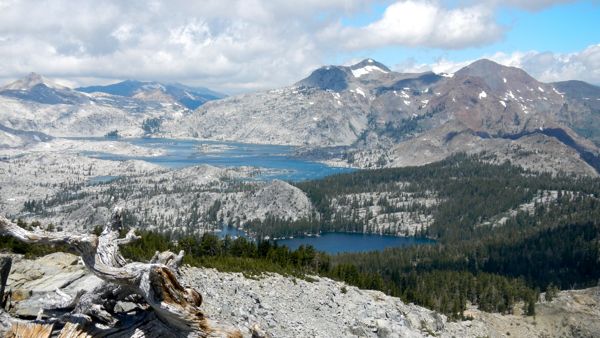
Looking down on Lake Aloha from the top of Ralston Peak. Photos/Kathryn Reed

Barren runs of Sierra-at-Tahoe; splotches of snow dotting Pyramid Peak – which at 9,983-feet is the highest mountain in the Crystal Range and Desolation Wilderness; the pools of Lake Aloha that resemble a moonscape; Price, Jack and Dick peaks looking manageable to climb from our perch at 9,235 feet; Lake Tahoe so vast it could be the ocean; Fallen Leaf so small it could be Heather Lake.

With 50 mph winds forecast for our destination, we were dressed more like a winter hike than summer. Warmth was not what we found on this last Sunday of June, but that didn’t matter – except that it meant we didn’t linger long.

There are 12 women and two dogs making the trek to the top of Ralston. I was not alone in this being my first excursion up this landmark that can be seen from Highway 50 near Horsetail Falls. While there are several routes to get to the top, we start at Echo Lake.

We cut off two miles each way by taking the boat across. It fits all of us. It costs $12 one-way – each person. The boat shuttle is a racket. They have a captive audience and are clearly ripping people off. That’s the only negative.

The ride is beautiful. Larkin delivers us to the dock on the far side where we begin our 8-mile roundtrip journey. (We start hiking at 8:40am and return to the dock at 3pm.)

It starts out rocky. The runners in the group sprint to the lead. Others fall to the back, taking in the scenery of Tamarack Lake that comes up on our left.

There are lupine, phlox, pussy paws, wallflower, Indian paintbrush, shooting star and sulphur buckwheat to photograph. Wildflowers, while not in abundance, dot the landscape in an array of colors.

At this elevation they are smaller than what is found at lake level – dwarf-like, Kim says.

Winter’s sparse snowfall has turned western-facing manzanita black. Lack of water has killed some of these bushes in the backcountry.

While they are a species that burns hot in a fire, dead manzanita is more susceptible to fire than a live plant. Fire is more of a concern for the manzanita trees because it becomes a ladder fuel, Lauri explains.

Trail signs pop up. So many choices for where to play in Desolation Wilderness. Some of the routes are along the Pacific Crest Trail.

We take the second left headed toward Lake of the Woods. We keep her to our right, never reaching her shore. Pyramid Peak – aptly named because it looks like pharaohs could call this mountain home – looms over this lake.

Pockets of snow crop up, but nothing substantial enough to hinder our progress.

We traipse through a soggy meadow before the last ascent to the tip-top.

Mountain hemlock and white bark pine are sprouting from the rugged terrain. They like it at this elevation.

Giddy with delight of making it to our destination and taking in the scenery, we are all smiles feeling like we are on top of the world.

ngg_shortcode_0_placeholder (Click on photos to enlarge.)


First commercial crayfish harvest permit granted for Lake Tahoe

By Carlos Alcalá, Sacramento Bee

Nevada wildlife officials have issued the first ever commercial permit for crayfish harvest in Lake Tahoe, allowing the Tahoe Lobster Co. to go after some of the 220 million crustaceans living in the lake.

The fishing is expected to be a boon for the economy, tourism, cuisine and lake clarity. Waste products from the nonnative crayfish – or crawdads – foster the shallow-water algae growth that clouds the lake’s crystalline waters.

The crayfish will be sold for local eating, replacing other, less-reliable supplies and possibly imports from China, such as those used at Isleton’s Cajun Festival in June.

“Nothing’s more local than Tahoe,” said Ben Deinken, a chef for the Brewer’s Cabinet in Reno. “We want to get ahold of that.”

Read the whole story


Discovery could hold key to beginnings of universe

By Dennis Overbye, New York Times

ASPEN, Colo. — Physicists working at CERN’s Large Hadron Collider said Wednesday that they had discovered a new subatomic particle that looks for all the world like the Higgs boson, a potential key to an understanding of why elementary particles have mass and indeed to the existence of diversity and life in the universe.

The British physicist Peter Higgs arrived at CERN’s headquarters on Wednesday.

“I think we have it,” Rolf-Dieter Heuer, the director general of CERN, said in an interview from his office outside Geneva, calling the discovery “a historic milestone.” His words signaled what is probably the beginning of the end for one of the longest, most expensive searches in the history of science. If scientists are lucky, the discovery could lead to a new understanding of how the universe began.

Dr. Heuer and others said that it was too soon to know for sure whether the new particle, which weighs in at 125 billion electron volts, one of the heaviest subatomic particles yet, fits the simplest description given by the Standard Model, the theory that has ruled physics for the last half-century, or whether it is an impostor, a single particle or even the first of many particles yet to be discovered. The latter possibilities are particularly exciting to physicists since they could point the way to new deeper ideas, beyond the Standard Model, about the nature of reality. For now, some physicists are calling it a “Higgslike” particle.

Read the whole story