Temperatures in Tahoe climbing

The temps are starting to sizzle in Lake Tahoe. Expect the mercury to be in the 80s for the next week.

Thunderstorms are not in the forecast, according to the National Weather Service.

Winds will be up to 15 mph in the South Lake Tahoe area this weekend.

Keep applying the sunscreen.

— Lake Tahoe News staff report

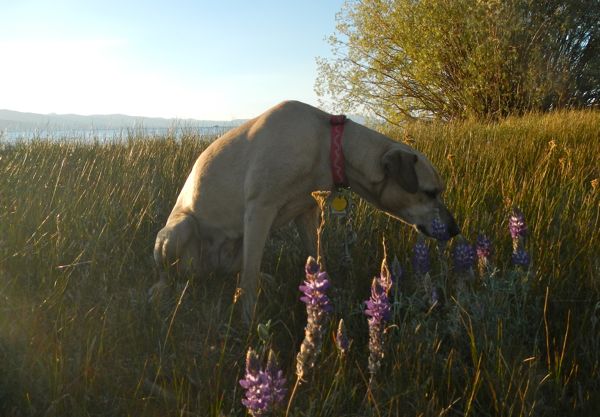
Even AJ likes to smell the lupine in Lake Tahoe. Photo/Kathryn Reed


Opinion: North and South Shore chambers plot Tahoe’s future

By Casey Blann

As a long-time resident of Lake Tahoe, my family and I have witnessed many changes. In fact, I am a strong proponent of change as it challenges status quo and requires us to look at situations in a whole new way; but it can also bring fear to some. It has been my experience that the only way to address these fears is through education.

Possessing the necessary information to make educated decisions has always been a challenge in Tahoe. Often, we are reading information from a variety of sources and it is impossible to determine whether it is factual, or biased. Faced with this situation, we decided to create a website that spoke to the scientific and verifiable facts of the issues that are facing us in the very near future; this site is TahoeFuture.org.

The TahoeChamber, (in conjunction with the North Lake Tahoe Chamber) have launched the regionwide campaign to help better inform the people of Lake Tahoe. The concept is simple — to get more people in-the-know in the most user-friendly way possible. Basically, we want more people to have a voice in Tahoe’s critical planning issues to create a brighter future for Lake Tahoe. The focal point is the TahoeFuture.org website which will quickly link community members to easy-to-understand, straightforward information streamlining “getting involved”.

Casey Blann

Over the next seven months, TahoeFuture.org will connect people to important information on two critical land use and transportation plans that create a blueprint for a revitalized Lake Tahoe. The overarching goal of these two plans, Tahoe Regional Planning Agency Regional Plan Update (RPU) and Regional Transportation Plan (RTP)/Mobility 2035, is to restore Lake Tahoe.

The draft environmental impact statement period for the RPU and RTP closed June 28. More than 70 people participated via speaking at hearings and writing letters to TRPA. Over the next few months, public comment in person and in writing will continue to be accepted on both plans.

We know the South Shore is sorely in need of change. And as many locals already know, there’s a movement under way via various efforts, all around Lake Tahoe to shift the direction of Lake Tahoe away from one of continued decline toward one of environmental and human health, prosperity and sustainability. TahoeFuture.org is linked directly to these numerous efforts happening simultaneously around Lake Tahoe to chart a new direction.

The new direction and brighter future is about effectively integrating accelerated environmental restoration with community revitalization and a new economic model for prosperity for residents, second homeowners and visitors.

Lake Tahoe continues to suffer from damaging runoff and one of the worst periods of economic decline in its history. The environment and the economy are intertwined; and without change, the lake’s clarity and the future of the region remain in serious peril. We must do something about it. Take a look at some facts:

• 72 percent of the fine sediment and pollutants clouding Tahoe’s water clarity are the result of untreated runoff from the old built environment (before water quality standards were put in place) of roadways and aging infrastructure.

• The economic decline started in 1997 at Lake Tahoe and unemployment rates have averaged 16 percent for the past three years. Due to the loss of jobs and local services, families have opted to move. The result has been a 15 percent drop in permanent population (and still falling) and a sharp decrease in business levels. In 2011, the average occupancy rate for Lake Tahoe lodging properties — large and small combined — was 30 percent or less. In short, the outlook for our future is anything but bright.

Here’s a quick description of additional collaborative efforts going on around the Region which are all aimed at fixing the mistakes of the past in order to achieve the goal of a healthier Lake Tahoe.

Regional Plan Update (RPU) is a blueprint for innovative, smart land use and transportation policy. About 4,500 citizens provided input that ultimately guided the TRPA RPU. The overarching objective is to restore Lake Tahoe and deliver environmental gains through a host of policy changes such as incentives for environmental redevelopment and the removal of existing development from the most sensitive areas. Expected to be approved at the end of 2012, its innovative new approaches include: creating livable walkable town centers, moving away from burdensome regulations that inhibit environmental redevelopment gains and investment in efforts to clean up blighted areas that have contributed to economic and environmental decline over the past 30 years. As a foundation for this effort, TRPA will maintain the existing regional growth control systems that stopped the rampant overdevelopment that was a product of the 1960s and early 1970s.

Regional Transportation Plan (RTP)/Mobility 2035 is a blueprint for connecting communities and stopping pollution impacts. In conjunction with the RPU, the RTP/Mobility 2035 is being updated to support the goals of improving lake clarity and air quality by boosting alternative forms of transportation as well as reconfiguring communities to be more walkable. Highlights of the Mobility 2035 Plan include: implementation of 160 miles of new bicycle and walking trails, programs to catch sediment on approximately 78 miles of roads and garnering federal and state transportation investments.

Tahoe Prosperity Center is a regionwide collaborative economic prosperity strategy for enhancing environmental quality and living standards for all residents. The plan aims to move the region away from a gaming and tourism only reliant model to one that focuses on three clusters: Outdoor Recreation-based Tourism; Health and Wellness; and Environmental Innovation. Board members are developing strategies related to their region-wide ‘pillar initiatives’ to drive leadership, planning and policy, infrastructure, capital generation and economic development.

Pathways to Prosperity Trek took local leaders to study comparable community models for inspiration. We visited other communities that have faced similar challenges and in response, have implemented smart, creative, collaborative solutions to turn their region around. Specifically, when Monterey and Livermore faced economic and community decline, local political and community leaders took bold steps to reverse this decline including the development of a new economy (geotourism and downtown revitalization) along with transportation and community improvements. 2012 Trekkers represented a diverse group of Tahoe basin leaders across various sectors including tourism, science, government, transportation, economic, business, health care, and recreation.

I believe now is the time for more people to get involved and join this energizing momentum toward positive change. Together we can bring back our economic wellbeing and chart the path toward environmental improvements and community vitality.

I invite each and every person who cares about Lake Tahoe to visit TahoeFuture and become more informed and involved. Let’s work together and actively participate in the process to build a healthier Lake Tahoe future. Let’s make Lake Tahoe more walkable and bikeable and maybe it will be a place where our kids can return to work, play and raise a family.

Casey Blann is chairman of TahoeChamber and vice president-general manager of Kirkwood Mountain Resort.


Bats are the answer to helping wipeout mosquitoes

By Cheryl Millham

Since West Nile Virus (WNV) has been reported with two American Robins in the Tahoe Keys area, many people are all of a sudden interested in learning more about this disease.

So, “What is West Nile Virus and Where did it come from?”

WNV is a mosquito borne virus that has been found in parts of Asia, Eastern Europe, Africa and the Middle East. The virus was first detected in the United States in New York City in 1999. WNV had its first active case in California in 2002, taking almost four years to cross the country.

I received a bulletin update from the California Department of Public Health on April 25, 2012. It read: “To date, there have been 3,146 human cases in California and 110 deaths. Last year (2011) 2,497 birds were tested, of which 28 percent were WNV positive. In addition, 108 dead tree squirrels were tested and 22 percent were positive. Dead bird surveillance is a key component of our early warning system, because positive birds are typically the first indicators of WNV in a county. Tree squirrels are also indicators of WNV in a local area.”

WNV is transmitted to people and animals by infected mosquito bites. The good news is that only certain species of mosquitoes carry the virus. A mosquito first acquires the infection by feeding on a bird with the virus in its blood. The virus lives in the mosquito and is transmitted to a new host in the mosquito’s saliva when the insect bites a person or animal. Human to human, bird or animal to human transmission of WNV does not occur.

So, please, if a bird or animal needs your help, help it. You cannot contract WNV from them, only by the bite of the mosquito.

Most people who are infected with WNV have no symptoms, whatsoever. The incubation period (the time between the bite and the onset of illness) range is five–15 days. Symptoms can include fever, headache, nausea, body aches, mild skin rash or swollen lymph nodes. One in every 150 people who are infected with WNV will require hospitalization.

So, what do you do if you find a dead bird or squirrel??

Get a plastic bag and reverse it. Put your hand inside the bag and pick up the dead bird or animal. Pull the plastic bag over the dead bird, then, call the WNV hotline, 877.968.2473. It is a toll free call and, if they want the dead bird or animal, they will arrange for a pick up. If they do not want it, just dispose of it in your trash.

What can we do to limit mosquito bites?

When you are outside, in the early morning and evening, be sure you have mosquito repellent on exposed skin. Be certain window screens are tight fitting and in good repair (remember, screens keep out mosquitoes, but are nothing to a bear). Buy mosquito fish for your ponds and keep your water moving. Mosquitoes don’t lay eggs in moving water.

The best part is to let our local birds help out. All swallows can eat up to 1,000 mosquitoes per day.

Ducks eat mosquito larvae as do frogs and snakes.

But, the best of all are bats. Bats can eat up to 1,000 mosquitoes per hour in a feeding frenzy. Here, at Lake Tahoe, we have only insect eating bats. So, don’t harm them. But encourage them by putting up bat houses.

My facts for this article were taken from the California Surveillance and Facts about WNV.

Cheryl Millham is executive director of Lake Tahoe Wildlife Care on the outskirts of South Lake Tahoe.


Celebrity golf tournament is major donor to Tahoe nonprofits

The American Century Championship has provided more than $200,000 in the last two years to the South Shore community.

Livestrong, the celebrity golf tournament’s nationally designated charity, in partnership with the Lake Tahoe Visitors Authority, NBC Sports and American Century Investments is continuing that effort.

This video from First Track Productions tells that story.


5 people pull papers to run for South Tahoe council

In the first week of election filing, five people have taken out papers to run for South Lake Tahoe City Council.

They need to turn in the papers to be on the November ballot.

The potential candidates as of July 20 are: Bruce Grego, Clinton Schue, Austin Sass, JoAnn Conner and Stacey Wheeler.

The seats occupied by Grego and Hal Cole are open. Cole is leaning toward running, but has not committed.

The filing deadline is Aug. 10.

— Lake Tahoe News staff report


Bamboo company wants to challenge forestry industry

By Johanna Somers, Seattle Times

MOUNT VERNON, Wash. — Jackie Heinricher, Booshoot’s founder and CEO, took a deep breath as she walked into a greenhouse full of hundreds of bamboo plants.

The fast-growing bamboo plants pump out more oxygen than trees do, and this concentrated atmosphere makes people smile, she said, so “when this is full, we bring clients in here.”

Buttering up visitors with oxygen has helped Booshoot land clients such as Home Depot, Costco and, most recently Kimberly-Clark, the world’s largest tissue manufacturer.

Kimberly-Clark recently announced an agreement to work with Mount Vernon-based Booshoot to develop a mass-market toilet paper using 20 percent bamboo fiber.

Booshoot already produces about 10 million bamboo plants annually and earlier this year signed an exclusive three-year contract to sell ornamental bamboo in Home Depot stores across the nation.

After more than a decade of research, Heinricher and her team of scientists have created an advanced tissue culture system to produce genetically identical bamboo plants at a commercial scale. This new technology has positioned them to infiltrate the forestry market.

“Even if bamboo penetrates just a small fraction of that, it is a multibillion-dollar opportunity,” said Pettus Randall, chief operating officer of Booshoot.

However, breaking into the market for paper products will be challenging.

Read the whole story


Tour to showcase mountain gardens, growth post-Angora

By Linda Conaboy

In preparation for its ninth annual garden tour, the Lake Tahoe Historical Society recently previewed all nine gardens that will be on view July 29. Five of the gardens are within the Angora burn area.

“It’s always scary to put this together, basically because we have to pick the gardens the year before. We looked at this year’s gardens in August and September last year,” Catherine Whelan, president of the historical society, said. “You just don’t know how gardens will turn out and what winter will do to them”

Creek bed and covered seating area in Marsha Ward-Hudson's garden. Photos/Linda Conaboy

Whelan said the historical society picks a variety of homes to showcase what can be done in a shade garden, as well as a sunny one and how to approach gardening at various levels — as well as to prove it’s possible to garden in the mountains.

“This year, we’re giving a special nod to the gardens in the Angora burn site. We support all of their struggles,” Whelan told Lake Tahoe News.

Traipsing around Debbie and Buzz Bera’s backyard it became apparent — yes, you can garden in the mountains. Although the Bera home wasn’t destroyed in the burn, their garden was singed.

Perennials are the corner stone in this not-too-large yard — bright perennials and the whimsical birdhouse fence tantalize the palette for more. More is the pond and waterfall fenced in by the wall of birdhouses, all on the sunny side of the yard. The shady areas include a greenhouse and enough hostas to add green to an otherwise difficult area to cultivate.

On to Marsha Ward-Hudson’s home on Mt. Olympia Circle. The welcoming front yard has a carefully manicured lawn with lots of plantings surrounding the large porch. To get to the back, the preview party marched along stepping stones buried in verdant and pillowy ground cover, the kind that makes one want to take her shoes off to see if it’s really as soft as it looks.

Who would think you could grow lush ground cover like this in the mountains? Believe it. In the backyard, a faux creek bed winds its way from the vegetable garden, along the lawn’s curvy edge to the covered patio.

Landscaping with natural elements at the Cressy home.

Ward-Hudson utilizes old tires filled with what looks like well-amended soil to cage her veggies. Like other yards here, this one suffered from the fire retardant used to smother the fire; however, about two feet of new topsoil seems to be providing ample nutrients for the multitude of flowers and emerging vegetables.

The third stop, the Angora Community Demonstration Garden proved to be a bittersweet one, for this is where Owen and Esther Evans once had a home. It was one of the 254 lost in the fire of 2007. Because of age, the Evans decided not to rebuild, but chose to create a garden to give back to their neighborhood.

A sign on the property states this collaborative garden is a model of water conversation, best management practices, defensible space and beauty. All of which became apparent by a stroll along the paths where various flowers, vegetables, ground covers and strawberry vines grow in profusion.

Like so many others, Lisa and Joe McAvoy not only had to plant another garden; they also had to rebuild their home, a task completed mainly by Joe McAvoy with a little help from his friends.

Lisa was responsible for the garden. Like the house, this, too, was a labor of love. With John Fellowes at Aspen Hollow Nursery, McAvoy created a visually resplendent and artful outdoor scene. “It’s going to be a forest,” McAvoy said. “To make way for new things, I keep moving plants around.”

Birdhouse fence at Debbie and Buzz Bera's home.

What has resulted, among the well-placed boulders, lush foliage and a water feature that looks like a natural oasis in this garden is a lovely place to sit and contemplate the magnificent mountain views. But look the other way for a reminder of the fire as blackened trees rise on the mountain in front of the house.

When visiting, be sure to check out the fanciful garden art and various sitting areas in the McAvoy gardens.

It’s hard to believe what has been resurrected from the Angora disaster, especially when visiting Brooks and Karen Martin’s home and garden.

Brooks Martin said they had put the finishing touches on their garden just before the fire (a two-year project with the help of John Fellowes), only to have their home and their garden disappear the next day.

“All that made it through the fire were the prayer flags, the Quan Yin statue and the statue of St. Francis,” Brooks said.

A fresh start among their huge, natural boulders, the likes of which you may remember from the fictional Ponderosa Ranch, features multiple outdoor seating areas, a large water feature and even some tiny mushrooms sprouting on the home’s north side.

The seating areas are arranged to catch the day’s lighting as it strobes across the landscape — there’s lots of shade for hot Tahoe days and sun when it’s needed.

Next, on down the hill and off of Pioneer Trail for neighboring homes owned by the Cressy and Williams families.

Although both of these houses have the same gardening conditions in their adjoining yards, each was treated to a different landscape. Jennifer Cressy, who, along with John Roos, is in charge of the demonstration garden at Lake Tahoe Community College, used all-natural vegetation in her yard, while the Williams produced more formal grounds amidst the towering evergreen trees.

Daniel Cressy designed and installed the many fountains in his yard, while the Williams opted for an in-ground koi pond, minus koi. In the Williams’ yard it’s interesting to note the juxtaposition of natural vegetation, fountains and succulents tucked into the landscape among the pines.

From the street, Stephanie and Neal Niederman’s home is a delight. Walking from the side to the back yard it’s easy to realize these folks have spent a lot of time and a great deal of effort on their yard.

Garden at the Niederman home.

“Our whole life is here,” Stephanie Niederman said. “And the plant of the year is delphinium.” Her tall and hearty delphiniums are enough to make even an inveterate gardener envious.

“The secret to our garden is well-amended soil,” a thought echoed by nearly all the gardeners on our tour. The Niederman side yard is a plethora of green grass and plants that flourish in the shade, as evidenced by the healthy hostas lounging at the edge of the grass. The sun-loving varieties, grown from Stephanie’s penchant for purchasing flower six-packs are happy too.

The last garden is Carole Spreklesen Foster’s. There is a lush garden cultivated on her original home site as well as the adjoining lot she purchased so she could grow more plants.

This is where you will find food, some provided by Harrah’s and Harveys, libations, and music courtesy of Dream Spirit Baroque Band, all to be enjoyed in Foster’s park — at least that’s what it may remind you of. Don’t forget to check out her authentic teepee, filled with all things Native American. The colt’s foot and Japanese willows are just two of the unique plants Spreklesen Foster grows.

Although Spreklesen Foster’s home is listed last on the tour, if it’s more convenient, there’s no need to visit it last. Food and drink will be served there all day.

——

Details:

When: July 29

Time: 10 am-4 pm

Price: $20

Tickets are available from: Tahoe Outdoor Living, Aspen Hollow Nursery, Nel’s Garden Center, Sunbasin Nursery and at the Historical Society at 3058 Lake Tahoe Blvd. If there are tickets left, purchase them the day of the event at the Historical Society.



Arrest made in Placer County fire

By Cathy Locke, Sacramento Bee

Information provided by the public shortly after the Robbers fire started last week led to Friday’s arrest of a 28-year-old Sacramento man, according to fire officials.

Bryon Mason was arrested on suspicion of recklessly causing the fire that began about 3:30 p.m. July 11 off Yankee Jims Road near the north fork of the American River in Placer County. Bail is set at $100,000.

Daniel Berlant, a spokesman for the California Department of Forestry and Fire Protection, said investigators determined that the fire was started by a pyrotechnic device.

“That first day, we received numerous reports from people who allegedly had information (about how the fire started), and that’s what helped us get to this point,” Berlant said.

The fire, which was reported reported fully contained late this afternoon, burned 2,650 acres northeast of Foresthill. It destroyed one home and four outbuildings, and threatened 170 residences. Families were forced for evacuate their homes, with some displaced for more than a week. CalFire reported that all evacuations were lifted Friday.

Read the whole story


Lawmakers give staff raises while cutting pay for other state workers

By Patrick McGreevy and Michael J. Mishak, Los Angeles Times

SACRAMENTO — Lawmakers gave raises worth $4.6 million annually to more than 1,000 of their aides before cutting the pay of most other state workers, newly released records show.

The lawmakers said they were trying to make up for several years without staff pay increases.

“Modest adjustments based on individual performance were appropriate,” after pay and hiring freezes during the previous four years, Senate President Pro Tem Darrell Steinberg, D-Sacramento, said in a statement.

But the raises, at least 10 percent for some top staffers in the last 11 months, have been disclosed at an awkward time for Steinberg and his fellow Democrats, who control the Legislature. They are gearing up to help Gov. Jerry Brown to convince the public that the state is desperate for money in the aftermath of a deep recession and should pass billions of dollars in tax hikes in November.

Opponents of the governor’s tax plan wasted no time in painting the Democrats as hypocrites.

“It’s an outrage that they did this when the governor is asking voters to approve a tax initiative because he says we can’t pay our bills,” said Lew Uhler, head of the California-based National Tax Limitation Committee.

And state workers hit with a 4.62 percent pay cut to help balance California’s budget were enraged by news of the raises.

Read the whole story


Ballet comes to Incline Village

The Sierra Nevada Ballet takes the stage this summer to present “Giselle” as part of the Lake Tahoe Shakespeare Monday Night Showcase Series in Incline Village on July 30.

This folktale comes to life through music, drama and more than 30 professional dancers who will share this story of doomed love.

For information, call 800.747.5697. Tickets are $22, $42 and $70.

This particular production of “Giselle” is based on the original choreography which was done in 1841 by Jules Perrot and Jean Coralli. The present production is set by Rosine Bena and based on the famous Igor Youskevitch’s version which was passed down to Bena in the late 1970s.