Quinn takes home ACC trophy for 5th time

By Craig Smith

STATELINE — Dan Quinn birdied three of his first seven holes Sunday to pull ahead and then stretched his lead on the back nine to earn a six-point victory over former NFL quarterback Mark Rypien in the American Century Championship at Edgewood Tahoe.

Quinn finished with 66 points. Rypien was second with 60 points and Hall of Fame quarterback John Elway finished third with 59 points. It was the fourth win at the event for Quinn, a former NHL star who will caddie for Ernie Els at next week’s Canadian Open. Els won the British Open earlier in the day.

Quinn, who collected $125,000 from a total purse of $600,000, started the day three points behind second-round leader Rypien, who had 43 points after 54 holes. The event uses a Stableford scoring system that awards graduated points for pars or better. This is the fifth time he has won the event.

Dan Quinn, right, and John Elway played together in the July 18 practice round of the ACC; and ended up placing first and third, respectively. Photo/Kathryn Reed

Billy Joe Tolliver finished fourth with 58 points; Tony Romo was fifth with 56 points, and Joe Theismann was sixth with 53 points. Former MLB pitcher Mark Mulder, who shared the first-round lead with defending champion Jack Wagner, finished in seventh place with 52 points. Wagner slipped to eighth place with 51 points.

At the half-way point, Quinn held a 52-50 lead over Rypien. The former hockey player birdied the par-4 11th to move in front by four points over Rypien and five points over Romo with three good scoring holes remaining; especially the par-5 16th and 18th.

Quinn then made a 25-footer for birdie on 16 to close the door on his challengers.

“My thought was just to get that putt to the hole,” said Quinn. “When I made it I thought, ‘Unless I did something crazy I looked pretty solid.’”

Romo failed to birdie the 16th and then took a double bogey on the final hole to lose two points.

“I just need to compete more,” said Romo, who heads to training camp next week. “I don’t play enough to compete in a three or four-day event. Golf is a tough game.”

“I’m lucky to be in the position I am in,” said Quinn after Saturday’s second round. “I think it will be decided on the last three holes and that’s exactly what NBC wants.”

He was wrong. Quinn salted the win away long before that.

Craig Smith is a former employee of U.S. Golf Association



S. Tahoe council miffed contract signed without their consent

By Kathryn Reed

South Lake Tahoe City Council members were less than thrilled with finding out a five-year contract for the use of a city building had been approved by a department head and not them.

Stan Sherer, Community Development director, defended his actions on July 17.

“We rent all kinds of facilities. Historically, we haven’t come to the council,” he said.

One of the problems as noted by City Attorney Patrick Enright is, “We don’t have a written policy as to how we lease properties.”

That is going to change per the council’s mandate.

It’s not that the recreation and other department heads won’t be able to rent city property, but they won’t be able to do so on a long-term basis.

The council was in a quandary with how to proceed because Unity at the Lake has been renting the property at 1195 Rufus Allen Blvd. for nearly a year. Rent is $1,700 a month.

Councilman Tom Davis asked what happens if the contract is not ratified by council.

Enright said, “I don’t know. They’ve been there 10 months and have made tenant improvements.”

A contract is signed between Sherer and Unity without its being dated. The lack of date infuriated the council as well.

Sherer said because Unity had been renting city space at the senior center and this group was the only one willing to make substantive improvements to the building, he picked them.

The council voted 3-1 to keep the contract in place. (It expires in October 2016.) Councilman Hal Cole abstained and Councilwoman Angela Swanson was absent.


Gloomy forecast for states even if economy rebounds

By Mary Williams Walsh and Michael Cooper, New York Times

WASHINGTON — The fiscal crisis for states will persist long after the economy rebounds as they confront rising health care costs, underfunded pensions, ignored infrastructure needs, eroding revenues and expected federal budget cuts, according to a report issued here Tuesday by a task force of respected budget experts.

The problems facing states are often masked by lax budget laws and opaque accounting practices, according to the report, an independent analysis of six large states released by the State Budget Crisis Task Force.

It said that the financial collapse of 2008, which caused the most serious fiscal crisis for states since the Great Depression, exposed deep-set financial challenges that will worsen if no action is taken.

“The ability of the states to meet their obligations to public employees, to creditors and most critically to the education and well-being of their citizens is threatened,” warned the chairmen of the task force, Richard Ravitch, a former lieutenant governor of New York, and Paul A. Volcker, a former chairman of the Federal Reserve.

The report added a strong dose of fiscal pessimism just as many states have seen their immediate budget pressures begin to ease. And it called into question how states will restore the services they have cut during the downturn, saying that the loss of jobs in prisons, hospitals, courts and agencies have been more severe than in any of the past nine recessions.

“This is a fundamental shift in the way governments have responded to recessions and appears to signal a willingness to ‘unbuild’ state government in a way that has not been done before,” it said, noting that court systems had cut their hours in many states, delaying actions including divorce settlements and criminal trials.

The report arrived at a delicate political moment. States are deciding whether to expand their Medicaid programs to cover the uninsured poor as part of the new health care law, with the federal government pledging to pay the full cost at first. Public-sector unions feel besieged, as states and cities from Wisconsin to San Jose, have moved to save money on pensions. And Washington’s focus on deficit reduction — with big budget cuts scheduled for after the fall election — has made cuts to state aid inevitable, many governors believe.

Read the whole story


Relay for Life volunteers, vendors needed

The next Cancer Relay for Life meeting is July 25 at 5pm at Kahle Community Park, Stateline.

Volunteers and vendors for the Aug. 11 are still being sought.

Call Maryon Tilley, (775) 586.8330, for more information.


Yosemite’s boundaries may increase by 1,575 acres

By Michael Doyle, McClatchy Newspapers

WASHINGTON — Yosemite National Park in California would grow by 1,575 acres under a bill seeking traction on Capitol Hill.

Written by a Democrat and backed by local Republicans, the Yosemite expansion legislation could have a leg up on some of the myriad other national park bills being shopped around Congress. But in an environment where public lands ownership also can push political buttons, advocates still have their work cut out for them.

“This is a challenging Congress to move things through,” Laurie Wayburn, president and co-chief executive officer of the San Francisco-based Pacific Forest Trust, said Tuesday. She added, though, that “this is one of those rare, common-ground movements. Yosemite has a very special place in Californians’ hearts.”

The legislation introduced last month by Rep. Jim Costa, D-Calif., authorizes the National Park Service to expand Yosemite’s western boundary through the addition of several adjacent Mariposa County parcels. The park service could buy the designated land, located near an existing resort development called Yosemite West; in theory, the agency also could accept donated property or acquire it through a land swap.

The Pacific Forest Trust currently owns about half of the 1,575 acres covered by the bill, and a consortium of medical professionals owns the other half. The non-profit trust bought its share about seven years ago with the long-term goal of conveying it to Yosemite, Wayburn said. The doctors had bought the land as an investment, potentially for development.

The landowners’ anticipated scenario now is that federal Land and Water Conservation Fund dollars would be used to buy both parcels once the National Park Service secured its authorization, Wayburn said.

Read the whole story


Insurance quote means money for Nevada parks

AAA of Northern California is teaming up with Nevada State Parks to provide much needed funding for park facility repairs that have been postponed due to significant budget cuts the past several years.

Through Aug. 31, AAA’s “Summer Road Trip” campaign will donate $5 to Nevada State Parks for each AAA insurance quote completed at a AAA branch office. The quote is free.

The money will help Nevada State Park’s accomplish its mission of managing, protecting and maintaining the natural, cultural and recreational resources of Nevada.


California voters to decide if genetically engineered foods should be labeled

By Marc Lifsher, Los Angeles Times

SACRAMENTO — A fight over genetically engineered foods has been heating up in the nation’s grocery aisles. Now it’s headed for the ballot box.

Voters will soon decide whether to make California the first state in the country to require labels on products such as sweet corn whose genes have been altered to make them resistant to pests.

Proposition 37 promises to set up a big-money battle pitting natural food businesses and activists against multinational companies including PepsiCo,Coca-Cola and Kellogg. Backers and opponents have already raised nearly $4 million combined for campaigns to sway voters, an amount that’s likely to swell into the tens of millions of dollars as the November election approaches.

So-called GMO foods — those made from genetically modified organisms — have been declared safe by U.S. regulators. But concern persists about the unforeseen consequences of this laboratory tinkering on human health and the environment.

The outcome in California could rattle the entire U.S. food chain. An estimated 70 percent to 80 percent of processed foods sold in supermarkets could be affected, industry experts said, along with a variety of fresh fruits and vegetables. The measure qualified for the California ballot with nearly 1 million signatures; labeling in the state could set a precedent that’s followed nationwide.

“This will be a big fight,” said Shaun Bowler, a UC Riverside political scientist specializing in initiatives. “This is a popular issue because people are very afraid of the words ‘genetically engineered.’ And the people who sell this stuff are worried about losing sales.”

Backers of the initiative are encouraged by a pair of recent national opinion surveys showing that about 9 out of 10 consumers support labeling. A California-specific poll, released Thursday by the Business Roundtable and the Pepperdine University School of Public Policy, showed Proposition 37 has an almost 3-to-1 ratio of support, with 64.9 percent of prospective voters favoring it, compared with 23.9 percent opposed.

Read the whole story


Lake Valley resumes chipping program

Lake Valley Fire Protection District is offering a free wood chipping service to residents in its service area.

Lake Valley is working with South Tahoe Refuse’s Recycle/Green Waste Program to offer two methods of slash removal. For piles smaller than 2 cubic yards (the size of a washer and dryer side by side), South Tahoe Refuse will pick them up on collection day, but they must be bundled and tied with twine – then placed curbside.

For piles larger than 2 cubic yards, Lake Valley FPD is continuing its curbside chipping program through this season.

The following are guidelines for the chipping program:

• Place slash and brush piles adjacent to a driveway or street so the chipper and crew can readily have access.

• Piles must be in an area where equipment can easily be turned around.

• Place the cut ends uniformly facing the street or driveway.

• Do not put anything in the pile that is greater than 6 inches in diameter, and do not leave pine needles, pine cones, or leaves.

• Piles must be free of dirt, rocks, wires, lumber and trash.

• Piles are easier to chip if they are wider and more spread out, rather than taller.

• Piles must be home owner-generated – not from work done by a contractor.

• If piles are inaccessible (blocked by cars, in a tight cul-de-sac, too far from the road, etc.), they cannot be chipped.

• The chips will be left in a pile on your property.

When your pile is ready, call (530) 577.2447 to put your name on the list.


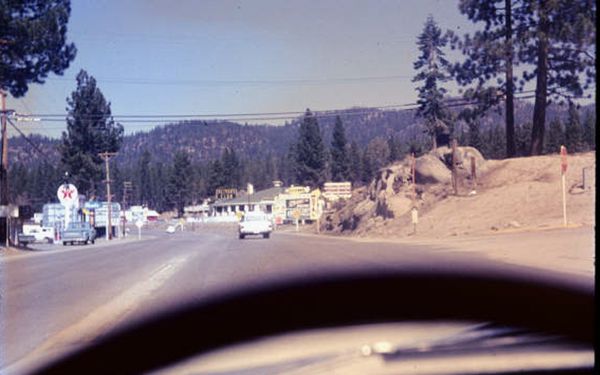
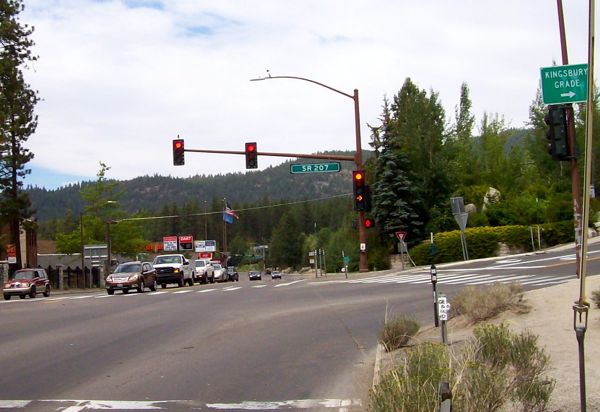
Then and now: Gas stations used to be on nearly every corner

Highway 50-Kingsbury Grade 1963.

Highway 50-Kingsbury Grade 2012. Photos/Bill Kingman

In the early 1960s, there were nearly 50 gas stations on the South Shore. Their original architecture is still evident in many of the current configurations; like Jiffy Lube, Ski Run Liquor, just-new Blue Dog Pizza, Winters Electric, and others.

In the old photo, the Texaco station sits to the left where Dart Liquor is today. Also, notice all the overhead wiring in 1963.

— Bill Kingman


Snippets about Lake Tahoe

• Lake Tahoe Unified School District’s bus schedule for 2012-13 is online. Go to the bottom of the page.

• Tahoe Maritime Museum has launched a Youth Paddleboard Program. It is every Wednesday through Labor Day at Commons Beach in Tahoe City. Call or email Katena at (530) 525.9253, ext. 103 or katena@tahoemaritime.org to book a spot or for more info.

• The Gene Upshaw Memorial Tahoe Forest Cancer Center opened July 17.

• The inaugural Lake Tahoe SummerFest is July 31–Aug. 19. For more information, call (775) 588. 2412.

• Joni Morris pays a tribute to Patsy Cline on July 25 at 7:30pm at Valhalla. For more info or tickets, go online or call (530) 541.4975.

• Here is the Caltrans roadwork schedule for El Dorado-Tahoe and Sierra.