Tahoe Tails — Adoptable Pets in South Lake Tahoe

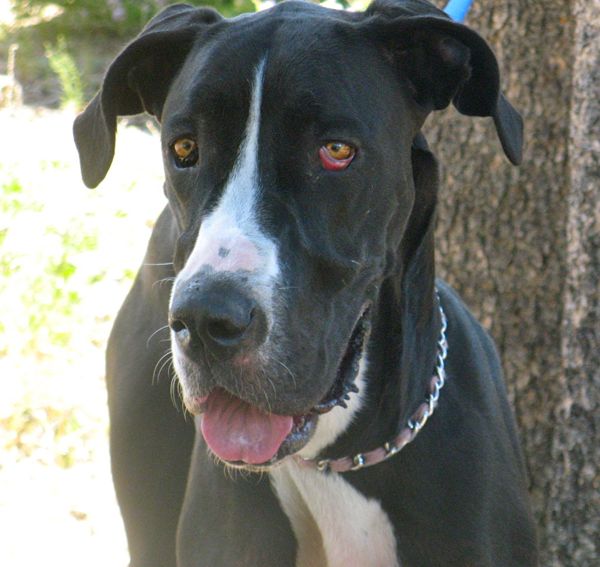
Are you looking for a project that offers great rewards? Do you have experience with large (really large) dogs? Mirabelle is a special girl who needs a special home. We believe she will come out of her shell quite nicely, but right now she is quite fearful of most people. She warms up pretty quickly and will lean against you for affection, and walks nicely on her leash.

Mirabelle needs to gain about 20 pounds, and should be in a home without children (they probably scare her), maybe with another dog, where she’ll get lots of gentle attention.

Mirabelle is spayed, microchipped, and vaccinated. She is at the El Dorado County Animal Services shelter in Meyers, along with many other dogs and cats who are waiting for their new homes. Go online to see photos and description of all pets at the shelter.

Call (530) 573.7925 for directions, hours, and other information on adopting a pet.

For spay-neuter assistance for South Tahoe residents, go online.

— Karen Kuentz


Snippets about Lake Tahoe

• Tahoe Regional Young Professionals keeps the summer sizzling with the next mixer at Brothers Bar & Grill in South Lake Tahoe July 24 from 7–10pm. Food and drink specials will be flowing throughout the evening.

• John Skeel is now district manager of Tahoe Resource Conservation District.

• California State Parks and the Sierra State Parks Foundation is putting on a Living History Day at the Ehrman Mansion at Sugar Pine Point State Park on July 28, 10am-4pm. The event is free; parking is $10.

• Truckee Rodeo is Aug. 25-26. For more information, go online.

• The Yosemite Sierra Visitors Bureau, which promotes the southern gateway region of Yosemite National Park, is now only selling items made in the USA.


Opinion: Access to information critical in emergency

By Adam McGill

The town of Truckee is working hard at better communicating with all those that visit or call Truckee home. With fire season upon us, it is now more important than ever to be able to communicate directly with the community in real time for important safety information. In an emergency seconds matter.

To that end, the Truckee Police Department has recently begun using an Internet-based software system known as Nixle. Nixle allows users to sign up free of charge online and elect to either receive text messages or emails from TPD. TPD uses this system to inform subscribers about police related activity in Truckee such as road closures and most important will use the system to alert users of an evacuation or other imminent safety information.

Adam McGill

To disseminate information quickly it is imperative to have as many subscribers as possible. Nixle guarantees your privacy and does not share your email address, wireless number, or any other personal information with the police department, nor does Nixle spam you with advertisements or other non-relevant notices. To do so would discourage new users and defeat the purpose of the system. Nixle is simply a public safety tool to keep the community informed. Please take a moment to explore Nixle and consider signing up.

Although we hope to make Nixle our primary notification tool because of its efficiency and real time benefits, the town of Truckee will continue to use traditional forms of communication as well. In the event of an emergency in Truckee, such as a wildfire, information will be available from a number of sources. The police department will be providing information via Nixle, the town’s website, Twitter and Facebook. The town will also be working with KTKE 101.5 to provide status updates and other important information to the community.

The town also has the ability to use an automated telephone call system to provide emergency notification to residents. Sacramento and local based television media often cover emergencies in our area and can be another source of information. During normal business hours information can also be obtained by calling the police department at (530) 550.2323.

The town takes seriously its role in emergency preparedness and works closely with our public safety partners to be ready for a major incident. Are you ready? You – are the real first responders. You are the first on the scene. Please take the time to prepare yourself and your family. Consider practicing with your family. Most important, have a family plan. Failing to prepare is preparing to fail.

For more information on how you can prepare yourself and your family check out this website and for wildfires visit the CalFire website.

Adam McGill is the Truckee police chief.


2-mile walk benefits South Lake Tahoe Cancer League

Sierra Athletic Club on July 29 at 2pm is putting on a 2-Mile Cancer Walk to benefit the South Lake Tahoe Cancer League.

The event will start at the Sierra Athletic Club parking lot at 2pm. Participants will walk from SAC to the shores of Lake Tahoe and back, followed by a barbecue, silent auction and entertainment.

Barbecue tickets will be $10 per person. All proceeds will go to the South Lake Tahoe Cancer League, which provides local cancer patients with financial assistance as well as support and aid throughout their treatment.

For more information, call Sierra Athletic Club at (530) 542.4426.


Animal shelter expense puts Truckee in the red

The Truckee Town Council has adopted the 2012-13 budget that results in a deficit of $965,000.

Revenues for the general fund are set at $17.8 million, while budgeted expenditures are approximately $18.8 million.

Officials say the deficit is due to the one-time expenditure of funds for construction of the animal shelter. Town Council approved the budget for the project despite the construction bids coming in overbudget by approximately $2 million.

The Humane Society has committed to contributing half of all project costs, including half of the budget overage of approximately $1 million.

The new animal shelter is one of the 70 projects that is included in the five-year capital improvement program budget. The total budget of the 70 projects is $92.4 million over five years.

For the third year in a row, the town is budgeting a decrease in property tax revenue (down 4 percent, or $330,000).

— Lake Tahoe News staff report


Protecting habitat critical to survival of mule deer

By Jeff Delong, Reno Gazette-Journal

Mike Piercy was readying his Truckee home for winter one afternoon when he “pretty much tripped over” a strange-looking device on the ground.

It was a calling card from deer No. 79897.

With mule deer numbers dwindling, biologists have been tracking deer and studying their annual Reno-Truckee migration to identify critical habitat that must be protected to maintain the herd.

Deer No. 79897 was tranquilized by biologists on Reno’s Peavine Peak in January 2010 and fitted with a satellite collar. The doe sported the device throughout the winter and in the spring as it wandered to its summer digs in the Truckee area.

The next fall, the collar accompanied the doe as it scampered down the Truckee River Canyon to the Reno area to weather winter’s snows, then again as the deer crossed the state line back into California as the seasons turned. Ultimately, the collar dropped off as it was designed to do.

Piercy picked it up, recognizing the device as a tracking collar for wildlife. As requested by a stamped notice, he dropped by the Nevada Department of Wildlife and asked if they wanted it back.


They did. Data later downloaded from the collar — which had malfunctioned so it couldn’t be located — was incorporated into a study conducted by biologists from Nevada and California. The scientists were monitoring deer that migrate twice each year through the Truckee River Canyon, with 25 does collared and their movements tracked.

Among the conclusions of the $170,000 study: These mule deer make their Truckee-Reno migration at about the same time each year, with departure dates only days apart, and travel very close to the same route every time.

“They’ve got their path dialed in,” said Mike Cox, big game biologist for the Nevada Department of Wildlife. “The take-home message is that these mule deer have an innate and learned behavior to use the same route time after time.”

Why? The answer is relatively simple, Cox said. They do it because it works.

The deer take roughly the same route because it’s easiest, minimizing expenditure of energy, and because they know where there is forage to feed upon, Cox said. Taking the same path may also help reduce the risk of being ambushed by a predator.

Read the whole story


University study questions USFS beliefs about fires

By Scott Sonner, AP

Scientists using field notes from surveys first conducted by the government before the Civil War believe they’ve gained a better understanding of how Western wildfires behaved historically.

Researchers at the University of Wyoming studied historical fire patterns across millions of acres of dry Western forests. Their findings challenge the current operating protocol of the U.S. Forest Service and other agencies that today’s fires are burning hotter and more frequently than in the past.

Combing through 13,000 firsthand descriptions of forests and retracing steps covering more than 250 miles in three states, where teams of government land surveyors first set out in the mid-1800s to map the nation’s wild lands, the researchers said they found evidence forests then were much denser than previously believed.
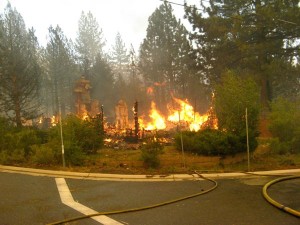
The 2007 Angora Fire ravaged the South Shore of Lake Tahoe. Photo/Lake Valley Fire

“More highly intense fire is not occurring now than historically in dry forests,” said William Baker, who teaches fire ecology and landscape ecology in Laramie, Wyo., where he’s been doing research more than 20 years. “These forests were much more diverse and experienced a much wider mixture of fire than we thought in the past, including substantial amounts of high-severity fire.”

If he’s right, he and others say it means fuel-reduction programs aimed at removing trees and shrubs in the name of easing fire threats are creating artificial conditions that likely make dry forests less resilient.

“It means we need to rethink our management of Western dry forests,” said Baker, a member of a U.S. Fish and Wildlife Service working group that is developing plans to help bolster northern spotted owl populations in dry forests.

Baker’s conclusions have drawn sharp criticism from other longtime researchers who believe that decades of fire suppression have led to more densely tangled forests and more intense fires, the position advanced by the Forest Service.

“I have yet to hear any knowledgeable forest or fire ecologist or forest manager say they are convinced by the main interpretations in that (Wyoming) paper,” said Thomas Swetnam, a professor of dendrochronology and director of the Laboratory of Tree Ring Research at the University of Arizona. “I doubt it will gain much traction in the scientific or management communities.”

The Forest Service did not immediately respond to a request for comment.

Baker said the historic government land surveys provided researchers with a surprisingly detailed and precise record.

The studies conducted by Baker and others over the past two years focused on parts of Colorado, Oregon and Arizona, but were indicative of dry forest types stretching from the Rockies to the Sierra Nevada previously thought to be “open and park-like” and typically enduring only cycles of frequent, low-severity fire.

“The major surprising finding was … areas of high density of forest and higher severity fires in really all dry forests across the West,” said Mark Williams, who co-authored two of the three studies with Baker.

“The notes are pretty descriptive,” said Williams. “You can look for where the fire started and ended. We were actually walking the same lines, collecting fire scars from trees.”

Wallace Covington, the director of the Ecological Restoration Institute at Northern Arizona University, takes no issue with the Wyoming duo’s data collection or statistical analysis but said some of Baker’s conclusions don’t follow from his data. Covington first testified before Congress in 2002 about the urgent need to thin forests to guard against catastrophic wildfires and insists it’s still necessary.

Others say the Wyoming studies are important new information in an emerging field of research.

Jennifer Marlon, a Yale University paleoecologist, said a study she recently led on the impact of climate change on forests over thousands of years appeared to be largely consistent “with Baker’s idea that there were large, severe fires even in dry forests historically.”

The fire record her team built for the Western U.S. for the past 3,000 years shows “that fires during the 20th century generally are actually fewer and smaller than ever before given current climate conditions,” said Marlon, who emphasized the role of climate on wildfire.

“The general trend from high fire in the 1800s to very low fire in the 1900s is strong and clear from three independent datasets,” she said. “Open park-like conditions may have indeed occurred after the ‘peak’ in burning during the mid-1800s.”

Baker and Williams contend that past studies of forest structure and fires were not so much wrong as “incomplete” because that they placed too much emphasis on anecdotal references, sampled too small of areas and often concentrated on old-growth stands more resistant to fire.

One of the earliest references to the open nature of the forests is found in a 1943 study by Harold Weaver, a forester from Oregon State who characterized forests in Oregon’s eastern Cascades as “like a park, with clean-boled trees and grassy forest floor.”

An updated view was summarized in the 2012 spring edition of California Forests: “Human fire suppression activity during the past 100 years have created dense, more crowded forests and shifted the fire regime in Sierran mixed conifer forests from one of frequent, low-level fire to one where high intensity wildfires are more common,” wrote John Battles, chairman of ecosystem sciences in Department of Environmental Science, Policy and Management at the University of California, Berkeley

Williams said the Wyoming studies have significant implications for wildlife that depends on post-fire habitat, such as the black-backed woodpecker, which has survived for millions of years by eating beetle larvae in burned trees.

Four conservation groups filed a petition with the U.S. Interior Department in May seeking Endangered Species Act protection for the bird in the Sierra Nevada, Oregon’s Eastern Cascades and the Black Hills of eastern Wyoming and western South Dakota.

The new studies provide the first “real, direct data'” showing that more forests burned historically, creating more post-fire forest habitat, said Chad Hanson, a forest ecologist and director of the John Muir Project who is helping lead the listing effort and suing the Forest Service to block post-fire logging in woodpecker habitat near Lake Tahoe.

“It indicates the woodpeckers had more habitat historically than they do now,'” Hanson said.

Williams said when he started the study he had “the same general ideas most people have – that the forests were less dense and there were frequent, less severe fires to maintain that structure.”

Now, he believes thinning and post-fire salvage operations should be re-examined and emphasis placed on maintaining high-density stands in certain circumstances that would not threaten people or homes.

“We shouldn’t be managing just for low-density forests,” he said. “We should not be unhappy with – or perhaps even manage for – higher severity fires in the forests.”


Gardnerville area fire brings smoke into Tahoe basin

A fire burning in the Pine Nuts is bringing smoke into the Lake Tahoe Basin.

The Spring Fire started the afternoon of July 22 after lightning struck western Nevada.

More than 1,000 acres have burned as of Sunday night.

“The fire made significant runs through pinon juniper today due to gusty winds near thunderstorms over the area. Access to the fire is difficult due to steep, rocky terrain and limited roads,” according to Sierra Front Interagency Dispatch Center.

 — Lake Tahoe News staff report


Dartmouth bus using vegetable oil to stop at Harveys

Dartmouth College’s Big Green Bus tour across America will stop at Harveys Lake Tahoe’s Outdoor Arena on July 24 to refuel with recycled waste vegetable oil from the resort’s restaurants.

The converted Greyhound bus, operated by 13 students, runs on 290 gallons of WVO and travels the country seeking to educate individuals on best sustainability practices.

The event begins at 1pm and is open to the public.

In 2011, Caesars Entertainment — which owns Harveys and Harrah’s — recycled 320,000 gallons of restaurant cooking oil to be reused at its resorts, or is removed and repurposed for use in biodiesel and other products.

The Dartmouth students, along with representatives from Harrah’s and Harveys Lake Tahoe, will be speaking about the concept of the Big Green Bus and other important sustainability issues.

The bus provides educational opportunities at each stop through stations including a tour of the bus, an interactive map telling stories of sustainability across the country, a demonstration of how individuals can build and shop with environmentally friendly products, a discussion about the energy costs of food, personal waste reduction, and a stationary bicycle hooked to a generator that powers several different energy-efficient bulbs.


Sexual harassment workshop in Truckee

The North Lake Tahoe Chamber/CVB/Resort Association and the Truckee Donner Chamber of Commerce in partnership with the Sierra Human Resources Association are offering Generations and Sexual Harassment: Awareness and Prevention for Business Owners and Managers on July 26, 9-11am, with registration and snacks at 8:30am.

The event will be at the Cedar House Sport Hotel, 10918 Brockway Road in Truckee. It will satisfy California AB1825 required training.

Attendees will learn how to bring their business into compliance regarding sexual harassment awareness in the workplace. The topic, presented by Laura Moriarty of SHRA and Tahoe Training Partners, is presented in an engaging and provocative way from the perspective of generations working side by side. It will teach attendees how to prevent unwelcome behavior, handling complaints, investigations and interviews, privacy issues, as well as documenting and resolving complaints.

Registration is $49/person for SHRA members, $59 for chamber members and $69 for non-members if registered before July 25. Last-minute registration runs $59 for SHRA members, $69 for chamber members and $79 non-members.

To register and for more information about the workshop, call Laura Moriarty at (530) 573.0224.