• Sierra Athletic Club’s Cancer Walk in July raised nearly $3,000 for the South Lake Tahoe Cancer League.
• On Aug. 23 the Governing Board of the Tahoe Regional Planning Agency is expected to vote on the Edgewood Lodge project. The meeting-public hearing is at the Stateline office of TRPA. The meeting starts at 9am.
• Are you a Lake Tahoe Newspaid subscriber? Become one to qualify for special deals – like free tickets to September’s cocktail event that benefits the Barton Health Foundation and a pair of tickets to a September Giants game.
• Camp Tadaka is excited about art and drama Aug. 6-10 for grades K-8. Call (530) 542.6056 to register.
• Phil Jimenez is now general manager of KRLT and KOWL radio stations that are based on the South Shore.
Tahoe residents work on New Yorker’s Burning Man artwork
A team of 50 craftsmen from across the country, including people in Lake Tahoe, is creating The Life Cube, an interactive public art installation at Burning Man.
Scott Cohen will begin on-site construction in the Black Rock Desert of Nevada in mid–August.
“I am overwhelmed with their support — donations of time, materials, tools, and other resources to help make my dream a reality,” Cohen said in an email to Lake Tahoe News of the support he has received.
Only a few art projects are authorized for burning at the end of the weeklong festival. The Life Cube will be one of them.
Cohen said he conceived The Life Cube as an aesthetic interpretation of his own belief that if you write down your goals, wishes and milestones, you will have a better chance of achieving them.
“The Life Cube’s art installation offers a stimulating and thoughtful place for people to meet and reflect on what they want in life, and encourages them to post their messages and deposit their written goals and aspirations into slots in the Cube,” the New York artist said. “TLC burns at week’s end in a cathartic fire ceremony committing all the wishes to ash and flame.”
The burning will be at midnight Sept. 1.
Lightning does little damage; hot temps for Tahoe to continue
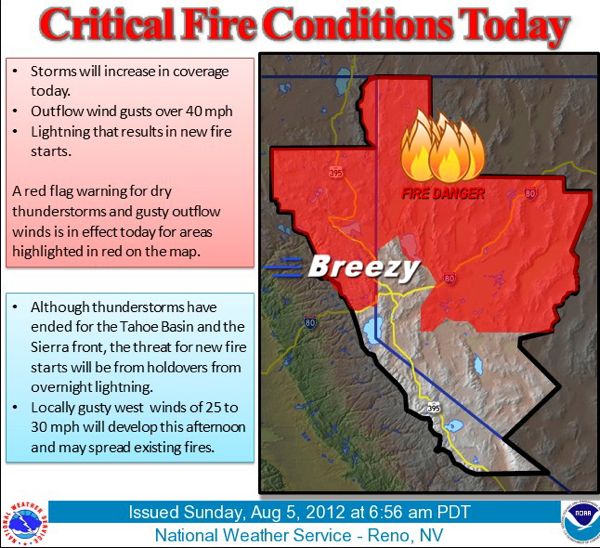
While thunder boomed and lightning filled the night sky in the Lake Tahoe Basin and beyond last night, the fire activity was minimal.
South Shore officials are not reporting any fires from the lightning. There were 34 strikes in the Tahoe National Forest that started two fires, with smoke coming from another area where crews are rushing to.
The first fire burned about 1.5 acres three miles east of Malakoff Diggings State Park in a remote area. Another fire was ignited on Snow Mountain in a remote area overlooking the North Fork American River. Smokejumpers have been requested from Redding. Smoke was seen in the Galloway Ridge area south of Downieville. Firefighters and a helicopter Sunday morning were searching for the exact location.
Three small fires started south of Smith Valley in Nevada from the Aug. 4 storms.
According to U.S. Forest Service officials on the North Shore, “The forecast for today includes continuing potential for scattered thunderstorms primarily west of the Sierra crest. Reconnaissance flights will take place throughout the day with expectations that additional fires will be spotted as the day warms up.”
While lightning is never welcome when terrain is so dry, the rain is a good thing. South Lake Tahoe received 0.41 inches of rain in July – 0.02 inches below normal.
The hottest day of July was the 12th when the National Weather Service recorded 89 degrees for Tahoe. It’s possible that mark will be matched this week.
— Lake Tahoe News staff report
Study: Wildfire risk to homes will double in 40 years
Publisher’s note: Getting rid of shake roofs is one way to protect homes. Lake Valley and Meeks Bay fire departments have grant funds to help homeowners put on a new roof. South Lake Tahoe Fire Department was asked to help write the grant and then get some of the money, but didn’t do so according to Fire Chief Brian Uhler,” … because we don’t have a dedicated bureau for fire prevention — a limitation relative to requirements to be eligible for applying for the grant.”
By Merced Sun-Star
Climate change, population growth in rural areas and other factors could double the risk wildfires pose to homes within the next 40 years, according to a UC Merced study.
The information is part of a report by UC Merced Professor Anthony Westerling, prepared for the California Energy Commission.
In the paper, released Wednesday, Westerling and co-author Ben Bryant looked at the impacts of climate change, the state’s projected population growth, urban and rural development, and land-use decisions on wildfires around the state in the coming century.
“Climate change is going to alter wildfire in our state,” Westerling said, in a press release from UC Merced. “How and where we build our homes, and how we manage the landscape around them, will shape our vulnerability to wildfire.”
Although policies to deal with climate change could help, Westerling said some level of additional warming is going to occur regardless.
As a result, smart-growth strategies for land use, such as concentrating growth in existing urban areas, educating people about implementing fire-proofing practices, such as creating defensible space around their homes, will help lessen the threat.
Fire-resistant home construction would help, especially in areas likely to be particularly threatened as the climate gets warmer.
“Fire suppression, fuels management and development policies, such as zoning and building codes, are the primary means we have to manage wildfire risks,” he said.
In addition, more people are building homes in forested areas. More developed rural land means a greater the chance for wildfires, the data shows, which increases the threat to the homes.
LONDON – Afternoon tea in England started as a pick-me-up, but I found it to be such a relaxing experience I was ready for naptime.
The history of this ritual dates to the early 19th century when Anna, the 7th duchess of Bedford, would have afternoon tea in her bedroom.
“Later friends were invited to join her in her rooms at Woburn Abbey and this summer practice proved so popular that the duchess continued it when she returned to London, sending cards to her friends asking them to join her for ‘tea and walking the fields’,” according to the Cadogan Hotel in London.
Afternoon tea is a ritual in England. Photos/Kathryn Reed
Others followed the duchess’ lead by hosting teas, and thus the ritual spread to all classes.
“Traditionally, the upper classes would serve a ‘low’ or ‘afternoon’ tea around 4 o’clock, just before the fashionable promenade in Hyde Park. The middle and lower classes would have a more substantial ‘high’ tea later in the day, at 5 or 6 o’clock, in place of a late dinner,” the hotel explains in its Afternoon Tea menu.
Walking into the parlor of the stately Cadogan Hotel, which is close to the high-end shopping on Sloan Street, I thought perhaps we should have petticoats and other attire of days gone by. Despite our “tourist” wardrobe, the staff didn’t turn us out onto the street.
Being there during Wimbledon meant the hotel was offering a special for the renowned tennis tournament. A group had already nabbed the table showing the match of the day. But we were still able to enjoy some of the tennis fun with the Apple Cream and Almond Puff Tennis Balls.
A variety of teas from India and China are on the menu. Sue picked the Jing Assam Breakfast – a black tea, while I chose the Jasmine Pearls.
With a strainer over the cup, our server poured the steaming tea into our cups. The strainer prevents leaves from getting into our cups. We each had a pot that later the server added more water to.
The three tiers of food may be called finger food, but it was a meal for the two of us and not just a snack. I have never been a fan of scones, but after eating the apricot creations made by pastry chef Marie Bolland, I could have these every day.
Tiny sandwiches ranging from cucumber and cream cheese to egg salad filled the first tray. Then the scones. An array of desserts, including the tennis balls, topped the ensemble.
At 22.50 pounds it’s a bit pricey, but considering this turned into a meal for us, it was worth it. While it’s not something I would pay for if I lived in London, except maybe for special occasions, I would definitely recommend high tea as something to experience while on vacation. And the Cadogan Hotel made the ritual seem so regal even for commoners.
ngg_shortcode_0_placeholder (Click on photos to enlarge.)
Then and now: Quonset hut-style theater showed popular films
"Let's Live Again" plays at the Lakeside Theatre in 1948. Photos/Lake Tahoe Historical Society
The quonset hut Lakeside Theatre was about midway between today’s Applebee’s Restaurant and the Park Avenue stoplight in South Lake Tahoe.
So much snow in winter 1953 makes it hard to get to the theater.
Highway 50 then was only a narrow two-lane mountain road, thus more frontage area as seen in these pictures.
This building was demolished by 1963 and a beautiful new Lakeside Theatre (not quonset) opened near the Y in November 1963.
It was razed in about 2000 and the site now is CVS next to McDonald’s.
— Bill Kingman
In 1956 it was "Diane" starring Lana Turner that brought movie-goers to the theater.
Californis using special funds to pay for basics
By Kevin Yamamura, Sacramento Bee
California drivers pay fees for smog checks, vehicle registrations and new tires, all supposedly for programs that benefit roadway use.
Consumers pay fees to recycle beverage containers, televisions and computers. Doctors and accountants pay license fees to regulate their industries.
But for more than a decade, the special funds collecting these dollars have served a second purpose: helping California pay for schools, social services and prisons that are supposed to be funded by general taxes.
California has 560 funds deemed “special” because in theory they’re walled off from general state expenditures. In the face of two recessions, however, California reached deeper into those funds for purposes that fee payers never intended. The state now owes $4.3 billion to special funds, more than five times the amount owed in 2008.
State leaders argue that special funds have enough extra money to pay for more critical state needs. Some special fund reserves grew after the state imposed furloughs on all state workers starting in 2009.
But program advocates say the borrowed money should have gone toward intended uses like reducing pollution or better enforcement of health care fields. Or, they suggest, it should have gone back to consumers and professionals through lower fees.
“Any of these funds set up by ratepayer money needs to be spent on its intended purpose,” said Mark Toney, executive director of The Utility Reform Network, a consumer advocacy group that has watched the state borrow $296 million in telephone-related surcharges. “The purpose is not to serve as a (state) piggy bank.”
Gov. Jerry Brown says the state will eventually repay $4.3 billion in outstanding special fund loans with interest, a promise that assumes voters will pass tax hikes in November. But state officials never retired $448 million in special fund loans from 2002 and 2003 even during good times. And $1.3 billion in loans have no repayment date in state law.
London’s vibrancy spills forth on every streetcorner
By Susan Wood
LONDON – It’s only fitting England’s largest city hosts the 204 nations that make up the family of the 2012 Summer Olympic Games.
London is a city of vast diversity – given its multicultural atmosphere. The many languages and ethnicities heard and seen on the streets and in the “tube” are as varied as a visitor’s choices of things to do, food to eat, beverages to consume, neighborhoods to scour and places to stay.
Among them, the Shepherd’s Bush neighborhood is what’s termed the West End, where theater is king, the BBC broadcasts, a menagerie of city blocks of Georgian architecture stand and even the history includes a different Olympic time.
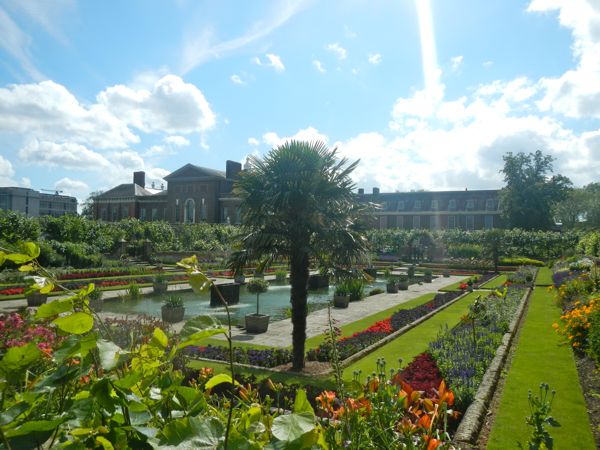
Kensington Palace's gardens are full of color. The gardens are free to roam, while there is a fee to tour the palace. Photos/Kathryn Reed
As the only city to host the Games three times, London’s first was staged in Shepherd’s Bush’s “White City” in 1908. Britain ended up winning 56 medals. White City eventually became home to greyhound racing on the speedway.
Today, a modern, hip neighborhood thrives – as reflected by the four-star K West Hotel & Spa on Richmond Way. The decade-old boutique hotel may be all glass at its front entrance, but it’s all eco-friendly green in principle – a gold member of the government-sanctioned Green Tourism Business Scheme among its four notable associations. Little touches can be noticed in the spacious executive double room — including two types of trash cans for waste, dimming recessed lighting and a perfectly-fitting narrow bathtub so there’s no waste of water for those who bathe as sport. And the towels are nicely oversized for drying off.
Downstairs, a luxurious, full spa awaits a robe-clad guest who wants to make the most of the water lounging experience for an additional 25 pounds a day. (Check the exchange rate to budget accordingly because the dollar is most often worth much less.)
Steps away from a massaging foot bath is the hydrotherapy hot pool that is equipped with metal chaise lounges to accommodate anyone of any height. (It’s much more comfortable than it sounds.) Across from it, the “water fountain” works on the shoulder muscles. If the spa visitor becomes overheated from the steam room or sauna, a unique Snow Paradise room with the simulated white stuff can bring the body temperature down. It’s hard to do more than a minute. For longer-lasting relief, a collage of treatments is available for an additional fee.
From the lobby, the K West Lounge is fun and inviting – especially with bartender Carlos at the helm. He goes out of his way to make sure the guest gets what she wants. Upstairs, the Kanteen restaurant serves breakfast, lunch, snacks and dinner at reasonable prices. (Recommended: sweet potato fries and a raspberry crème brulee in the evening with Wimbledon on the “tele” make a good room picnic until starting the next day with a filling full English breakfast in the Kanteen restaurant.) A guest can either opt for a hot breakfast there or the continental version served in the lounge downstairs for an extra room charge.
After the Olympics in September, K West rooms run from 127 pounds a night for a junior double to 177 pounds for an executive double or 268 for a suite.
With cushy seats and rectangular, rock fireplace in the lounge as well as piped-in jazz and mood-enhancing colored lighting throughout the hotel, the comfortable, relaxing K West offers subtle and blatant amenities that make a guest’s stay so comfortable one may not want to leave if not for the city of London calling.
Stepping out for the day highlights the new and the old
When venturing outside with the chirping birds, K West Hotel is an ideal launching pad for inviting walks around Shepherd’s Bush or hopping the London Underground metro to see the varied sites.
The West End touts some of the best theatrical performances in the world. For one, there’s the captivating “War Horse” that started in the National Theater and moved over to New London Theatre. Walking through the Piccadilly Circus neighborhood is a carnival experience. Pedestrians jam the sidewalks, lights are flashing at night and the place is electric with activity. There and farther east to Covent Garden where the pub crawl is the scene, street performers try their hand at entertaining pedestrians with either gravity-defying feats or statuesque displays.
At a slower pace, a meandering stroll from Shepherd’s Bush down the bustling, shop-lined Bayswater Road and historic High Street of Kensington can lead a walker to the ornate Kensington Palace and colorful Gardens, where the late Princess Diana lived with her sons William and Harry. About a 15-minute walk from the palace, a visitor can see where she is honored at the Diana Memorial Fountain on the corner of Hyde Park. It’s a circular wading pool that brings out all ages.
Kensington Palace tours cost 12 pounds. (For about 150 pounds, the London Pass with transportation card gives a visitor access to more than 50 attractions and six days of riding the Underground.)
The palace built in 1605 and restored a year ago features the Royal Ceremonial Dress Collection, a Queen Victoria story told through quotes from room to room and a film of Queen Victoria’s Diamond Jubilee celebration of 1897. Queen Elizabeth II’s ceremony was set last June, a few weeks before the Olympic Games.
A quick hop and connecting change on the Underground from one of two Shepherd’s Bush stations (Hammersmith and City or Central lines) within walking distance from K West Hotel can place a London visitor in the heart of Olympic Park, where Blue Badge Tour guides provided a thorough history and view of the park and surrounding structures in the East London area of Stratford. (Crossing the city only takes between 45 minutes to one hour and is convenient to use.)
From the far east side, visitors have ample choices to backtrack on a sightseeing day – by train from the multitude of stations, bus or ideally on foot to take it all in.
A bridge-to-bridge pedestrian tour on your own over the windy River Thames is highly recommended given their different personalities and views.
The gothic Tower Bridge, one of the most famous in the world, has donned giant Olympic rings for the host city’s special occasion. A tour, which is included on the London Pass, costs 8 pounds without and includes a trip to the Victorian engine room that’s so immaculate one could almost eat off the hardware. Either way, it’s well worth the trip down London’s memory lane and a high-level walkway featuring displays of other famous bridges of the world and past Olympic Games from one end of the bridge to the other.
Across the way, standing on the London Bridge provides a world-class view east to the Tower of London fortress housing the heavily-guarded Crown Jewels and west to Shakespeare’s Globe Theatre and Southwark Bridge. Each bridge characterizes a different personality of this exciting city along the River Thames. The waterfront walkways are alive and electric with visitors hitting the famous attractions.
Due southwest of the Tower Bridge is grand central for government — the House of Parliament with Big Ben alongside. The complex may be one of the most recognizable landmarks in London, but it’s Westminster Abbey across the street that is a must for sightseers wanting to immerse themselves into the heart of London.
Its history is unsurpassed in terms of grandeur and importance. One can almost feel an apple drop when standing in front of Sir Isaac Newton’s memorial. The working church’s acoustics are like no other with its high, majestic ceiling and walls adorned with stained glass and soaring vaults to demonstrate its glory to God. The church was designed in the shape of a cross. (No photographs can be taken, but the audio tour provides a long-lasting visual.) Tours cost 8 pounds without the London Pass.
A longer walk over the Westminster Bridge can transport a visitor from the 10th century to the modern age of the London Eye. The ride, which crosses between a Ferris wheel and a gondola, provides the best 360-degree views of the city at 443 feet up. In London, its height is only surpassed by the city’s newest skyline addition – the modern-looking, pointed Shard, which opened at more than 1,000-feet high just prior to the 2012 Summer Olympic Games.
An Olympic first
A short, direct tube ride due south of Shepherd’s Bush gets a visitor to Wimbledon, home of one of the four tennis grand slams. The All England Club is hosting the venue in the Olympic Games for the first time – something 2012 French Open winner and clay king Rafael Nadal was quoted in the Wimbledon museum as saying “is fitting for the best tennis club in the world” to host. Many tennis greats from Serena Williams and Roger Federer to Maria Sharapova and hometown hero Andy Murray have shown up for the Games.
Like the Olympics, Wimbledon tickets are expensive or hard to come by with a discount – bringing most of the tennis faithful fans to queue. The process requires standing in line in the wee morning hours with thousands of others. Once in the grounds, the lucky fans will find court seats.
All the work is worth the effort, despite the usual threat or reality of rain. New over the last few years has been the premier Centre Court retractable roof and giant Jumbotron screen set up on the front field for grounds spectators to watch the television broadcast.
Up-close and personal with television
A 15-minute walk from the K West hotel down Wood Lane invites a sightseer wanting the more unconventional tour to the grounds of the BBC, Britain’s primary television network watched by 20 million viewers. The tour lasts up to two hours and costs about 12 pounds.
The complex is shaped in a giant question mark, resembling an ideal motto for the proud, serious network, which tour guide Debbie said differs from CNN’s broadcasts that look like footage of “a disaster movie.” The television news operation alone employs more than 2,000 people and is divided between “planned” and “breaking” news. Guests of the tour get a brief view of the busy newsroom.
The BBC Weather Centre cranks out 140 forecasts every day; something a tour guest can try in front of a green screen. The tour is part learning, part interactive and involves waiting rooms and studios where Mariah Carey, the Metallica band and Madonna have sat to go on the air and well-known shows like “Absolutely Fabulous” have been taped.
The BBC will move to Manchester in the near future.
Moving across the city changes the scene
Three Underground station stops away from Shepherd’s Bush off the Central Line opens up the world of London’s largest of its Royal Parks – Hyde Park.
Just on its edge, K West’s sister hotel — the four-star, traditional Lancaster London that started in 1967 — sits steps away from the Lancaster Gate station off the Central Line.
Location, location, location seems to be the mantra here. A guest could spend a whole day in Hyde Park. For three years, the park’s lime trees have been pollinated by the hotel’s 1 million bees that are kept in rooftop hives. Among others, the Lancaster’s efforts have given it the eco-friendly reputation as the Green Hotel of the Year this year from the Considerate Hoteliers Association made up of its lodging peers. In October, the hotel will aptly host the London Honey Show, and at least 500 people are expected.
The 416-room Lancaster hotel serves the honey in its Island Grill, the floor level casual restaurant off the street that’s one of two it runs along with a bar. The Thai eatery, named Nipa, is reasonably priced and boasts tasty dishes.
When the Lancaster London Hotel Company owner from Thailand comes to visit, he makes a point of stopping into the restaurant, according to spokeswoman Alison Hull, who added the city has been “transformed” since the arrival of the Olympic Games. Upstairs, the view rooms provide an awe-inspiring, picture-window-sized view of the London skyline and tree-lined park. The rooms start at 199 pounds in September following the Olympics.
(Note of caution: opening those windows may serve to save a guest from an inconsiderate one who decides to smoke at all hours of the night on a non-smoking floor. After three complaints, security officers and staff elected to do nothing about it.)
Nonetheless, the view will draw a guest outside for the day.
First on the list, no visit to London would be complete without going to the queen’s Buckingham Palace for the changing of the guard by her royal staff. The mid-morning spectacle of mass tourism and pomp and circumstance requires patience and height in a crowd.
But with a 25-minute stroll through one end of Hyde Park to the other, the photos alone are worth the 45-minute presentation. To the delight of the masses who fight tooth and nail for an ideal viewing spot, the guard marches in unison – some on horseback, others with swords and yet more with brass and others with big guns.
The brass guard band covered a song list from the Britain anthem to jazz and even a Billy Joel tune, “Moving Out,” before the members did so.
“I can’t believe they’re playing jazz,” one amazed man said in the crowd.
Upon the guard and crowd disbursing, the best of the estimated millions of photos shot can be grabbed. The return from the southeast corner of Hyde Park to Lancaster Gate on the northwest end can be made on foot with an unscheduled trip along the lovely Serpentine channel to watch the birds and boaters. (Recommended: take a stop at the Lido Lounge along the Serpentine for one of England’s pub beers to slow things down on a sightseeing marathon.)
Out the door for a short walk to the Knightsbridge neighborhood down Sloan Street may be just what a shopper is looking for. The exclusive boulevard is home to Harrods, a department store extravaganza. Window shopping alone can be a magical experience. Plus, there is a tribute to Princess Diana and Dodi Fayed.
ngg_shortcode_1_placeholder (Click on photos to enlarge.)
S. Tahoe youth campers heading to Sand Harbor
Camp Tadaka is having a Fun Trip Aug. 9 for K-10-graders. The South Lake Tahoe group is headed to Sand Harbor Beach for the day. Cost is $25.
Bring lunch, swim stuff, sunscreen, hat, goggles, rash guard, and a water bottle.
Call (530) 542.6056 to register.
Panel: Spend $4 mil. to fund Nev. student tracking system
By Sean Whaley, Nevada News Bureau
CARSON CITY – A state panel charged with implementing a system to track individual student performance from preschool through entry into the workforce is recommending that $4 million in state funds be appropriated by Gov. Brian Sandoval and the 2013 Legislature to help accomplish the task.
The P-16 Council, led by chairwoman and state Sen. Barbara Cegavske, R-Las Vegas, finalized its recommendations to Sandoval on Monday, proposing the funding to ensure the Statewide Longitudinal Data Systems (SLDS) project moves forward in the next two-year budget.
“Everybody’s really been doing a yeoman’s job, I mean really working hard to get the information that we need to continue on,” she said. “I think the governor is going to be very pleased. I’ll be anxious for his review as well.
“So we’re really excited to be able to move on with this,” Cegavske said. “And we’re going to be like other states. It took a lot of people a long time to put theirs together and we’re not going to be any different. But I’m very hopeful that all entities will join and we’ll be able to get this done in a reasonable amount of time.”
Sandoval issued an Executive Order on Oct. 7, 2011, asking the council to take the necessary steps to create the system to track students, following the lead of other states as part of an effort to reform education and improve student performance in Nevada.
The effort got a boost in June when the Nevada Department of Education was awarded a $4 million grant from the Institute of Education Sciences (IES) to develop the SLDS. Nevada was one of 24 states to receive funding to support the design and implementation of its tracking system.
The three-year grant will create and assign a Unique State Personal Identifier so that students, teachers and those in the workforce can be followed from pre-school through grade 12, into post-secondary education and on into the workforce.
The grant will also be used to fund an in-depth technical needs assessment at the state Department of Education, the Nevada System of Higher Education and the state Department of Employment, Training and Rehabilitation to determine solutions for implementing the enhanced SLDS. The assessment is expected to be completed by June 2013.
But the P-16 Council, in its report, said that state funding will be needed to accomplish the solutions identified in the assessment. In addition, funding will be needed to incorporate early childhood data into the SLDS – a project that is not included within the grant.
As a result, the council made the funding recommendation to support the next steps of the SLDS project and sustain it beyond the grant funding.
The council made no recommendations on data polices, such as which data elements will be shared and how, or how privacy will be protected, saying such decisions are premature until the needs assessment is completed.
In introductory remarks to the council in November 2011, Sandoval said he wants Nevada to create a data system that will put it on a par with states that have successfully accomplished the task, including Florida, Maine, Connecticut and Washington. The information, including performance measures of educators, is critical to moving Nevada forward in student achievement, he said.
A new panel, called the Teachers and Leaders Council, was created as a result of legislation passed in the 2011 session, Sandoval said. It is charged with developing a statewide performance evaluation system for administrators and classroom teachers. Half of the evaluation must be based on student data, which is why the charge to the P-16 Council is so important, he said.
“This is a historical moment, this is really a crossroads in the state of Nevada and we have some great opportunities to really improve the delivery of education in this state,” Sandoval said.
The Department of Education has already created a student data system, but it is not as comprehensive as required for Sandoval’s education reform efforts.
A national report showed that Nevada made progress in this data collection effort in 2011. The Data Quality Campaign’s (DQC) seventh annual state analysis, Data for Action 2011, shows that states have made major progress building their student data systems. More states than ever – 36, up from zero in 2005, including Nevada – have implemented all of DQC’s 10 Essential Elements of Statewide Longitudinal Data Systems.
 • Sierra Athletic Club’s Cancer Walk in July raised nearly $3,000 for the South Lake Tahoe Cancer League.