Opinion: Proof it takes a village to make a community function

To the community,

According to the African proverb, “It takes a village to raise a child.” We are fortunate to live in our South Lake Tahoe “village” that is filled with community support for our kids. This summer Edgewood Tahoe exemplified how our community steps up when our club needs them.

According to Natalie Cazares, unit director for our Bijou Site, “During the summer, most of our Bijou members have not been able to attend the club because we are only able to offer the all-day programs from our main site. Having transportation to and from the club has always been a challenge during that time for our Bijou families.”

The challenge was turned into an opportunity this year with support and a shuttle bus from Edgewood. Plus, the drivers volunteer their time to drive the kids. Wow!

What a great “village” we live in. Our kids, our families and our club all say thank you Edgewood.

To learn more about the Boys & Girls Club of Lake Tahoe and how you can become part of our village go online.

Karen Houser, Lake Tahoe Boys & Girls Club executive director


Snippets about Lake Tahoe

• CASA El Dorado County is having a fundraiser Aug. 31 from 4 to 8pm at Lakeview Commons in South Lake Tahoe. Admission is free. There will be a battle of the bands.

• The band Everest has been added as the opening act for Neil Young & Crazy Horse on Aug. 9 at Harveys. Lauren Alaina will not open for Sugarland on Aug. 18.

• Tahoe Improv Players returns to the Boathouse Theatre at the Tallac Site on Aug. 7 at 7:30pm. Click on the flyer for details.

• Here are the Caltrans roadwork schedules for the Sierra and El Dorado-Tahoe.

• For parents looking to do something different with their kids, Lake Tahoe Community College’s Connect Ed is offering a cooking camp Aug. 13-17, 9am-noon each day. Go online for details and to register.


Squaw Valley wants to build housing, retail at the base

Squaw Valley Resorts is proposing to develop a recreation-based, all-season resort community consisting of 1,275 fractional ownership residential and guest accommodation units that would include condominium hotels and semi-attached and detached fractional ownership residential properties.

The four-phase development would be built over 12 to 15 years. The first phase would include approximately 25 acres and almost 1 million square feet of development.

Placer County planning staff gave a presentation recently to the Board of Supervisors.

This project would be on project on a 100-acre portion of the 4,700-acre Squaw Valley General Plan area. The Specific Plan for the development proposes to amend the General Plan.

“This will be a very closely watched proposal as it could have substantial impacts—positive or negative– on water, traffic, air and other quality of life issues for Olympic Valley residents and businesses in the eastern end of Placer County,” Board of Supervisors Chairwoman Jennifer Montgomery said. “Placer County is committed to a full, robust, open and transparent process that will include the voices and input of all affected stakeholders in the region.”

Members of the public also commented on the project and voiced their concerns over several aspects of the project, including its size, building height, water, effect on the valley and Squaw Creek and the Squaw Valley community.

There will be more public meetings in the future.


Astronomy exploration at Spooner Lake

Professional stargazer Gigi Gileslaser will lead a tour of starry wonders at Spooner Lake.

View the night sky with high-powered telescopes and astronomical binoculars at an elevation of 7,000 feet. Wear comfortable shoes and bring a light jacket and flashlight.

The event is Aug. 18 from 8-10pm. Meet at Spooner Lake Park off Highway 28. No pets allowed.


Opinion: TRPA has outlived its usefulness, time to disband

By Kathryn Reed

What is wrong with Lake Tahoe? Plenty.

What is right with Lake Tahoe? A few things.

What can be done so the answers are reversed?

Every time I leave town I contemplate the above questions because the negatives of Tahoe become crystal clear when other locations seem to have their stuff together. I also contemplate those questions and their answers with friends, colleagues and others in the area.
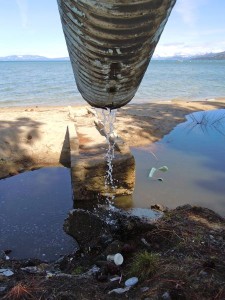
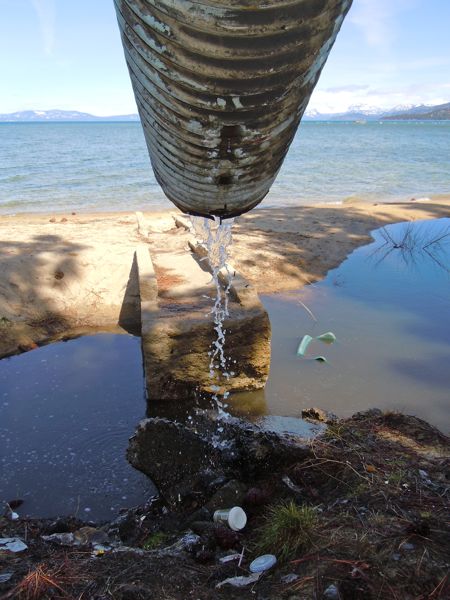
TRPA, a federal agency, has allowed cities, counties and state transportation agencies to let gunk flow directly into Lake Tahoe. Photo/LTN file

I have relatively minor examples in my life that show the difficulties I have had with rules in the Lake Tahoe Basin.

We don’t have our TRPA best management practices certificate because our driveway is out of compliance. It has a 1 to 2 percent grade. It’s concrete. The most expensive part of replacing the driveway is getting rid of the concrete. Tahoe Regional Planning Agency and the Tahoe Resource Conservation District want us to put in a swale on the “lake” side of the driveway. The water flows the other way, in front of our neighbor, into a ditch and into a field by an elementary school where sediments are naturally filtered out.

We live on a high water table. Each spring the sump pump sends water from under the house, through a pipe to the back yard – where many times the yard is then flooded. The water goes underground, back under the house and the process is repeated. I have spoken to TRPA, Lahontan Regional Water Quality Control Board, South Lake Tahoe and South Tahoe PUD officials about having a communitywide catch basin for all this water so it could be used for irrigation. I have even said tax us. Yep, I used that three-letter word.

They all said it’s not possible, that there is no shortage of water here so there is no incentive and that people would not tax themselves.

Well, taxing for the sake of taxing we won’t support. But taxing because there is a true, tangible benefit is different.

You see people, we are going to have to pay for the improvements in town. We are the government. I hear people say taxes are high in Tahoe. Prove it. Show me.

Yes, it’s expensive in terms of housing, food and gas. But taxes? Not so much.

(Yes, the state of California is outrageous – but that’s a different issue.)

Another personal issue was with business licensing. When I wanted to start a home-based business, I needed to go to the airport (aka city hall) for the regular business license. Then I had to go to South Lake Tahoe’s Tata Lane office for the home business license. Then I got to pay more money for the privilege to work at home – where I am not adding more vehicle miles traveled to get to an office.

Imagine if I had wanted to do something grander?

Government and regulatory agencies are the problem.

Companies and individuals wanting to do large-scale (even medium-scale) projects are hindered by regulations and then sued by environmental groups that don’t like the projects. The hoops people have to go through are astounding and counterproductive.

Improving infrastructure

Not all development or redevelopment is bad. But neither should it all be approved because there is environmental gain.

Do we really need a five-star resort at Homewood along a road that is so crowded? Do we really need a state highway in front of the only bi-state park in the country?

We can’t blame our woes on second homeowners. Like South Lake Tahoe, in Vail and Park City about 70 percent of the houses are not occupied by primary residents. Those towns are functioning and look great.

But those cities taxed themselves. (They aren’t perfect, no area is, and it’s not that we have to be them – but we do need to stop saying what we don’t want to be and figure what we do want because what we have is crap.)

We have to pay to have free transit if that’s what we want. We have to pay for roads if that is what we want.

Yes, part of the problem cities and counties have is the amount of money doled out each year on pensions and health care for retirees. But don’t begrudge the retiree for getting what their union bargained for. Look at the electeds who agreed to those public dollars to be spent on a few employees instead of the greater public. (It’s only a handful of employees who abused the system by racking up OT and doing other things to inflate their pension. But we the public need to demand those practices are not allowed – to stop the loopholes that essentially amount to the theft of public money.)

We can start by voting. Nov. 6 is the next chance to make a difference. City and county reps sit on TRPA and other vital boards. If you don’t vote, you are part of the problem.

Lakeview Commons in South Lake Tahoe was paid for by California Tahoe Conservancy dollars. That’s state money. Part comes from Tahoe license plate sales. Wouldn’t it be more logical to drive around with a Tahoe plate (California or Nevada), than a bumper sticker?

Improvements to the North Shore in Placer County come from taxing hotel guests in Lake Tahoe. Maybe next year when South Lake Tahoe asks voters to increase the hotel tax some of the dollars could be allocated for events or the arts or to improve athletic facilities and not just go to balance the general fund.

Monumental change needed

There are other ways to bring change beyond voting.

It is time to disband the TRPA.

A week from today is the annual Lake Tahoe Environmental Summit. Sen. Dean Heller, R-Nev., is hosting it at Edgewood Tahoe. Two other U.S. senators, a congressman and possibly the governors of California and Nevada, along with a cadre of local muckety-mucks, who often act like star-struck adolescents around these Washington-types, will join him.

TRPA was enacted by Congress to protect Lake Tahoe. Congress can make TRPA go away. What if we showed up at the 10am event in Stateline and took back our lake? What if we the people told these members of Congress that enough is enough?

TRPA has nine thresholds. Lake clarity is just one of them. That is why they get to say if your deck can be expanded, waffle on how big of a tree you get to cut down in your yard, if windows on a house should be allowed to be seen by boaters on the lake, and to decide after a fire obliterates 254 houses that pine needles as an erosion control measure isn’t so wise.

TRPA has done good. But even its executive director keeps admitting to how things must change, that past policies weren’t based on science, and that it is a new day.

Well, the new day should be that they go away.

Local jurisdictions can figure out how to zone areas. Local jurisdictions can figure out what type of lighting is good, what paint colors work, what signs should look like and if a tree should be removed.

Local water agencies and fire departments have proved that they can form regional alliances. Because we do need a regional, aka lakewide, approach to some matters.

Lahontan and the Nevada Department of Environmental Protection, along with owners of lakeside property, U.S. Coast Guard, and departments of waterways for the states will figure out the lake clarity part.

TRPA stresses that is a planning agency and not a doing agency. It looks like it planned the demise, ruin and destruction of Lake Tahoe based on the dilapidated infrastructure, lack of attention to water clarity along beaches (where we and the tourists are swimming), creating commodities out of commercial floor area and tourist accommodation units, and the empty buildings (because it’s so dang impossible to convert old hotels into housing or to renovate structures because of the air mitigation fees).

TRPA has failed us. We must stop this. We can’t rely on the updated Regional Plan that is supposed to be approved in December. Those close to the process say a lawsuit is likely if it does pass, and that it won’t include any meat in terms of real change. All of that remains to be seen and is speculation at this point.

Still, TRPA is hurting the Lake Tahoe Basin, not helping it. It served a purpose once, but now it is so much about creating job security for the people inside those walls.

This is the agency that last month paid approximately $12,000 for two people to come talk to the Governing Board and locals about what Tahoe needs to do fix itself. At the end of the three-hour public session I told two TRPA employees that the night was a complete waste of my time. Someone else told them the two speakers were preaching to the choir.

TRPA is a public agency – so that means those were our dollars that paid those people to essentially have a paid vacation in Lake Tahoe. Wow, I could talk for $6,000. I could give you my opinion for much less – oh, wait, I just did – and it was free.



Bouldering hounds to converge in Meyers

The 2nd annual Meyers-Lake Tahoe Climbing Festival and Bouldering Competition is Sept. 15.

The contest is for all ability levels — beginners to pros. The competition will highlight more than 100 problems ranging from V0 to V12 and new areas.

Nearly 100 people completed last year.

This event will also include booths for local adventure and climbing businesses, dyno competition, slack line comp, youth speed climbing, food, music and awards.

The event starts at 3pm.

For more information and to register, go online.


Do you have a calendar dog?

Lake Tahoe pets are invited to star in a calendar project to benefit local Tahoe pets in need. Pets are eligible to become a 2013 Tahoe Pet Calendar Cover Pet, Pet of the Month or be part of a Tahoe Pets on Parade montage.

Photo submission deadline is Aug. 31.

This is sponsored by the Lake Tahoe Humane Society and Society for Prevention of Cruelty to Animals.

Information, photo tips, entry rules and a submission form are available online or by dropping by the office at 1221 Emerald Bay Road.

The calendar theme is pets at Tahoe.

The submission fee is $20 per entry. Every paid entry – whether selected or not – receives a free calendar upon publication. All proceeds benefit local Tahoe animals in need. The Lake Tahoe Humane Society and S.P.C.A. has been serving the pets and people of the Greater Lake Tahoe Basin for 45 years. All proceeds from the Tahoe Pet Calendar Project will stay in Tahoe.


Study: Nevada’s tax system means fewer specific incentives for businesses

By Sean Whaley, Nevada News Bureau

CARSON CITY – A report from the Council of State Governments exploring the successes that 13 Western states have had with tax incentives to encourage economic growth found that Nevada has fewer such programs in large part because of its tax structure.

Nevada does not have a personal income tax, unitary tax, corporate income tax, inventory tax, estate and/or gift tax, franchise tax, inheritance tax or special intangible tax, notes the report “Trends in Western State Business Incentives” released this week by the CSG.

The report found that Nevada does offer some incentives, including sales tax abatements on capital equipment purchases, a sales and use tax deferral on capital equipment purchases, abatements on personal and modified business taxes and real property tax abatements for recycling.

In addition, the Nevada Train Employees Now Program provides short-term, skills-based intensive job training to assist new and expanding firms to reach their productivity goals quickly.

“While state leaders may not agree on what strategy is best when it comes to reviving our economies, learning how our neighbors are innovating and pushing through tough fiscal times can help guide us as we move forward,” said Nevada Assemblywoman Debbie Smith, D-Sparks, chairwoman of CSG West Fiscal Affairs Committee.

“This report adds to our knowledge base and gives policymakers another tool as they look for better, more efficient ways to bring jobs back into our communities and get our states back on track,” she said in a press release announcing the release of the document.

While Nevada’s incentives may be more limited than those in other Western states, they are playing a major role in the state’s successful effort to bring Apple to Reno to build a new data center and related facilities that are expected to bring $1 billion in investment over the next decade. Part of the deal includes $89 million in sales tax and personal property tax abatements.

The tax breaks were discussed this week by the state Board of Economic Development, which includes Gov. Brian Sandoval, a strong advocate of the deal that is bringing Apple to Nevada.

The CSG report also noted the work by Sandoval and the 2011 Legislature that completely reorganized the state’s economic development efforts. The new Governor’s Office of Economic Development has taken over the tasks of job development and diversification.

Diversification and job creation are top priorities for Sandoval, who has set a goal of creating 50,000 jobs in Nevada by the end of 2014.

The report also mentions Assembly Bill 202 from 2011, which provides for a partial abatement of some property taxes for eligible new manufacturing businesses, including those that renovate an existing building or other structure.

But Nevada has come in for some criticism for failing to evaluate the effectiveness of its tax incentives. A study by the Pew Center on the States released in April identified Nevada as one of 16 states that did not publish a document between 2007 and 2011 that performed such an evaluation.

Jennifer Burnett, CSG’s program manager for research services and special projects, said in a news release on today’s findings that there are definite trends in the kinds of economic incentives Western states are using.

“Although each state approaches development differently, every state relies on incentives in varying degrees as a component of their overall strategy,” she said. “For example, every Western state offers a tax exemption on raw materials used in manufacturing, while almost all states offer exemptions on goods in transit, manufacturers’ inventories and raw materials.”

Burnett also said state leaders are looking more closely at how incentives are used and more closely scrutinizing the payoff, which could mean big changes in the future of state economic development strategies.

“States have cut basic, essential programs – like education and infrastructure – to the bone and leaders don’t want to make even deeper cuts,” she said. “That means everything is on the table for discussion, including incentives and whether they are getting the return on investment they should be.”


Forests in Placer, Nevada counties looking for project ideas

The Nevada and Placer County Resource Advisory Committee will be meeting Sept. 4 and Sept. 6 to review and vote on project proposals that will benefit the National Forests.

The meeting on Sept. 4 will be at the Truckee Ranger Station, 10811 Stockrest Springs Road Truckee, beginning at 9am. The meeting on Sept. 6 will be held at Tahoe National Forest Headquarters, 631 Coyote St., Nevada City, at 9am.

Depending on percentages approved by each county, approximately $150,000 could be available for Nevada and Placer counties.

Project proposals need to be submitted by Aug. 23 to Ann Westling, RAC Committee Coordinator, 631 Coyote St., Nevada City, CA 95959 or awestling@fs.fed.us. Proposals should be submitted as a hard, signed copy as well as electronically and should include a letter of support from the district ranger.

All projects must meet the legislative criteria:

• Must benefit National Forest System land and;

• Improve the maintenance of existing infrastructure;

• Implement stewardship objectives that enhance forest ecosystems; and

• Restore and improve land health and water quality.

Project proponents are also encouraged to include letters of support from partners and/or community organizations. Project proposal forms are available from Tahoe National Forest offices, all RAC members and online.


Science day to educate youths about Lake Tahoe

Children are invited to spend Aug. 11 with scientists learning about the unique ecology, function, restoration and preservation of Lake Tahoe.

The 13th annual Children’s Environmental Science Day is a free event sponsored by the UC Davis Tahoe Environmental Research Center.

More than 40 interactive science activities hosted by organizations around the region will be available for children ages 6 and up. The day will include interactive science demonstrations by UC Davis scientists, local agency and nonprofit organization staff, and AmeriCorps members. Hands-on activities are designed for the whole family.

Children’s Environmental Science Day will be at the Tahoe Center for Environmental Sciences in Incline Village on the Sierra Nevada College campus at 291 Country Club Drive from 1-4pm.