State’s top educator promotes LTCC’s Spanish institute

By Kathryn Reed

“The key to dreams is education.”

That was one of the messages Tom Torlakson, state superintendent of public instruction, delivered Monday at Lake Tahoe Community College.

Not only was Torlakson the guest speaker on the first day of the college’s Intensive Spanish Summer Institute, he was also one of the students.

He called the program a role model for the state – one he would like to see expanded to other two-year institutions.
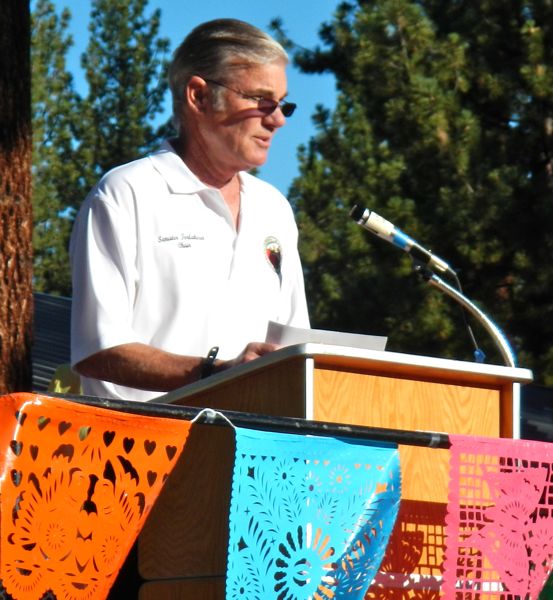
Superintendent of Public Instruction Tom Torlakson launches ISSI Aug. 6 at Lake Tahoe Community College. Photo/Kathryn Reed

“I feel this is a great institute. It is the gold standard of language learning,” Torlakson told the group of students ready to start their week of intensive learning.

He is a firm believer that the more people who know more than one language, the better off California’s economy will be because they will be able to communicate with the state’s diverse population as well as the world beyond.

Torlakson relayed how 38 percent of Californians identify themselves as Latino, one-quarter and soon to be one-third of the state’s students are English learners, and that one-quarter of the students in California grow up in poverty without health care.

All of those stats are why he believes an educated society is important.

He shared how one way the state is emphasizing the importance of being multilingual is by putting a bi-literacy seal on high school diplomas. This was the first year for the program, with 10,000 students receiving the designation.

While the LTCC program goes through Aug. 10, the California official was in town for two days.

On Monday after the opening of the Spanish immersion program, Torlakson received some language instruction, learned how to make tapas, went to Spanish through Storytelling and dropped in on a variety of other classes.

He had to be back in Sacramento today for budget issues and what he told Lake Tahoe News would be “three more intensive weeks.”

What brought him to South Lake Tahoe was the opportunity to see what the summer Spanish program is all about, how the 400-plus students get an education, and how the college has been able to sustain it for 19 years.

Maxine Alper and Sue O’Connor who run the program (O’Connor and Diane Rosner started it) said they have had to pay attention to every penny.

“We are being very frugal,” O’Connor told Lake Tahoe News. Staff cuts and cutting back on materials have been essential in this economy.

More changes are likely next year, with the potential of LTCC’s Connect Ed being a more integral component as the state keeps taking away dollars.

A pre-institute course was offered Aug. 5 through Connect Ed that Torlakson attended. Besides two hours of learning verbs, the group went to Taylor Creek to explore the natural environment of the South Shore.

The coordinators are taking feedback to heart by offering for the first time a three-day Spanish institute Oct. 5-7, which will be through Connect Ed.

ISSI offers 12 levels of instruction, which is why nearly one-third of the students are returnees. Plus, new break out sessions are added each year.

More information about ISSI may be found online.

Information about Connect Ed is also online.


Confiscated items from travelers go to highest bidder

By Ravali Reddy, Sacramento Bee

Have you ever wondered what happened to the items you have had to surrender at airport security over the years?

There’s a chance your confiscated belongings found a new owner Saturday at the state property auction in Natomas run by the California Department of General Services.

The auction featured hundreds of items that have been confiscated by the national Transportation Security Administration and the California Highway Patrol, along with surplus equipment from various state agencies. Items ranging from computers and cellphones to office furniture and jewelry were made available to the public.

“Most of the crowd consists of small businesses and resellers,” said Monica Hassan, a spokeswoman for General Services. “We’re expecting to see somewhere between 300 and 600 people come through the auction.”

Read the whole story


Learn about water’s role during the Comstock

Former backcountry ranger Cheryl Surface will lead a bus tour of the backcountry of Spooner with the topic being Water History of the Comstock.

Surface will tell stories about Red House, Hobart Reservoir, Marlette Lake, the Flume trail and the Marlette Water System.

Bring lunch, water, a light jacket and camera. Comfortable shoes are best because there will be limited walking.

The event is Aug. 11 from 9am-4pm. Adults only and space is limited to 12 people. Call (775) 749.5980 for reservations.


FCC chief witnesses Barton’s leap into telemedicine

By Rebecca Wass

Using a multi-disciplinary leadership group called the “Telehealth for Tahoe Task Force” to guide and advance its telehealth efforts, Barton Health hopes to export specialty services to distant medical facilities, and further expand access to additional specialties to improve healthcare for its patients.

To witness some of what the South Lake Tahoe medical facility is doing, Julius Genachowski, FCC chairman, took a tour of facility last week. Joining him was Wireline Competition Bureau Deputy Chief Carol Mattey.


Genachowski and his team observed best practices in telemedicine and how Barton has implemented and utilized funds from the Federal Communications Commission for the Rural Health Care Pilot Program through their telehealth program.

Genachowski participated in a mock consultation with a physician located at UC San Diego through a telehealth video monitor.

Barton has made significant progress in telemedicine, while providing patients access to specialties such as cardiology, endocrinology, infectious disease, dermatology, adult psychiatry and neurology at Barton Memorial Hospital, Barton Community Clinic, Barton Family Medicine, Internal Medicine, Urgent Care and Family Practice. By providing these specialties to patients via telehealth, the healthcare system has provided an average of 75 patients a month, cost and time-effective, alternatives to seeing physicians outside of the Basin.

“Through Barton’s telehealth equipment, and with its CTN connection, local patients can ‘visit specialists’ from their local doctor’s office, without the need for travel,” Greg Bergner, Barton board of directors member and Barton doctor, said. “Although not all health visits can be accomplished using telehealth, many can, and the time saved, along with the improved efficiency, and the cost savings is wonderful.”

Ann Truscott, telemedicine coordinator, said patients save them time and money by eliminating travel expenses to urban areas for care.

In August 2011, Barton was chosen as the lead agency partner for ACCEL and received three telemedicine carts, as well as a dual monitor computer to support its telehealth efforts.

The network is a separate, off-Internet, statewide broadband pipe dedicated to healthcare purposes. The CTN network is optimized to allow the upload of Blu-Ray quality video, with guaranteed transmission speeds not available on the commercial Internet. It also facilitates the back-and-forth communication and secure transfer of electronic medical records.

“I think these types of site visits are very important to better inform our Washington, D.C., polic makers how current federal funding is being utilized and provide them input on how federal resources can be improved,” Eric Brown, CEO of CTN, stated.

CTN is the product of an unprecedented statewide coalition of healthcare, technology, government, and other stakeholders which was funded by the FCC. Under the FCC’s rural pilot program – with the goal of significantly increasing access to acute-specialty-care, and even primary and preventive healthcare in rural America – the FCC provided nearly $22.1 million over three years. Additional funds for the CTN have been provided by the California Emerging Technology Fund, and UnitedHealth/PacifiCare. Barton Health is one of three ACCEL sites connected to the CTN.

“You are making a powerful contribution to harness the power of technology in providing healthcare,” Genachowski said.

Rebecca Wass is communications specialist for Barton Health.


Indian tribes leaning toward favoring Internet gaming

By Rob Hotakainen, McClatchy Newspapers

WASHINGTON — Fearing they may get left behind in the rush to expand legalized gambling to the Internet, more U.S. Indian tribes are lining up to back online poker and are angling for new ways to cash in.

Consider the Tulalip Tribes in Washington state: Eight months ago, tribal Secretary Glen Gobin told Congress the tribe opposed any kind of Internet gambling, regarding it as a threat to its two casinos. But on July 26, he told a Senate panel that tribes “must have equal footing to participate” and that Congress should consult with them before junking a 2006 ban on online gambling.

“Glen is a realist,” said W. Ron Allen, the chairman of the Washington Indian Gaming Association, which represents 27 federally recognized tribes.

John Pappas, the executive director of the Poker Players Alliance, a lobbying group that represents 1.2 million members across the country, said it was “definitely safe to say that the tribes’ position is evolving on a federal solution.”

Many tribes still oppose Internet gambling because they worry that gamblers would be less likely to go to casinos. But Allen predicted that there’ll be “less reluctant resistance” as tribes realize that there’s little hope of stopping the push for legalization in Congress.

“Inevitably, they’re going to pass something,” he said. “I think tribes as a general observation would prefer that it not happen, but tribal leaders are being realistic.”

With online gambling expected to quickly become a new cash bonanza, a feud has developed on Capitol Hill over who should regulate it. Two competing plans have emerged so far.

Read the whole story


Precautions while RV’ing can help ensure safe experience

While cooking in your camper or RV, open a window or two for ventilation.

This is important due to the fact that cooking in a confined space can deplete your oxygen supply. Remember, the air we cook with is also the air we breathe.

Another precaution to take while camping is to periodically check your propane appliances, hoses, and fittings for leaks. Statistics show that a leak in one of these areas is a primary cause of fire.

On behalf of the South Lake Tahoe Fire Department, have a safe and fun camping season.

— Sallie Ross-Filgo, South Lake Tahoe Fire Department


Legislation would make Olympic medals tax-exempt for U.S. athletes

By Ed O’Keefe, Washington Post

Did you know that U.S. athletes owe taxes any time they win a medal? Republican lawmakers — clearly seizing on Olympic fever and general displeasure with the tax code — want to change that.

After winning gold in London, an Olympic athlete also stands to earn a $25,000 honorarium. Silver medalists receive $15,000 and bronze medalists are slated to leave London with a $10,000 payday. Current U.S. tax law requires athletes to add the value of medals and honorariums to their taxable income — just as any winning game show contestant would have to pay taxes on a new car or toaster oven.

But Sen. Marco Rubio, R-Fla., and Rep. Blake Farenthold, R-Texas, introduced legislation Wednesday that would exempt American medal-winning gymnasts, rhythmic gymnasts, swimmers, divers, synchronized divers, runners, cyclists or water polo players from paying taxes on their Olympic winnings.

Read the whole story


Wildland fire burning near Sly Park

A fire near Sly Park off Highway 50 in El Dorado County had consumed about 35 acres as of Monday morning.

The Hazel Fired started the afternoon of Aug. 5, though no cause has been given.

The fire is burning dry timber and brush southeast of Jenkinson Reservoir.

The fire was estimated to be 60 percent contained.

Smoke is likely to be affecting people living and re-creating in the area.

No structures are threatened.

 — Lake Tahoe News staff report


Brown wants to use ‘found’ California parks money to encourage donations

By Kevin Yamamura and Matt Weiser, Sacramento Bee

Gov. Jerry Brown asked lawmakers Friday to spend $20 million in newfound parks money on repairs and a matching fund to solicit future donations rather than return money to donors who gave when they believed the system was broke.

The governor’s announcement came as his Department of Finance determined that none of California’s other 560-plus special funds contain hidden assets akin to what the state parks department tucked away, based on an audit compiled in the past two weeks.

The department, however, found multiple cases totaling $268.5 million in which departments made accounting errors showing either more or less money than the Finance Department knew about in 2011. The biggest error – a $113.3 million mistake in the state Beverage Container Recycling Fund – was corrected before lawmakers and Brown crafted the budget they enacted in June.

Department of Finance Director Ana Matosantos said those gaps were honest mistakes, in contrast to state Department of Parks and Recreation officials “deliberately” hiding assets for years.

“There are accounting differences …,” Matosantos said, “but there are not other hidden asset-type circumstances in other departments.”

Read the whole story


Presidential election comes down to 10 states — including Nevada

By Ken Rudin, NPR

In 92 days, we will either re-elect President Obama or replace him with his Republican opponent, Mitt Romney. On paper, at least, voters in all 50 states and the District of Columbia will make that decision.

But if you look at the travel schedules and campaign budgets of Obama and Romney, it’s clear that the 2012 election will be decided in only ten or fewer states.

I’m not arguing for eliminating the electoral college and calling for the president to be elected by popular vote. But until that happens, and as long as states are considered solidly Democratic (such as California and New York) or solidly Republican (such as Texas), the presidential election is going to be decided by a small number of battleground states where the votes are truly up for grabs.

Obama’s 2008 victory was made possible by his picking up a bunch of states that hadn’t gone Democratic in years (and in some cases, decades) or states that narrowly went to George W. Bush in 2000 and/or 2004: Virginia, North Carolina, Indiana, Ohio, Florida, Colorado, Nevada, Iowa and New Mexico. All nine went for Bush in 2004. Virginia and Indiana hadn’t voted for a Democrat since Lyndon Johnson in 1964. For North Carolina, it was Jimmy Carter in 1976.

Read the whole story