Some schools believe the answer is more time in the classroom

By Motoko Rich, New York Times

PHOENIX — It was the last Sunday in July, and Bethany and Garvin Phillips were pulling price tags off brand-new backpacks and stuffing them with binders and pencils.

Griffith is one of five schools in Phoenix’s Balsz Elementary School District.

While other children around the country readied for beach vacations or the last weeks of summer camp, Bethany, 11, and Garvin, 9, were preparing for the first day of the new school year at Griffith Elementary, just six weeks after the start of their summer vacation.

Griffith, one of five schools in the Balsz Elementary School District here, is one of a handful of public schools across the country that has lengthened the school year in an effort to increase learning time.

A typical public school calendar is 180 days, but the Balsz district, where 90 percent of the students qualify for free or reduced lunch, is in session for 200 days, adding about a month to the academic year.

According to the National Center on Time and Learning, a nonprofit research group in Boston, about 170 schools — more than 140 of them charter schools — across the country have extended their calendars in recent years to 190 days or longer.

Neither Bethany, who plans to run for student council president, nor Garvin, who was excited about his fourth-grade teacher, seemed bothered by the change. “The kids’ education is more important than all of these breaks that we have,” said their mother, Debra Phillips.

A growing group of education advocates is agitating for more time in schools, arguing that low-income children in particular need more time to catch up as schools face increasing pressure to improve student test scores.

Read the whole story


Nevada awarded money to implement Common Core Standards

By Sean Whaley, Nevada News Bureau

CARSON CITY – Nevada has been selected by the National Governors Association to receive a $65,000 grant and additional technical assistance to implement Common Core State Standards at the postsecondary education level.

Nevada, Maryland and Missouri were selected to receive the support from NGA staff, the National Association of System Heads and the U.S. Education Delivery Institute as well as other national experts.

The Common Core State Standards Initiative is a state-led effort coordinated by the NGA Center and the Council of Chief State School Officers. Governors and state commissioners of education from 48 states, two territories, and the District of Columbia developed a common core of state standards in English language arts and mathematics for grades K-12.

The standards seek to define the knowledge and skills that students should have to succeed in entry-level, credit-bearing, academic courses and in workforce training programs. They are internationally benchmarked to ensure that all of America’s students are prepared to succeed in a global society.

To date, 45 states, three territories and the District of Columbia have adopted the standards.

The Common Core State Standards Postsecondary Collaborative is designed to accomplish four main objectives to support successful postsecondary implementation of the CCSS: Identify necessary policy actions, develop a communications and engagement plan, engage multiple stakeholders and foster alignment and collaboration across education systems.

“Nevada has already developed a framework for CCSS implementation that recognized the importance of postsecondary involvement,” said Gov. Brian Sandoval. “Although Nevada’s higher education system is well positioned and willing to fully support CCCS implementation, the collaborative will help the state develop a comprehensive engagement plan.”

Funding for the collaborative is provided by the William and Flora Hewlett and Lumina foundations.


2-day festival all about dogs at Squaw

The Village at Squaw Valley is paying tribute to man and woman’s best friend with the 3nd annual Peaks and Paws Festival on Aug. 25-26.

Dogs and their people can enjoy 16 wineries, beer, 12 hours of continuous live bluegrass, pet themed art, and activities and outings specially designed for furry friends.

All of the proceeds from the festival will benefit the Humane Society of Truckee-Tahoe.

Headlining at Peaks and Paws are the Dead Winter Carpenters, a high-energy, Americana/roots-infused five-piece band from North Lake Tahoe, and the Emmitt-Nershi Band, whose co-founders cut their teeth with Leftover Salmon and the String Cheese Incident respectively. The festival lineup also includes a host of other acts including The Iguanas, David Jacobs Strain, Head for the Hills, Tony Furtado and Bison.

The Peaks and Paws Festival is 11am-6pm each day.

The wine tasting costs $25 per day.

Go online for a full list of activities, times and fees.


South Tahoe going to the dogs for a day

Dawgs on the Run is a canine carnival that will take place Sept. 15 from 10am-4pm on Ski Run Boulevard in South Lake Tahoe.

Activities for dogs, their people and kids are planned.

More information about the various activities and contests is online.

All proceeds will go to local pet nonprofit organizations.


Unique dime minted in Carson City sells for $1.84 mil.

By Jessica Parks, Philadelphia Inquirer

A one-of-a-kind, pristine-condition 1873 dime fetched $1.84 million in an auction Thursday night at the American Numismatic Association convention.

“It’s not rare, it’s not scarce – it’s unique. And it’s pretty much immaculate,” said Brian Kendrella, director of operations at the Spectrum Group. He entered the winning bid on behalf of a private collector who sought to remain anonymous.

Before the live auction began, online bids had already reached $950,000. The price went up in seconds, with bidders in the room, on the phone, and online answering the auctioneer’s calls – $1 million, $1.1 million, $1.2 million, $1.3 million, $1.4 million, $1.5 million. The winning bid was $1.6 million, plus a 15 percent buyer’s fee.

The coin is the sole survivor of a one-day run of dimes from Carson City, a sparsely populated frontier town whose mints are now highly valued for their rarity and historical significance.

The 1873-CC No Arrows Liberty Seated dime was the keystone coin in the Battle Born Collection, which contained one of every coin minted in Carson City before the facility closed in 1893. All 111 pieces were parceled off Thursday night, fetching a total of $9.98 million.


Barton remodels patient rooms

Patients at Barton Memorial Hospital are staying in renovated and remodeled private and shared rooms.

Barton’s goal is to provide all private rooms, but some are designed to accommodate two patients to meet an increase in patient admission on any given day. Located on the second floor of med-surge and orthopedics, each room provides private hotel-like accommodations.

Barton Hospital's rooms have been remodeled. Photo/Provided

The rooms gleam with warm paint colors, flat screen televisions, beds, curtains, chairs, cabinetry, flooring and Lake Tahoe artwork. Each room also has a newly remodeled bathroom all completed with patient comfort in mind.


Opinion: Why does anyone need 100 rounds of ammo?

Publisher’s note: This editorial is from the Aug. 5, 2012, Sacramento Bee.

We ought to be able to agree that no citizen has any need for 100-round magazines of the type that police say James E. Holmes used on the night of the movie theater massacre in Aurora, Colo.

But we can’t.

Holmes’ arsenal included a 100-round dual drum, a device that looks a little like mouse ears and affixes to an AR-15 semi-automatic assault rifle of the type Holmes had purchased. An Internet retailer currently offers a deal, selling them for $139, a $20 discount.

In the wake of the shooting that left 12 dead and 58 people wounded, Democrats are renewing calls for a federal assault weapons ban, and limits on the capacity of magazines.

Operating on the theory that elections have consequences, The Bee surveyed most candidates and incumbents seeking Sacramento Valley congressional seats, and asked two questions: Do they support reinstating the assault weapons ban, and would they vote to prohibit the sale of 100-round drums?

The answers generally fell along party lines. Some candidates offered equivocal answers. Rep. Tom McClintock, R-Elk Grove, failed to respond to calls and emails placed over a one-week period.

Rep. Dan Lungren, R-Gold River, and Ami Bera, a Democratic physician from Elk Grove, are in a tight campaign for the 7th Congressional District, which includes Elk Grove and much of eastern Sacramento County.

“Dr. Bera supports the assault weapons ban and especially in light of the recent tragedy in Aurora,” his campaign spokesman Josh Wolf said. Wolf said Bera also would vote to ban 100-round magazines.

Lungren offers a nuanced view of gun law compared with other Republicans in the area, and has broken with the National Rifle Association in notable areas.

“If you need 100-round clips, there are lots of things I would call you, but ‘sportsman’ or ‘hunter’ is not one of them.” Lungren said in an interview. “What do you need 100 rounds for?”

He didn’t say if he would vote for a federal assault weapons ban, but noted that there is no appetite for gun control legislation in Washington. As California attorney general in the 1990s, he was responsible for enforcing the state’s assault weapons law, which caused a rift with pro-gun organizations.

“California has decided what we’re doing. That’s it,” Lungren said. “We should enforce the laws we have.”

Rep. John Garamendi, D-Walnut Grove, faces Colusa County Supervisor Kim Vann, a Republican, in the 3rd Congressional District, which includes Yolo, Glenn, Colusa and Yuba counties.

Vann’s campaign manager, Rob Stutzman, said Vann supports California’s law, including the assault weapons ban, but would oppose federal weapons legislation.

“She supports state regulation of firearms, not federal. She has a federalist view of state rights,” Stutzman said.

Garamendi voted for California’s first assault weapons ban when he was a state senator. He had represented Stockton in 1989 when a gunman using an assault weapon opened fire at an elementary school, killing five children.

“My support for such bans continues to this day,” Garamendi said in a statement.

Garamendi, like Rep. Doris Matsui, D-Sacramento, is among 113 co-sponsors of House legislation that seeks to ban magazines of more than 10 rounds.

Sen. Doug LaMalfa, R-Richvale, is running in the 1st Congressional District, which stretches from Auburn and Gridley to the Oregon border. He opposes laws that would ban assault weapons and continued sale of 100-round drums, his campaign manager, Dave Gilliard, said.

LaMalfa’s Democratic opponent, Jim Reed, a Redding attorney, opposes an assault weapons ban, but said he would support a ban on 100-round magazines.

McClintock is running in the 4th Congressional District, which includes Lincoln and Lake Tahoe, and runs south past Yosemite National Park. Although he did not respond to calls or emails, McClintock long has been a pro-gun vote.

Read the whole story



Douglas County forming youth flag football teams

The Douglas County Parks and Recreation Department will be accepting registration for the NFL Youth Flag Football League until team rosters are full.

NFL Flag Football teaches boys and girls the fundamentals of football, sportsmanship, and teamwork in a fun, less-competitive, non-contact way.

Players receive a reversible NFL Flag jersey, mouthpiece, and individual award.

All games will be played on Saturdays at Stodick Park. Participants will be divided into four age groups, 5-6 coed, 7-8 coed, 9-11 coed, and 12-14 coed. Players must be at least 6 and not 15 by Sept. 1. Coaches will randomly choose teams through a draft system.

Season starts with the new player skills training in September. Parent volunteer coaches are the backbone of the league. Forty coaches are needed for a successful season.

For more information, email Anthony Davis at adavis@co.douglas.nv.us or call Douglas County Parks & Recreation at (775) 782.9828.


High-tech sandbox teaches all ages about Lake Tahoe

By Katherine E. Hill

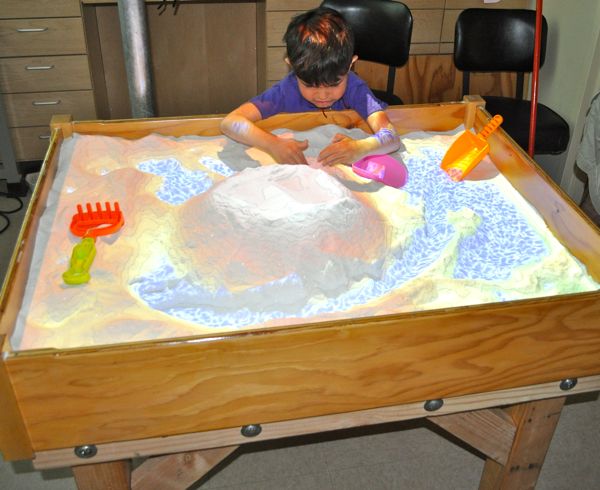
INCLINE VILLAGE — What do you get when you mix a sandbox, 3D imaging and a Wii Kinect? A cutting-edge exhibit designed to teach kids, and adults, about hydrology and topography.

The Augmented Reality Sandbox uses 3D technology to teach kids of all ages about science, and in this case, the movement of water as the landscape changes that will be part of the exhibits at the Thomas J. Long Foundation Environmental Research Center in Incline Village. The sandbox will be added to the center by next summer, but a prototype is likely to be on site during the Children’s Environmental Science Day on Aug. 11.

A sandbox of information for children to play in on Aug. 11 in Incline Village. Photo/TERC

Imagine that you build mountains and rivers in a sandbox with a Wii Kinect mounted above the box projecting topographic features onto the sand in real time. You dig a large lake in the box, and the computer puts an image of a lake in the sand. And, when you’ve built mountains, meadows and streams, you can make it rain (virtually, of course) and see how water flows.

Playing in the sand will never look the same again.

The sandbox is one of several projects that the Tahoe Environmental Research Center is developing to add to its education component – an app is in the works, as well as several other exhibits using augmented reality technologies.

Augmented reality is a live view of a physical, real-world environment (such as an image viewed through a cell phone or other device) that is augmented by audio, video, graphics or GPS data.

“It’s exciting that Tahoe is one of the places that will get these exhibits right off the bat,” Heather Segale, TERC education and outreach director, told Lake Tahoe News.

The app, which uses a location-based augmented reality, uses GPS coordinates to display points on interest based on the user’s location. Sitting in Segale’s office on the campus of Sierra Nevada College, she demonstrated a prototype of the app using her phone. She pointed the phone at the lake (through a wall for this demo) and the app located Lake Tahoe, based on GPS coordinates, and then offered points of interest from environmental improvement projects around the lake to the Tahoe City Marina to earthquake faults to local beaches. TERC envisions a component that could be used by visitors, or for learning about wetlands and topography, to sailors being able to access weather conditions on different parts of the lake. TERC is still working on a way for the app to designate elevation differences.

TERC also is looking to incorporate what it calls tabletop prototypes into the Incline Village center. The tabletop prototypes are activity-based exhibits in areas from the movement of water to stewardship of fresh water lakes like Lake Tahoe and ecology, among others.

The projects are being funded through a National Science Foundation grant and is a joint venture with the Lawrence Hall of Science for the tabletop exhibits and the U.C. Davis KeckCAVES for the 3D visualizations. When complete, the technologies also will be made available to other education centers.

—-

Children’s Environmental Science Day

Children are invited to spend the day with scientists, and see the Augmented Reality Sandbox up close, on Aug. 11 from 1 to 4pm learning about the ecology, function, restoration and preservation of Lake Tahoe. And, free ice cream will be provided from 2 to 4pm.

The 13th annual Children’s Environmental Science Day is a free event sponsored by TERC with more than 40 interactive science activities for children ages 6 and older. The day will include interactive science demonstrations by UC Davis scientists, local agency and nonprofit organization staff, and AmeriCorps members. Hands-on activities are designed for the whole family.

About the center

The Thomas J. Long Foundation Education Center is a resource for children and anyone interested in learning more about Lake Tahoe.

The center features three unique stations offering different perspectives on the lake. The first is the Virtual Research Vessel with a two-thirds model of the research vessel John LeConte, which features some of the research tools including a Secchi disc, a net used to collect Zooplankton and a Van Dorn sampler used to captured water from 1,600 feet.

The second station is a Virtual Laboratory with informative videos and beakers with Mysis shrimp, an invasive species, Zooplankton and other experiments.

The 3-D Visualization Lab, the third station, offers three 3-D movies including the Global Earthquake View, “Lake Tahoe in Depth,” which lets viewers dive under the surface of Lake Tahoe to see fault lines, the footprint of glaciers and underwater landslides, and the newest film, “Mapping Change,” on the changing face of our forests.


Snippets about Lake Tahoe

• Beachtree Properties, a collection of 11 boutique hotels across the country, is launching a pilot program to provide complimentary use of customized iPads. Initially, Beachtree will offer iPads in South Lake Tahoe at Secrets Inn and Heavenly Inn, and in Maryland at Inn at Deep Creek.

• The North Lake Tahoe Chamber/CVB/Resort Association is undergoing a membership renaissance – adding new services and programs directly related to helping local businesses and increasing their bottom line. One of the most visible changes is the addition of the North Lake Tahoe Business Directory to the website.

• On Aug. 24 from 6:30-10pm is a Parents-Kids Night Out at the South Lake Tahoe Rec Center. Cost is $25 and includes pizza, swimming, games, and a movie (G or PG). Call (530) 542.6056 to register.

• El Dorado County Sheriff John D’Agostini talks about the accident on the Rubicon Trail in this video.

• U.S. Department of Labor reports the travel industry is growing faster than the overall American economy.