Ropes course tests physical, mental strength
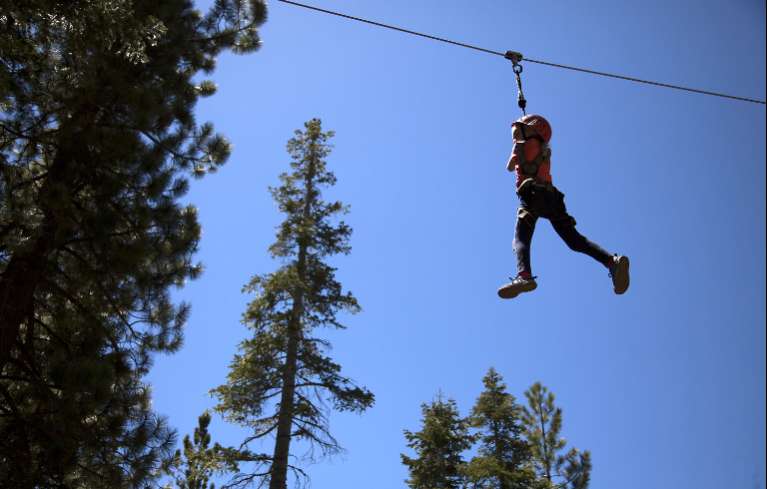
Gabriella Thompson, 6, flies through the air at the ropes course in Tahoe City. http://northtahoeadventures.com/

Gabriella Thompson, 6, flies through the air at the ropes course in Tahoe City. Photo Copyright 2014 Carolyn E. Wright

By Kathryn Reed

TAHOE CITY – A cable to walk on that is no bigger around than the diameter of an average finger, balance beams swinging a hundred feet off the ground, bridges swaying even without the wind, ropes that turn climbers into spiderpeople. These are just a few of the contraptions of the ropes course at Granlibakken.

“I’m like Indiana Jones,” 8-year-old Jace Smith of Vancouver, Wash., says as he scampers along a bridge. His parents are below with cameras and words of encouragement.

His friend, Gabriella Thompson, 6, of Corpus Christi, Texas, is all smiles as she whirs through the air on a zipline.

They are on the Flying Squirrel course, which is designed for kids as young as 5. Apparatuses are closer to the ground and the safety equipment is different than what it is used on the adult course. But big kids can go on this one, too.

Bridges is a loosely used word by designers. It’s really some contraption to get from Point A to Point B. And never is it a solid bridge in the traditional sense, where one feels secure and doesn’t think twice about crossing it.

These bridges are tricky. They all move. Sometimes the only thing to hang onto is your harness. Steps can be at angles or much farther apart than is comfortable. Ropes to grasp sometimes feel out of reach.

One “bridge” is really a snowboard suspended in air that requires hanging on like you’re water skiing.

And the ground, well, it’s always quite a ways down.

Some of the courses have ziplines going from one platform to another. These are brief opportunities to catch your breath, or take a look around at the incredible scenery. But that’s assuming ziplines don’t take your breath away.

All the stations are tucked into the woods.

The whole thing is like an adult jungle gym.

These ropes courses are not for people who like staying in control and in their comfort zone.

Ricki and Mark Viray came over from Marysville for the day to test their agility in the Monkey zone. There are five options – one beginner, three intermediate and one advanced. It’s possible to do all five in the time allotted.

Even though Mark Viray has a desk job, it’s in the military, so he has more practice doing things like this. His wife shows off her balancing skills by not holding onto ropes or her harness as she cautiously puts one foot in front of the other.

Carolyn Wright of Zephyr Cove is thanking her Pilate’s instructor for building up her core muscles.

Balance and a bit of upper body strength, along with the mindset that fear of heights is not going to cause paralysis, are helpful.

“Fear of heights is such a common fear. I don’t think you overcome it, but you learn to manage that fear,” Jesse Dessens, president and CEO of North Tahoe Adventures, told Lake Tahoe News.

Besides friends and couples who want to challenge themselves, the courses are often used by families and as team building excursions by companies.

Twenty people can go in a group, with groups starting every hour.

This will be the third summer North Tahoe Adventures has operated the ropes courses at the Tahoe City resort. Their Squaw Valley operation has existed for 16 years.

Notes:

• North Tahoe Adventures runs the ropes course at Granlibakken. More info is online.

• Phone – 530.581.7563

• Cost — $50 for 13 and older; $40 ages 5-12. Sessions are 2½ hours.

• Maximum weight – 260 pounds.

• Open year-round.

ngg_shortcode_0_placeholder (Click on photos to enlarge.)


Letter: Don’t P on Tahoe

To the community,

The other day I saw a bumper sticker against paid parking in South Lake Tahoe on a nice car with a Nevada license plate. While the driver of that vehicle understandably would like to revert to the days of getting his front row beach access for free, eliminating the kiosks at Lakeview Commons and other locations simply means that South Lake Tahoe taxpayers will pick up the tab instead.

According to the city’s website, revenues gathered from the parking kiosks (approximately $250,000 per year) is dedicated to maintaining and improving the facilities where the kiosks are located, such as the boat ramps and restrooms at Lakeview Commons/El Dorado Beach. Without these dedicated funds, the city will either have to neglect maintenance — which would be unacceptable in this popular, highly trafficked destination — or use general fund revenue, aka local taxes, to pay for it.

Unlike the Lake Tahoe Airport, where city taxpayers subsidize high-rolling Nevada-bound golfers and gamblers, the paid parking program brings revenue to the city from those using city services, who paid on average $3.20 per visit last year. This is hardly an unreasonable price.

As a resident of El Dorado County, it’s in my selfish interest to get “free” parking, thank you very much city taxpayers. But as a resident of the South Shore community, I’m more than happy to make a small contribution for the privilege of parking right next to a great new gathering area on the lake that took tens of millions in public investment to create. If this were a private vendor trying to get a decent return on investment, rest assured the rates would be much higher.

Think of the community and the lake first when voting on the parking measure. Let’s not “P” on Tahoe – vote no on P.

John Friedrich, Meyers


2 nights of pops concerts at STHS

South Tahoe High School pops concerts are June 2 and June 4 at 7pm in the TADA Theater.

On Monday night, the Vocal Pops Concert with the Glee Club and Chorale will perform their favorite songs from famous blockbuster movies.

The Band & Orchestra Pops Concert will be Wednesday night with special “Dream” songs to be performed.

The first STHS commissioned piece, “The Lake in the Sky,” written by Alan Lee Silva will be performed. Silva is a composer, arranger, and orchestrator whose credits include scores for the independent feature films “Full Moon Fables” and “Eli’s Coming”; orchestrations and arrangements for feature films “Cinderella 3”, “Enough”, and “Lethal Weapon 4” and more.

Other original pieces written by the STHS class of 2014 graduating seniors will be performed. These pieces include “What Stalks at Midnight” written by Joseph Robles and “Midnight Dream” written by Bryan Arreola and Sara Ortega.

Tickets will be available at the door for $5.

For further information, contact Casson Scowcroft at 530.541.4111.


Ropes course at Granlibakken

Flying through the air is just part of the fun at the North Tahoe Adventures rope course based at Granlibakken resort in Tahoe City.


USFS work on Upper Truckee River resuming

Work on restoring the Upper Truckee River will resume June 2. The U.S. Forest Service and California Tahoe Conservancy are working on what’s called Reach 5.

The first stage involves the reinstallation of a temporary bridge. During bridge installation and once the temporary bridge is in place, passage underneath the bridge will not be possible. Boaters will need to remove their vessels from the river and carry them around the bridge, which is located approximately 5,000 feet downstream from the Highway 50 crossing at Elk’s Club.

The next step will be the construction of a temporary access road and the installation of construction and boundary fencing. Then construction of the new channel begins.

Approximately 7,400 feet of new channel will be built in two phases, over four years that began in 2013.

The project will replace the existing stream channel with a new channel that is designed to be more stable. It is connected to the adjacent floodplain, which is expected to provide a better aquatic habitat, support a healthier meadow ecosystem, and reduce the amount of fine sediment that reaches Lake Tahoe.

For safety reasons, the area will be closed from June 15-Oct. 15. The closure area and more info is online.


Barton keeping focus on pain management

By Warren Withers

Death by drug overdose has tripled from 1990 to 2008. In 2008, according to the Center for Disease Control and Prevention, 36,450 people died from a drug overdose and 75 percent of overdoses were prescription drug related.

Of the prescription drug-related deaths in 2008, the CDC reports 74 percent were opiate prescription drugs.

Opiate pain medications are prevalent and frequently prescribed. They are sold under many names: Vicodin, Norco, and Lortab are brand names for pills that contain hydrocodone, and Percocet and Oxycontin are brands containing oxycodone.

Other common opiate pain medications include morphine, methadone, and Dilaudid.

Between 1999 to 2010, the CDC claims that the quantity of opiate pain medication prescribed in the United States increased fourfold.

The origin of the increase of opiate pain medication prescribing goes back to the 1990s when pain management was considered not aggressive enough. The medical community, along with encouragement from the pharmaceutical industry, recognized this as an issue that needed to be corrected. Consequently, with the rise in availability of prescription opiate pain medications in the last twenty years, data shows that addiction, overdoses, and death related to prescription opiate pain medicine has increased.

Against this backdrop, the physicians and staff in the Barton Memorial Hospital emergency department acknowledge the strengths and limitations of opiate pain medications. We have comprehensive knowledge and experience with current opiate medications as a pain relieving strategy. Opiates can be quite potent and effective in certain settings. However, as their use broadens, we have seen diminishing returns and a cost, a cost paid in lives.

With this in mind, the Barton emergency team wants to bring a new perspective to the prescribing of opiates. While we strive to alleviate pain, it is our primary obligation to do no harm. We have committed to the following steps toward reducing opiate abuse in our community.

  • We will work closely with community physicians to coordinate care of patients with chronic pain.
  • We will identify people with chronic pain and direct them to primary care and/or chronic pain specialists.
  • We will identify high risk behavior and use that information in our prescribing practice.
  • We will do all for the health and safety of our community.
  • We believe one day opiates in the management of chronic pain will become far less common. There will be newer, safer, and more effective medications and therapies to relieve chronic pain. This is not wishful thinking, but is the history of modern medicine. We look back, a decade or two, and see medications and therapies that were standard accepted practice, but now appear old-fashioned or even dangerous.

One day, this will be the history of opiates. For now, we will do our best to consider the safety and well-being of our patients and our community as our highest goal.

Warren Withers is the medical director for emergency medical services at Barton Health.


School districts push back on federal lunch menu

By Tom Hamburger, Washington Post

In Georgia, kids resisted the loss of their beloved fried chicken. In New Mexico, whole-wheat tortillas went straight to the trash can. And in Tennessee, after schools replaced familiar flaky white biscuits with a whole-grain variety, one official reported a “severe amount of rejection.”

What began as an effort led by first lady Michelle Obama to serve more-healthful food to American schoolchildren has turned into a clash of cultures across the country — and, now, a high-profile Washington lobbying battle.

At stake in the argument over lunch menus, beyond the natural tension between nutrition and children’s taste buds, are the profits of several large food companies that sell frozen pizzas, french fries and other prepared foods to schools.

The dispute provides a fresh illustration of the ways special interests can assert power in Washington. In this case, food companies forged an alliance with a key lobbying group, the School Nutrition Association, and pushed it to shift its position from publicly supporting the Obama-backed standards to pressing Congress for relief.

On Thursday, a House committee voted for a Republican-backed measure that would allow school districts to temporarily opt out of the nutrition standards, which were passed in 2010 with the support of the White House and set mandates to reduce sodium and increase whole grains and servings of fresh fruits and vegetables.

The party-line vote served as a rebuke of sorts to the first lady, who has made curbing childhood obesity a priority and delivered a series of public pronouncements in recent days decrying the opt-out proposal as a full embrace of junk food.

The measure is expected to be considered later this summer when House and Senate members meet to negotiate spending bills.

Read the whole story


Divide exists over involuntary mental health treatment

By Kirk Siegler, NPR

The attacks near UC Santa Barbara are renewing focus on programs aimed at requiring treatment for people who are mentally ill as a way to prevent mass shootings and other violence.

In California, a 2002 law allows authorities to require outpatient mental health care for people who have been refusing it. Proponents argue that this kind of intervention could prevent violent acts.

But counties within the state have been slow to adopt the legislation and mental health professionals are divided over its effects.

The story behind Laura’s Law begins in 2001. In rural Nevada County 19-year-old Laura Wilcox was shot and killed by a 41-year-old man with a history of mental illness. He had walked into the county’s behavioral health center and opened fire.

Tom Anderson was the county’s chief public defender at the time and represented the gunman in court. He recalls that the man’s family had tried to alert mental health officials numerous times before the shooting.

“[Officials] were declaiming privacy issues and stuff and wouldn’t communicate with the family,” Anderson says. “He … started amassing guns and setting up booby traps around his house and he had this psychosis of he was going to be attacked any minute.”

Now Nevada County’s presiding judge, Anderson is also a vocal advocate for Laura’s Law, which was passed by the state legislature in 2002. The law allows counties to compel outpatient treatment for people whose family or friends are concerned about their mental state. It’s seen as an intermediate step before someone is forced into inpatient psychiatric care.

Read the whole story


Mountain festival returns to North Shore

The second summer Alpenglow Mountain Festival is June 21-29 on the North Shore.

The festival is a celebration of human-powered events, demos, presentations, film and more. Participants may hike, trail run, and enjoy natural history excursions and lake shore yoga.

Alpenglow Mountain Festival is geared toward beginner and intermediate summer recreation enthusiasts,

offering a range of activities for all interests and ability levels. The majority of events are free and space is limited. Participants are encouraged to register online in advance.


Disabled access available at Vikingsholm

Usually the only way to get down to Emerald Bay and tour the castle is either by hiking or boating in.

California Parks is offering an ADA Vikingsholm Escort program. Reservations must be booked at least 24 hours in advance by calling 530.525.9529. It is a first come, first serve program with a maximum of two guest cars. One person in the car must have a disability placard.

It costs $10.

The escort down is at 1pm, returns at 3pm. Guests follow the volunteer escort in their own car.

The schedule, so far, is June: most Tuesdays, Thursdays and Saturdays; July: most Tuesdays, Wednesdays, Thursdays and Saturdays; August: most Mondays, Tuesdays, Wednesdays, Thursdays and Saturdays.