Campbell reinventing soups to attract younger consumer

By David Welch, Bloomberg

Campbell Soup’s iconic red-and-white cans dominate nearly half the domestic market. That’s a problem.

For the last several years, U.S. soup sales have been sliding. As a percentage of all frozen, canned and perishable food sales, the staple has shrunk by one-ninth since 2007, from 3.6 percent to 3.2 percent.

While Campbell sells V8 vegetable juice, Prego pasta sauce and a bevy of Pepperidge Farm snacks, soup remains its most important product line. Last year its U.S. Simple Meals unit, which relies heavily on soup products, accounted for 48 percent of its $7.7 billion in sales and 64 percent of its $1.3 billion in operating income. Those sales figures have fallen every year since 2007, and Campbell’s North American soup business has lost market share since 2008.

Company executives cite a generational shift in tastes. Campbell’s research shows that young consumers ages 18 to 29 are 15 percent less likely than the average consumer, and far less likely than middle-aged boomers, to buy soup. They eat out twice as often as their grandparents, and when they cook, they value easy preparation and fresher, more exotic ingredients over canned staples.

“They’re more experimental,” says Charles Vila, Campbell’s vice president for consumer insights, who began inviting young consumers into the company’s test kitchens last year to analyze their preferences. “They love to sample.”

Vila’s research squared with Trouble in Aisle 5, a recent study of young consumers’ shopping habits by the research firm Jefferies and the consulting firm Alix Partners. The ideal product, the study concludes, would be both high-end and simple.

Campbell’s answer: Go! Soup, a ready-to-eat meals line coming this month in varieties that include chorizo, pulled chicken with black beans, and golden lentils with Madras curry. To provide fresher ingredients and speed preparation time, the new soup line eschews the traditional cans in favor of plastic pouches in colors such as fuchsia. Campbell is using similar pouches in its skillet sauces, another new line that includes flavors such as creamy chipotle.

The company will charge $2.99 per pouch, or about three times the price of a can of one of its traditional soups. The question is whether a population grappling with higher-than-average unemployment will spend that kind of money for food in a pouch, says Ken Harris, a consultant who has worked for Campbell.

“If they sold it for 99 cents, they would have a runaway success,” Harris says. “But for that buyer group, paying extra for an accompaniment to a meal may be a stretch.”

ConAgra Foods sells its Healthy Choice entrees for less than $2.40 each, and Amy’s Kitchen of Petaluma, a privately held maker of organic soup, sells its offerings for less than $2.30 a can.

Still, this wouldn’t be Campbell’s first success with soups at a higher price point. Its line of Slow Kettle Style soups sells well for $3.99 a cup. Those recipes, which include burgundy beef stew, target an older audience.

Darren Serrao, vice president for innovation for Campbell’s North American business, says Go! Soup can bridge the generation gap. Just as Starbucks has persuaded consumers to pay a premium for once-plebeian coffee, he says, “consumers are savvy enough to understand the value proposition.”


Rookie gets a lesson at the shooting range

TAHOMA — Master the trigger pull and the bullet will pierce whatever I want it to.

That’s essentially what Sonny Piazza told me as he gave me a lesson in firearms Aug. 14. Piazza is one of two range instructors certifying El Dorado County sheriff’s deputies. I have a long ways to go before that happens.

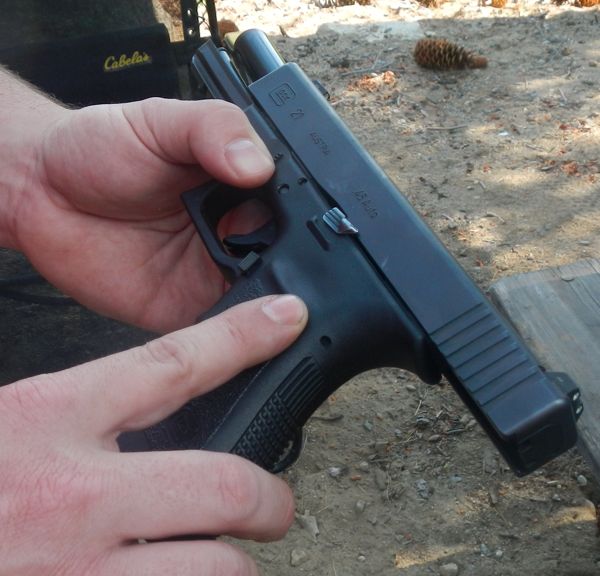
Glocks are the most popular gun in law enforcement. Photos/Kathryn Reed

I shot a Glock 27 .40-caliber, a little smaller gun than what is pictured here. It fit my hand better. It fit and felt better than I expected.

I had shot a gun once before — probably 15 years ago. Adrenaline kicks in when that trigger is pulled. It takes practice to not let the recoil pull the gun up and for my left hand to stay on the gun.

Kathryn Reed's target from 4 yards out.

Piazza is patient. He talks about treating any firearm as though it is loaded. He is quick to make sure my index finger comes off the trigger as soon as I shoot.

Don’t ever point at something unless I intend to shoot it, he tells me.

I stand straight at the target so if the bad guy were to shoot, he gets my whole vest and not under arm that isn’t protected.

From 7 yards out I hit the “head”, knock over the bowling pin and splinter the clay; from 4 yards the “body” has holes that would have sent that bad guy to the coroner’s office.

— Kathryn Reed


What recreation project(s) should Tahoe embrace to stimulate the economy?


Mammogram van to roll through Stateline

The Mammovan will be making its way into Harrah’s Lake Tahoe on Aug. 21 from 7:45am–3:15pm.

The Mammovan will be offering mammograms to insured and uninsured women in the community. Uninsured women must bring proof of income, proof of address, and proof of dependents.

To schedule an appointment, call 877.581.6266.


Opinion: Guns are not the problem

By Tom McClintock

In its editorial (“Why Does Anyone Need a 100-Round Rifle Clip,” Aug. 5), the Sacramento Bee notes that I “failed to respond” to its inquiries. The editorial amply demonstrates the reason: the Bee is notorious for stating one-sided political manifestos, listing its heroes and villains, and offering no opportunity for a balanced debate.

In the event I am mistaken and the Bee actually welcomes a differing viewpoint, here is mine.

Tom McClintock

The inherent fallacy of all gun bans is that only law-abiding citizens obey them. Violent predators already operate in an extensive underground economy and such laws merely incentivize and reward an additional criminal class to traffic in the contraband.

Gun bans might make it more difficult for lunatics to obtain them, but they make it impossible for the law-abiding. The Bee notes that guns make it easier for a criminal to commit a crime, but forgets that guns also make it easier for the law-abiding citizens to defend themselves, as thousands do every year.

Indeed, the theater in Aurora that banned firearms on its premises became a tragic microcosm of the world the Bee’s policy would produce: a defenseless civil society in which the gunman is king.

The Bee lost this argument long ago and is now reduced to chipping away at ancillary issues like limiting ammunition clips. After all, no legitimate target shooter or hunter can justify a gun with more than ten rounds. The Bee wonders why any decent citizen would want more?

I certainly wouldn’t.

Unless, perhaps, I worked the night shift at a convenience store; or I owned a theater where such an attack could happen again; or I owned a ranch or home near the border where drug cartels often operate; or if I were planning to take a sailboat into international waters; or one of countless other reasons the law simply cannot anticipate.

The Bee asserts that gun related deaths have dropped faster in California than the rest of the nation and credits its strict gun laws. True, according to the FBI’s Uniform Crime Reports, between 1994 and 2010 violent crime in California declined 56.5 percent while falling 43.4 percent nationally – a 13-point difference. But the Bee somehow missed the other half of this statistic: non-violent crime in California (unaffected by its gun laws) dropped by a nearly identical spread, (48.9 percent compared to 36.7 percent nationally).

What would account for an equal decline in violent and non-violent serious crimes in California since 1994 relative to the rest of the nation? Perhaps harsher sentencing laws in the 1980s, culminating with California’s “Three Strikes” law of 1994 that locks up repeat offenders for violent and non-violent serious crimes explain the statistics far better.

Of course, the Bee opposed the “Three Strikes” law when voters enacted it. The editorial was ironically entitled, “Shooting Ourselves in the Foot.”

Tom McClintock represents the California side of the Lake Tahoe Basin in the House of Representatives.


Weapons training keeps El Dorado sheriff’s deputies prepared for the worst

By Kathryn Reed

TAHOMA – Columbine changed so many things. No longer do officers wait for the SWAT team to arrive. Assault teams of three officers will go find the bad guy.

“If a gunman is killing people, it’s our responsibility to engage them,” El Dorado County sheriff’s Lt. Pete Van Arnum said. “We are constantly evolving our tactics and training.”

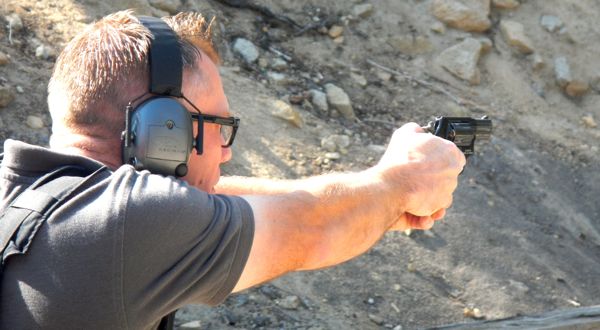
El Dorado County sheriff's Deputy Matt Harwood trains with his personal gun Aug. 14. Photos/Kathryn Reed

For the past two days the shooting range at D.L. Bliss State Park has been full of El Dorado County deputies getting certified on their weapons – mostly Glock semiautomatic .40-caliber handguns, plus rifles – which all patrol cars have, and some personal weapons.

“Most of our officers are encouraged to carry a handgun off duty,” Van Arnum said.

The Carson City IHOP shooting in September 2011 proved that unarmed military have little recourse.

The 1999 Colorado school shooting provided the old practice of waiting didn’t work.

Last month’s shooting in Aurora, Colo., at a movie theater proved how easy it is for mentally unstable individuals to acquire weapons.

In his years in law enforcement, Van Arnum has seen an increase in mentally ill people committing mass murder, as well as individuals seeking concealed weapons permits. More people were in his office after last month’s shooting for permits.

Sheriff John D’Agostini campaigned on wanting to uphold the Second Amendment – the right to bear arms. This includes concealed weapons. For people living in the county, they must go through Van Arnum to get a weapon. In South Lake Tahoe, the police department regulates them.

The movie theater shooting also points to the need for officers to practice shooting at a suspect’s head. Many bad guys now wear chest protection, but not even a gas mask – like the Aurora shooter had – will protect a shooter’s head.

Van Arnum isn’t one who believes limiting the size of magazines is going to matter much to the person intent on killing. If someone is skilled, they can reload in two to three seconds.

A 12-gauge shotgun is what the Aurora shooter started with. That’s the same type of gun some of the deputies were getting certified on Monday and Tuesday.

“Everyone in a rural area has them because they are a bird shooting gun,” Van Arnum said. “The are also effective at close range against people.”

Even the Olympics – Summer and Winter – have events involving guns.

While deputies in Tahoe have not been involved in recent shootings, every time they pull their gun out of the holster it’s considered using their weapon.

While this week’s training was about target shooting, that isn’t the only type of training the officers do. A court ruling has said they need to be trained in more realistic scenarios – to be able to run and shoot, reload on the move, take into account if a hostage is involved and those types of events.

Simulators have been brought in before. Those are provided by the state on a rotating basis to departments.

With ammunition costs increasing and budgets being cut, Van Arnum said time at shooting ranges in the area is dwindling.

But training will never end because the possibility of needing to use their weapon is there every hour of the day and night.

“Most police shooting are within 7 yards and are over in two or three rounds. Often it’s at night with poor visibility,” Van Arnum said. “All of these guns have night sights so they glow in the dark.”

Paul Kuhn and Sonny Piazza are the instructors at the outdoor range. As the officers are being told what to do by Piazza, Kuhn explains how it’s necessary to practice shooting from the hip without time to get into a proper stance, line everything up perfectly or even have the second hand on the weapon before firing.

“Someone can be on you from 20 feet before you can draw your firearm,” Kuhn explained. “That’s why we train for it.”

Gradually the guys keep moving back until they are shooting from 20 yards. Two stances on their knees test their ability from those positions.

“Low kneeling is very stable and very uncomfortable. Your foot will fall asleep,” Piazza tells the deputies. But he explains the position will provide them a good base.

Targets are shaped like a soda bottle. They are told to rapidly fire two shots to the body and one to the head. If the suspect doesn’t go down after being shot twice, likely they have body armor on.

Then it’s time to knock the bowling pin over with a bullet as well as obliterate the orange clay target that is dangling.

Finally, the holes in the “bottle” are counted to ensure they have passed this quarterly test.

ngg_shortcode_0_placeholder (Click on photos to enlarge.)


Family volunteer trips require ample preparation

By Jennifer Conlin, New York Times

Like many affluent parents, Carolyn Everson, an executive at Facebook who lives in Montclair, N.J., with her husband and 9-year-old twins, is committed to raising “socially conscious” children, as she puts it. For that reason she did not hesitate to sign her family up for a trip to Kenya last August with Me to We, a company that offers what its Web site calls “transformative trips.” At a cost of $4,195 per person (excluding international airfare), guests spend 10 days immersed in African culture while participating in community development programs and living in “rustic, luxury cottages.”

In Kenya, Everson’s family carried jugs of water on their backs alongside tribal women, and helped build a school. They learned beading, planted trees and listened to lectures over leisurely dinners.

In Everson’s view, the trip was a success. “My daughters are growing up in a very privileged town,” she said. “This trip was a chance for us, as a family, to play a global role in helping others while also expanding our worldview.”

Travel — “fatal to prejudice, bigotry, and narrow-mindedness” in the words of Mark Twain — has long been a way to broaden one’s perspective. What is changing, at least for some parents, is the kind of trip that offers such broadening. A decade ago it was enough to peer into the Grand Canyon or bike through Tuscany. Now, galvanized by disasters like Hurricane Katrina and 9/11, and aware of the insulating effects of wealth, many parents are using travel to deliver to their children potent doses of real life.

Some parents, particularly those who are doctors or educators with a toehold in a foreign community, design family volunteer trips themselves. Others are signing on to organizations like Me to We, a partner company of the children’s rights charity Free the Children. And while it is hard to miss the incongruity in spending thousands of dollars to inoculate children against the scourge of privilege, traveling abroad costs money, period; for families with limited time and a desire to help, these organizations fill an obvious need. Me to We has seen family participation double over the last few years, while Globe Aware, which offers trips to 15 countries, had a 100 percent increase in the number of families signing up from 2003 to 2008. More recently, that number jumped 22 percent in the first half of 2012 compared with the same period last year. Chris Clum, executive director of Experience Mission, which arranges Christian mission trips around the world, estimates that 50 percent of the 3,000 to 4,000 volunteers who travel with his 10-year-old organization each year are now families.

Not surprisingly, the effects of children’s involvement in service travel are showing up in areas like education. “Everyone in admissions started seeing essays about these volunteering trips six or seven years ago,” said Bev Taylor, the founder of the Ivy Coach, a New York-based college admissions counseling service. “Now we have to tell kids not to write about them.”

Though that is unlikely to dampen interest, keep in mind that such trips can be more complicated than the brochures suggest. Below are some common questions with answers collected from families who have taken such trips, and experts who are aware of the risks and rewards.

Read the whole story


Bocce event raises money for High Fives Foundation

The 4th annual Bocce Tournament benefiting the High Fives Foundation is Sept. 23.

The event is at the Truckee River Winery.

Forty teams will compete for prizing and bragging rights.

Cost is $100 for teams of two.

More information is online.


Eldorado National Forest has money to give out

The El Dorado County Resource Advisory Committee is accepting proposals for projects that benefit National Forest lands in El Dorado County. The deadline for applications is Aug. 31.

Applications, instructions, project evaluation considerations and other information are found on the Eldorado National Forest website.

The committee is expecting to have approximately $170,000 available to recommend projects to the Eldorado National Forest and the Lake Tahoe Basin Management Unit Forest Supervisors for implementation on their respective units.

Resource Advisory Committee funds were made available under Title II of the Secure Rural Schools and Community Self Determination Act of 2012 which spells out how the funds can be spent. The act says funds may be used for the purpose of making additional investments in, and creating additional employment opportunities through, projects that improve the maintenance of existing infrastructure, implement stewardship objectives that enhance forest ecosystems, and restore and improve land health and water quality.

The act goes on to say that projects should have broad based support with objectives that may include, but are not limited to: road, trail, and infrastructure maintenance or obliteration; soil productivity improvement; improvements in ecosystem health; watershed restoration and maintenance; restoration, maintenance and improvement of wildlife and fish habitat; control of noxious and exotic weeds; and reestablishment of native grasses.

At least 50 percent of the funds must be used for projects that are primarily dedicated to: road maintenance, decommissioning, or obliteration; or restoration of streams and watersheds.


Financial help available to attend Sierra Nevada Allliance conference

Rose Foundation for Communities & the Environment is providing scholarships for people who want to attend the 19th annual Sierra Nevada Alliance Conference Sept. 21-22 in South Lake Tahoe.

The scholarships cover registration and may cover the costs of travel and/or lodging for about 10 people.

For more information, contact Jenny Low at (530) 542.4546, ext. 306 or Jenny@sierranevadaalliance.org.

The conference is at Embassy Suites Lake Tahoe.

Go online to find more out about the conference and to register.