Unconventional ice cream flavors all the rage

By Josh Sanburn, Time

Vanilla is still by far the most popular ice cream flavor in America. That’s a testament not only to its use in sundaes and on pies but also to its ability to compete with the 32 bazillion other flavors that are vying for our attention. Partly as a response to the trendiness of artisanal foods, ice cream has been moving into more adventurous territory.

Weird flavors–or at least the idea of them–have become so mainstream that customers expect a good ice cream shop to offer something unusual even if no one ever orders it. At Sweet Republic in Scottsdale, Ariz., the summer lineup includes chocolate orange Sichuan peppercorn, honey blue cheese and sweet corn, which contains whole kernels of locally grown corn.

“They either love it or tell us that it was a fun flavor–and then get their usual favorite,” says co-owner Helen Yung. “But they’ll still tell their friends about it.”

Owners are generally happy to crank out the experimental stuff, since it’s often what gets folks in the door. At Salt & Straw in Portland, Ore., chef Tyler Malek uses goat cheese to make a marionberry-and-habanero-jam ice cream. He recently began work on a tempura-battered-bacon flavor, but his cousin (and the store’s co-owner) Kim Malek nixed it. It was too labor-intensive, for one thing, and in terms of flavor, she says, “it was too far out for me.”

Contrast that with Manhattan’s Il Laboratorio del Gelato, where in-store customers can get scoops of such oddities as black sesame, Earl Grey tea and cheddar cheese. Although the street traffic is great, about 75 percent of its business comes from restaurants, many of which request new, specially designed flavors. In 10 years, owner Jon Snyder has rejected only one ingredient request — caviar — but not because of the ick factor, he says. “I just didn’t want to contaminate my machinery with it.”


Passport to Dining in Kings Beach

North Lake Tahoe’s most affordable, all-you-can-eat/drink event, Passport to Dining, will take place Oct. 4.

It features food and beverage samples from more than 25 restaurants, breweries, and wineries, pluse live music, a raffle and auction.

The event is from 6-9pm at the North Tahoe Event Center in Kings Beach (8318 N. Lake Blvd.).

Tickets are $30 — call (530) 546.9000.


Veggie sausage a reason to stay at Haven Cottage

By Kathryn Reed

AMBLESIDE, England – I have long said I don’t like sausage. Didn’t even like it when I ate meat. And I’m not one of those vegetarians who likes the flavor of fake meat products found in the frozen food section (except for burgers).

Then I went to Haven Cottage and my sausage world was turned upside down.

Tim Hall caters to meat and non-meat eaters at Haven Cottage in England's Lake District. Photo/Kathryn Reed

Tim Hall said he wanted to offer his vegetarian guests something to complement the meat version others were served.

Sue took a bite of mine and thought it was so good that she ordered the veggie version the next morning.

Besides the rich flavor, what makes this sausage so wonderful is Hall uses the freshest ingredients that are available locally.

His entire breakfast is yummy – but the veggie sausage is a must-have.

While I haven’t made the recipe, I can tell you the end result is scrumptious. I’m waiting for Hall to market these so I can shop in the frozen food section.

(All the notes in the recipe are from Tim Hall.)

 Haven Cottage Veggie Sausage

This makes 16 to 18, but they freeze really well and I defrost them overnight in the fridge.

300 grams of white bread. Make into breadcrumbs in a chopper or whatever they are called. Tip into large mixing bowl.

2 good size leeks. Cut into 10mm bits and then put in blender – see above.

2 shallots – in with leeks

75 grams walnuts – in with leeks

I prefer not to smash them too much as it allows the different flavors to remain separate. Mix all together in a large mixing bowl with fairly large wooden spoon.

250 grams local cheese of your choice and grate into mix

2 tsp chopped parsley

2 tsp chopped sage

2 tsp mustard powder

2 tsp lemon juice

Mix all in.

4 eggs, whisked

Mix all in.

120 grams goat cheese, not crumbly and not too soft as you want it in small square chunks.

Mix in.

Add a bit of salt and black pepper to your taste.

Using the spoon, scoop up enough to make a sausage in your other hand and roll and squeeze until you have the acquired shape.

I then place all on a tray and put in fridge for a couple hours to allow the flavors to develop. Then you either freeze them on the tray and then when frozen bag them for future use or cook them.

When ready to cook, just roll them in white flour to just give them a coating – shake off excess and then lightly fry in hot shallow oil-butter until gold brown (about 20 minutes) over a medium to low heat.

All the measurements are not rigid and I do vary them slightly each time, but then you might prefer to experiment. Shallots are a recent addition to the recipe and I think add a tiny bit of sweetness.


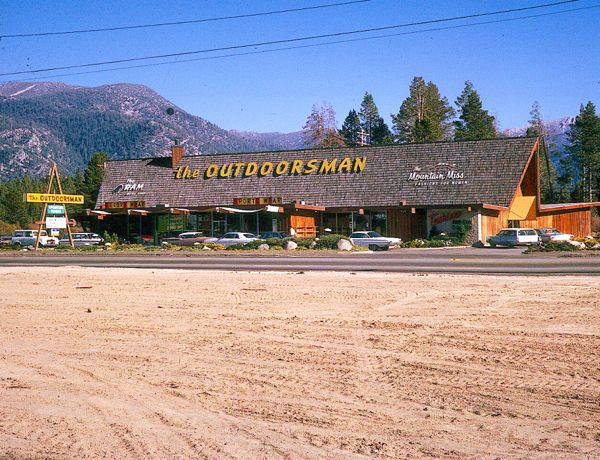
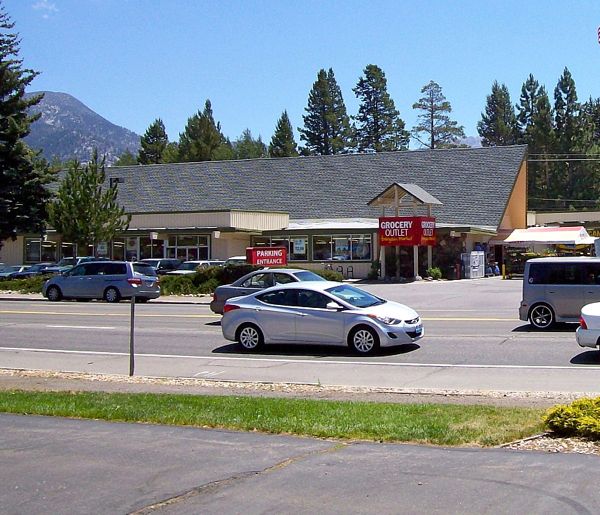
Then and now: For many, it will always be the Outdoorsman

The dirt lot in 1965 is where Motel 6 is today. Photos/Bill Kingman

Grocery Outlet is where the Outdoorsman was.

The Outdoorsman in South Lake Tahoe is still talked about by locals with a certain fondness.

It was here in the 1960s and at least through the late 1980s. It had a bit everything — from sporting goods to a decent selection of clothing to being the place to buy a gift.

Today it is home of Grocery Outlet.

Notice how signage has changed through the years.

— Lake Tahoe News staff report


Nevada retailers expect back-to-school sales to increase

By Sean Whaley, Nevada News Bureau

Nevada retailers and their online counterparts expect to see $245 million in spending on back-to-school merchandise for public school children this year, a 15.4 percent increase over spending levels in 2011, the Retail Association of Nevada reported this week.

College spending in Nevada is expected to generate another $134 million in what is as the second biggest consumer event for retailers behind the winter holidays, according to the National Retail Federation. The NRF reports that combined K-12 and college spending will reach $83.8 billion this year.

“Parents want to make sure their kids have everything they need to start the new school year and are willing to spend more than ever on school-related necessities,” said Mary Lau, president of RAN. “However, the economy remains a concern in most households, which will have an impact on the way families shop. Bargain-hunting will remain important to budget-conscious consumers.”

According to the latest survey results from the NRF, families nationwide with children in grades K-12 are expected to spend an average of $689 on clothing, backpacks and other supplies. The latest estimate is a 14.1-percent increase from the estimated $604 spent last year.

According to demographics released by Nielsen Marketplace, there are approximately 1 million households in Nevada, and 34 percent (or 355,000 households) have one or more children in grades K-12. Assuming national trends as reported by the NRF generally hold true for Nevada families, total spending in the state will reach approximately $245 million. Due to an increase in both the count of families with children entering elementary or middle school, and an increase in spending per family, back-to-school spending in the state is expected to increase 15.4 percent compared to last year when total spending was an estimated $212 million.

As for college-bound students, the NRF estimates families will spend an average of $907 on new clothes, dormitory or apartment furniture and other college supplies. Compared to last year’s estimate of $809, college spending is expected to increase 12.2 percent.

Utilizing the latest estimate of Nevada residents who will be enrolled in undergraduate and graduate degree programs within and outside of Nevada in the coming school year released by the U.S. Census Bureau’s American Community Survey, aggregate back-to-school spending on college supplies is expected to increase this year as well. Again, assuming Nevada residents follow national trends, college spending is estimated to reach $134 million, compared to $120 million in 2011.

Bryan Wachter, director of government affairs for RAN, said back-to-school spending is exceeded only by the Christmas holiday season.

“Back-to-school is for a specific purpose, and we feel we can measure it pretty accurately,” he said.

Wachter said clothing and electronics, from calculators to laptops to phones, are the big spending categories.

“Electronics, not quite but almost, total clothing,” he said. “The average person is going to spend about $250 per student on clothing and we’re going to spend about $225 on electronics.”

The spending increase is due in part to some increased confidence among Nevadans that their jobs are more secure, Wachter said.

The Internet is continuing to grow as a preferred shopping “destination” for back-to-school items. Approximately 39.6 percent of consumers will be using the Internet to shop for needed supplies, nearly double the 2007 estimate. That said, discount stores are expected to be the most popular shopping destination, with 67.1 percent of consumers planning to shop there. Department stores followed with 59.9 percent.


Opinion: Parents need to give kids space to grow

By Madeline Levine

The brief reprieve of summer is almost over, and parents everywhere are bracing themselves for the return to school. Back to the homework wars, the grade worries and the endless carpools to a dizzying array of extracurricular activities. Back to the feeling that we have to be ever-vigilant in order to optimize our children’s performance and hoping that somewhere down the line, whether that’s this year or in a decade, it will all pay off with a letter of acceptance (preferably several) from a prestigious college or university.

We’re worried and, in light of the miserable economy and the reality of global competition, with good reason. We want to make certain that in uncertain times, our kids have a leg up. But here’s the irony: Our constant oversight, our over-parenting isn’t doing what we think it’s doing. Rather than giving our kids a leg up, it’s making them less resilient, less resourceful and less engaged with learning. In other words, over-parenting makes our kids less, not more, likely to succeed.

Counterintuitive as it seems, the very things we’re doing to secure our children’s futures can end up compromising them. Pushing and over-scheduling prevent them from becoming competent adults capable of the resilience, perseverance, motivation and grit that business leaders say they’ll need to compete in tomorrow’s workforce. Just as importantly, it interferes with the ability to cultivate healthy relationships and to feel that life is meaningful.

Many parents have significant misunderstandings about how children learn and what circumstances are likely to drive success in them. Our (culturally sanctioned) faulty thinking is pushing us to do, in many cases, the exact opposite of what kids need to thrive.

Madeline Levine is a psychologist, consultant, educator and co-founder of Challenge Success at the Stanford University School of Education. She is the author of “Teach Your Children Well: Parenting for Authentic Success”.

Read the whole story


Ambleside beckons the tourist who likes to play outdoors

By Susan Wood

AMBLESIDE, England – Billed as one of the most beautiful places on the planet, England’s largest national park may be vast and full of superlatives – but it also holds the distinction as having a small-town spirit. The region of northwest England is welcoming, friendly and oh, so comfortable.

This is the place to feel at home – especially if you hail from another lake with stunning scenery and you grow up in the rolling, emerald hills of New England.

From the minute a visitor steps off the train at the Windermere station and boards a bus for a 10-minute ride to Ambleside, it’s difficult to not be taken in by views that take your breath away. The scenery is filled with grazing sheep and cows, lush landscapes dotted with rocks dating back 500 million years, as well as England’s largest, deepest lakes as serene as a plate-glass window.

Ambleside, England, is the perfect place to travel for people who like the outdoors. Photos/Kathryn Reed

Arriving in the small, quaint village of Ambleside is like entering another world – with its notable stonewalls, cobblestone streets, tiny abodes and gorgeous flora that includes vivid purple foxgloves standing 6-feet high.

London has William Shakespeare. Bath relishes its past with Jane Austen. But this fantasyland of sorts has gained a worldwide reputation as being the home of Beatrix Potter, who wrote a series of children’s books based on the lovable “Peter Rabbit.” Potter’s legendary rabbit, which turned 110 years old last month, makes up the vacation plans of thousands of Japanese parents who have religiously taken their children through the book series as they grow up. One may tour her nearby home.

Ambleside serves as the inspiration to artists, creative types and adventurers for hundreds of years. Poet William Wordsworth and C.S. Lewis, professor and author of the “Chronicles of Narnia” known to escape in its sheer beauty and embrace its atmosphere.

The small town is appropriately named. Many visitors can be found holding walking sticks, carrying packs and wearing hiking boots – ambling along.

Before going out to explore, it’s highly recommended that visitors park their hiking boots in the front-entry of the Haven Cottage. There’s a reason it won the AA B&B Friendliest Landlady of the Year in 2011. With rooms averaging about 85 pounds a night, the bed and breakfast owned by Tim Hall and Lindsey Kinley is homey. They take hospitality to a level beyond the highest peaks found in the Lake District.

“People come from all over. It was like the (United Nations) around here (recently),” Hall said, noting his guests from the United States, Belgium and Germany. One Scottish woman has returned to the Haven Cottage 30 times. The place “stays busy every weekend throughout the year,” Hall added. The Lake District has come to be known as a four-season destination, but it’s summer that keeps the place hopping.

The B&B has much character in its exquisite décor, which is complemented by Hall’s insatiable humor. He bravely hung a sign at the entrance reading: “Hot beer, lousy food, bad service – welcome.”

In fact, visitors may want to stay just to hear Hall spin a yarn, tell a joke or serve up a puzzle for each guest before they devour the inn’s famously delicious breakfasts. (Note: If the intoxicating smell of his own vegetarian sausage recipe and roasted tomatoes grown locally isn’t enough to fill the senses, wait until the fresh baked bread comes out of the oven.) In the evening, a nightcap of liqueur or wine on the sofa in the living room is the perfect activity to cap off the day.

Ambleside sits on the northernmost corner of Windermere Lake in the Lake District.

Windermere Lake Cruises, which can be accessed out of Ambleside or Bowness to the south, runs a variety of cruises across England’s largest lake, which spans 10 miles and goes to a depth of 219 feet.

The boat cruise company uses old steamers, with one – the 122-year-old Tern — carrying the Olympic torch into the Bowness harbor in June amid a regatta of boats alongside and thousands of cheering spectators awaiting its anticipated arrival into port.

“Ten thousand people were gathered at Bowness,” said Windermere Lake Cruises staffer Jacqui O’Connor, who was on board at the time.

She was still smiling widely as she recalled the experience aboard the Tern’s sister boat, a 75-year-old triple-decker steamer called the Teal. It takes out hundreds of visitors on its sunset jazz cruise in the summer. The enchanting two-hour cruise is one sure way to slow down life for the evening. Jazz from a local band and a full, tasty buffet complement the backdrop of amazing views. The scenery, especially as the sun dips into the horizon, is nothing short of spectacular. White swans float along the shoreline. Sprawling estates that look like mini castles poke out of the waterfront forest lining the lake. Vast green meadows dominate the hillsides behind the forest.

Those green hills also provide an excellent scenic route pedaling south to Coniston Lake — touted by Bing.com as one of the 10 most beautiful lakes in the world. It is one of 80 lakes in the Lake District in the Cumbria region. An 1859 steam yacht also takes visitors across its northern section. At half the length of Windermere, the lake also holds speedboat records.

The destination is definitely worth the trip via bike. (BikeTrek in Ambleside has hybrids for rent and suggestions for where to ride.)

The roads from Ambleside to Coniston are filled with offshoot paths where the national government trust has secured arrangements with local farmers to allow visitors to walk and cycle through the ranchland with its captivating green meadows, colorful flowers, clear streams and pretty mountains in the background. (Just remember to close the gates when passing through.) The single- or double-track paths are fun and sometimes challenging without ever feeling like too much for novice technical mountain bikers.

The round-trip ride, which provides a few elevation gains that are not for the faint of heart, takes about three hours to complete. But afterward, one of England’s famous ales may await a hardy rider in Ambleside without guilt. (Note: Ambleside Tavern or Royal Oak Pub – especially the latter if a Wimbledon tennis match is on — are worth visiting.)

ngg_shortcode_0_placeholder (Click on photos to enlarge.)



Audit: Caltrans spent millions on unnecessary house repairs

By Jack Dolan, Los Angeles Times

California transportation officials have spent millions of dollars making overpriced, unjustified repairs to houses the state owns in and around Pasadena, according to an audit released Thursday.

Caltrans bought the houses decades ago to bulldoze for the long-planned, never built extension of the 710 Freeway. The agency has spent $22.5 million since 2008 to maintain the homes, but transportation officials are “unable to demonstrate that the repairs were necessary, reasonable or cost-effective,” according to the report by the California State Auditor, which was sparked by a Times investigation.

The state is also losing $22 million per year because tenants, including 15 state employees, are paying far below market rates for rent. Other homes, some of which have been recognized as historical landmarks, have been boarded up and empty for years.

For one of those vacant houses, state officials recently estimated it should have cost $56,000 to repair a roof and replace the garage. But the cost soared to more than $184,000 after it was expended to include “miscellaneous interior repairs” — a coat of paint and upgrades to two bathrooms. “Caltrans could provide no evidence of the need for additional work,” the investigators said.

In a six-page response to the audit, Caltrans officials did not dispute the findings and vowed to inspect houses before and after repairs are done in the future to ensure work is performed properly.

What to do with the hundreds of houses spanning a corridor through Pasadena, South Pasadena and Los Angeles has vexed state officials since the plans for the freeway extension stalled years ago. The properties could be sold, but buying them back would be expensive if the road plan ever gets revived. So state officials settled on renting at least some of them, often cheaply, to boost the supply of low-income housing.

Read the whole story


Privacy advocates worry about monitoring of government workers

By Lisa Rein, Washington Post

When the Food and Drug Administration started spying on a group of agency scientists, it installed monitoring software on their laptop computers to capture their communications.

The software, sold by SpectorSoft of Vero Beach, Fla., could do more than vacuum up the scientists’ e-mails as they complained to lawmakers and others about medical devices they thought were dangerous. It could be programmed to intercept a tweet or Facebook post. It could snap screen shots of their computers. It could even track an employee’s keystrokes, retrieve files from hard drives or search for keywords.

“Every activity, in complete detail,” SpectorSoft’s Web site says about its best-selling product, Spector 360, which the company says it has sold to dozens of federal agencies.

Government workers have long known their bosses can look over their shoulder to monitor their computer activity. But now, prompted by the WikiLeaks scandal and concerns over unauthorized disclosures, the government is secretly capturing a far richer, more granular picture of their communications, in real time.

Federal workers’ personal computers are also increasingly seen as fair game, experts said.

Nonintelligence agencies spent $5.6 billion in fiscal 2011 to safeguard their classified information with hardware, software, personnel and other methods, up from $4.7 billion in fiscal 2010, according to the Information Security Oversight Office. Although only a portion of the money — the amount is not specified — was spent on monitoring for insider threats, industry experts say virtually every arm of the government conducts some form of sophisticated electronic monitoring.

“It used to be, to get all of an agency’s records out you needed a truck,” said Jason Radgowsky, director of information security and privacy for District-based Tantus Technologies, which evaluates monitoring systems for the Federal Aviation Administration, the Export-Import Bank and the National Institutes of Health. “Now you can put everything on a little USB thumb drive.”

The stepped-up monitoring is raising red flags for privacy advocates, who have cited the potential for abuse. Among other concerns, they say they are alarmed that the government has monitored federal workers — including the FDA scientists, starting in 2010 — when they use Gmail, Yahoo or other personal email accounts on government computers.

Although the FDA has said it acted out of concern that the scientists were improperly sharing trade secrets, the scientists have argued in a lawsuit that they were targeted because they were blowing the whistle on what they thought had been an unethical review process.

Read the whole story


K’s Kitchen: Simple tips for dealing with summer’s harvest

By Kathryn Reed

Beets keep arriving in the harvest basket. Luckily this past week’s came with some suggestions with what to do with them.

But what surprised me is the folks at the Natural Trading Co. said the greens should not be thrown away.

“A quick sauté of beet greens provides a delicious dish that contains vitamins A and C. Chop the greens, sauté them in 1 tablespoon olive oil for 10 minutes over medium heat and you’ll have a delicious side dish for grilled fish or chicken,” the farmers wrote in their weekly newsletter.

I’ll have to try this one day. Mine keep ending up in the garbage.

I’m in the habit now of taking off the greens of anything. This is because Joy, whose box this really is, told me that’s the way to make sure carrots stay fresh. She’s right. They were going limp with the greens on them.

Another thing I’ve started doing after reading about it multiple places is not putting basil in the fridge. Instead, I set it at room temperature in a glass of cold water. It stays much longer.

I’ve already started making batches of pesto to freeze for winter and spring use. This summer I’m using walnuts because pine nuts are so dang expensive. I put the green stuff in a freezer bag, lay it flat in the freezer and then have fresh pesto when basil is harder to come by or it tastes less than ideal. And homemade pesto is always better than store bought.

Never put tomatoes in the fridge. It just zaps the flavor from them. Store them on the counter and don’t stack them.

When choosing tomatoes and you know you will be cooking them, don’t worry about how they look. Flavor is what counts.

Consider buying cherry or grape tomatoes as a snack. Put a bunch in a bowl and eat them like candy.

To test if your knives are sharp try slicing through the skin of a tomato. It should be easy.

What tips do you have to share?