Reclusive South Lake Tahoe sisters died of natural causes

By Cathy Locke, Sacramento Bee

Reclusive twin sisters who were found dead in their South Lake Tahoe home in February died of natural causes, according to El Dorado County investigators.

The sheriff’s office announced Aug. 30 that the determination regarding the deaths of Patricia and Joan Miller, 73, was made after a review of pathology reports and evidence from the Miller residence. A pathology report concluded that Patricia Miller died of coronary artery disease. Joan Miller, who relied heavily on her sister for care, died of probable environmental hypothermia, according to a sheriff’s office news release.

The women were found dead in their home Feb. 26, and sheriff’s officials sought the public’s help in locating relatives.

The sisters were entertainers in the Bay Area, where they regularly appeared on a weekly television show, “The Hoffman Hayride,” in the 1950s. They also entertained troops at several military bases.

Originally from Portland, neither woman married, and the two were largely dependent on one another throughout their lives, officials said.

With the public’s help, authorities were able to locate two second cousins.


Annual fire summit set for October in Reno

The inherent dangers of having so many homes located in such dangerous terrain prompted University of Nevada Cooperative Extension’s Living With Fire program six years ago to sponsor the first

The annual Nevada Wildland-Urban Interface Fire Summit is Oct. 1-2 at the Grand Sierra Resort in Reno.

It will give homeowners and firefighters a chance to compare notes, plan strategy and discuss in detail what they need to do to protect their neighborhoods from fire.

Research indicates that pre-fire activities performed by the homeowner – such as creating defensible space, removing pine needles from rain gutters, replacing wood shake roofs and screening vents – can significantly improve house survivability during wildfire.

The summit is an opportunity for homeowners to learn what they can do. The event is free, but participants need to register by going online.

A highlight of this year’s program will be a review of the Caughlin Fire from the eyewitness accounts of homeowners and firefighters. This discussion will be led by North Lake Tahoe Fire Protection District Fire Chief and Caughlin Fire Incident Commander Mike Brown.


Sensors for brain injuries may help future athletes

By Anne Eisenberg, New York Times

Football teams of the future — even high school squads on limited budgets — may someday have a new tool to check players for brain injuries. It’s a special form of headgear, packed with sensors that read the brain waves of athletes after they come off the field, thus detecting changes caused by the trauma of hard knocks.

The compact, portable sensors decipher neural activity by measuring changes in the brain’s tiny magnetic field. These small magnetometers — still in the laboratory and in prototype — have yet to be tried on athletes. But their potential is enormous for brain imaging and for inexpensive monitoring of brain diseases, as well as for many other applications like the control of prosthetics, said Dr. José Luis Contreras-Vidal, a professor of electrical and computer engineering at the University of Houston.

Contreras-Vidal’s research includes work on a system that will use brain signals to control prosthetic legs.

“This is a transformative technology” that could make brain interfaces available at a small cost, he said. “We could potentially use these devices to record in real time brain waves that could be analyzed for specific diseases such as Alzheimer’s, or the progression of these diseases.”

The research is occurring at a time of growing concern about collisions and subsequent brain injuries in sports — and the dire effects that may show up only many years later. But an inexpensive system for spotting changes in brain behavior could play an important safety role one day in boxing, football and many other sports.

The magnetic sensors, part of a field called optical or atomic magnetometry, were created at the Commerce Department’s National Institute of Standards and Technology in Boulder, Colo., by Svenja Knappe and colleagues.

Read the whole story


Nevada lawmakers want to revamp education funding

By Sean Whaley, Nevada News Bureau

CARSON CITY – A panel of lawmakers this week recommended Nevada’s public education funding formula be revised to take into account the higher cost of educating specific groups of students, including English-language learners and children in poverty.

But lawmakers also acknowledged that updating the formula won’t mean any significant changes in funding for the state’s 17 school districts until the state’s economy improves and tax revenues increase.

There is no proposal to shift current funding from one district to another to fund a new weighted formula.

The New Method for Funding Public Schools interim study was authorized by the 2011 Legislature to look at the “Nevada Plan” the current funding formula adopted in 1967. The Clark County School District sought the review to look at whether the state’s education funding plan needs to include additional funding for educating specific groups of students.

The six lawmakers serving on the panel supported the recommendation to revise the formula, which will be presented to the Legislature when the 2013 session gets under way.

But lawmakers deferred to the Department of Education the technical details of which groups should be included and how the different categories of students should be weighted in any new funding formula. Other groups that could be included in a weighted formula are gifted and talented and career and technical education, among others.

“The committee, I think, could find quick and unanimous support for the recommendation that we as a state consider changing our K-12 funding formula to one that considers a variety of different weights, including but not limited to; and then a comprehensive list,” said Sen. Greg Brower, R-Reno. “That tees up the issue then for the next session. It tells the Legislature as a whole that this committee did its job, it studied the issue and it decided it was worthy of legislative consideration.”

The recommendation came after the Clark County School District provided $125,000 to the legislative panel to hire a consultant to study the issue. The consultant, American Institutes for Research, issued a final report which found in part: “As low‐income students and English learners are widely accepted in the mainstream education finance literature to be associated with higher educational costs, it is our strong recommendation that funding adjustments be incorporated into the current funding system to account for these student need cost factors.”

The report found that Nevada is not in line with most other states on funding, being one of 14 states that does not adjust funding for low-income students and one of eight that does not account for the cost of English learners.

“I think what we’ve learned is that the 1967 formula is no longer adequate,” said Assemblyman Ira Hansen, R-Sparks. “I think everybody on this committee agrees with that. It doesn’t meet the needs that it was originally intended to do.”


2 special fund-raising concerts for TOCCATA

Two special “Soiree” events will take place in private homes as fundraisers for TOCCATA’s summer season finale concert series and for the Tahoe Symphony Youth Orchestra.

The first is Sept. 7 at 5pm in Glenshire-Truckee and the other Sept. 9 at 3pm in Incline Village.

Wine and hors d’oeuvres are included with the special entertainment.

Singers Joy Strotz, Anna Helwing, Liudmila Mullin, and Stuart Duke will perform, accompanied by Donna Axton on piano. Elizabeth Pitcairn will perform selections from Brahms’ Violin Concerto and several encore favorites on the famous Red Stradivarius.

For “Soiree” information or reservations, call (787) 602.2121.


TRTA looking for people for trail camp

Tahoe Rim Trail Association’s final Backcountry Trails Camp is Sept. 15-16.

Camp will be near Barker Pass on the west side of the Lake Tahoe Basin. Volunteers of all ages and skill levels are welcome to attend.

Food will be provided, but in order to offset this cost the camp is $40. Scholarships are available. Families are welcome, and children’s camping equipment is available upon request.

For more information or to register, call Morgan Fessler at (775) 298.0232.

Volunteers must bring their camping equipment, and must wear long-sleeved shirts, long pants, boots and work gloves. The Tahoe Rim Trail Association will provide hard hats, trail tools, volunteer kitchen staff, and crew leaders to guide and support trail work.


World may be forced to stop eating meat

By Dylan Stableford, Yahoo News

By the year 2050, you may be forced to become a vegetarian. That is, if Sweden’s water scientists are to be believed.

According to the Stockholm International Water Institute, “There will not be enough water available on current croplands to produce food for the expected 9 billion population in 2050 if we follow current trends and changes towards diets common in Western nations.”

Humans now derive about 20 percent of their daily protein intake from animal-based products, reports London’s Guardian. But a new report published by the institute says the world’s population will have to cut that figure to 5 percent by 2050 to accommodate the planet’s “considerable regional water deficits.”

Why not just produce more food?

“Nine hundred million people already go hungry and 2 billion people are malnourished in spite of the fact that per capita food production continues to increase,” the report said. “With 70 percent of all available water being in agriculture, growing more food to feed an additional 2 billion people by 2050 will place greater pressure on available water and land.”

So vegetarianism, the scientists say, is one option to combat the water shortage.

“A move towards vegetarian diets could help free up large portions of arable land to human food production,” Orion Jones wrote on BigThink.com. “A third of current farmland is used to grow crops that feed animals. Additionally ‘animal protein-rich food consumes five to 10 times more water than a vegetarian diet.'”

The report was released for the start of “Water Week” and the annual world water conference in Stockholm. And while the forecast may sound dire, the world’s water situation is already grave.

According to the World Water Council, 1.1 billion people now live without clean drinking water.

And the United States is experiencing its worst drought in a generation, punishing farmers and burning up the nation’s corn crop. On July 31, nearly 65 percent of the nation was experiencing drought conditions, according to the U.S. Drought Monitor.

The drought’s been so severe and water levels so low, Midwestern towns that were intentionally submerged decades ago are starting to surface.


Scientists digging around Tahoe to gain info on earthquakes

By Jeff Maher, News 10

TAHOE CITY — Is Lake Tahoe due for a big earthquake? If so, will a large tsunami follow? That’s the question a research team is literally digging to answer.

The team is using advanced technology to collect ancient evidence, including core samples from the Lake’s deepest points.

This is an average geological expedition, then again, Lake Tahoe is not an average place.

“We’re just about to go out and do some water column sampling.” Professor Ross Powell said as the team was getting ready to head out from the shore.

The research team, made up of geologists from the California Geological Survey, Northern Illinois University and the UNR, are on a mission to find out the potential effects of a large-scale earthquake hitting the Lake and what kind of tsunami the lake could produce.

Some of the drilling technology the team will use is being tested at Lake Tahoe for an upcoming expedition in Antarctica, which will investigate how life under the ice is being impacted by global warming.

Read the whole story


Snippets about Lake Tahoe

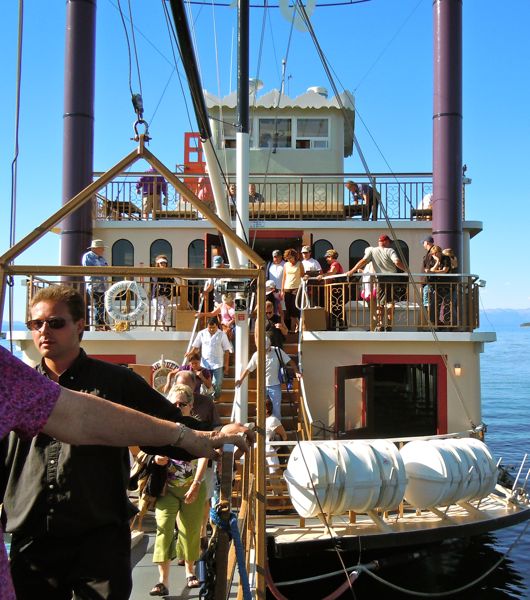
• The M.S. Dixie II and Tahoe Queen on Sept. 1 will race along Tahoe’s South Shore in a four-mile race for the title of the fastest paddle-wheeler on the lake. For more info, call 800.238.2463.

• South Lake Tahoe’s library (1000 Rufus Allen Blvd.) is hosting a Princess Party on Oct. 6 at 2 pm. Wear your best gowns, crowns and diamonds. Games, crafts and refreshments will be available for your royal enjoyment. For more info, call (530) 573.3185.

• People who don’t want to pay the rural fire tax fee the state is imposing might want to click on this link.

• Labor Day fireworks on the South Shore start at 8:30pm Sept. 2 — not Labor Day.

• South Lake Tahoe City Council candidate JoAnn Conner is having a series of coffees to tell people about her platform: Aug. 30, 7-9am, at the Simple Bliss Vegan Cafe in Swiss Chalet Village; Sept. 5, 5-7pm at Hot Gossip Coffee Shop in Bijou Center; and Sept. 9, 9-11am, Don’s Cakes by the Lake, 661 Emerald Bay Road.


A hefeweizen before noon may help with digestion

By Eric Asimov, New York Times

In the heat of a waning summer, when half the world seems to have taken off on vacation, a late-morning glass of wheat beer can be another sort of pleasurable departure. In Bavaria, home of the hefeweizen style of wheat beer, such refreshment is an essential component of the brotzeit, or second breakfast.

The brotzeit may consist of a little cheese and bread, or even better, a fresh pretzel; perhaps veal sausage; some long white radishes; and a hefeweizen.

In German, hefeweizen means yeast wheat, so called because the beer is traditionally unfiltered, leaving particles of yeast sediment to turn the golden beer cloudy and turbid. It may be this suggestion of solidity that leads Germans to occasionally refer to hefeweizen as bottled bread.

Americans might look askance at a pre-noon glass of beer, but hefeweizen is light, crisp, fairly low in alcohol, undeniably refreshing and, the Germans believe, good for digestion.

No matter what time of day, however, the hefeweizen style has become popular with American consumers, whose own contribution to the tradition has been to serve the beer with a wedge of lemon on the rim of the glass, dipping into what ought to be a foamy, crenelated head.

American brewers, too, are drawn to hefeweizen, which is but one distinctive style among many German wheat beers. Kristalweizen is similar to hefeweizen, except it has been filtered, so it is crystal clear. Berliner weisse is pleasingly tart and sour; dunkelweizen is a darker version of hefeweizen; weizenbock is darker and more powerful.

Read the whole story