Then and now: Stateline — a honeymoon destination

Stateline in 1953 before the high-rise casinos. Photo/Provided by Bob Rockwell

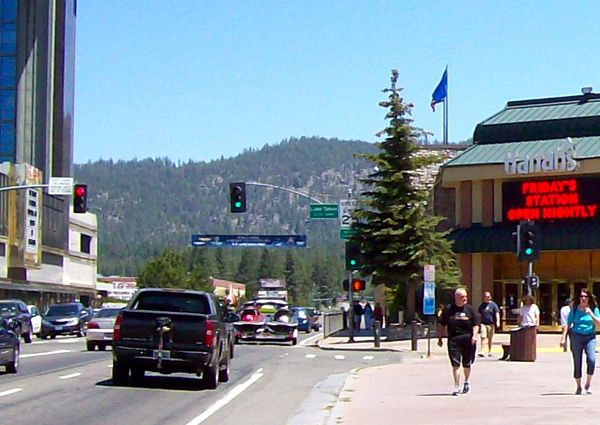
Where the pine tree is today is about where the person was standing nearly 60 years ago. Photo/Bill Kingman

This is a picture of my dad at Stateline in 1953. My mom took the photo. They were on their honeymoon. They stayed at Lakeland Village.

If you look under the sign my dad is leaning on, you can see the Wagon Wheel Saloon and restaurant signs. That’s where Harveys is now.

Across the street is Sahati’s and the Nevada Club which became Harrah’s.

— Bob Rockwell


Labor Day observances date to 1882

The first observance of Labor Day is believed to have been a parade of 10,000 workers on Sept. 5, 1882, in New York City. It was organized by Peter J. McGuire, a Carpenters and Joiners Union secretary. By 1893, more than half the states were observing “Labor Day” on one day or another.

Congress passed a bill to establish a federal holiday in 1894. President Grover Cleveland signed the bill soon afterward, designating the first Monday in September as Labor Day.

As of June, there were 155.2 million people age 16 or older working in the United States.

The number of employed increased 1.4 percent from December 2010 to December 2011, accord to the U.S. Bureau of Labor Statistics. Employment increased in 266 of the 322 largest counties (large counties are defined as having employment levels of 75,000 or more).

The number of people who worked from home in 2010 was 5.9 million.

The 2010 real median earnings for male and female full-time, year-round workers, was $47,715 and $46,931, respectively.

The percentage of workers who drove alone to work in 2010 was 76.6 percent, while 9.7 percent car pooled and 4.9 percent took public transportation (excluding taxis).


Scientists’ calls to warn Yosemite visitors of virus went unheeded

By Christina Jewett, California Watch

California public health scientists have twice recommended in the past five years that Yosemite National Park authorities educate visitors about hantavirus, a rare disease that is linked to the deaths of two park visitors, one illness and a possible fourth this summer. Yet park officials did not warn visitors until after the disease showed up in recent weeks.

In a 2010 risk assessment document, state inspectors explicitly asked Yosemite officials to educate those staying in the tent cabins linked to the hantavirus cases about the fatal disease. The risk assessment was performed after a 54-year-old park visitor fell ill with hantavirus in 2010 after staying in the type of tent cabin inhabited by the 2012 victims.

“Provide each cabin with information on (hantavirus),” the 2010 risk assessment recommended. “Together with the bear safety guidance, guests should be advised to minimize contact with rodents and to report signs of rodent intrusion (e.g., droppings, chewed items) to Tuolumne Meadows Lodge management.”

In 2007, state vector-borne disease sector scientists recommended that Yosemite “minimize risk to staff and visitors through an active prevention program that includes the following elements: education … and active rodent removal within buildings and developed areas.”

Capt. Charles Higgins, who has been director of the public health office for the National Park Service for eight years, said he is not aware of any effort prior to this summer’s outbreak to warn tent cabin renters about the disease. He said the risk of disease transmission was thought to be low and there was potential for guests to tune out an overabundance of warning messages.

“That’s always a dilemma because people have message fatigue,” Higgins said. “Their eyes glaze over, they quit paying attention to messaging. It’s a little bit of an art form on when to (issue warnings) and how to approach it.”

Yosemite park ranger Kristen Kosick said Yosemite staff were trained about the risks of hantavirus and how to avoid transmission. “There’d been no outreach to visitors but there had been to staff,” Kosick said. “It’s a general virus people should be aware of if they’re in Western states and outdoors.”

Training on hantavirus is given to Yosemite employees in the spring and throughout the year, said Kari Cobb, a park ranger. She said education on the disease is mandatory for employees who open up closed buildings after each year’s thaw.

Park authorities announced last week that they notified 1,700 people who were possibly exposed to the mouse-spread disease after staying in Curry Village tent cabins. Two people who stayed in the cabins have been reported dead. One other fell ill with a respiratory disease, and there is a possible fourth case.

Scientists have found that the risk for the disease is concentrated in buildings within California’s national forests.

Giorgio Cosentino, an East Bay microbiologist, said one of the deceased 2012 hantavirus victims is a physician and a family friend. He said even though the risk of hantavirus transmission is low, the park should have warned visitors that it existed.

“If you can’t get rid of the rodent problem completely and you can’t get rid of the virus completely, the safety net includes educating visitors so if they do become ill, they can get to a hospital sooner,” Cosentino said. “That still doesn’t guarantee that they’ll live, but chances of survival are better if you get to a hospital sooner.”

The rare but deadly disease is spread by white-bellied deer mice and most readily caught by inhaling mouse feces or urine dust inside of buildings. Symptoms begin one to six weeks after exposure and include fever, headache, muscle aches and, later, difficulty breathing. The disease kills more than a third of those infected.

Since 1993, 60 cases have been reported in California, including 2000 and 2010 cases at Yosemite, and 587 in the U.S., according to the California Department of Public Health.

Higgins said his office, in Washington, D.C., has deployed several scientists to study what gave rise to the cluster of hantavirus cases at Yosemite.

“These are opportunities to contribute to the science, to make the effort to understand as deeply possible what the risk factors were that were so different and in the effort help everyone refine their (prevention) strategies,” he said.

Vicki Kramer, chief of the state vector-borne disease section of the Department of Public Health, said scientists have worked closely with Yosemite for three years to examine rodent-, tick- and flea-spread diseases. The park has trapped and tested deer mice to monitor the hantavirus problem and urged authorities to educate visitors.

“It is federal land,” Kramer said. “Certainly we can make recommendations, but it’s up to Yosemite on what further steps to take.”

In 2010, a 54-year-old San Mateo woman reported she became ill from hantavirus after she stayed in a Yosemite tent cabin. She recovered after three days in a hospital. According to a state summary of the case, she reported seeing one or two mice in the cabin and swept the room with the broom that was provided.

After the 2010 Yosemite case, state Department of Public Health scientists examined the Tuolumne Meadows area and found rodent hiding places, such as stacked firewood, and deficiencies that would allow rodent access to cabins.

“In addition to removal/correction of these factors, (state scientists) recommended providing staff and guests with information and supplies to safely clean and decontaminate cabins,” the 2010 report said.

Reviews by state vector-borne disease scientists show that hantavirus infection, before the Curry Village cases, has tended to be isolated and spread out among rural counties such as Nevada, Mono and Inyo.

Kosick, the Yosemite ranger, said park staff and concessioners were given a 12-page directive that details warning signs of the disease, precautionary measures to prevent infection and protective gear to wear. Kosick said park staff are now handing pamphlets to visitors informing them about hantavirus and expect to continue doing so indefinitely.

Risk for the disease and prevalence in rodents is routinely monitored in California’s national forests.

California Department of Public Health scientists published a 2008 study showing that 20 percent of the deer mice in U.S. Forest Service areas tested positive for the virus, higher than the statewide rate of 12 percent of deer mice. They also concluded that nearly all of the buildings they examined showed signs of rodent access or infestation.

Rodent testing in the Tuolumne Meadows area of Yosemite in a separate 2008 review showed that 24 percent – about twice the statewide average – of deer mice tested positive for hantavirus.

The study of U.S. Forest Service areas also showed that the disease tends to impact workers, who are often the first people inside buildings inhabited by mice after a snowy winter. In California, those workers comprised 27 percent of the hantavirus cases reported through 2008 and included a camp counselor, ranch hand, sanitation worker and U.S. Forest Service employee.



Angora Lakes — a destination no matter what season it is

By Kathryn Reed

Hiking to Angora Lakes is one of those mixed blessings this time of year. It’s the same feeling one can have on Fallen Leaf Lake Road.

The route to get to either lake is crowded with vehicles on what is really a one-lane road, but the end result is a majestic alpine wonder.

Last Sunday four people and two dogs made the 6-mile roundtrip trek to Angora Lakes. It’s one of those climbs I never get tired of no matter the season.

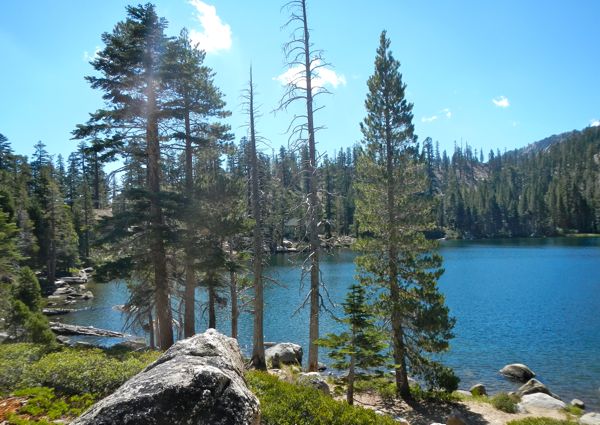
Lower Angora Lake is much quieter than the upper lake. Photos/Kathryn Reed

Plus, Angora Road is multipurpose – good for walking, biking, snowshoeing and cross country skiing. And in the fall, the aspens at the start of the route are stunning. And in winter it feels so much more like being in the wilderness, even somewhat desolate.

It got its name from the angora goats that used to graze in the area.

While we called it a hike, it’s hard to do so when the bulk of the walk is on pavement. It had been some time since any of us had been there. And for all I know, it was AJ’s first trek there.

It’s not the best excursion for dogs because they are not allowed to swim in the upper lake where all the people are – which is the easiest point to reach the water. However, there were no signs at the lower lake saying dogs were not permitted. So, AJ and Buddy were able to get a little swim in and some water there.

But there is no other water along this trail for dogs to cool off in.

Still, what makes this a good people destination are the views and the ability to walk side-by-side. The latter is good for catching up with friends.

After a fairly steady ascent, the road flattens out on Angora Ridge. To the left is the Angora burn area. Tons of underbrush gives the hillside a look of rejuvenation, though the blackened and even ash white remnants of the dead trees from the 2007 fire dominate the landscape.

To the right, though, is the more serene Fallen Leaf Lake, where those who are willing to brave the chilly waters are skiing. And beyond it is Lake Tahoe.

From the resort’s parking lot the trail really is a dirt trail for about one-half mile. This allows the experience to be called a hike.

Food may be purchased in the little store, and paddleboards and kayaks may be rented.

For those who want to spend more than a day or afternoon at Angora Lakes, there are nine cabins that are for rent on a weekly basis. The Hildinger family has been operating the seasonal resort on U.S. Forest Service land since 1917.

Getting there:

From South Lake Tahoe, at the Y go on Lake Tahoe Boulevard toward South Tahoe High School or the burn area. Turn right on Tahoe Mountain Road. Go right at the T intersection. Go left at the next T. The road curves a bit. Go slow. Now until early October the U.S. Forest Service gate on the left is open. Park nearby to get the full “hike”. Drive up the road for a half-mile hike from the parking lot to the resort.

Notes:

• In the winter, don’t park on that road during snow removal.

• It costs $7 to park during the season at the resort.

• Definitely stop long enough for lemonade.

• While people cliff dive, note that submerged rocks are not marked and people have lost their life.

ngg_shortcode_0_placeholder (Click on photos to enlarge.)


Free music at Valhalla

Ike Marr and Martin Shears have been making music together for 18 years. From their first musical meeting in Phoenix, their chemistry was undeniable.

Sharing a passion for great songwriting, harmony vocals, humor, and bourbon, they forged a friendship and musical partnership that has wowed audiences all over the world.

The will be playing for free on the lawn at Valhalla on the South Shore on Sept. 2 from noon-2pm.


Placer County cracking down on underage drinking

The Placer County Sheriff’s Office recently received a grant from the state Department of Alcoholic Beverage Control for 2012-13.

The $99,760 grant will be used to combat underage drinking and alcohol sales to minors countywide. The grant will also assist the sheriff’s office in providing awareness and training in alcohol-related crimes and their impact for school staff, parents, students and the community.

Throughout the year, the sheriff’s office will aggressively target problematic ABC licensed establishments that sell alcoholic beverages to minors and obviously intoxicated adult patrons. Minor-decoy and shoulder-tap operations will also be conducted countywide to minimize alcohol access to minors.

Deputies and police officers will also identify problematic areas and businesses where alcohol use is causing problems. They will inspect operations at those locations and at randomly selected establishments to ensure licensees are operating within the standards required by ABC.

Two training sessions will also be conducted for businesses that possess alcohol licenses. These sessions will provide a review of the rules and regulations governing the service of alcohol.

Agencies who will participate along with the sheriff’s office in the grant are Auburn, Lincoln, Rocklin, and Roseville police departments.


Volunteers sought to remove milfoil from Baldwin Beach

The League to Save Lake Tahoe invites volunteers to join in the final milfoil removal project of the season at Baldwin Beach on the South Shore on Sept. 16.

Volunteers are needed from 10am to 1pm to help remove barriers and sand bags used to control the invasive water weed. The control effort is a joint project of the League, U.S. Forest Service and Tahoe Regional Planning Agency.

Volunteers may preregister by contacting Flavia Sordelet at the League office at (530) 541.5388 or by email at events@keeptahoeblue.org.


Law gives cities power over blighted foreclosures

By Andrew Edwards, Contra Costa Times

Cities will keep their power to issue heavy fines against the owners of foreclosed properties that are not kept up to city code following Gov. Jerry Brown’s signing of an inland lawmaker’s bill.

Assemblywoman Wilmer Amina Carter, D-Rialto, introduced the bill, which allows cities to levy maximum fines of $1,000 per day to property owners who fail to maintain residential properties obtained at a foreclosure sale or through the foreclosure process under a mortgage or deed of trust.

The bill also gives property owners a grace period of up to 60 days to make a good-faith effort to correct any code violations.

The governor’s office announced Brown’s signing of the bill on Monday.

Without Carter’s bill, cities would have lost their power to issue $1,000 per day fines on Jan. 1. The new legislation, AB2314, allows cities and other California governments to keep that power indefinitely.

“The Inland Empire has been hit hard by home foreclosures, and untended properties encourage blight and bring down property values. Well-kept properties make for safer, cleaner neighborhoods,” Carter said in a statement provided by her office on Monday.

The city of San Bernardino has given its code enforcement officers, city attorney’s investigators, police, fire inspectors and some others power to issue $1,000 per day fines for any municipal code violation since 2008.

Read the whole story


Endless bowls of chili to raise money for historical society

Lake Tahoe Historical Society will be the recipient of proceeds on Sept. 6 at the Coyote Grill in Round Hill.

The all you can eat chili is $1. Twenty percent of all food purchases between 5-9pm will go to the society.


IMBA to teach sustainable trail building class in Incline

The International Mountain Bicycling Association’s Subaru/IMBA Trail Care Crew will be in Incline Village Sept. 7-9 to share sustainable trail building techniques and more with local mountain bikers, land managers and recreation specialists.

The visit, which was requested by the Tahoe Area Mountain Biking Association, is one of about 70 stops on the 2012 schedule. Everyone is invited to attend the weekend’s events. There is no cost, but preregistration is requested.

The Tahoe visit will include the Better Living Through Trails presentation on Friday that focuses on the health, economic, and social benefits of trails to a community. On Saturday, the crew will spend the morning teaching attendees about the proper techniques of trail building with actual hands-on trail work in the afternoon on the U.S. Forest Service’s Tyrolian Trail.

The Trail Care Crews teach “sustainable” trail building, which means building lasting trails that require minimal maintenance. This helps reduce trail damage, protects the environment and enhances visitor enjoyment. The Crews travel in new Subaru Outbacks provided by Subaru of America. The company has been IMBA’s leading sponsor since 1997.

For more information and to register, go online.