Opinion: It’s time to raise the minimum wage

By Mark Weisbrot

WASHINGTON — The federal minimum wage is just $7.25 an hour and hasn’t been raised in three years. But a raise is much more overdue than that. If we look at the minimum wage 44 years ago, and simply adjust it for inflation, it would be more than $10 today.

This is another ugly symptom of what has gone wrong in America over the last 35 to 40 years. From 1979 to 2007, about 60 percent of the income gains have gone to the now infamous 1 percent at the top, with the majority of those gains going to the top 0.1 percent – people who made, on average, $5.6 million per year.

But some of the worst effects of giving more to those who have the most have affected people toward the bottom of the income ladder, and there is no excuse for it.

Productivity – the amount that a worker produces in an hour – has more than doubled over the last 44 years. When the minimum wage doesn’t rise, or falls in terms of its purchasing power, it means that these millions of low-income workers are not sharing in the gains from improved technology, knowledge and organization.

There is currently legislation before Congress to raise the federal minimum wage from its current $7.25 an hour to $9.80, over three years. After that it would be indexed to inflation.

Contrary to prevailing myths about who would benefit from a proposed increase in the minimum wage, 88 percent of the 28 million workers affected are not teenagers.

As the Economic Policy Institute has shown, the majority are full-time workers, and on average they earn about half of their families’ income. And 28 percent of the nation’s 76 million children would have a parent who would benefit from the raise.

Another oversize myth promoted by the fast-food industry and other low-wage employers is that raising the minimum wage hurts workers by increasing unemployment. Although it is theoretically possible to raise minimum wages enough to cause employers to hire fewer workers, there is hardly any indication from economic research that the proposed increase in the minimum wage would have this effect.

Employment in the overall economy depends on aggregate demand or spending, which is determined – especially in our currently weak economy – by macroeconomic policy, including the Federal Reserve, and fiscal policy.

And raising the minimum wage doesn’t only cut into profits, it also increases demand in the economy by moving income to workers who spend more than those who receive profit.

The EPI estimated that the proposed increase in the minimum wage would actually increase employment.

In Brazil, the minimum wage was raised by 60 percent in real terms by the country’s most popular president, Lula da Silva – a former metal worker and union leader – as Brazil’s economy moved toward record low levels of unemployment. Across South America, other governments including Argentina, Ecuador, Bolivia and Venezuela have significantly reduced inequality while increasing economic growth.

What a shame that the hemisphere’s richest country, where it would be so much easier to lift-up the working poor, has moved in the opposite direction.

It means that the U.S. political system is actually more corrupt and less democratic in very important ways than those of our developing country neighbors to the south.

The vast majority of Americans would favor an increase in the minimum wage, as well as restoring the rights of labor to organize unions. But our financial elite have a veto over what we want to vote for, in large part because of our system of legalized bribery – aka, the financing of political candidates’ elections.

Raising the minimum wage is about the minimum that we could do to reverse America’s retreat from civilization at home.

Mark Weisbrot is the co-director of the Center for Economic and Policy Research.


Trains take the stress out of traveling in England

By Susan Wood

LONDON – If securing Wimbledon or Olympic tickets were as easy to negotiate as getting around England by rail, the All England Club and London Games officials would have to dramatically expand their venues.

United States take note.

Great Britain is one of those places where you can forget getting behind the wheel and successfully touch down in 2,500 places in England via BritRail. Prior to the Games, Lake Tahoe News spanned one end of England to another – London to the Lake District (Windermere station) to Bath and back to the host city without any glitches.

The system with its 18,700 trains and varied connections to the London Underground as well as bus routes and air makes “Am”trak look like “am”ateur hour in terms of being on time, number of routes, convenience, train comfort and helpful staff. (Granted, Britain is only about two-thirds the size of California.)

The train system in England makes it so a tourist does not need a car. Photos/Kathryn Reed

It’s difficult to believe California in 2012 is still debating installing a high-speed rail train linking the north with the south.

What’s more, “Fast Food Nation” author Eric Schlosser must have been onto something when he lamented in his best-selling book how U.S. motorists’ love affair with the car and its isolationist view of the world may be attributable to the downfall of our transportation system and high carbon footprint leading to climate change. At the time, strip malls were going in – encouraging vehicle miles, and train tracks were dug up.

This is not so in England. The British people and their visitors embrace the romantic, relaxing form of travel. The system is run by 26 train operators, with Network Rail handling the infrastructure of the system. The company intends to spend more than 10 billion pounds this decade on improving it.

The Intercity 125 provides the majority of long-distance services. For example, at King’s Cross, the line covers 393 miles from London to Edinburgh in four hours flat. Virgin Trains, a subsidiary of the highly successful, customer service-oriented airlines of Virgin America and Virgin Atlantic, operates 334 high-speed trains. First-class customers may use at-seat catering if they don’t feel like walking 10 feet to the snack bar. The lounge features soft drinks, some cocktails, sandwiches and snacks. There are also power ports for audio entertainment, laptops and cell phones.

The Great Western first-class cabins provide roomy seating and the London Times on the table in the morning from Bath to Reading. Most train cars with seating at the tables have large picture windows to accommodate daydreaming and a glimpse of what’s in store for a visitor. The rides are smooth and quiet.

The trip from London to Windermere is an adventure in green with villages that almost invite a rider to get off before the planned destination. Only one stop – Oxenholme – sat in between the route. Once in Windermere, the bus to the bucolic Ambleside, along with a row of taxis sat ample and ready because the service is on time, and there is a coordinated system that alerts other means of transportation and their passengers of the arrival times. (Take note South Lake Tahoe. BlueGo would appear to be a joke to a British traveler, assuming they figured out what a BlueGo is.)

The BritRail timetables posted at stations are easy to follow. And once on the train, a bulletin scrolls the names of the stations before and during the stops. There’s plenty of space for baggage. And unlike some tourism destinations, the staff is courteous, friendly and helpful. Upon the trip from Windermere to Bath – a conductor printed out a more convenient schedule with Birmingham and Bristol as connections, as if it were no trouble at all.

BritRail, which can be reached through the British Tourist Authority at 800-GO2-BRIT or online www.BritRail.com, sells a variety of passes. Aside from a standard unlimited pass, the FlexiPass offers train travel for four, eight and 15 days within a two-month period. On the consecutive pass, a rider can pick any sequence of days. Sleeper cars start at 38 pounds per berth in standard class and six pounds more for first class. Tickets may be previously arranged.

A BritRail pass is not to be confused with the London Underground pass, which whizzes passengers through the busy city in a matter of minutes. A trip from the West End to East London around the host city’s Olympic Grand Central can take about an hour.

The Underground, or tube as locals call it, represents a superior metro rail network to get around London. Billed as the largest underground network in the world, the system evolved through the efforts of F.J. Sprague. The engineer saw that the trains needed to advance from steam power to electric cars. Each electric motor cranked out enough electricity to power 30 homes. In its first year, 5 million people came on board.

Today, 12 lines serve central London through routes running from east to west, north to south and most providing several different ways to connect the diversified neighborhoods that make up this cosmopolitan city.

“You just don’t need a car in this city,” said Alison Hull, a public relations executive who undoubtedly needs to get around. Hull added she and her husband own a car, but pull it out to use about once a month.

For visitors, purchasing the London Pass for access to more than 50 attractions in a designated number of days runs hand in hand with the Travel Card. The auxiliary pass allows a traveler to board the tube as many times as desired in that time frame. The London “attraction” Pass gives a tourist the opportunity to board the unique double-decker sightseeing buses or city cruise lines on the River Thames, another option of negotiating the city.

ngg_shortcode_0_placeholder (Click on photos to enlarge.)


3 Nevada counties to meet to discuss bear-trash laws

The Nevada Board of Wildlife Commissioners is sponsoring a meeting to discuss trash laws specific to Washoe, Carson and Douglas counties in Nevada, and potential solutions to any perceived deficiencies in those laws.

The meeting is Sept. 10 at 5pm at the Tahoe Center for Environmental Sciences, Rooms 139, 141, 291 Country Club Drive, Incline Village.

The committee will hear a presentation of the Bear Smart Community program that has been used to address bear-related conflicts in other communities. The committee will take input from the public and discuss the potential for establishing a similar program in Nevada.


Burglary, tagging spree ends with 2 arrests

Two South Lake Tahoe teenagers were arrested Sept. 8 in connection with a burglary and tagging buildings, signs and vehicles.

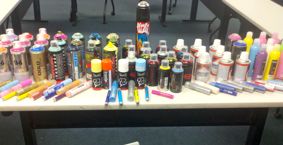
More than $3,000 work of spraypaint, markers and cash were stolen from a local store on Sept. 7. Police are neither releasing the address nor the name of the store.

Cans of paint recovered Sept. 8 from a commercial burglary. Photo/Provided

On Saturday, people started called the police department to say their property had been tagged.

The investigation led officers to Silver Dollar Avenue where they conducted a probation search of a residence. Two boys, ages 15 and 16, were hiding in a closet. During the search spray paint and markers that had been taken in the burglary were recovered, according to officers. Officers said the two juveniles admitted to being involved in the burglary and one admitted to tagging buildings, signs and vehicles.

A third juvenile has been identified as a suspect and is on the loose.

The property damage from the graffiti is estimated to be in the thousands of dollars.

Anyone with information, should call (530) 542.6100 or Secret Witness at (530) 541.6800.

 — Lake Tahoe News staff report


Award-winning author to speak, give workshop at SNC

As part of the Community Read, Tim O’Brien will speak at Sierra Nevada College on Sept. 21 and conduct a writing workshop ($50) the following morning from 10am-noon.

The Friday evening talk is free and open to the public. Contact the SNC Registrar’s Office to register for the workshop — (775) 881.7435 or jrainwater@sierranevada.edu.

O’Brien graduated from Macalester College in 1968 and was drafted into the Army. He served as a soldier in Vietnam in 1969-70.

He has published numerous stories and books, fiction and non-fiction, most of them connected in some way with his experience in Vietnam. He received the National Book Award in Fiction in 1979 for his novel “Going After Cacciato”. In 2005, “The Things They Carried” was named by the New York Times as one of the 20 best books of the last quarter century. It received the Chicago Tribune Heartland Award in fiction and was a finalist for the Pulitzer Prize and the National Book Critics Circle Award.


Cancer ‘breakthroughs’ cost too much, do too little

By Laura Beil, Newsweek

In his more than 35 years of practice, Dr. Lowell Schnipper has seen a lot of women die from breast cancer. A patient’s options start to dwindle by the time tumor cells set up outposts in the bones, lungs, and other organs, defying all attempts to keep them under control.

But in June, when the government approved Perjeta, Schnipper had something new to offer. The drug is one of an innovative class of drugs known as “targeted therapies.”

As the chief of oncology at Beth Israel Deaconess Medical Center in Boston, Schnipper knew Perjeta was not a cure: added to a standard treatment with Herceptin—another targeted therapy that was hailed as a breakthrough in 1998—Perjeta gives the average woman only about six months more of calm before her disease starts to stir again.

Given the limited benefit, the price was startling. For most women, a full course of the drug combination will cost $188,000—enough, he says, “to give anybody a cold sweat.”

Americans spent more than $23 billion last year for cancer drugs, more than we paid for prescriptions to treat anything else. But many oncologists are starting to question what we are getting in return for that bill, whether the war on cancer has become too much of a race to produce the next blockbuster.

“In general, progress for cancer has been halting and slow,” says David Howard of the Department of Health Policy and Management at Emory University. So far, most new drugs offer only marginal extensions of life and few cures. Howard says new so-called breakthroughs “overpromise and underdeliver.”

Consider the popularity of Avastin, a targeted drug approved for metastatic colon cancer in 2004. A recent study found that almost 70 percent of patients on chemotherapy were receiving Avastin within a year of its release. In clinical trials, the drug increased survival by about five months. The cost? About $10,000 a month.

Treating cancer has never been cheap, but today, the price of each new treatment seems to outpace the one before, with little bearing on its efficacy.

According to figures from insurer United Healthcare, a standard cocktail of drugs for treating lung cancer used to run about $1,000 a month. Today’s regimens cost from more than $6,000 to almost $10,000—for about two more months of life.

“There is no such thing as a cancer drug coming on the market that is some sort of regular drug price,” says Dr. Peter Bach of Memorial Sloan-Kettering Cancer Center in New York, who studies the impact of cancer costs on U.S. health care. “They’re all priced at spectacularly high levels.”

Which leads to an unsettling question: how much is a little more time worth? Would you spend $50,000 for four more months? How about $15,000 for two weeks?

Of three frontiers in cancer treatment, targeted therapies like Perjeta are widely seen as the best hope for a cure. Traditional chemotherapy is notorious for side effects because it wields destruction indiscriminately throughout the body. Targeted therapies are designed to hit cancer cells only. Perjeta, for example, targets a protein produced in excess amounts in some breast cancers; Avastin hinders the ability of a tumor to form new blood vessels to feed itself.

Read the whole story


Historic Virginia City church to commemorate 150-year anniversary

St. Mary’s in the Mountains Catholic Church of Virginia City will celebrate the 150th anniversary of its founding with three days of celebration Sept. 14-16.

This icon of the Comstock is the birthplace of Catholicism in Nevada.

The celebration will begin Sept. 14 with a wine tasting as well as guided tours of the historic and recently renovated church and museum from 4-6pm. Wine will be from St. Mary’s Mad Monk Wine Cellar and commemorative glasses will be available for purchase.

The original baptismal font is on display as well as treasures serving the parish for the past 150 years.

On Saturday afternoon, Bishop Randolph Calvo of Reno will celebrate an anniversary Mass at 4pm.

For more about all the weekend activities, contact St. Mary’s at (775) 847.9099 or stmarysvc@att.net.


TRTA hike in Van Sickle park

The Tahoe Rim Trail Association is sponsoring a family hike in Van Sickle Bi-State Park on Sept. 14.

Find out about the barn beneath the Heavenly gondola, if the Pony Express rode through the park, and if this area had anything to do with the Gold Rush.

Meet at 10am at the Tahoe Rim Trail kiosk.


Coffee takes out neck kinks for computer workers

By My Health News Daily

If your job is a literal pain in the neck, drinking coffee may help, a study from Norway says.

People who drank coffee before sitting down to work at a computer for 90 minutes reported less pain in their necks and shoulders than those who didn’t drink coffee, according to the study. Some in the study had previously suffered chronic neck and shoulder pain, while other participants hadn’t — but people in both groups who drank coffee reported less pain, the researchers said.

Among people whose daily work involves low levels of muscle activity, such as sitting at a computer all day, about 10 percent report shoulder and neck pain, according to the study.

The researchers looked at 48 people, including 22 with chronic neck or shoulder pain, and 26 healthy people. The experiment was part of research on how pain develops during office work; it was not intended to look at the effects of caffeine, the researchers said.

People in the study reported to the laboratory first thing in the morning, so to offset any effects of sleepiness, coffee and tea were available. Nineteen of the study participants chose to drink either coffee or tea, but were instructed not to drink more than one cup.

Then, for 90 minutes, participants performed a computer task, using only a mouse.

Researchers found that people who drank coffee — whether they had previous chronic pain or not — developed less pain over the course of the 90 minutes, compared with those who didn’t drink coffee. And at the end of the computer task, the coffee drinkers rated their pain as less intense than the other study participants.

It’s possible the reduction in pain experienced by coffee and tea drinkers in the study was due to other traits or lifestyle behaviors common to people in this group. Future studies should be conducted in which participants are randomly assigned to consume caffeine or not in order to better understand whether the caffeine itself is truly reducing pain, the researchers said.

The study, conducted by researchers at the Sunnaas Rehabilitation Hospital in Norway, was published Sept. 3 in the journal BMC Research Notes.


Patriots Day celebration in South Lake

There will be a Patriots Day observance Sept. 11 at 5pm at American Legion Post No. 795 in South Lake Tahoe.

The public is welcome.

The legion is on Highway 50, where the Tuesday farmers’ market is.