Nevada public education funding options remain elusive

By Sean Whaley, Nevada News Bureau

RENO – Northern Nevada state lawmakers and candidates in the November general election identified a number of public education priorities at a forum here Monday, from ending social promotion to paying the best performing teachers more to making much-needed capital improvements to older Washoe County schools.

But those participating in the event at Reno High School at the invitation of the nonpartisan group Parent Leaders for Education had few specifics about where funding to implement the ideas will come from when the Legislature convenes next February.

Those participating included Sen. Greg Brower, R-Reno, and former Sen. Sheila Leslie, a Democrat challenging Brower for the new District 15 seat. Sen. Ben Kieckhefer, R-Reno, who is not up for re-election, also participated, as did Assemblyman Pat Hickey, R-Reno, who is running unopposed for another term in District 25.

The panel was rounded out with two Assembly Democrats running for new terms and their Republican opponents. David Bobzien faces Heidi Waterman in District 24 and Teresa Benitez-Thompson faces Tom Taber in District 27.

Several of the participants identified the need to find revenue to repair and renovate the Washoe County School District’s older schools as the top priority for the delegation next year.

Kieckhefer said those studying the issue are seeking about $15 million to $20 million annually in revenue that could be used to make repairs to more than half of the district’s schools that are more than 30 years old and are in need of major repairs.

Brower said Washoe County lawmakers are working toward a solution to repair the county’s schools and sell the proposal to Southern Nevada lawmakers who will ultimately have to support any funding option.

“It will be the best investment I think we can make in our schools in Washoe County for decades to come,” he said.

Leslie issued a note of caution to those attending the forum, saying past experience has shown that even bipartisan priorities, such as finding revenue to repair older schools, can be derailed in a legislative session.

“And I don’t want to sound like a cynic, but I’ve been through it several times,” Leslie said. “And so I think meetings like this where you put people on the spot, and I’m willing to be put on the spot and tell you that I will vote for just about any revenue source I can think of right now, to improve our schools. But you need to put the pressure on all of us to make sure that we find a solution and we don’t get to the end of the session and say oops, sorry, can’t do that.”

Brower said he agrees with Gov. Brian Sandoval, who announced earlier this year that he will propose to extend a package of taxes now set to sunset on June 30, 2013, into the next two-year budget to ensure that there are no further budget reductions for public schools or higher education.

But Leslie said the Legislature needs to do more than maintain the status quo and instead find a way to restore the $123 million cut from Washoe County schools over the past five years. Nevada ranks poorly in many national rankings, including ranking 50th in the number of children who attend preschool, she said.

“So obviously we can’t cut any more but what we really need to do is find a way to put that money back,” she said.

Hickey said he does not believe that raising taxes to find more revenue for education is likely to see any serious consideration at the next session. An option he favors is to look at shifting money that now goes to corrections and health and human services to public education.

Spending more on public education now so that money doesn’t have to be spent later on prisons is a better investment in the long term, Hickey said. Even so, several neighboring states, including Utah and Arizona, spend less per pupil but perform better than Nevada, he said.

“It’s wiser to educate than incarcerate,” Hickey said. “So we do need to spend more, we do need to spend wisely, but money is not the entire answer.”

Bobzien, who served as chairman of the Assembly Education Committee in 2011, said a number of major reforms were passed in a bipartisan show of support. But those reforms won’t turn Nevada’s schools around over the long term without adequate financial support, he said.

Waterman said the findings of the Sage Commission, established by former Gov. Jim Gibbons to find ways to make state government more efficient, need to be considered by lawmakers. Eliminating duplicative programs could help find money for public education, she said.

Benitez-Thompson said specific policy proposals are fine, but lawmakers need to look at the overall funding challenges facing public education. Ending social promotion from the third to the fourth grade is fine, but there are costs involved when children are held back, she said. Those children will need additional assistance so they can succeed, Benitez-Thompson said.

Taber said teachers need to be given more control over their classrooms to help their students achieve. Funding also needs to be allocated with a business-oriented approach to ensure it is spent wisely, he said.

“Business sense is important,” Taber said.



South Tahoe working on disabled plan — 20 years late

By Kathryn Reed

Twenty years after the federal government mandated accessibility to public buildings for the disabled, South Lake Tahoe has adopted a plan to make this a reality.

While the city believes it would take $3.5 million to bring all of its facilities into compliance, the Tahoe Area Coordination Council for the Disabled believes that figure is closer to $5 million.

The City Council this month approved a plan to get the city’s facilities into compliance. It’s not that the city has not done anything, it’s that it needs to do more.

“Our newer buildings have been built to the code requirements enforced at that time, but the codes keep changing so upgrades are required as time passes,” Dave Walker, city building official, wrote in his Sept. 4 staff report.

Compliance goes beyond the obvious accessibility for those with wheelchairs. It involves providing access to people with hearing, sight and other disabilities.

Besides wanting to accommodate locals and visitors with disabilities, the city also wants to protect itself against what many consider frivolous lawsuits.

Gov. Jerry Brown this week by signing Senate Bill 1186 is helping the city and small business owners in that regard. Even Sen. Dianne Feinstein, D-Calif., has weighed-in on this issue. She wrote a letter to Brown urging him to sign the legislation.

“Numerous small businesses and chambers of commerce in California have expressed to me their concern about the increasing number of predatory lawsuits and coercive demand letters that have been filed against small business owners for technical noncompliance with the Americans with Disabilities Act (ADA). As you know, I proudly support the ADA, but after learning of the alarming rate of demand letters sent to “mom and pop shops” requesting settlements that ranged from $5,000 to $90,000, it became clear to me that reform in this area of the law is necessary,” Feinstein wrote.

The bill bans attorneys from sending demand letters for money, reduces statutory damages from $4,000 to $2,000 for defendants who correct violations within 30 days of being served the complaint and prevent stacking of multiple claims used to increase statutory damages.

South Lake Tahoe businesses are not immune to these types of lawsuits and will be aided by the state legislation.

The city will be educating all staff about their responsibility to the disabled. Barriers to the disabled will be removed through the capital improvement program.

The first course of action is accessible parking at all public facilities.

“Over the course of eight years we hope to have path of travel to our building, meeting rooms, restrooms, recreational features and sidewalks made compliant,” Walker wrote in his report.


Important to keep fire devices away from children

A child’s curiosity about fire is natural. That’s why parents, grandparents, babysitters, and all grownups, must take steps to protect children from their curiosity.

Fire safety education is an important first step, but it’s not enough. For young children, intervention is necessary. Move matches, lighters, and other fire tools up high, beyond a child’s reach.

Remember: big fires start small. Keep matches and lighters in the correct hands.

For more information, contact the South Lake Tahoe Fire Department at (530) 542.6160.

 — Sallie Ross-Filgo


Breathing can help turn stressful situations around

By Mandy Kendall

I had one of those days yesterday. You know, when everything that could go wrong, does go wrong. It’s times like this when things get a bit overwhelming that a session of relaxation and meditation would really help.

However, although many of us have heard of the benefits of meditation, who really has the time to practice it? It is usually because everything is so fast-paced, and time is in such short supply, that causes the issues in the first place. So, how do you relax and ease the tension when there is so little time no matter where you are and what you’re doing?

Mandy Kendall

Someone who I admire very much once shared a very quick breathing meditation technique that can be used in any situation and is incredibly effective in a very short space of time. It can be used by those new to meditation as well as those who have been meditating for a long time.

Here are the Qwik-e instructions on how to use the technique and some examples on when to use it:

Now, here is the real magic in this exercise: There is no need to be aware of what it is you are accepting and releasing. It works wonders whether you are focused on something specific or are just out-of-sorts and not really sure why.

While taking a deep breathe in: think/say/visualize the word “accept”.

While breathing out: think/say/visualize the word “release”.

Keep repeating and you will notice the negative feeling easing away.

If you prefer a bit more focus, try this technique:

Breathe as above but at the end of the inhale, and the exhale, pause for a moment and give thanks for something.

For an even more focused version:

Breathe as above but think specifically about what you want to accept and release.

Here are some examples of situations where this breathing technique can be used:

If you are anxious about something try “accepting and releasing: the anxiety you are feeling about it.

If you are in a situation where you are not in control, but you are still being affected by it, try accepting the fact that you are not in control and releasing the way this is making you feel.

If you don’t like the way someone is behaving toward you, try accepting them for who they are (or the situation in general) and releasing the way it is affecting you.

If you’re having trouble getting to sleep you can use this as a general tension releaser.

If you have can think of other situations where you think this would be useful, or have any questions, feel free to post in the comments below.

Until next time.

Mandy Kendall operates Health Connective in South Lake Tahoe, which aligns wellness seekers with their ideal wellness provider. If you have questions, would like some advice, or would like to request some Qwik-e tips on any health and well-being topic, drop her an email at connect@healthconnective.com or keep an eye out on Lake Tahoe News for regular Qwik-e tips on how to make healthy changes one Quick and Easy step at a time.


LTCC students learning the impact of gender bias in ads

By Susan Wood

While politicians declare war on women’s issues, the battleground actually started long ago in the media world.

This is what longtime Lake Tahoe Community College sociology Professor Scott Lukas has discovered.

A decade ago, Lukas focused on gender bias in advertising for one of his sociology classes. His students became so widely interested they asked him for the PowerPoint presentation. The topic became so intriguing, Lukas took the 50 images he gathered depicting women in compromising, denigrating positions and installed them with analysis into a website.

The exploitation of women in ads is the subject of a class at LTCC. Photo/Provided

The site has grown to more than 3,000 images. Lukas still calls it “a work in progress” despite having worldwide readership.

The topic that now features television shows has morphed into its own class – and started this week at LTCC called Gender. (It’s under the Sociology Department.)

Lukas, who has made presentations on the project, including one before the LTCC board, went on a sabbatical from teaching last year to complete the project. This enabled him to delve deeply into how simple images may spur sexism, violence, child abuse, homophobia and even torture.

Noting a curious situation, the project’s report asks: “Why should we accept the association of a product, such as a stereo system or a table and a sexualized woman?”

So why should we care and why can’t we tune out what we don’t want to hear or see?

“Everyone is impacted by gender issues because the effects can be tragic,” Lukas told Lake Tahoe News, further citing the Jerry Sandusky case as an example. The former Penn State assistant football coach was convicted of severe child abuse charges, including rape.

A major concern is in a society where the population picks up a barrage of images that show women and children being abused, objectified or sexualized (even in the mildest form) desensitizing effects take place. One exhibit on the website highlighted a television show called “Toddlers and Tiaras” in which a young girl is dressed up as the prostitute character in the hit movie “Pretty Women”. And in an episode of “America’s Top Model,” models were asked to pose as crime victims.

These images are prevalent in “Big Daddy” ads with professional racecar driver Danica Patrick breaking the mold for women in the workplace resorts to her looks to sell the product.

“In a sense, ads have gone backward,” Lukas said of the pendulum swinging for women’s equality.

“We laugh at it all the time,” South Shore veteran ad man Bruce Rettig said of the times he and his wife watch ads on television.

In the big picture, Rettig called objectifying women as the “Barbie syndrome” in which girls want to obtain the body of a perfect model and that if you look at the demographic the ad is reaching, one might find that “maybe a large segment” looks to the images to tell them who to look up to or aspire to be. Then, there’s the obvious – sex sells.

“It seems that way as a part of human nature. It’s a shame,” Rettig said.

Even a small town like South Lake Tahoe cannot escape stereotypes that perpetuate the images – no matter how innocent they seem. Take the casino ads that show women in tight-fitting outfits wildly dancing and partying. Sure, they look fun. But they represent something larger going on at a societal level.

“Everyone is impacted by gender issues because the effects can be tragic.”          — Scott Lukas

“We have nothing to the level of Las Vegas or Los Angeles, but it’s still there,” Lukas said, referring to male-dominated sexism. “Awareness is key. We should be aware we’re under the influence of these ads.”

When Lukas first brought the topic to his classroom, he encountered a mixed reaction from students.

“The men felt more threatened. They learned the material, but they thought of it as propaganda,” he said. Their behavioral theory was: “If you have differences in the sexes, men are perceived as weaker. That’s part of their resistance,” Lukas added.

The professor especially witnessed resistance when the class discussed how former President George W. Bush brought back the “macho president” after the 9/11 terrorist attacks.

The subject of machismo hit close to home for one of Lukas’ male students, Jose Pena.

The origin of “machismo” comes from Spain, however its influence as an exaggerated display of male dominance over women spans many nations.

The conversation struck a chord with Pena because of his Hispanic background. Although he said he didn’t witness these types of relationships in his family, Pena has seen the behavior in some of his male friends when it comes to how they view their mates.

“This kind of goes hand-in-hand with the aspect of treating women as second-class citizens,” Pena said, citing the lack of equal pay for women and few breaking the glass ceiling. “I guess this would be the American equivalent of machismo.”

Nonetheless, Pena said he’s optimistic about what the future brings, but agrees it’s “an uphill battle” for society to accept the notion of “all totally equal in this land of opportunity.”

Progress may start with one person.

“I am a male that will forever recognize the hardships that females face on a daily basis. Like my mom always said: ‘For every bad person out there, let’s just hope that there (are) two more good ones to replace the bad one.’”


Lake Tahoe Wildlife Care busy with birds, bobcats and bears

By Tom Millham

As some of you may be aware, we now have five bobcats in house. We have had a total of six this year, which is the most we have ever had.

The one we got in about a month ago was just with us for about three days after being hit by a car in the Woodfords area. We got her back so she could – hopefully – take care of her babies.

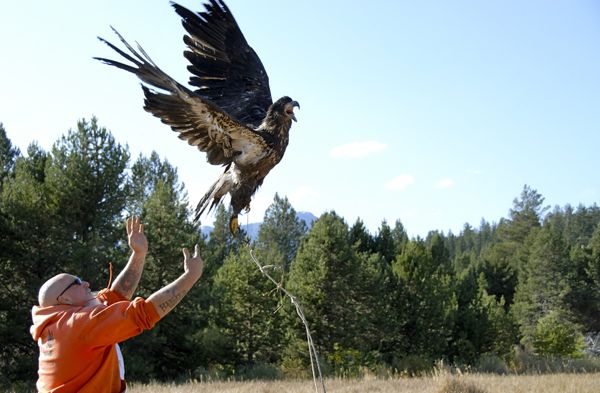
LTWC volunteer Wayne McKnight throws a golden eagle into the air as a way to exercise it. Photo/John Adamski

Of the five we have left, three of them came in on May 20, the second day of our annual training seminar. About three weeks ago, one of those original three was limping in our bobcat cage. As it turned out, she somehow broke her right front leg.

Dr. Kevin Willitts took an X-ray and determined the exact damage, then took her down to Reno for a specialist to perform the surgery, which was successful. However, for the next three weeks, our instructions were to leave her alone as much as possible to allow her to heal.

Willitts took a follow up X-ray Sept. 20 and determined that she has healed about as much as she is going to. So, after she woke up from her sedative, we let her out of her pet carrier to be with her two siblings. The three of them have been getting used to each other and so far no fur is flying.

For more than 25 years, Willitts has been there to volunteer his time for the betterment of the wildlife entrusted to LTWC.

Yes, we still have Chips and, now, Sierra. Chips came to us from the Chips Fire near Lake Almanor about 2½ weeks ago and Sierra came to us from the Sierra Army Depot near Herlong (just south of Susanville) where he got separated from his mother. He is about one week older than Chips.

After we clear up Chips’ problem with Coccidia, we will be able to put the two together. Other than the Coccidia, Chips is doing very well and growing every day. Since we now have two cats, almost the same age, we will most likely raise them here at LTWC and then release them in a suitable environment early in the new year. We will keep you updated on all five bobcats.

On another note, we will be releasing another golden eagle Sept. 23. We plan to meet at LTWC at 10am, then caravan up toward old Highway 40, west of Donner Lake. The exact location will be determined Friday. Anyone who would like to join us is welcome. We anticipate the release to take place at or around 11:30am.

Tom Millham is secretary-treasurer for Lake Tahoe Wildlife Care.

Riley Rettig shot this video of the Lake Tahoe Wildlife Care eagle release earlier this summer near Carson Pass:


Nevadans to decide if legislators can call special session

By Sean Whaley, Nevada News Bureau

CARSON CITY – Nevada voters will determine the fate of only one statewide measure in the Nov. 6 general election, but the proposal put on the ballot by the Legislature is somewhat controversial.

Question 1 on the ballot asks Nevada voters if the state Constitution should be amended to allow the Legislature, on extraordinary occasions and only with two-thirds support of lawmakers in each house, to call itself into special session. Sessions would be limited to 20 days, but could be convened on a continuous basis if the extraordinary occasion requirement was met and with two-thirds support from lawmakers.

The term “extraordinary occasions” is not defined in the proposed constitutional amendment.

The Constitution now says that only the governor can call a special session of the Legislature.

Currently, legislatures in 34 states are authorized to call a special session.

Nevada voters have rejected this concept once before, in 2006, by a margin of 52 percent to 48 percent.

The measure is on the ballot after Assembly Joint Resolution 5 was approved by the Legislature in both 2009 and 2011. In 2011, the proposal passed both houses only by a party line vote with all Republicans opposed.

Opponents of the proposal are concerned the change could move the Legislature away from its tradition of meeting on a part-time basis.

In a discussion of the ballot language for the question by the Legislative Commission in June, Senate Minority Leader Michael Roberson, R-Las Vegas, said the ability of lawmakers to continue special sessions indefinitely was a concern.

Assemblyman William Horne, D-Las Vegas, said at the commission meeting that giving lawmakers the authority to call themselves into special session could be important if a situation like that in Illinois arose with impeached Gov. Rod Blagojevich. It is unlikely that a governor facing impeachment would call a special session to allow for his removal from office, he said.

Sen. Mo Denis, D-Las Vegas, said in an interview this week that with the state getting bigger and issues sometimes requiring immediate attention, there are times the Legislature may need to convene itself into special session.

“I think it is closer to the people if the Legislature has the ability to do that,” he said.

But Sen. Ben Kieckhefer, R-Reno, said this week he likes the way the system works now.

“I like the fact that we have a strong chief executive state,” he said. “That the Legislature can’t call itself into session for whatever purpose it chooses. I think the system that we have is functional for our state.

“And the idea that the Legislature can start calling itself into session whenever it wants just doesn’t really fly with me,” Kieckhefer said.

Special sessions of the Nevada Legislature have become more frequent in recent years, in part because of the state’s ongoing budget problems. But they have all been called by the sitting governor at the time. Gov. Brian Sandoval has not yet called for a special session in his 21 months in office.

The last special session was called in February 2010 by then Gov. Jim Gibbons to deal with a shortfall in the state budget. It lasted seven days.

There have been 10 special sessions of the Legislature since 2001. They were called for a variety of reasons, including tort reform for the medical industry and the impeachment of the late state Controller Kathy Augustine. Many were called because the Legislature could not finish its work by the constitutionally-mandated 120 days, a limit approved by voters in 1998 and taking effect for the first time in 1999.

Previously there had not been a special session since 1989.


Pedestrian from Ohio dies from injuries

The 71-year-old Ohio woman who was struck by a vehicle while crossing Highway 50 in South Lake Tahoe on Sept. 15 has died.

Washoe County coroner’s officials told Lake Tahoe News that Betty Petrick died Sept. 18 at Renown Medical Center in Reno.

South Lake Tahoe Police Chief Brian Uhler said no charges are expected to be filed against the Butte County man who hit her.

“Unfortunately in our city we have too many bicycle and pedestrian accidents,” Uhler said.

— Lake Tahoe News staff report


Appellate court sides with USFS regarding Angora project

The Ninth Circuit Court of Appeals on Sept. 20 unanimously upheld a U.S. District Court ruling saying the U.S. Forest Service’s environmental analysis for the Angora Restoration Project was valid.

The John Muir Project had found flaws with the project because it encroached into habitat for the black-backed woodpecker. The environmental group, which is a subsidiary of the Earth Island Institute, filed a lawsuit to stop the logging-restoration efforts.

This species of bird likes to live in burn areas. The Forest Service is owner of most of the nearly 3,100 acres that burned in the 2007 Angora Fire on the South Shore.

In early June the Forest Service agreed to move its logging operations away from the nests. Since then the mechanical and hand thinning of trees on approximately 1,441 acres in the burn area have been completed.

The Forest Service left approximately 1,168 acres of the fire area untreated for species such as the black-backed woodpecker that use burned forests as habitat.

 — Lake Tahoe News staff report


Fundraiser on tap for longtime South Tahoe local

There will be a fundraiser on Oct. 2 at 5pm for longtime South Lake Tahoe resident Vinnie Contaxis.

He suffered an acute stroke a little more than a week ago. He is at Renown Medical Center in Reno.

The fundraiser is at Classic Cue, 1961 Lake Tahoe Blvd., South Lake Tahoe. Donation of $15 includes free pool.

An account has also been set up for the family at U.S. Bank.