Tahoe USFS sites to close for the season

The U.S. Forest Service Lake Tahoe Basin Management Unit annual closure of recreational facilities around the Lake Tahoe Basin has begun.

Campgrounds and day-use areas traditionally close around mid-October. Forest roads typically close around mid-November. The Taylor Creek Visitor Center will remain open through October.

Recreation sites in the basin are managed and operated by both concessionaires and the Forest Service. Tahoe Recreation (formerly California Land Management) sites will close Oct. 14. These sites include Nevada Beach, Fallen Leaf, Bayview, Meeks Bay, William Kent and Kaspian campgrounds and Nevada, Pope, Baldwin, Meeks Bay, William Kent and Kaspian beaches. Camp Richardson, Roundhill Pines and Zephyr Cove resorts remain open year-round.

For a complete list of facility closures, go online or call (530) 543.2694.


Attempt to be made to wipe-out Asian clams at Emerald Bay

The largest Asian clam control project at Lake Tahoe begins Oct. 15 at the mouth of Emerald Bay with the treatment of up to 5 acres.

The goal is to treat a small, isolated population of Asian clams before they spread to an unmanageable level. Clams live on a shallow, gravel sill that partially separates Emerald Bay from Lake Tahoe. Treatment will be accomplished by covering the infested lake bottom with thin rubber barriers, augmented with organic material, that reduce the available oxygen and smother the clams.

Asian clams have a variety of negative impacts. They could increase the potential for other species such as quagga mussels to establish in Lake Tahoe by increasing localized calcium concentrations. They also promote the growth of algae by releasing highly concentrated nutrients. Increases in algae impact the scenic beauty of the shoreline by changing the water color, reducing water quality, and washing rotting materials onto the beaches.

Asian clams also compete with native animals for habitat and food, which causes a disruption in the food web.

Bottom barriers are hand placed by divers over known populations of Asian clams on the bottom of the lake. Steel rebar on top of the barriers keep them in place and deny the clams oxygen. By adding thin, woven sheets of biodegradable organic material under the rubber mats the loss of oxygen can be accelerated to improve the effectiveness of the treatment method. Organic material that does not decompose during the project will be removed with the bottom barriers.

The Tahoe Regional Planning Agency is the lead agency in the project.


Halloween party for youth at S. Tahoe rec center

The South Lake Tahoe Recreation Center is putting on a Kids Night Out Pre-Halloween Dress-up Party.

The Oct. 26 6pm event is for grades 1-8.

The $25 fee includes swimming, pizza, movie, games, crafts, dress-up competition, decorations, face painting, candy, and more.

Prizes will be given for most realistic, most creative, and scariest costumes.

Call (530) 542.6056 to register. Space is limited.


Learn how to be a travel writer

Do you want to put your travel stories on paper?

Award-winning travel author Suzanne Roberts is putting on a writing workshop hosted by Bona Fide Books on Oct. 11 from 6-9pm.

In this class, you’ll learn the basics of writing travel and adventure essays, including crafting work for an audience, basic revision strategies and publishing opportunities.

Roberts is the author of “Almost Somewhere: Twenty-Eight Days on the John Muir Trail” (University of Nebraska Press, 2012), as well as four collections of poetry, including “Three Hours to Burn a Body: Poems on Travel” (2011).

Named “The Next Great Travel Writer” by National Geographic’s Traveler, Roberts has a doctorate in literature and the environment. She teaches English at Lake Tahoe Community College and for the low residency MFA program in creative writing at Sierra Nevada College.

The class fee is $40. The workshop is limited to 10. To sign up, go online.

Bona Fide HQ is located at 1069 Magua St., No. 4, behind the Getaway Café, in Meyers.


Opinion: Lawsuit against fire tax is a good move

By Ted Gaines

I applaud the class-action lawsuit filed by the Howard Jarvis Taxpayers Association against the illegal fire tax.

I attempted to fight the fire tax through a referendum and legislation and am pleased to see the Howard Jarvis Taxpayers Association challenging it in court. I encourage everyone who might get stuck paying this phony fee to get in the arena and fight it too. The answer to fire protection in California is not illegal taxes, but budgets that invest in core government services that protect every citizen in the state – rural, urban and suburban.

Ted Gaines

The class-action complaint, filed in Sacramento County Superior Court, seeks to overturn the fire fee, which costs property owners an additional $150 per year for each habitable structure on their property. The class-action names plaintiffs from Kern, Mendocino, Calaveras, Butte, San Bernardino, Solano, San Luis Obispo, El Dorado and Lassen counties, who together represent a cross-section of the roughly 825,000 property owners subject to the new fee.

As the state’s largest taxpayers’ association, HJTA is challenging the constitutionality of the fee on the grounds that it is really a tax that needed a two-thirds vote in the Legislature to pass, but garnered only a bare majority and therefore never should have become law.

The complaint was filed against the California Department of Forestry and the Board of Equalization, as the two agencies responsible for identifying owners of the parcels subject to the new tax and collecting the tax, respectively. If the class-action suit is successful, approximately 825,000 homeowners could be eligible for refunds.

To be eligible for a refund, property owners must first pay their bill, and then file a protest with the State. HJTA has established a website that shows how to protest the fee and provides the necessary forms. Property owners can also sign up for free email bulletins that will keep them informed of the progress of the class-action suit. For more information, go online.

This $150 fire tax is illegal and unfair – plain and simple. Many rural property owners already pay local fire agencies for protection so it is clearly double-taxation and it is being dumped on the backs of rural Californians when the state has more than 10 percent unemployment and families are struggling just to make ends meet. I look forward to seeing it overturned.

Ted Gaines represents the 1st Senate District, which includes all or parts of Alpine, Amador, Calaveras, El Dorado, Lassen, Modoc, Mono, Nevada, Placer, Plumas, Sacramento and Sierra counties.


‘Wizard of Oz’ — an early Halloween treat

Celebrate Halloween with a safe, fun family night out. It’s Movie Night at Unity with the classic “Wizard of Oz” on Oct. 26 at 7pm.

Bring a young child who’s never seen the movie or join with others who have seen it 50 times.

Donation appreciated.

For more information, call (530) 544.2266.

Unity at the Lake is at 1195 Rufus Allen Blvd., across from the South Lake Tahoe Recreation Center sign.


Highway 28 plan — safe road for drivers, recreationists

By Anne Knowles

CARSON CITY – A dozen Nevada and federal agencies are developing a plan they say will make the East Shore of Lake Tahoe a safer and more accessible recreational destination for motorists, cyclists and pedestrians alike.

The plan covers about 13 miles of Highway 28, from Incline Village to Spooner Lake, and is an update to the 2000 corridor management plan for the area.

A 2- to 3-mile stretch from Crystal Bay already is being undertaken locally by Washoe County and will include a separated bikeway, new signage, traffic calming and enhanced line of site at intersections.
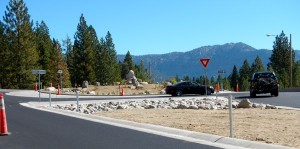
Improvements are already happening on Highway 28, like the roundabout put in this season at the base of Mount Rose Highway. Photo/LTN

The agencies are relying on local efforts like the Crystal Bay plan and other studies, and then working to fill in the gaps, according to Derek Kirkland, capital program specialist with the Tahoe Transportation District in Stateline, one of the participating agencies.

“One of the thoughts being considered in the plan is to relocate the unsafe shoulder parking to various off-highway locations within the corridor and provide more convenient access to popular recreational destinations,” Kirkland said, “and create multi-modal connections through shared use paths separated from the highway as well as transit service for the entire corridor.”

The Highway 28 plan could end up including transportation service from as far away as Reno as well as new parking lots, hiking and biking trails and road improvements such as new signage and guard rails to boost safety, improve lake clarity and attract new visitors.

The agencies are seeking public comment on the project during four public meetings. Three meetings – in south Reno, at UNR and in Carson City – were this past week and the final meeting, at The Chateau in Incline Village, is scheduled Oct. 9 from 5-7:30pm.

Three of the four meetings were outside the basin because the majority of the visitors to the corridor are from Reno, as well as Carson City and Carson Valley, Kirkland said.

There is also a website to post suggestions and ideas through Oct. 29. At the website, people can type comments on virtual sticky notes and attach the notes anywhere on a map of the area. Visitors can also read and “like” comments left by others.

The effort started last year with the launch of the East Shore Express bus service between Incline Village and Sand Harbor State Park, which was designed to reduce car traffic and parking along the highway during the busy summer season.

The service, which had 12,000 rides between June 15 and Sept. 3, resulted in about 162 fewer cars parked along the shoulder of Highway 28 on peak summer days, according to the TTD, which used LSC Transportation Consultants to count cars during busy days in August.

Kirkland said the goal is to extend the bus service to Spooner Lake. To fund that, service on Monday and Tuesday may be reduced in the future to free up the limited money. Currently, two buses run every 20 minutes from 9am to 6pm between Incline Village and Sand Harbor during the summer. The service is funded by grants from the U.S. Forest Service and the Nevada Department of Transportation as well as fares, which are $3 for adults and $1.50 for children.

Bike trails from Lake Shore Boulevard to Sand Harbor are also being studied and will soon undergo environmental review with construction slated for 2014. Loomis Engineering in Carson City is designing the trail and a draft document for public comment should be available this winter or spring, said Nanette Hansel, senior environmental planner with Ascent Environmental in Stateline.

The trail, designated for now as the North Demonstration Project, would be part of the Stateline-to-Stateline bike trail. The first mile of the South Demonstration Project, from Kahle Drive to Elks Point Road, is expected to be completed this month and the next portion, from Elks Point to Round Hills Pine Beach, will begin next summer.

Kirkland said they are also talking to the Mt. Rose ski resort about using its parking lot in the summer and providing transportation from there to the corridor.

“Students (at UNR) want a bus from Reno to the lake,” he said.

For the future, the agencies are considering adding parking lots along the Highway 28 route to reduce shoulder parking, adding trailheads to make it easier to access beaches, more bike trails, and signage and guard trails both for safety and aesthetics.

“One option is getting rid of all shoulder parking with new parking lots,” Kirkland said. “Not taking away parking but relocating it.”

Shoulder parking, said Kirkland, contributes to road erosion and poses dangers to drivers, bike riders and walkers alike.

But it will be close to impossible to find land to build parking lots, said North Swanson, a resident of Cave Rock who attended the Carson City public meeting on Oct. 4.

“It’s steeper than heck on both sides,” said Swanson. “Frankly, our concern is they will take away our parking. We’ve fought the battle for parking for 25 years.”

Swanson is a coordinator for Tahoe Area Naturists and appealed a USFS plan to enlarge its lots that he said would have reduced parking from 500 spots on the highway shoulder to 50 parking lot spaces.

Shelly Aldean, a Carson City supervisor who also attended the meeting, said she was in favor of plans that cut down on car traffic and its ill environmental effect.

“Anything that reduces congestion, idling time and removes people from the shoulders,” Aldean said. “We need a multifaceted approach.”

This Highway 28 diagram outlines some of the plans.


Gaming officials believe industry is growing

By Richard N. Velotta, Las Vegas Sun

Representatives of six gaming companies are optimistic about what the future holds for the industry with expansion and technological advancements leading growth in the next five years.

While executives aren’t predicting any major resort openings on the horizon, they are enthusiastic about the potential for new venues internationally and using technology to more effectively market to younger players.

Most of the panelists also view the legalization of Internet poker as a potential driver for more customers in their brick-and-mortar casinos.

Comments were made Wednesday at the third day of the four-day Global Gaming Expo at the Venetian. Representatives of Las Vegas companies MGM Resorts International, Las Vegas Sands and Bally Technologies were among the speakers addressing a broad range of topics on the state of the industry.

Patti Hart, CEO of gaming equipment manufacturer International Game Technology, said she’s optimistic about growth because gaming is expected to spread throughout Asia after the successes of Macau and Singapore. She said her company also is continuing efforts to personalize casino experiences with software programs that provide more interactivity between casinos and their customers to appeal to a market of young players comfortable with the portable computer devices they use.

Michael Leven, president and chief operating officer of Las Vegas Sands, and Jim Murren, CEO of MGM Resorts International, said a number of Asian countries — Vietnam, Cambodia, Thailand, Taiwan, South Korea and Japan — are considering casino-centered integrated resorts after seeing how well operations in Macau and Singapore have performed. Sands and MGM have resorts in Macau, Sands is the market leader in Singapore and MGM is building a nongaming resort in Vietnam and is exploring prospects in the Canadian province of Ontario. Sands also has focused attention on a Las Vegas-style resort in Spain.

Panelists expect the legalization of Internet poker in the United States would lead to expansion of gaming in land-based casinos in the same way that the expansion of gaming in other states and on Indian reservations ultimately led to growth for Las Vegas.

Leven added, however, that his boss, Sands CEO Sheldon Adelson, opposes the legalization of Internet poker because he fears the inability to control underage gambling and because the investment necessary to get enough online customers to make a venture lucrative would diminish its profitability.

“There are three concerns with online gaming which we as a company have studied in-depth,” Leven said. “One is the profitability of it when there are so many people in line. Today, there are a few people in the market nationally that make a lot of money. We believe that when everybody gets in that the cost of acquisition of customers in the online gaming marketplace will go up dramatically so profitability is going to go down. So it’s not going to be a free lunch for everybody where everybody wins.

“Secondly, we believe there is some danger particularly with at the college-student level and with young adults where potentially we can’t control the irresponsibility of their gaming. I think Sheldon has been outspoken about it, but he has not, to my knowledge, talked with any senator or anybody in government about how to vote on the issue. He has just vocalized that he is worried about that particular control problem.

“The third issue is simply a matter of wealth distribution,” he said. “How much money is available in the market? Will it affect Las Vegas casinos? We don’t really think so. But will it affect some of the Indian casinos or casinos in some of the smaller markets? We think it will have some impact because some of the money will not be available to be played in those markets.”

Leven also said the industry’s desire for federal oversight in online poker could also lead to more government intrusion and lower profits because the federal government tends to build bureaucracies when developing regulatory agencies.


Ex-employees sue disability attorney

By Anne Gonzales, Sacramento Bee

A prominent Carmichael quadriplegic attorney who sues small businesses for disability access violations has been sued by employees alleging wrongful termination, sexual harassment and a hostile work environment.

The four female workers say they were hired as legal assistants but were first “forced to go through personal care training,” including taking off their boss’s underwear and putting on his swim trunks, according to the suit filed in Sacramento Superior Court in August.

Calls to attorney Scott Johnson’s office for comment were not answered.

Johnson has been in Lake Tahoe for several years suing small businesses who are out of ADA compliance.

The employees, who worked for the law office operated out of Johnson’s Carmichael home, also were uncomfortable with some of Johnson’s business practices in gathering evidence for lawsuits and his payments to students to sign declarations, according to the suit.

The workers were trained to care for their boss in case a personal attendant was not present. During the training, they helped Johnson out of bed, undressed him, put on his swimsuit, carried him to a hot tub, then removed him from the tub, took off his wet trunks, dried him off and rubbed lotion on him before dressing him, the suit says.

The plaintiffs also claimed that Johnson aimed cameras on them in the office, including one trained on an employee’s breasts, and placed a camera in the restroom, keeping tabs on them through a 72-inch screen TV in his upstairs bedroom and a mobile application on his cellphone.

The plaintiffs – Jenna Doeuk, Esra Jones, Monthica Kem and Micaela Lucas – say they lost their jobs Aug. 9, after protesting the working conditions. They seek economic, general and punitive damages, along with court costs and attorney’s fees.

The plaintiffs worked for Johnson at his firm, Disabled Access, for anywhere from one to five years.

The suit alleges the workers were forced to go into businesses to see if they were in violation of the Americans with Disabilities Act. Johnson has built a legal career around threatening to sue hundreds of businesses for noncompliance with the ADA, typically settling for undisclosed amounts after fixes or upgrades were made.

In a recent local case, Ford’s Real Hamburgers in Sacramento closed last weekend, citing a slowdown in business and a Johnson suit over alleged ADA violations.

The plaintiffs said they felt like they were “committing fraud” by visiting businesses “under the ruse” of seeking the businesses’ goods or services. They also used restrooms to check for violations, sometimes while Johnson waited outside in his van.

They claimed Johnson would sometimes merely drive by businesses that were potential lawsuit targets. He also would find disabled students in housing complexes he was interested in suing, the lawsuit alleges, and paid up to $150 month toward their rent. In one instance, he asked a student to sign a declaration of some kind.

The employees also complained that Johnson made sexual comments, stared at their breasts and buttocks, asked them about their bathroom habits, displayed racy calendars, required them to help him change his dress shirts and made them do his son’s homework.


Managing forests could boost water yields

By Kathleen Masterson, Capitol Public Radio

Here at the 4,000-acre Blodgett Forest Research Station in the Sierra Nevada foothills, researchers have ongoing projects testing different techniques like clear-cutting and selective harvesting and prescriptive burns.

And soon they might also look at what kinds of forest management produce more clean water.

Forest manager Rob York shows me a 12-acre plot where he’s selectively removed individual trees. The sunlight is filtering in. It’s a much more open space than the shady reserve of 100-year old trees we just came from.

“Water yield we would expect to increase, compared to the reserve, because we have reduced the amount of large trees that are constantly pumping water out of ground and releasing water into the atmosphere. And we’ve reduced the canopy cover, so that’s more through-fall of snow,” York said.

If more snow makes it through to the forest floor, it’s more likely to percolate into groundwater supply.

About a third of California’s water supply comes from mountain snowpack. If forestry managers can learn techniques that boost water yield from forests, even a small percentage increase could make a difference for the state.

The forest research could also offer lessons about how forests respond to climate change, that will likely bring stressors like drought and heat.

York says forests that haven’t been thinned may have a tough time in a drought.

“If climate change causes drought stress, then we’re more likely to see the impacts on those high density forests,” York said. “So density management I think is something that we can focus in on as having a high potential to be useful, with respect to making forests more resilient.”

York says another worry with climate change is whether it may allow invasive species or pests to thrive in the Sierra. He says so far the Sierra hasn’t had extreme problems that some other forests have experienced.