Douglas County explorers excel at competition

Cadets of Douglas County Sheriff’s Office Explorer Post No. 2015 recently won numerous top honors at a Law Enforcement Explorer Cadet competition in Paso Robles.

The 13th annual Central Coast Law Enforcement Explorer Competition hosted more than 400 law enforcement explorer cadets from 42 law enforcement agencies throughout California, Nevada and Arizona.

The three-day competition was extremely demanding; testing the mental preparedness, physical endurance and tactical and operational expertise of competing Explorer Cadets.

Cadets compete in a variety of law enforcement related scenarios, including Felony Suspect Detainment and Arrest, Crisis Negotiation, Vehicle Traffic Enforcement Stops, DUI Investigations, Vehicle Searches, Building Searches, Domestic Violence Investigations, Suspect Interview and Interrogation, Emergency Medical Aid, Patrolling, Hazardous Response/Active Gunman and a host of other law enforcement related tasks. Explorer Cadets also compete in individual and team physical agility tests.

Fifteen Douglas County Sheriff’s Office Explorer Cadets competed in the event. They ranged in age from 14 to 19. Due to the outstanding performance by the DCSO Explorer Cadets in the various competitions during the event, they placed third overall out of the total of 42 competing Explorer Posts.

The success of the DCSO Explorer Cadets is the culmination of months of extensive training and practical application exercises administered by DCSO Youth Services Officers Chris Griffith and Teresa Duffy.

To be a member of the DCSO Explorer program, Cadets must maintain an academic grade of 2.5 or above in school. Additionally they must train for several hours each week at the Sheriff’s Office, and they participate in hundreds of hours of community service each year.


FBI wants citizens to report government fraud

The FBI wants to help people who think there is public corruption and government fraud going on.

Gina Swankie, the FBI spokeswoman for the Lake Tahoe area who is based in Sacramento, said the alleged bribery involving South Lake Tahoe City Councilwoman Angela Swanson and former pot club owner Gino DiMatteo had nothing to do with issuing the press release.

“It’s more of an initiative because people don’t know where to report things they observe,” Swankie told Lake Tahoe News.

The Sacramento office includes 34 California counties: Alpine, Amador, Butte, Calaveras, Colusa, El Dorado, Fresno, Glenn, Inyo, Kern, Kings, Lassen, Madera, Mariposa, Merced, Modoc, Mono, Nevada, Placer, Plumas, Sacramento, San Joaquin, Shasta, Sierra, Siskiyou, Solano, Stanislaus, Sutter, Tehama, Trinity, Tulare, Tuolumne, Yolo and Yuba.

Public corruption, according to the FBI, includes bribery, extortion, embezzlement, racketeering, kickbacks, and money laundering, as well as wire, mail, bank, and tax fraud.

Anyone with information about such activities is urged to call toll free — 855.466.7243. Callers are asked to leave their name, telephone number and a brief description of their concerns and observations. Agents will review voicemail daily and contact individuals as needed.

“While the vast majority of public officials remain committed to the communities they serve, an extremely small minority of individuals usurp their public positions for personal or private gain,” the FBI said in a press release. “The FBI remains dedicated, along with our law enforcement partners, to ensuring this behavior is fully investigated and if necessary, prosecuted under the law.”

— Lake Tahoe News staff report


Then and now: Some businesses last throughout the decades

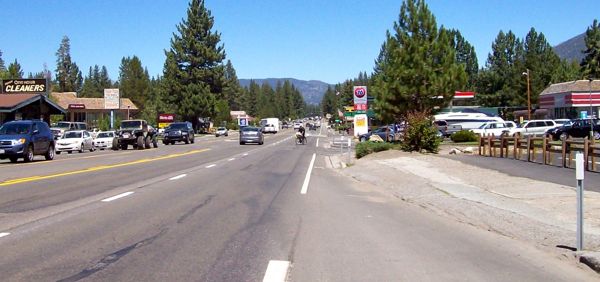
This is what Highway 50 looked like 47 years ago in South Lake Tahoe. Photo/Don Lane

These photos compare Highway 50 at Winnemucca Avenue in South Lake Tahoe from approximately 1965 to July 2012.

The dry cleaners at left has been there since at least 1965.

Hancock Gas is now an extinct brand. The station is now 76.

The profile of the distant trees hasn’t changed much.

South Tahoe at Winnemucca Avenue today. Photo/Bill Kingman

The casino billboards in the meadow were later replaced by Motel 6.

— Bill Kingman


Event helps future college students be prepared

The nonprofit Learning Bridge of the Sierra is collaborating with Adventure Risk Challenge, Sierra College and Sierra Nevada College to provide useful information for all college bound high school students at the College Knowledge Expo on Oct. 24.

Public, private and home-schooled students are encouraged to attend the free event. Families can come for a portion of the evening or for specific educational sessions.

Presentations begin at 6pm. Each presentation includes tips and resources as well as time for questions.

Attendees will learn how they can afford college by taking advantage of financial aid packages. Financial aid insights and invaluable resources for all college bound students based on actual case studies with Tahoe Truckee students who have attended CSU, UC and private four-year colleges will be shared. Accurate information on the Dream Act will also be provided.

At 6:30pm Laurie Brown from Adventure Risk Challenge will lead participants in an activity that will help them be more informed about writing a meaningful personal essay.

At 7pm, representatives from Sierra College and Sierra Nevada College will share useful information about their respective colleges.

For more information about the College Knowledge Expo, call (530) 426.2710 or email emily@learningbridgesierra.com.

The event is at Learning Bridge of the Sierra, 11603 Donner Pass Road, Truckee.


Opinion: Diminishing Sierra snowpack impacts all of California

By Forrest Shearer

As a professional snowboarder lucky enough to ride mountains around the world, I have seen the impacts of climate change first-hand. I’ve seen once-famous slopes now with zero snow, ski resorts that have shut down, and glaciers that are disappearing.

In my native state of California, boarders and skiers are bracing for the effects of a warmer world. Scientists are predicting the Sierra snowpack will decline by 25 percent by 2050. We caught a preview this past ski season, when Lake Tahoe and Squaw Valley had to make their own snow well into February. It’s no wonder the California Ski Industry Association is a big supporter of AB32, the state’s landmark clean energy and climate law.

But whether or not you’ve ever strapped on a board or some skis, all Californians should get behind the state’s groundbreaking efforts to save energy and tackle climate change. Because sooner or later, our changing climate will affect all Californians.

Consider that declining mountain snowpack I mentioned. It’s not just important for skiers and boarders and the businesses that rely on them. It also provides about one-third of California’s drinking water.

Or look at the record heat that’s been roasting parts of California, along with much of the rest of the country. It’s been epic; in fact, July was the hottest month on record for the continental United States, with drought covering almost two-thirds of the lower 48 and wildfires burning up two million acres.

Scientists tell us that extreme heat will become more and more common as the world warms. And we can expect more severe droughts, heavy rainfall events, and other extreme weather, as well as more wildfires.

Communities in vulnerable areas across the country are already feeling the burn of global warming. Through a program with the environmental nonprofit, Protect Our Winters, called “Hot Planet/Cool Athletes,” I go to schools in mountain communities throughout the U.S. to talk about climate change.

Through these visits, I’ve seen that young people get it. Their future depends on a healthy environment, and they are committed to doing their part. At one school, a teacher talked about the school’s recycling efforts, and said anyone who wanted to get involved should see a student who was in charge of the whole program. I was very impressed with that kid and it’s my hope that today’s young students become tomorrow’s environmental leaders.

But we shouldn’t put the burden on kids to protect the environment.

Adults have to take responsibility for the mess we’ve made and not leave it for future generations to clean up.

So far, California is doing pretty well. The first step in tackling climate change is burning less fossil fuel, and California leads the nation in energy efficiency. Then you develop alternative energy sources that are cleaner or that don’t pollute at all. California leads the country in solar power, wind power, and electric vehicle deployment. And now with AB32, we will show the nation how to create a successful market-based system for reducing emissions.

What Californians do is especially important, because what happens here will be imitated elsewhere. Californians are trendsetters, especially when it comes to influencing younger people. Surfing, skateboarding, and snowboarding started here, movies and television shows are made here, and environmental trends get started here – the rest of the country, and much of the world, ends up following our lead. Through AB32 and other smart energy policies, California is blazing a trail to a sustainable clean energy future.

For some people, it’s too much. They want us to slow down. But we can’t stop now.

When you’re tackling gnarly terrain on a snowboard, you can’t hesitate. You have to know that you’ve trained, trust your instincts, and commit yourself fully. California has made a great start on a rad run. Let’s stay committed.

Forrest Shearer grew up as a Southern California surfer and is now a professional snowboarder. He works with Protect our Winters, the Alliance for Climate Education, and the Action Sports Environmental Coalition.


Cocktails evolving into more than just a mixed drink

By Kathryn Reed

Drinking isn’t just about quenching one’s thirst. These days it can be a meal unto itself based on some of the ingredients.

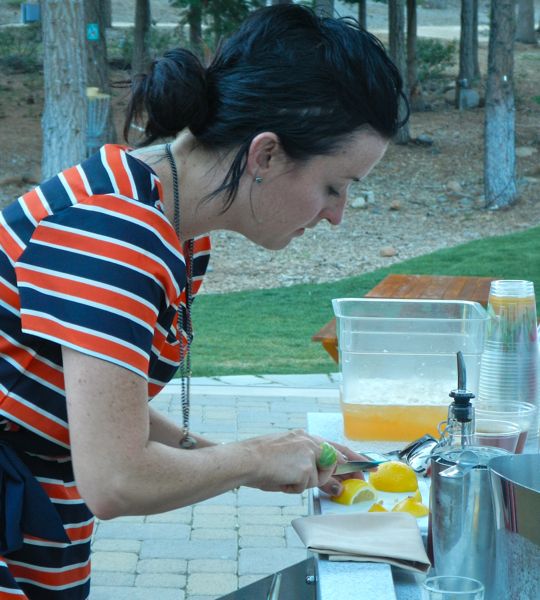
Mixologists have come into their own. They are much more than a bartender. They are chefs behind the bar – creating cocktails that are anything but ordinary. While using locally grown ingredients, much like chefs are doing these days, they are also creating drinks that are seasonal in nature.

“We are bringing the kitchen to the cocktail,” is how Camber Lay, with Parallel 37 at the Ritz in San Francisco, described how mixologists approach drink making.

Glasses are ready to be filled with A Wild Rose from the West Shore Cafe, one of the winning drinks at the Mix It Up event at the Ritz-Carlton, Lake Tahoe. Photos/Kathryn Reed

Two events in September tested regional drink creators’ ability to invent an original drink for the public, while competing against their peers. Wild Turkey was the spirit those at the Ritz-Carlton, Lake Tahoe had to use, while vodka was the liquor in the drinks at the Barton Foundation gathering.

Both events collected money for charities. The one at the Ritz at Northstar raised funds for Project MANA, which is a hunger relief organization serving the North and West shores of Lake Tahoe and Truckee. This event was part of the larger annual Autumn Food & Wine Festival. Barton’s Signature Cocktail event at Riva Grill in South Lake Tahoe was a fundraiser for the Barton Foundation.

The South Shore event grossed $5,900. Each bartender donated his or her tips, which raised more than $500 of that amount.

Gail Oversteg from Manzanita restaurant at the Ritz picked some lemon verbena from the property for her Mela Melange, which she described as a deconstructed Manhattan.

Nicole Barker of Cin Cin at the Eldorado casino in Reno has a pear tree at her house. She boiled some down for six hours to use as the base for her drink.

Camber Lay likes using local, seasonal items in her cocktails at Parallel 37 in San Francisco.

“We do everything fresh, from scratch. There are no low end liquors,” Barker said of her bar.

Kelley Luchs from the West Shore Café in Homewood came up with A Wild Rose. He said he wanted to play with something not often used – so rose water was his special ingredient.

The public picked the winning drinks at the Ritz, with Luchs and Barker tying.

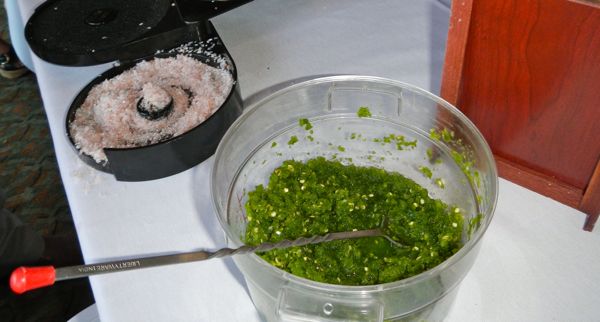
Muddled jalapenos were an ingredient in two drinks at the Barton event.

On the South Shore, with the winning drink eventually winding up on the menu at the Barton Gala in December as part of the Festival of Trees and Lights, winter was a central theme for the creators.

Two cocktails at this event used fresh jalapenos. Jimmy Kelso from the Edgewood came up with the Caliente Christmas Martini. Vodka, pomegranate and muddled jalapeno were the major ingredients. It was served with a candied jalapeno.

James Kent Meiers of the Cantina devised the Cukacabra. Vodka, orange agave liqueur, with muddled cucumber and jalapeno were the winning combination. That drink will be served at the gala in two months.

“I was mixing flavors to complement Cantina’s food,” Meiers said of how he came up with the drink.


Hospitals less safe than most people think

By Marty Makary, Newsweek

When I was a medical student, modern medicine began to seem as dangerous and dishonest as it was miraculous and precise. The defining moment came when I saw a sweet old lady I cared about die after a procedure she didn’t need and didn’t want.

I had been assigned to follow Ms. Banks, whose scans revealed advanced ovarian cancer. Despite the poor prognosis, the conventional treatment is major surgery to remove the uterus, cervix, fallopian tubes, and ovaries. But I got to know Ms. Banks, and she told me that she just wanted to spend time with her family and do a few more things before she died. I explained to her that she could be passing up a potential, albeit unlikely, cure; then at the morning staff meeting I tried to communicate her wishes to forgo both a biopsy and treatment. I was shredded up, down, and sideways.

The drive for the doctors to do a biopsy was like a train no one could stop. Eventually, by overstating the benefits and understating the risks, the doctors convinced Ms. Banks to undergo the biopsy to confirm her diagnosis. Then, during the procedure, the biopsy needle accidentally punctured a major blood vessel, which resulted in an added six-week stay in the hospital, marked by blood transfusions, multiple CAT scans, and malnutrition, since most of the time she was not able to eat. Those six hellish weeks turned out to be six of her last nine on earth. Despite the apparent problems with her care, information about her preventable complication and prolonged hospitalization were never presented in our staff meeting or reviewed internally in the same way that other industries learn from their bad outcomes. I realized that hospitals did not have to disclose their outcomes to anyone, even when they were much worse than the national average. In fact, when I explained to the head attending surgeon what happened and recounted Ms. Banks’s objections to the biopsy, I was told that sometimes patients don’t know what they want and we need to decide for them.

A host of new studies examining the current state of health care indicates that approximately one in every five medications, tests, and procedures is likely unnecessary. What other industry misses the mark that often? Others put that number even higher. Harvey Fineberg, M.D., president of the Institute of Medicine and former dean of the Harvard School of Public Health, has said that between 30 percent and 40 percent of our entire health-care expenditure is paying for fraud and unnecessary treatment. While patients are encouraged to think that the health-care system is competent and wise, it’s actually more like the Wild West. The shocking truth is that some prestigious hospitals participating in a national collaborative to measure surgical complications have four to five times more complications as other hospitals. And even within good hospitals, there are pockets of poorly performing services.

A new generation of doctors has been developing fair and simple ways to measure how well patients do at individual hospitals. In hospital-speak, we call the information “sensitive data”—data that would tell you which hospitals have much worse outcomes than others.

It’s the kind of data that, if you had access to it, would help you know just where to find the best care. But you don’t. And that is precisely the problem with the entire system: because a hospital’s outcomes are hidden from the public, neither consumers nor payers have any way of measuring whether the medicine they provide is good, adequate, or even safe. Much as the financial crisis was incubated when bank executives turned a blind eye to the ugly details about their mortgage-backed securities, so too does medicine’s lack of accountability create an institutional culture that results in overtreatment, increased risk, and runaway costs.

Politicians debate different ways to pay for our broken system. But if we are going to get serious about reducing health-care costs—and improving health-care outcomes—we need to address the 20 percent of medical care that is unnecessary and dangerous. The public should demand disclosure of a hospital’s patient-outcome statistics. After all, we have information on a car’s safety record to inform our decision about which car to buy. But when it comes to choosing medical care, the consumer is left to walk in blind. While we currently have a free market for health care, the competition is at the wrong level. Many patients tell me they choose their medical care based on parking. For an industry that represents one sixth of the U.S. economy, we can do better than that.

Read the whole story


Sense of adventure needed to eat this Nordic cuisine

By Katie Baker, Newsweek

When foodies hear the word “Fäviken,” it conjures up dark spruce forests, deep Scandinavian cold, and a hunting, foraging chef whose 14-seat restaurant in the remote Swedish hinterlands has become a pilgrimage site for global gastronomes.

Now, Magnus Nilsson is bringing his robust brand of New Nordic cuisine—famous dishes include wild trout roe in a crust of dried pig’s blood, and scallops cooked over burning juniper branches—to his first cookbook, Fäviken, out Oct. 1 from Phaidon Press.

Not yet 30, with wild blond hair and babyish cheeks, Nilsson is a local Jämtland kid who worked in two of Paris’s greatest kitchens before returning home to run an eatery whose intense commitment to locavorism is perhaps rivaled only by René Redzepi’s Noma in Copenhagen.

Like Redzepi, Nilsson crafts his menus out of rare ingredients specific to his corner of the world—reindeer lichen, lingonberries, black grouse—and his familiarity with the Swedish landscape is deep and reverent. He knows how to stuff a hare’s cavity with pine branches to keep it from spoiling; where to find tufted vetch and edible lupin; how to drain the blood from a wild bird to keep its flesh fresh and flavorful.

Nilsson’s reliance on the bounty of his surroundings is, of course, what makes Fäviken so famous—and also what makes the cookbook less of a practical how-to for the home chef and more of an ode to a fantastical place and a type of cooking that has mostly disappeared from the Western world. Few but the most monkish of readers will have the time, equipment, or dedication that Nilsson counsels for his dishes.

Recipes call for fresh cow hearts, rib-eyes “dry-aged for 20 weeks,” and burning marrow bones sawed apart at the table. Pantry staples include birch syrup, moose-meat powder, and mead. Dishes can take a year or two to prepare due to the drying time for marigold petals or the fermenting process for grey peas.

One of the most enchanting things about the book is its powerful sense of place: its pages shimmer with the mountains and glens of Jämtland, a region supposedly created by the Norse god Thor “during a drunken accident” and whose woods and streams team with fish and fowl. Nilsson’s recipes are paeans to this wilderness: capercaillie and “coniferous forest”; pine-bark cake with wood sorrel; pork broth filtered through moss. Nilsson tracks his menus as they change with the seasons: here, in spring, are fresh mussels, wild onions, and thrush. By summer, the kitchen bursts with ripe berries and herbs. Fall brings chanterelles, fat geese, and decaying leaves. Winter is austere, all about survival, with cured meats and jams and all manner of vegetables pickled and dried.

This is the type of food that Nilsson’s grandparents ate—rektun mat, or “real food”—and the emphasis is on the earthy and the super-fresh. The techniques are from another time, too—such as knowing how to butcher a cow to use all its parts. It’s cooking from a pre-industrial — or maybe post-apocalyptic—age. (Globalism does creep in: the staff’s favorite family meal is Hawaiian pizza, with ham and pineapple.)

As a teenager, Nilsson says he sketched out a 20-year business plan that “ended in me running the best restaurant in the world.” But when he first started at Fäviken, the restaurant was so isolated and unknown that he could barely recruit extra staff members. Yet he never gave up his belief that his food would be of a “high-enough quality to make it worth travelling for.”

He’s clearly passed that mark: the restaurant is often booked up months in advance. For the rest of us who can’t make the trip, there’s this cookbook, and its little slice of his “magic culinary wonderland out there in the wilderness.”


Court: Red Hawk Casino receiving excessive amount of water

By Denny Walsh, Sacramento Bee

The El Dorado Irrigation District is supplying an unlawfully excessive amount of water to the Red Hawk Casino in El Dorado County, a state appeals court ruled Thursday.

The district based its 2008 agreement to supply 95 gallons of water per minute to the casino’s owner, the Shingle Springs Band of Miwok Indians, on two legally flawed premises, a three-justice panel declared in a 36-page published opinion.

A residents’ group, Voices for Rural Living, challenged the agreement.

Thursday’s opinion affirms an earlier ruling by El Dorado Superior Court Judge Kenneth J. Melikian, except for the remedy. The judge exceeded his authority in directing the district to prepare an environmental impact report in compliance with the California Environmental Quality Act, the panel said.

“How an agency complies with CEQA is a matter first left to the agency’s discretion,” the justices said. “We thus will reverse (Melikian), but only on this point to allow (him) to set aside EID’s decision and remand the matter to EID for further consideration.”

The irrigation district claimed the memorandum of understanding between it and the tribe did not require an environmental review because it fell under a CEQA exemption for small construction projects.

The district and the tribe relied on the fact that the only necessary physical adjustments were relocating a meter and installing pipeline linking it to a water main.

But the appellate panel found that selling that much water to the tribe carries environmental risks apparently not considered by EID officials.

The project’s scope – providing an amount equal to 216 additional residences – “obviously is a fact that distinguishes (it) from the type of projects contemplated by the exemption,” the panel said.

“EID apparently did not give any consideration to (the) possibility of additional shortages of water during a drought due to climate change when it determined how much of its supply was unallocated and available for use. Its analysis was based simply on past historical use and supply. It thus ignored evidence in the record suggesting it already lacked sufficient water to meet its expected demand during a drought, even when it delivers the reduced levels of water it plans to deliver.”

The opinion was authored by Associate Justice George Nicholson, with Acting Presiding Justice Cole Blease and Associate Justice Elena J. Duarte concurring.

They were equally unforgiving about the irrigation district’s conclusion that restrictions imposed in 1989 by the El Dorado County Local Agency Formation Commission on how much water could be sold to the tribe are unconstitutional.

The tribe and EID entered into an annexation agreement, subject to LAFCO approval, that brought the tribe’s 160-acre parcel along Highway 50 between Shingle Springs and Placerville into the district’s service area.

LAFCO authorized water only for residential and related uses, and only in an amount necessary to serve no more than 40 residential lots.

The appellate justices noted the Legislature has vested area LAFCOs “with the sole and exclusive authority to approve annexations of territory into special districts. This authority includes the power to impose conditions of approval on an annexation.”

California law makes these conditions enforceable and a public agency “has no discretion to disregard them,” the justices said.

They also included a reminder for EID: What is and is not constitutional are issues “to be resolved by the judiciary.”


Second World Cup snowboarding event canceled

Money is impacting the snowsports world. The second event where snowboarders earn points to qualify for the Sochi Winter Olympics in February 2014 has been canceled.

Organizers in Stockholm have canceled the Nov. 17 Snowboard World Cup “due to economical reasons.”

An event scheduled for London later this month was nixed last month because of money issues.

This season is when athletes begin earning points for the next Winter Games.