Homes selling throughout Lake Tahoe Basin

Home sales have continued to rise around Lake Tahoe, where there was a 37 percent jump in units sold and a 16 percent rise in sales volume, according to a quarterly report released by Lake Tahoe-based real estate company Chase International.

Homes less and more than the million-dollar mark experienced significant increases in sales (37 and 33 percent, respectively) while overall prices fell around the lake. The median price of a home in Lake Tahoe is $330,000 (down 11 percent) and the average price is $538,289 (down 15 percent). There is promise for home prices however, as the National Association of Realtors is projecting the median existing-home price to rise about 5 percent in 2012 and 2013.

Sales were strong in all areas of Lake Tahoe. Tahoe City saw a 33 percent increase in sales volume and a 42 percent leap in homes sold. Incline Village experienced a 30 percent increase in volume and 44 percent jump in homes sold. South Lake Tahoe came in with a 22 percent rise in volume and 34 percent increase in homes sold, while the East Shore saw a 39 percent decrease in volume (primarily due to a small dip in units sold for more than a million dollars) and a 27 percent rise in homes sold.

Incline Village has the highest median home price (down 8 percent to $702,000) and South Lake Tahoe has the lowest median home price ($239,000, down 14 percent). Tahoe City saw the lowest drop in median home price (down 7 percent to $419,000) while the East Shore had the biggest drop in median home price (down 29 percent to $410,000).

There were slight variances in Truckee home sales. The median home price rose two percent to $445,000 while sales volume was up three percent and units sold increased six percent. Ski areas (Northstar, Squaw Valley, and Alpine Meadows) experienced an 11 percent drop in sales volume and nine percent rise in units sold. Homes selling for less than $1 million were up 24 percent.

The report compares sales from Jan. 1 through Sept. 30, 2012, to the same time frame of 2011.

 — Chase International real estate


Learn about how women got the right to vote

Do you know what went into getting American women the right to vote? The film “Iron Jawed Angels” (with Hilary Swank) tells the story of two courageous women who in the early 1900s helped get women the right to vote.

Unity at the Lake is sponsoring the movie night on Oct. 15 at 7pm.

Donations will be accepted.

Unity at the Lake is located at 1195 Rufus Allen Blvd., across from the South Lake Tahoe recreation sign.


‘Green Fire’ to be aired in Incline

“Green Fire”, a documentary film about legendary conservationist Aldo Leopold, will be shown Nov. 8 at Sierra Nevada College.

Doors open at 6:30pm and film begins at 7pm. A question-answer period will follow.

The screening is free.

The college is at 999 Tahoe Blvd., Incline Village.


Controversy arises over using wastewater for snowmaking

By Mary Catherine O’Connor, Outside

Pointing to the sacredness of the San Francisco Peaks north of Flagstaff, Ariz., a coalition of Native American tribes has been fighting the development and expansion of Arizona Snowbowl ski resort since 1979. It remains defiant, reports the New York Times, despite having suffered a key legal defeat this winter. A federal court ruled against the tribes in a nearly decade-old lawsuit that claims the ski resort’s plans to use treated wastewater from Flagstaff’s sewage system to make artificial snow for the resort would interfere with religious practices and mar the mountains.

Wait. The resort will use sewage to make snow? Technically, yes. That’s why the story has garnered lots of attention. But recycling treated wastewater for applications that do not require potable water is not nearly as icky, nor as uncommon, as it might sound. This type of water is commonly used for irrigating golf courses and soccer fields, for example.

While Arizona Snowbowl would be the first resort in the U.S. to use 100 percent treated wastewater to make snow, it’s a common practice in Europe and in parts of Australia, says Hunter Sykes, an environmental sustainability consultant who closely tracks the outdoor recreation industry and produced a 2007 documentary about the environmental impacts of rampant ski resort development called Resorting to Madness. “Most people who work with wastewater don’t see this an issue, because it’s not going to make people sick and, as far as we know, it’s not going to contaminate flora or fauna,” he says.

Not everyone is quite so comfortable, though, with the idea of using treated wastewater for snowmaking. Among the groups that oppose it, on the grounds that the water may contain chemical inputs from pharmaceuticals and other potentially hazardous hard-to-trace sources, include the Center for Biological Diversity. Sykes agrees that there is still much we don’t understand about the chemical agents that persist in treated wastewater and how they could impact the ecosystems into which they’re released, but says if it was up to him, he would use the treated wastewater.

Taylor McKinnon, public lands campaigns director for the Center for Biological Diversity points to a study that linked wastewater effluent released into a creek in Boulder, Colorado, with abnormal fish gender distributions. “There is an emerging and growing list of compounds [about which] we don’t know the affects,” he says, but we know that endocrine disruptors [in wastewater] will change fish sex ratios. This points to the need for additional research and more advanced water treatment.”

But McKinnon and Sykes do agree on one thing: the real story here is the increase in snowmaking, industry wide, and the wider environmental impacts of making snow.

One can argue that for a ski resort in an arid landscape such as Arizona, reusing wastewater for snowmaking can be a much better alternative, environmentally speaking, than using increasingly scarce fresh water. In either case, other issues loom large. These include the energy required to pump the water, the quality of that water (even if it comes from “natural” sources), and the ways that artificial snowpacks change mountain landscapes.

In the Times story about Arizona Snowbowl, a forester with the U.S. Forest Service is quoted saying that climate change is making snowmaking increasingly necessary at ski resorts. That may be true, but the act of making snow where coal is used to generate the energy to make the snow is only exasperating the situation.

“Burning coal to make snow is a self-destructive behavior for federal agencies and for outdoor recreation industry,” says McKinnon.

The energy required to make snow will only increase if winters begin later and skew toward warmer or more erratic temperatures. “For a lot of [ski] areas, snowmaking is the biggest single expense, even before payroll,” says Sykes.

Fortunately, many ski resorts are increasing the wind, solar and other types of renewable, clean-burning fuel they use for power generation. Plus, snowmaking equipment is increasingly energy efficient.

Ski resorts often make snow using nearby natural streams or lakes, but that doesn’t mean the water is clean. Sykes points to how, in Colorado, water pulled for snowmaking from the Snake River is tainted with zinc, copper, lead and other metals that seep from old mining claims.

Even if water that is extracted for snowmaking is clean, the act of extracting it leads to other “externalities,” he says. For one thing, pulling clean water upstream from sources of contamination, such as mining claims, removes the benefits of dilution that the water would have otherwise provided.

Reducing stream flow could have other consequences as well. “Another extraction issue is that you’re removing sizable amounts of water from streams in the fall, which is a key time for aquatic life,” says Sykes.

As snowpacks decrease in some parts of country, the demand for terrain parks is growing everywhere. To manufacture a sizable terrain park, ski resorts must manufacture snow. A lot of it.

That has led to more snowmaking, using more water and energy every year. In some areas, summer comes and goes but the massive piles of snow that were once halfpipes or tabletops remain. This prevents the natural cycle of melting and of plant growth and while these areas are small on each mountain, they add up in aggregate.

“You have a longer runoff period, so you have a lot of water running off smaller streams and they’re carrying increased amounts of sediment. This is happening in parts of the mountain that have already been denuded, so topsoil is already depleted,” says Sykes. “You’re changing the profile of the mountain.”

While sewage for snowmaking makes for good headlines, the real environmental issues seem to be hiding within the business of making snow.
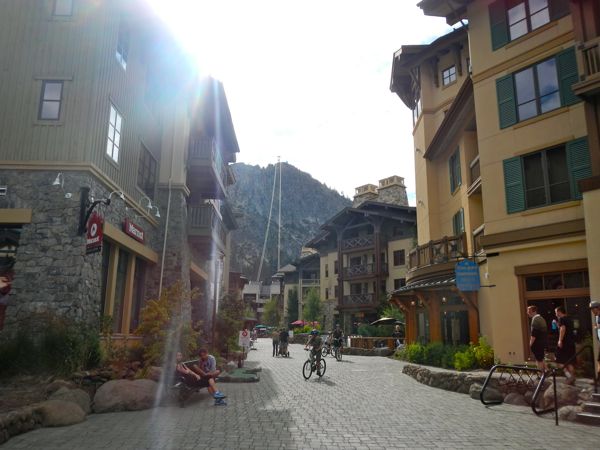



Snippets about Lake Tahoe

• Placer County has released the Notice of Preparation for the Squaw Village proposed project. The document is online. Comments will be taken through Nov. 9.

• The Sacramento Bee did a study on California legislators that shows in the 2011-12 session 99 percent of the time Democrats voted the same way as the majority of their party; 94 percent of the time Republicans voted the same way as the majority of their party.

• The Tahoe City Transit Center (165 West Lake Blvd.) will be officially unveiled Oct. 22 at 3pm.

• The Truckee Halloween Parade starts at the train station Oct. 26 at 6pm.

• A partnership between Homewood Mountain Resort, West Shore Café & Inn, and the Annenberg Foundation has put a camera on the mountain and at the lake as part of the nonprofit’s Pearls of the Planet initiative. Go online for more info.


Opinion: A no vote on Prop. 30 would be ‘horrific’

By Vicki Barber

Driving around our expansive El Dorado County — sprawling from the valley up through the foothills and forests to Lake Tahoe — I am constantly amazed at the diversity and beauty of the terrain.

I am equally impressed by the diversity of our school districts.

Vicki Barber

Yet after a quarter century of striving to improve the quality of education in both large and small, urban and deeply rural districts, I am feeling a growing concern — and personal sadness — about our local schools and the future of education in our communities.

My primary concern is not just about the pivotal Proposition 30 facing state voters in the Nov. 6 election but from a cumulative erosion of funding for schools in the past five years.

In El Dorado County our 12 local elementary districts, two unified districts and union high school district have been forced to cut about 20 percent from their annual budgets — about $22 million in real-world dollars. Numerous programs have had to be curtailed or canceled, with talented teachers and staff being laid off.

Amazingly, our schools have been able to sustain a solid performance level of 81 percent, despite cutback upon cutback. I credit the professionalism and dedication of our teaching, administrative and support staffs, as well as involved parents in our schools.

However, in my conversations with our professionals, I sense that the extra sacrifices most have made to sustain quality have taken a personal toll. The cuts are creating a level of discouragement and fatigue that begins to approach burnout for some.

There are two types of cuts: direct reductions in funding due to the multi-billion-dollar statewide budget deficit, and “deferred” payments — which amount to the same thing (cutting people and programs) locally.

Then comes this year’s blow (if voters reject Prop. 30): By the end of the school year, our districts must make another drastic cut of about 10 percent, or about $455 per student on a basis of $5,000 per student from the state. This would amount to several million more dollars.

While I am not advocating on behalf of Proposition 30, I feel it is my responsibility to warn of the immediate and longer-term impacts of its failure — impacts that will directly impact our 30,000 students, 6,500 professionals and support staff, and the overall quality of the education we provide our children.

Based on my lifetime of experience in education, including a quarter century with the El Dorado County Office of Education in budgeting, special services and as superintendent, last month I said publicly that the impacts would be “horrific.” I stand by that professional assessment.

It is demoralizing to those of us who have spent our careers trying to provide quality education for children, and now we’re dismantling programs that make a real difference.

I am not alone in my concern and sadness at witnessing the erosion of the quality educational programs I have spent a career helping build. It is what I hear from officials in our local districts, from colleagues statewide, from teaching and support staff throughout our schools, and even from within the County Office of Education itself.

Deputy Superintendent Jeremy Meyers, in charge of educational services and programs, believes that we are quite literally at a “tipping point” where quality cannot be sustained despite the dedication and best efforts of our staff. He notes that the cutbacks are not only increasing class sizes and reducing programs but are actually ending the careers of some teachers.

He’s right. We are seeing the brightest, our youngest folks who are coming into the profession at a time when we’re then saying to them, “We can’t continue,” as we hand them layoff notices under the last-in-first-out seniority rule.

The loss of another 10 percent in per student funding, on top of the deep cuts already made, could mean shortening the school year by three full weeks.

And despite the rhetoric of politicians on the importance of education to America, do we really believe — in comparison to other countries and the world economy — that we want our kids in the United States to receive three weeks less of school?

Vicki Barber is superintendent of schools for El Dorado County.


‘Silent Spring’ impresses more today than when first published 50 years ago

By Bryan Walsh, Time

When my predecessors at Time reviewed ecologist Rachel Carson’s book “Silent Spring” 50 years ago this month, they were less than impressed. While the piece praised her graceful writing style, it argued that Carson’s “emotional and inaccurate outburst” was “hysterically overemphatic,” which I believe is a fancy way of saying that the lady writer let her feelings get the best of her.

Time’s take was gentle compared with the reactions of some of her other contemporary critics. As William Souder writes in his new biography of Carson, “On a Farther Shore”, chemical companies threatened her with lawsuits after she argued that pesticide overuse was ruining the environment and threatening human health. Others insinuated that she was in league with communists who wanted to cripple American agriculture. As a former chemical-industry spokesman put it bluntly, “If man were to follow the teachings of Miss Carson, we would return to the Dark Ages, and the insects and diseases and vermin would once again inherit the earth.”

Today “Silent Spring” is regarded as a masterpiece, one of the most influential books of the 20th century. The criticism of Carson–and the sexism implicit in much of it–is a relic from an age devoted to better living through chemistry. Yet 50 years after its publication and 48 years after Carson’s untimely death from breast cancer, there’s still a small but vibrant industry in attacking “Silent Spring” and its author.

The claim now is that her polemic against pesticides led the world to phase out the insecticide dichlorodiphenyltrichloroethane, or DDT. That might seem like a good thing. In “Silent Spring” Carson describes the toxic effects of DDT use on animals, particularly birds, and in 1972 the Environmental Protection Agency banned it partly on the grounds that it was a probable human carcinogen. So long-lived and potent is DDT that even now, 40 years after the ban, most Americans still carry traces of the chemical in their bodies.

But DDT was also effective in killing the mosquitoes that carry malaria. Conservative critics have argued that by turning the world against DDT, Carson crippled efforts to fight the deadly disease in Africa, where it kills hundreds of thousands of people a year. The right-wing Conservative Enterprise Institute maintains a website called RachelWasWrong.org arguing that Carson’s “extreme rhetoric generated a culture of fear, resulting in policies that have deprived many people access to life-saving chemicals,” namely DDT. In 2005, British politician Dick Taverne wrote that “the anti-DDT campaign that she inspired was responsible for almost as many deaths as some of the worst dictators of the last century.”

The Godwinning of Carson ignores a few facts. Carson took pains to make it clear that she wasn’t calling for the banning of all pesticides, especially those that might be able to protect human beings against insect-transmitted diseases. Carson simply wanted to bring some balance to the use of powerful chemicals at a time when ecology was barely considered a science and industry had license to do whatever it wanted in the name of progress. As for DDT, many experts believe the pesticide would have been less effective against malaria-carrying mosquitoes in the scattered and remote villages of sub-Saharan Africa than it was in more densely populated North America. Africa’s staggering malaria death toll has more to do with decades of Western indifference than it does with a single book.

If “Silent Spring” gave birth to the modern green movement, the critical reaction to it created the blueprint for how industry defends itself against environmentalism. Whether it’s pesticides, asbestos or air pollution, the battle plan is the same: question the science, attack the scientists’ credibility and warn of unbearable costs. The plan hasn’t worked: the U.S. has become cleaner and healthier since “Silent Spring”, and the Dark Ages that serious men warned us about have yet to descend. But the fight is far from over, as the polarized debate over climate change demonstrates. Rachel Carson may have prophesied a silent spring, but the battle between her acolytes and her enemies will be long and loud.


Declining property values at ‘the hole’ in South Lake Tahoe create $1.5 million problem

By Kathryn Reed

Deciding to disband redevelopment agencies throughout California has proved to be more cumbersome than many people anticipated and has necessitated the revision of laws and new ones created to help local governments comply with what Sacramento wants.

It has left South Lake Tahoe and El Dorado County battling over $1.5 million. It’s Nancy Kerry as a member of the successor agency and Joe Harn, the county auditor who is supposed to oversee all the financial dealings with the agency, who are going after each other.

A meeting Oct. 11 of the South Tahoe Redevelopment Successor Agency board was heated and contentious at times. This is the board created after the state said redevelopment agencies must go away.

A lower assessed value on properties at the South Tahoe hole means a loss of $1.5 million. Photo/LTN

Hal Cole represents South Lake Tahoe and he is the chairman of the board. Other members include John Knight, El Dorado County supervisor; Kindred Murillo, Lake Tahoe Community College president; Vicki Barber, superintendent El Dorado County Office of Education; Randy Vogelgesang, South Tahoe Public Utility District board member; Nancy Kerry, South Lake Tahoe employee; and Coy Baugh, public member.

The battle over the nearly $1.5 million stems from property owners of the rebar and concrete that was supposed to be a hotel-convention center near the state line asked for their parcels to be reassessed. They were. It meant about $1.5 million less in property taxes having to be paid by those property owners.

But the problem is the county already allocated those funds. They went to the Redevelopment Agency before it was dissolved.

On Oct. 1, Harn said he would deduct the $1.5 million from the 2013 property tax disbursement.

On Oct. 9, city staff on behalf of the successor agency wrote a letter objecting to Harn’s actions.

Kerry, at the Oct. 11 meeting, said she is not disputing the money is owed, but questions who gets paid first. She believes the money should be considered a debt the successor agency would deal with. Harn says that is wrong, that the money is a tax roll adjustment.

Harn said it’s his job to make the correction without regard to who is affected by the action.

Kerry wants it as a debt because then the obligation to pay it back is secondary to the bondholders.

“It’s crippling to take all of it at once. The successor agency is not questioning that the money is owed,” Cole said.

In this post-redevelopment era, is it the county treasurer-tax collector who would determine if a payment plan could be structured. If it’s not, then where the $1.5 million comes from remains unknown.

It was resolved at Thursday’s meeting that the city on behalf of the successor agency would see if the county would work on a payment plan for the $1.5 million and that a meeting with the state Department of Finance would be sought so those people can weigh-in.

However, Mindy Patterson, lead analyst with the Department of Finance, on Oct. 11 via email confirmed the $1.5 million is a roll correction – not debt, as the city would prefer it labeled.

Having $1.5 million be wiped off the books also means the agencies that benefit from this property tax won’t be getting their share. That includes South Lake Tahoe, El Dorado County, STPUD, LTCC and Happy Homestead Cemetery District.

It’s likely their share of funds from what was redevelopment won’t be seen for years based on all the debt the successor agency is now saddled with.

The one bright spot for the agencies is that at the Oct. 11 meeting on a 5-2 vote, with Cole and Kerry the dissenters, it was agreed the $1.4 million that had been set aside for the Aspens housing project will be returned to the successor agency coffers. And in turn it will be distributed to the government bodies listed above.


Fuel mixture likely cause of South Tahoe fatal plane crash

While the definitive reason a plane crashed in August while taking off from Lake Tahoe Airport has not been determined, preliminary data points to the mixture of fuel as the reason.

Five people from Fresno died Aug. 25 when the Piper Cherokee nose-dived into a field as it was taking off toward the lake. Witnesses had said they heard the plane sputtering before is crashed.

“While taxiing to the ramp, the airplane’s engine shutdown and it took numerous attempts for the pilots to restart it,” according to the National Transportation Safety Board’s preliminary report. “Upon parking, the pilots reported to the attendants that the airplane’s fuel/air mixture was difficult to establish at such a high density altitude and that if you operate the engine too lean its temperature will exceed normal operation parameters.”

On board were Francisco De La Mora, 43, owner and pilot of the plane; his wife Lorena De La Mora, 39; their 6-year-old daughter Esmeralda De La Mora; Harold Cardwell, 60; and his wife, Kin Cardwell, 41.

— Lake Tahoe News staff report


Trail building day on Rim to Reno section

Tahoe Rim Trail Association will put the finishing touches on a new section of trail within the Rim to Reno Trail System on Oct. 20.

This new section of trail was started in 2011 and allows hikers accessing the Tahoe Rim Trail at Relay Peak from the Mt. Rose Summit trailhead off Highway 431 to hike on approximately 2.5 miles of new single track trail from the Galena Waterfall. In the past, hikers on this section of trail walked on a dirt access road for approximately 4 miles.

This section of trail is part of the larger Rim to Reno Project that will connect the Tahoe Rim Trail to the Thomas Creek Trailhead in Reno. Since 2010, the Tahoe Rim Trail Association, United States Forest Service-Carson Ranger District, Great Basin Institute, Washoe County Regional Parks and Open Space, and hundreds of dedicated volunteers have worked to make this vision a reality putting in thousands of hours to construct new trail.

On Oct. 20, the Tahoe Rim Trail Association will be celebrating this herculean effort during its End of Season Work Day Celebration. Community members, trail enthusiasts, and the general public are invited to attend. Festivities will kick off at 8:45am in the Mount Rose Summit parking lot off Highway 431. From there, attendees will carpool to the work site where the Tahoe Rim Trail Association will provide an overview the project and accomplishments to date. Trail building volunteers will then dig into the last workday of the season and will build the connection between the new trail and the old.

Volunteers of all skill levels and physical abilities are welcome and encouraged to participate — no prior experience necessary. The Tahoe Rim Trail Association will be providing lunch to volunteers. Register online in advance.

Volunteers should bring water, wear long-sleeved shirts, long pants, and sturdy closed toed shoes. The TRTA will provide hard hats, trail building tools, expert crew leaders and lunch.