South Tahoe library giving away a Kindle

Teens are encouraged to create a book mark this week because it is Teen Read Week.

Bring completed bookmarks to the South Lake Tahoe branch library by Oct. 20. For every bookmark submitted, the creator will be entered into a drawing for a Kindle.

For additional information, call the library at (530) 573.3185.

The library is at 1000 Rufus Allen Blvd.


Marijuana grow house found in Markleeville, 3 men arrested

Three Markleeville men are accused of growing marijuana at a barn in Alpine County.

“The barn contained two downstairs grow rooms. One room was complete with lights, timers, humidity monitors, fans, a carbon dioxide enrichment system and filtered external ventilation. There was even air conditioning installed and operating in the one grow room that was finished,” Alpine County sheriff’s deputies said in a press release of the Markleeville grow house. “The other room was nearly finished with all of the equipment new and in boxes, ready to be installed. The upstairs of the barn had younger plants growing with three tubs converted to producing hydroponic starter clones. A smaller grow was found in one of the rooms of the residence.”

John Borchard, 23, Stephen Seiller, 25, and Justin Jones, 35, were all taken into custody Oct. 13 on a variety of drug charges.

Deputies said of the house on Spring Canyon Drive in Markleeville that it was one of the most “sophisticated marijuana grows ever found in Alpine County.”

Deputies seized 312 marijuana plants, along with miscellaneous drug paraphernalia and thousands of dollars of growing equipment.

 — Lake Tahoe News staff report


Funds committed for Kings Beach mental health facility

Placer County Board of Supervisors last week committed $500,000 in state funding to support the Community House of Kings Beach, a proposed drop-in center for mental health and support services.

The funds will help finance the purchase and renovation of a former motel and residence at 265 Bear St. in Kings Beach by the Community House of Tahoe Truckee Community Foundation. The foundation has completed its purchase of the site and has started renovation work.

The property will be turned into a community center that will house the project’s three main partners: Tahoe Safe Alliance, North Tahoe Family Resource Center and Project MANA. The center also will provide desks for other service providers, four individual counseling rooms, a children’s therapy area and designated space for family team meetings.

It is estimated the community center will serve about 3,000 people annually.

The $500,000 will come from funds Placer County receives from the state under the California Mental Health Services Act. In a plan approved by the state in 2009, Placer County identified a community center committed to providing mental health and other services at North Lake Tahoe as a proposed use of MHSA funds earmarked for capital facility and technology projects.


Meeting to focus on trails through Martis Valley

By Barbara Barte Osborn, Sacramento Bee

A meeting for public review of a final environmental impact report for a proposed paved, multiuse trail through Martis Valley is scheduled Wednesday in Truckee.

The board of the Northstar Community Services District, lead agency for the project, will consider certification of the report at the meeting, scheduled for 5:30pm in the Truckee Town Hall council chambers, 10183 Truckee Airport Road.

If the district’s board certifies the report, it will later determine which of two alignments the approximately 9.5-mile trail would follow.

The alignment, width, aesthetics and potential user conflicts were among many concerns expressed during public review of the draft EIR.

Fifteen feet would be cleared for the 10-foot-wide, paved trail, which would begin on the south side of Highway 267 opposite Truckee-Tahoe Airport, continue through Martis Valley to the Village at Northstar, then climb to Forest Service Road 73, which leads into the Lake Tahoe Basin.

The originally planned route follows current walking trails and dirt roads and passes through a wildlife management area operated by the U.S. Army Corps of Engineers.

Because of protests from the public and the Corps, moving part of the trail closer to Highway 267 is also under consideration.

With an elevation change from 5,880 feet at its beginning to 6,200 feet at Northstar and 7,280 feet at the basin’s ridge line, the trail is planned to accommodate bicycles and all pedestrian uses except equestrian. The only motorized use would be powered wheelchairs.


Opinion: Free speech is fine until someone doesn’t like it

By Jonathan Turley, Washington Post

Free speech is dying in the Western world. While most people still enjoy considerable freedom of expression, this right, once a near-absolute, has become less defined and less dependable for those espousing controversial social, political or religious views. The decline of free speech has come not from any single blow but rather from thousands of paper cuts of well-intentioned exceptions designed to maintain social harmony.

In the face of the violence that frequently results from anti-religious expression, some world leaders seem to be losing their patience with free speech. After a video called “Innocence of Muslims” appeared on YouTube and sparked violent protests in several Muslim nations last month, U.N. Secretary General Ban Ki-moon warned that “when some people use this freedom of expression to provoke or humiliate some others’ values and beliefs, then this cannot be protected.”

It appears that the one thing modern society can no longer tolerate is intolerance. As Australian Prime Minister Julia Gillard put it in her recent speech before the United Nations, “Our tolerance must never extend to tolerating religious hatred.”

A willingness to confine free speech in the name of social pluralism can be seen at various levels of authority and government. In February, for instance, Pennsylvania Judge Mark Martin heard a case in which a Muslim man was charged with attacking an atheist marching in a Halloween parade as a “zombie Muhammed.” Martin castigated not the defendant but the victim, Ernie Perce, lecturing him that “our forefathers intended to use the First Amendment so we can speak with our mind, not to piss off other people and cultures — which is what you did.”

Of course, free speech is often precisely about pissing off other people — challenging social taboos or political values.

This was evident in recent days when courts in Washington and New York ruled that transit authorities could not prevent or delay the posting of a controversial ad that says: “In any war between the civilized man and the savage, support the civilized man. Support Israel. Defeat jihad.”

When U.S. District Judge Rosemary Collyer said the government could not bar the ad simply because it could upset some Metro riders, the ruling prompted calls for new limits on such speech. And in New York, the Metropolitan Transportation Authority responded by unanimously passing a new regulation banning any message that it considers likely to “incite” others or cause some “other immediate breach of the peace.”

Such efforts focus not on the right to speak but on the possible reaction to speech — a fundamental change in the treatment of free speech in the West. The much-misconstrued statement of Justice Oliver Wendell Holmes that free speech does not give you the right to shout fire in a crowded theater is now being used to curtail speech that might provoke a violence-prone minority. Our entire society is being treated as a crowded theater, and talking about whole subjects is now akin to shouting “fire!”

Read the whole story


Students continue to be spanked at school

By Alice Park, Time

Fifteen-year-old Taylor Santos let a classmate copy her homework, and she learned the hard way never to do it again. Santos, a student at Springtown High School in Texas, was punished by a vice principal with a swift swat to her bottom using a wooden paddle. The spanking left blisters and forced her to sleep on her side that night.

As upset as Santos’ mother was, however, it wasn’t the spanking, which she had consented to, that led her to complain to the school board. It was the severity of the punishment and the fact that it was delivered by a male administrator, contrary to the district’s policy that only teachers of the same gender as the student may mete out corporal punishment.

Across the U.S., Santos’ case and that of another student in the same school have fired up parental passions over whether corporal punishment should be allowed in schools at all. Nineteen states permit it, but researchers say there is little evidence that spanking actually works to change children’s behavior for the better.

In fact, kids spanked by their parents tend to be more aggressive than other kids and are likelier to develop behavioral problems as they get older; some studies show that corporal punishment can even lead to lower IQs. “The more kids are spanked, the more problematic their behavior is,” says Elizabeth Gershoff of the University of Texas at Austin, who has conducted the most comprehensive analysis to date of studies on corporal punishment and its outcomes.

Still, some experts say that because most of the research on spanking focuses on punishment at home, not in schools, it’s unfair to assume the effects are the same. It’s also possible that the studies aren’t measuring the impact of the punishment at all but instead simply reflect the fact that disobedient children who are disciplined are more likely to have behavioral problems in the first place. These experts point to studies showing that even nonphysical alternatives like verbal scolding don’t lead to positive changes in behavior among children.

Then there’s the issue of finding the line between discipline and abuse, which is hard enough for parents punishing their children to define and defend, never mind for non–family members like teachers. That’s what prompted Santos’ mother to speak out; the vice principal, she feels, just went too far.

In response, the Springtown school board decided to make changes to its corporal-punishment policy. Under the old rules, parents had to opt out of corporal punishment for their kids; now they must provide written permission for it to be administered. And parents can specify whether they want the punishment to be delivered by a male or female teacher, although an official of the same gender as the student must witness the punishment no matter what–meaning two adults will always be present.

For some experts, having to go to such lengths to make corporal punishment acceptable supports the idea that it doesn’t belong in schools at all. They say exposing children to any type of violence, at home or in school, can simply be too harmful.

Dozens of countries have taken a simpler approach, banning all forms of corporal punishment against kids, even if it’s administered by parents. While the U.S. Congress is considering such a ban in schools, the final vote — on the Hill and in the classroom — is uncertain.


2 Republicans seek to represent Tahoe in state Assembly

By Dana M. Nichols, Stockton Record

SAN ANDREAS — Non-Republicans may cast the deciding votes in the 5th Assembly District in November, even though Republicans have by far the largest registration numbers in the district and a Republican is certain to win.

That’s because two Republicans – Rico Oller of San Andreas and Frank Bigelow of Madera County – are on the ballot.

In the June primary, Oller had 33.9 percent of the vote and Bigelow had 29.9 percent. That primary, decided by California’s new top-two rule, sent the top finishers on to November regardless of party.

Those registered Democrat and no party preference combined make up just more than half of registered voters in the district, which means the eventual winner will likely need at least some of their votes.

Yet Oller, 54, and Bigelow, 58, are campaigning as conservatives who say they favor small government and believe that cutting taxes and easing regulation on businesses is the way to spur economic growth.

As a result, nonpolicy questions have become a significant focus in the campaign, with Oller portraying Bigelow as a lukewarm conservative prone to changing his views and Bigelow portraying Oller as a career politician.

“They don’t want people that have already served in the Legislature,” Bigelow said of why he thinks voters will choose him over Oller.

Oller formerly served two terms in the Assembly and one in the state Senate. Bigelow is a Madera County supervisor.

Both men also own businesses. Bigelow comes from a ranching family that also owns Ponderosa Telephone Company. Oller has a building materials supply company in San Andreas.

Oller criticizes Bigelow for waffling on high-speed rail. Although Bigelow now says he opposes the plan, he voted for it in years past on the Madera County Board of Supervisors.

“I am the same person I have been all through the race and I am not going to change,” Oller said. “Frank, on the other hand, is much more morally flexible and is willing to change his positions depending on the circumstances.”

Bigelow said his views on high-speed rail changed because more recent reports exposed problems with the viability of such a system.

Bigelow says he, too, is a solid conservative.

“I think I am a strong person who has a conservative ideology,” Bigelow said.

Bigelow has raised significantly more campaign donations than Oller, much of it from political action committees tied to corporations and Sacramento lobbying groups. His donors include the California Dental PAC, the California Real Estate PAC, the California Professional Firefighters PAC and the United Indian Auburn Community, which is the tribe that owns the Thunder Valley Casino in Lincoln.

Bigelow’s perspective on why these donors give to him: “Maybe because people want me elected.”

Oller’s perspective: Bigelow is tied to Sacramento special interests.

Oller, too, has donations that indicate the interests he supports. Organizations that have given him money in the past few months include the Howard Jarvis Taxpayers Association and the National Rifle Association.

The 5th Senate District includes all or part of seven counties on both slopes of the Sierra Nevada south of Lake Tahoe. It also includes a few Valley areas around Madera.


Snippets about Lake Tahoe

• After six years of planning and lots of money spent, the owners of Bob Dog Pizza in Meyers broke ground last week on their building.

• State Sen. Ted Gaines, R-Rocklin, scored 100 percent on the California Taxpayers Association’s 2012 Voting Record. Gaines was one of 29 state legislators out of the 120 to receive the top score.

• Here are the roadwork schedules from Caltrans for the coming week – Sierra and El Dorado-Tahoe.

• Placer County is having a meeting on the Tahoe Basin Community Plan on Oct. 17 at 6pm in the North Tahoe Event Center, 8318 North Lake Blvd., Kings Beach.

• Nevada Department of Transportation officials are warning it’s fall migration time for deer – and to drive carefully. In the U.S. a vehicle hits a deer every 26 seconds.


Opinion: GOP platform contains world’s strictest abortion policy

By Joel Brinkley

Costa Rican women are appealing to the Inter-American Court of Human Rights to overturn a national law banning in-vitro fertilization.

The state’s national ombudsman, Ofelia Taitelbaum, started the process, saying “people will understand that this is about rights” that are appropriate for “our times.”

In the worldwide debate over abortion and women’s rights, this might seem like an unusual law. After all, in-vitro fertilization actually creates life. But Costa Rica is heavily Catholic; more than 76 percent of its people identify themselves as Roman Catholic, and the Vatican openly opposes in-vitro fertilization, widely known as IVF.

When British scientist Robert Edwards won the 2010 Nobel Prize for his development of in-vitro fertilization therapy, Monsignor Ignacio Carrasco, the Vatican’s spokesman for bioethics, declared that because of IVF, “a large number of freezers” in the world are “filled with embryos. In the best of cases they are transferred into a uterus, but most probably will end up abandoned or dead.”

The odd thing is that Costa Rica is one of Latin America’s most progressive nations, a true, longtime democracy that has one of the region’s more liberal abortion policies. The state allows abortion in cases that are important to the woman’s physical or mental health.

Last year, the United Nations published a study of abortion and related policies worldwide and found that the most restrictive laws are in Latin America. But in truth, the study’s findings show that the United States would be home to the world’s most restrictive abortion policy – if the Republican Party has its way.

The party’s platform calls for a constitutional amendment that would forbid abortion under all circumstances. The U.N. study shows that only four of the world’s 230 states have similarly restrictive policies – El Salvador, Nicaragua, Chile and the Dominican Republic. All of them are predominantly Roman Catholic.

The Vatican firmly opposes contraception and abortion. About 95 percent of Dominicans are Catholic, for example, while fewer than one-quarter of Americans identify themselves as members of that faith.

But the Republican position takes the prohibition even further. Mitt Romney and many other Republicans are promising to eliminate funding for Planned Parenthood, the organization that provides health care services for poor women nationwide – including abortion referrals in most of its offices.

Well, even those four Latin American nations that forbid abortion under any circumstances all provide government-funded family-planning services, the United Nations reported. So do Iran, Bangladesh, North Korea and East Timor, the Southeast Asian country that is the world’s most heavily Catholic state. Only 2 percent of Timorese identify with another faith.

In August, a federal appeals court ruled that Texas can end financing for Planned Parenthood clinics. The state’s Republican-controlled Legislature had passed a law last year forbidding state funding for any organization affiliated with abortion providers.

All of this seems to be another big problem for Romney, who has been self-immolating over the last few weeks. A recent Gallup poll showed a continuing gender gap in President Obama’s favor. Female voters preferred Obama by eight percentage points, and the Democrats are seizing on that, running ads about the Republicans’ “war on women.”

The truth is that if the Republicans were to get their way, many American women wanting or needing an abortion would certainly turn to back-alley abortionists, which would be an extremely dangerous turn for American society.

“Unsafe abortions continue to be widespread, and nearly all are performed in developing countries” where abortion is restricted, the United Nations said. The World Health Organization reported that in 2003, back-alley practitioners performed 19.7 million abortions worldwide. That number rose to 21.6 million in 2008, the last year for which statistics are available.

The United Nations added, “globally, it’s estimated that 47,000 women lose their lives each year from the complications from unsafe abortions, almost all of which could have been prevented through better access to sexuality education.”

No other nation in the Western world restricts abortion as severely as the Republican Party platform advocates. In fact, the U.N. study shows that since 1996, far more nations have been liberalizing their abortion policies than restricting them – by a factor of more than 4 to 1.

However, it also adds that some states impose policy conditions that might not be reflected in actual law, among them a compulsory waiting period, parental or spousal consent or mandatory counseling. It did not report that any other countries order invasive ultrasound examinations before an abortion is permitted, another favored Republican proposal.

Will the Republicans get their way? Not likely. Most Americans, women particularly, adamantly oppose that.

Joel Brinkley, a professor of journalism at Stanford University, is a Pulitzer Prize-winning former foreign correspondent for the New York Times.

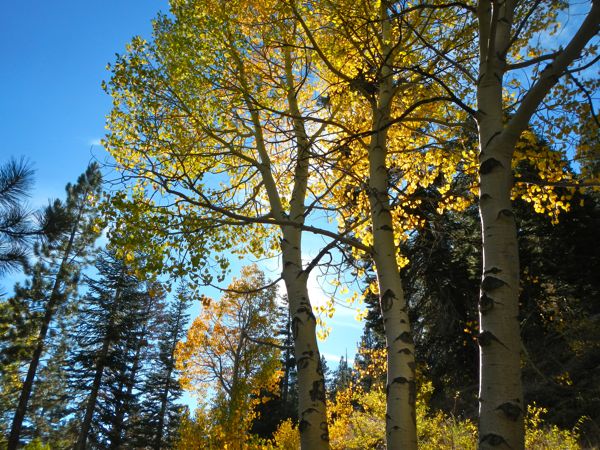


Splash of autumn color shines throughout Lake Tahoe Basin

By Kathryn Reed

SPOONER SUMMIT – Autumn has such a distinct scent. You know it when you smell it.

All along the trail to Marlette Lake on Saturday I kept taking deep breaths. While it is really death that is in the air, the power of it gives me energy.

Perhaps it’s the power of nature to cycle through life and death with such relative ease that makes me jealous. We humans have such a difficult time with such monumental things like life and death.

But nature, well, she seems to embrace each season.

Fall is in bloom throughout the Lake Tahoe Basin. Photos/Kathryn Reed

Aspens really do seem to quake in the gentle breeze. Shimmering in the vibrant sun on this rather warm fall day, it’s hard to know if the leaves are hanging on for dear life or trying to shake free to move on.

It’s like a painters palette – all these shades of green, yellow and orange decorating the landscape.

A woman on the trail says she was out three days earlier and notes how much more color there is Oct. 13. She’s what a New Englander would call a “leaf peeper” – because of her ardent interest in the fall colors and desire to see them at different stages.

The abundance of green proves the peek is still to come. Maybe this week. Temperatures, wind and moisture play a role in this leaf changing business.

It’s such a ritual on the East Coast that foliage is tracked for when best to see it. Even the National Weather Service has a color meter.

Mostly it’s aspens along the route to Marlette Lake, though this is not the only flora turning color.

So many people are out – and many with their dogs – that it feels a bit like hiking to Winnemucca Lake during the height of wildflower season. But we don’t mind. Everyone is so friendly. Those of us with cameras seem to play a game of leapfrog with each other as we keep passing one another.

Instead of taking the North Canyon Trail, we take the Marlette Trail. It’s narrower and is not open to mountain bikers. While we didn’t see any horses along the way, we saw plenty of evidence they had been out that afternoon.

We aren’t sure how far we went. The sign at the trail on the Spooner side says it’s 3.75 miles to Marlette Lake. The sign at Marlette says it’s 4.5 miles to Spooner.

Along the way we saw people with shirts that said “Hike for Beer” and finally asked about it. There was beer for sale at the lake. We saw people walking back with cups of beer.

Then we were told the amber ale was gone. Yet visions of aspens seemed to remind me of my thirst that could not be quenched until I got home. Oh, the punishment for getting a late start.

Still, this was an excursion about foliage. And we were not disappointed.

Getting there:

From South Lake Tahoe, take Highway 50 east.

Either turn left onto Highway 28 and then park at Lake Tahoe State Park on the right for a fee; or pass that turn and at the true summit park for free on the left.

(That lot can get full and the state park can use your money.)

Note: For a less ambitious hike, but still one full of color, consider the 2.1-mile loop around Spooner Summit. This would be suitable for most ages and abilities.

ngg_shortcode_0_placeholder (Click on photos to enlarge.)