Lake Tahoe Airport’s financial flight plan unique
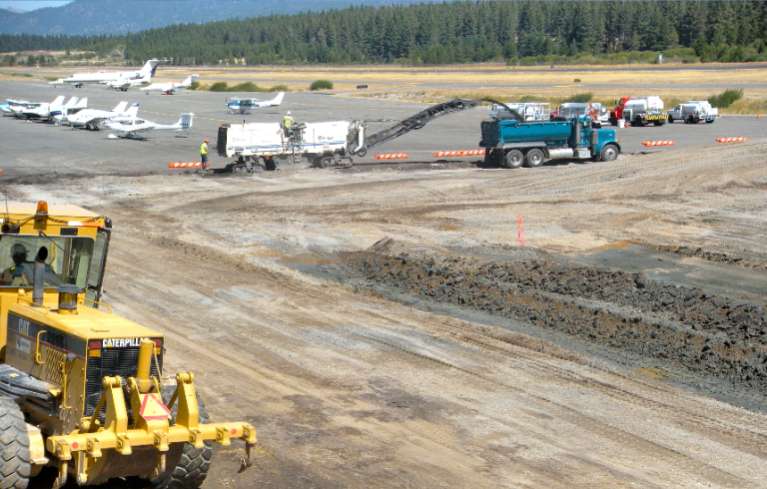
Lake Tahoe Airport runway improvements are in large part because of FAA grants. Photo/LTN line
By Joann Eisenbrandt
“There are many people in the community who question the value of the airport and why the city continues to subsidize airport operations. This persistent question must be answered.”
— Letter to South Lake Tahoe after the Feb. 13 Airport Master Plan Community Meeting
For decades, Lake Tahoe Airport has been a highly visible symbol of the lake’s acrimonious and complex balancing act between economics and environment.
Does the airport provide economic, safety and access benefits significant enough to offset any environmental impacts it may cause? This is the larger question; but for now, let’s set aside the environmental issues and focus just on the economic ones. How is the Lake Tahoe Airport funded? Is its economic value measured only by the balance sheet of revenues versus expenses, or is there a broader definition of its financial impacts on the community?
South Lake Tahoe is updating the airport’s 20-year-old master plan. The city received a $315,000 FAA grant for completion of the master plan and contracted with C&S Companies in July 2013 to prepare the plan at a cost of $280,212. The FAA’s share is 90 percent ($252,191) and the city’s share is 10 percent ($28,021), which was budgeted in fiscal year 2012-13. The city had the first community meeting on the plan Feb. 13 and the second May 29.
The master plan is the airport’s blueprint for the future – how the physical plant will be configured, how operations will be financed, what types of aircraft will use the facility, and how the needs and priorities of the community will be addressed. South Lake Tahoe City Manager Nancy Kerry described the process to Lake Tahoe News as, “a public process funded by the federal government to make the best use of the airport. We hired (the consultants) to talk to other airports and see what’s their strategy, to find out how to manage the airport in the best way.”
Lake Tahoe Airport is an enterprise fund within the city’s budget. As the budget narrative explains, “Enterprise funds are used to account for activities that are financed and operated in a manner similar to private business enterprises. Costs are financed or recovered primarily through user fees.”
These fees include fuel sales, passenger enplanement fees, hangar rentals, aircraft tie down fees and property taxes, and rental fees from on-site airport tenants. Lake Tahoe Airport’s user fees have not covered expenses for some time, and have been supplemented by transfers of money from the city’s General Fund — by as much as $600,000 a year. Airport Director Sherry Miller told LTN that the budgeted General Fund transfers to the airport for FY 2013-14 is $300,000. After the 2014-15 budget cycle, when the new hangars will be paid off, the city’s General Fund contribution could drop to $120,000.
Still, how does this fit into the “enterprise fund” business concept? If a South Shore business operated at such a yearly deficit, many ask, how long would it remain in business? Should the airport be self-supporting in the same way a business must be in order to survive?
Kerry sees the airport as a public service and answers the question this way, “Under the definition of an enterprise fund, yes, but most public services we provide don’t capture enough revenues through user fees to be self-supporting. Most airports are not moneymakers. Other taxes subsidize public services when user fees aren’t enough…. There’s no debate that people expect us to answer the call when a fire occurs … for the airport, it’s a fair debate to say, ‘Is this a service to the public? How does a city resident benefit from a high roller giving money to the casinos?’ City residents are paying for a city airport that a majority of them may not use…. They don’t see the direct benefit to themselves.”
League to Save Lake Tahoe Executive Director Darcie Goodman Collins recently told LTN, “We can only reiterate the facts, which are that the airport has been subsidized over the past 20 years so it’s hard to see an economic benefit there. Commercial service has not worked in the past, so it’s hard to imagine it working in the future, especially with the growth of the Reno airport.
“We think the potential environmental benefits of reducing the size of the airport and restoring some wetland would far outweigh economic gains from expanding service.”
Others believe the airport doesn’t belong in the basin. A comment from the Feb. 13 community meeting reads, “We support closing the airport.”
Downsizing is one thing; entirely closing the airport is quite another. Lake Tahoe Airport has received about $21 million in FAA funding. In taking those dollars the city made certain guarantees, one of which is reimbursing all those funds should the airport close. The city recently requested a letter from the FAA explaining in detail the airport closing process. That letter, dated April 17,
2014, to Miller from FAA Airports Compliance Specialist Robert Lee, explains that FAA approval for closing an airport is not just predicated on a return of the money granted. It notes, “… the benefit to civil aviation is the FAA’s prime concern.” This includes the effect a closing would have on the interests of aeronautical users and service providers, and on the state and national airport system. Approval would only come after the FAA evaluated a complex checklist of considerations.
While the balance sheet of Lake Tahoe Airport’s expenses versus revenues is relatively straightforward, the trickier question has always been the airport’s broader economic impacts. This is what economic impact studies term the “trickle-down effect” – the economic rollover as the airport’s direct revenues filter down to benefit the community as a whole. The city has long contended that the airport provides such a benefit.
In its comments after the February community meeting, the board of directors of the California-based chamber of commerce agreed, “The South Lake Tahoe Airport is a vital regional and local transportation resource. It is a connector between the Tahoe basin and the U.S. Transportation System. It is an economic engine for the South Shore.”
The city has conducted economic impact studies as far back as 1987 to quantify this, specifically targeting the money generated by commercial air service, but not everyone has bought into the results. A letter to C&S Companies, the master plan consultants, from a resident following the February meeting says: “We need a 2013 study that shows a positive economic boost to the community and defines those entities that will thrive from this endeavor. What is driving the demand for a full service airport? How are these statistics being gathered?”
Looking beyond Lake Tahoe
Is the Lake Tahoe Airport the only small regional airport dealing with these issues? How are other area airports financed and how is their value perceived by the communities they serve? In looking at three such airports – Placerville, Truckee-Tahoe and Mammoth Yosemite – it’s important to remember that no two airports are exactly alike, and even less so given Lake Tahoe Airport’s unique environmental and regulatory constraints.
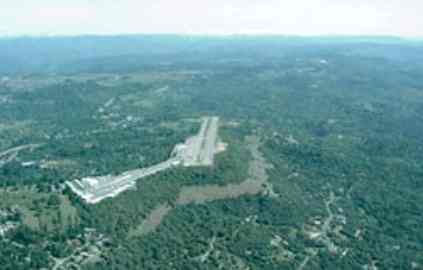 Placerville Airport is a public-use general aviation (GA) only airport situated just east of the city limits of Placerville. El Dorado County operates it. Its last master plan was completed in 2007. Like Lake Tahoe Airport, it is an enterprise fund, and also like Tahoe, its revenues from user fees do not totally cover expenses.
As Matthew Mergen, operations and maintenance supervisor, told Lake Tahoe News, “We cover the majority of our expenses through leasing of land, hangars, fuel sales and property taxes on locally-based aircraft. We receive a small portion from the General Fund, which is usually equal to the amount of property taxes the county receives from on-airport uses.”
Misty Garcia, administrative services officer for the county’s Community Development Administration and Finance Division – the overseer of the airport, agrees with Kerry that airports are not moneymakers. She also agrees with Mergen that the “airport pretty much runs on its own,” pointing to the line item in the county’s 2013-14 budget showing the transferred “from General Fund for property taxes generated at airport” amount of $30,631.
“At one point,” Mergen told Lake Tahoe News, “the airport covered its costs. But when the economy slowed down and fuel costs went through the roof, many people got rid of their aircraft.”
Unlike Tahoe, Placerville Airport, with between 15,000 and 20,000 yearly GA enplanements, has never considered introducing commercial air service.
“We couldn’t support it,” Mergen explains. “The biggest aircraft coming in here is a large turbo-prop aircraft. In fire situations, CalFire helicopter crews could come in and we would make part of the airport a helicopter base.”
Placerville airport’s runway is 3,910-feet long, compared to Tahoe’s 8,541-foot runway.
No recent economic impact studies to quantify the airport’s larger financial impacts have been done or are anticipated. The last one was done in 1994. There have also been no cries to close the airport. As their Airport Land Use Compatibility Plan indicates, the facility is located, “in a hilly, low-density, rural residential area adjacent to the eastern boundary of the City of Placerville.” Long-term high-density land use changes could potentially affect that, but right now the community view of the airport is largely a positive one.
As Garcia says, “Most of those living around the airport are airport supporters.”
 Truckee-Tahoe Airport
Truckee-Tahoe Airport, situated in Truckee, is not operated by a city or county, but instead came into being at the impetus of the Truckee Donner Chamber of Commerce through a ballot measure in 1957, which created a Bi-State Airport District comprised of the eastern portions of Nevada and Placer counties.
The airport’s finances are different as well. As Airport General Manager Kevin Smith explained to LTN, “It’s such a different animal with cities and counties. (Those airports) are competing with other departments for funding when they look at allocating the monies at budget time, which I don’t have to do.”
While it is not an “enterprise fund” in the same sense as South Lake Tahoe and Placerville, the airport strives to recoup costs through the same type of user fees in place at those airports. The property tax revenue from the Bi-State District is used to supplement as needed, much as the general fund is for cities and counties, mainly for capital improvement projects. The airport land and improvements are valued at about $45 million and, as Smith states, “we have no debt. We own all the buildings.”
He has 19 employees. (Lake Tahoe has five.)
Asked if they had a “business plan,” Smith replied that they would be codifying one as soon as the Master Plan update, which they financed themselves, is completed.
“The Master Plan,” Smith noted, “is asking the community what they want us doing with this airport? We own 2,500 acres of property around the airport. What do they want us to do with all that land? We want to be a mirror of the community we serve.”
As part of the Master Plan process, they had eight community outreach meetings and received about 3,500 comments.
“We felt,” Smith added, “that doing a robust and open, interactive process was important.”
That process provided clear direction that district residents didn’t want scheduled commercial air service. The airport has about 25,000 yearly operations. Half are turbo props and small jets bringing in visitors and the other half are itinerant aircraft from the Bay Area and Los Angeles bringing in second homeowners.
“The idea of getting on a SkyWest jet and flying from Truckee to L.A. isn’t wanted,” Smith explained. The Reno-Tahoe Airport is “just down the road,” with easy access even in winter. “There is no push,” he added, “even from larger businesses, to bring in commercial service or regional jets. They don’t want to do anything with this airport that would affect the larger airlines’ service to Reno-Tahoe. More direct flights from Chicago to Reno is more important than direct flights from Chicago to Truckee.”
High rollers, he added, will still choose to fly into Truckee instead of flying into Reno-Tahoe and taking a shuttle. They use membership-based fractional operators and buy a share in an airplane. “They’re not price sensitive,” Smith added.
As with Placerville Airport, community views of the airport are largely positive. Noise complaints are minimal, Smith explains, as the majority of the higher-decibel noise contours are on the airport property itself.
“As far as environmental impacts of the airport, there are not a lot,” he said.
The Bi-State Airport District hasn’t done a full-scale economic impact study since 2000.
“Some agreed with the results and some weren’t sure,” Smith notes. “We know the airport has a substantial impact. My board is talking about doing another study after the Master Plan. There’s just some caution needed in doing these that they they’re not pointed or steered to a product.”
 Mammoth Yosemite Airport
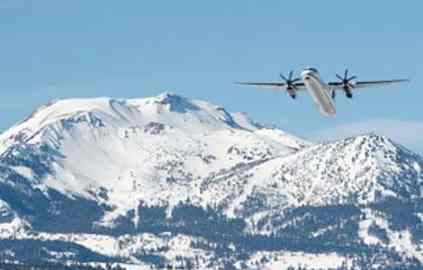
Mammoth Yosemite Airport, situated about seven miles outside Mammoth Lakes, has many similarities with Tahoe, as well as some important differences. It’s operated by the town of Mammoth Lakes as an enterprise fund, and, as with Placerville and Tahoe, the user fees it collects do not totally cover expenses. The General Fund allocation to the airport for FY 2013-14 was projected to be $286,943.
Unlike Tahoe, in addition to general aviation traffic, the airport also has regional commercial service provided by Alaska Airlines and United, focused on the Los Angeles, San Diego and San Francisco markets. The number of overall yearly GA and commercial enplanements ranges from 30,000 to 35,000.
“We’re a mountain airport,” Airport and Transportation Manager Brian Picken explained, “so the terrain and technical issues are somewhat similar. We went through a period of growth about 10 years ago where the community wanted small regional jets; since that time the airport’s been using Q400s or other planes of 120 seats or less. You’re in a difficult operational area in Tahoe. There’s been mitigation to restore the (Upper) Truckee River. You’re in town and we’re not. ”
Acting Public Works Director Peter Bernasconi adds, “In 2007 we updated our General Plan to align the town with healthy lifestyles, basically committing the town to a ‘feet first’ goal – transit first, auto last. We see air service as part of that ‘feet first’ concept. Reno-Tahoe is the closest commercial airport, 3½ hours away in summer and up to six hours away in winter. LAX is five hours away.”
The airport also receives funding from hotel taxes and a Tourism Business Improvement District, put into effect in September 2013, with a five-year life. The 2 percent of the 13 percent marketing TOT the airport receives and the funds from the TBID are collected by the town of Mammoth Lakes and then distributed by Mammoth Lakes Tourism, a 501(c)6 nonprofit for promotional purposes.
Unlike the General Fund subsidy, which covers airport operations, the TBID money is used to provide minimum revenue guarantees to the airlines.
The TBID, John Urdi, executive director of Mammoth Lakes Tourism, explains, “gets the businesses involved.” The assessment is on all tourism businesses within the town limits of Mammoth Lakes. The assessment for each business — restaurant, lodging, retail or the biggest contributor Mammoth Mountain — is determined by a tier structure based on annual revenues and the percentage of business from tourism.
“The guarantees are revenue related,” Urdi explains. “If a flight doesn’t meet the guaranteed revenue figure for that flight, then the difference goes into that airline’s account. It’s paid to each airline on a seasonal basis at the end of summer and winter. If load factors are high and there’s money left, then it can rollover and provide a cushion. The TBID always covers the first $1.5 million in winter and (Mammoth Mountain) will cover above that.”
Urdi, Bernasconi and Picken all agree on the importance of commercial service for Mammoth and the necessity of revenue guarantee to get airlines to provide that service.
“Commercial service opens up the world to us,” Urdi told Lake Tahoe News. “Tahoe is different since you have Reno close, but we don’t have an airport close. Commercial air service has made us accessible. It’s opened up an international market. People book flights from Singapore to L.A. and then from L.A. to Mammoth.”
But that service comes with a price.
“Airlines aren’t going to come into an airport like ours, or Tahoe,” Bernasconi emphasizes, “without some kind of guarantees. A revenue guarantee is a fact of life.”
Urdi believes the positive economic impacts of that commercial air service are clear. “We want to see longer stays, people staying during the shoulder seasons, or coming mid-week in winter, which are the most difficult times for the ski resort. Air service helps with that. It makes it easier to get here. Passengers that come via air spend more and stay longer.”
A report was done several years ago by American Express using data from its cardholders, showing where and what people spend money on. Based on the air) passenger numbers and spending numbers, after removing locals, it showed a winter impact of $15 million. The airline subsidy in a normal winter, Urdi noted, would be $1.5 million to $2 million. “That’s a 10 to 1 return on investment.”
Tahoe stands alone
But then again, no airport is totally comparable to Lake Tahoe Airport, or has faced the same intense, ongoing debate over its value and viability. The city manager sees the unfolding Master Plan process as a positive step forward.
“We’re not approaching this process,” Kerry says, “based on what people said it should be in the past. You have to have an open mind and an open process. I want people to be inspired and encouraged.”
She adds that she has directed the consultants to proceed with an open mind as well. “Everything is on the table.”
Michael Hotaling, C&S project manager for the master plan, told LTN, “Our job is to support what the city and the community want to do.”

Lake Tahoe Airport doubles as city hall.
Although acceptance of the master plan by the FAA does not mean it agrees with everything it contains, there are two parts of the plan they must review and approve – the Aviation Demand Forecast and the Airport Layout Plan. The Aviation Demand Forecast is the financial backbone of the Master Plan. As the FAA describes it, “Forecasts of future levels of aviation activity are the basis for effective decisions in airport planning. Once approved, the forecasts may be used to provide an initial timetable for facility improvements, as a basis for the development of alternatives to meet the projected demand, and as a basis for environmental analyses and economic and financial plans.”
Hotaling adds, “The Aviation Demand Forecast is the key driver in the long-term development of the facility.”
After the Aviation Demand Forecast is approved, a preferred alternative is selected, based in part on the financial realities the forecast has revealed. After that, a Financial Feasibility Analysis is done on that alternative, showing the airport’s ability to fund the projects in the master plan, including airport management, on-site uses and leases and operating issues that will affect the airport’s cash flow.
“We will be doing a Development Plan,” Hotaling explains, “showing the financial investment required. In it there is an assessment of the current expenses and revenue generated and a cursory examination of the potential revenue streams that could develop as things change at the airport.”
An analysis of the viability of commercial air service with and without revenue guarantees is part of this process.
“It’s about who pays and how much,” Kerry notes. “What are the costs and benefits of commercial service? If that is not a go, then what’s the best use of the airport?”
Who should be paying is, of course, at the heart of the matter. A comment from the Feb. 13 meeting makes the concern clear, “Since the airport is a regional resource that crosses county lines in California and state lines, both public and private sector airport and commercial air service supporters and advocates should be asked to financially support commercial service ventures if such support is requested by commercial carriers. “
Kerry agrees that asking residents to subsidize an airline at a cost of perhaps $2 million a year is not appropriate. Asking El Dorado County, Douglas County, the skiing and gaming industries to help support a facility that provides them significant benefit should be considered.
In the past, the city has been strongly criticized for not giving residents enough or timely input into airport planning processes. The FAA strongly encourages public input into the master plan process early on. Its Advisory Circular 150 on Airport Master Plans states, “Public involvement has its greatest impact during the early stages of the planning process, before irreversible decisions have been made and while many alternatives can be considered.”
Kerry believes the city is doing a good job this time in reaching out to the community. The first public meeting on Feb 13 was “just to get initial feedback.” Hotaling agrees, noting that, “We didn’t have much information (on the status of the master plan process) for that first meeting. Now that we’ve accomplished some of the master plan tasks, we’ll have something to share. I was encouraged by the number of people who attended that first meeting.”
At the second, on May 29, Hotaling of C&S companies explained they had not yet received final FAA approval of the Aviation Demand Forecast because the FAA needed additional clarification on some of the figures.
He reviewed issues raised at the Feb. 13 meeting, including the FAA process for an airport closure, and explained the economic changes in the airline industry from 2000 to 2014. Through mergers and attrition, seven major carriers have been reduced to three and six low cost carriers have also been reduced to three. Over those years, the airlines have lost $54 billion.
“Their decisions today are based on economics,” he added. Driving those economics are load factors—how full each scheduled flight is. From 2000 to 2014, load factors have risen from 67 percent to 83 percent, with a goal of 85 percent. It costs the same to fly a plane no matter how many people are on it.
It is just those economics that caused C&S to conclude in the draft Aviation Demand Forecast that Tahoe cannot support commercial airline service.
“It is unlikely,” Hotaling confirmed, “to have commercial service return to Lake Tahoe in the (master plan) forecast period of 20 years.”
If the city wants to pursue it anyway, there are options: a subsidy such as Mammoth Yosemite Airport uses, or approaching El Dorado and Douglas counties and the gaming and skiing industries for financial support. As Kerry put it, “The South Shore doesn’t have any lines.”
Finding better ways to utilize the existing airport and enhance its financial bottom line, even without commercial service, is another option. As an audience member put it, there are “other things we could sell to people with this property here.”
Once the Aviation Demand Forecast is approved by the FAA, the consultants will release that data, then prepare the other parts of the Master Plan, including the selection of a preferred alternative which will outline the airport’s future direction. Both Kerry and Hotaling encouraged those at the meeting to make their views known on what that direction should be.
Additional public meetings will be scheduled as the process continues, with a tentative timetable of selecting a preferred alternative by late summer or early fall.
“We anticipate as many public meetings as the public thinks should happen. The public process should be extensive,” Kerry insisted.