Truckee River watershed receives special designation

The Truckee River watershed has recently been designated as one of the newest sites by the National Forest Foundation as a part of the “Treasured Landscapes – Unforgettable Experiences” program.

Vance Russell, National Forest Foundation California director explained the vision for the area, “As one of the 14 designated Treasured Landscape sites nationwide, our goals for the Truckee River watershed are to ensure healthy forests and healthy and abundant water in the Truckee River watershed in conjunction with the community. There are many beautiful National Forests, but the Truckee River stood out due to the partnerships and the community support for its restoration.”

The Truckee River watershed NFF site is 234,000 acres and includes public land within the Tahoe National Forest and the Lake Tahoe Basin Management Unit. The primary objective will be to complete key restoration work by 2017 with ecological, economic, and social benefits from the work continuing in perpetuity.

Impacts to the watershed have occurred over the past 150 years and date back to the construction of the transcontinental railroad and the discovery of gold and silver. A legacy of resource extraction, road and railroad construction, hydrologic modification, fire and fire suppression, and development and extensive recreation has seriously impacted the watershed.


Snippets about Lake Tahoe

• Oct. 22 is the last day to register to vote in California for the Nov. 6 election.

• Driftwood Café owners in South Lake Tahoe have opened Peppers Mexican Grill in Heavenly Village.

• There will be a public scoping meeting Nov. 1 about Squaw Valley’s plans to develop 100 acres at the base of the mountain. The 10am meeting is at the Resort at Squaw Creek. The notice of preparation has been released, with comments being accepted until Nov. 9 at 5pm.

• Here is the Caltrans roadwork schedule for the Sierra.

• Northstar COO Bill Rock gives a pep talk to the snowmaking guns. But with the forecast, maybe they won’t need to be used as much as they were last season.

Game On Mother Nature from Northstar California Videos on Vimeo.


Letter: Praise for South Lake Tahoe library

To the community,

I cannot begin to emphasize my love and appreciation for our local public library. It is the go-to place to find deeper information on a myriad subjects and so many good reads.

If any books or music are not readily available, they are freely available via request via the county service area.

It has been most satisfying to be a member of the Friends since moving here over 12 years ago. Following a long and enriching career in the public library, I can attest to the veracity of the quote by writer Anne Herbert: “Libraries will get you through times of no money better than money will get you through times of no libraries.”

Sherna Kopple Svensson, president of Friends of the Library South Lake Tahoe


Nominees for Blue Ribbon Awards announced

The Blue Ribbon Award nominations have been tallied, with more than 150 nominations received.

The 5th annual Blue Ribbon Awards Dinner and Ceremony will be Nov. 15 at Embassy Suites in South Lake Tahoe. Tickets are $50 (775.588.1728) and include a cocktail hour.

Here are the nominees for the 2012 Blue Ribbon Awards:

Tourism – Avalon Lodge/Cle Hospitality, Lake of the Sky Outfitters, Lake Tahoe Adventures, MontBleu Outdoor Concert Series, and South Tahoe Stand Up Paddle.

Geotourism – Discover Lake Tahoe Tours, On Course Events, South Tahoe Stand Up Paddle, Sustainable Tahoe/Tahoe Expo, Tahoe Rim Trail Association, and Tahoe Tallac Association/Valhalla at Tahoe.

Small Green – Connie’s Clothesline Thrift Shop, Elevated Fitness, South Tahoe Stand Up Paddle, Sustainable Tahoe/Tahoe Expo, and Tahoe Resource Conservation District.

Large Green – Edgewood Tahoe, Harrah’s & Harvey’s, Heavenly Mountain Resort/Echo Program, and South Tahoe Refuse.

Entrepreneur – Amy Thompson/Tahoe Tot Spot, Bob Nielsen/MacDuff’s Public House, Brandi Brown/Tahoe Production House, Bren Tate/Sea Leagues Skates, Cindy Rawlins/CC’s Pirate Treasures, Dana Smith/Straw Hat Pizza, Darrell Wampler/K-Tahoe Radio, Fred Jackson/Tahoe Lobster Company, Rob Giustina/On Course Events, Paige Rice/Tahoe Best Friends, Paul Reder/PR Entertainment, and Theresa Bertrand/BioSpirit Day Spa.

Experience – Barton Hospital, Bona Fide Books, Discover Lake Tahoe Tours, Elevated Fitness, Getaway Café, Heavenly Sports, On Course Events, PR Entertainment, Primo’s Italian Bistro, South Shore Bikes, South Tahoe CrossFit, South Tahoe Stand Up Paddle, Tahoe Tot Spot, V’z Image Option’z, and Zip Tahoe.

Customer Service (Private Sector) – 968 Park Hotel, Adra Fenstermaker/Body by Adra, Amy Thompson/Tahoe Tot Spot, Beth Lee/Affordable Construction Services, Brian Cohen/Overland Meat & Seafood Co., Bridget McGrath & David Kumpe/Elevated Fitness, Cheryl & Tyler Cannon/Sprouts, Clean Tahoe Program, Diane Guth/Getaway Café, Don Muren/Edgewood Tahoe, George Zepeda/Jalisco Grill, Hec Hernandez/South Shore Bikes, Kim & Jim Warlow/The Cork & More, Joe Hayes/Heavenly Mountain Resort, Joshua Ashby/Park Tahoe Inn, Les Schwab Tires, Lira’s Market, Marie Logie/Jazz Kat Café, Mark Podesto/NorCal Beverage, Matt Reinke/The Burger Lounge, Maureen Stuhlman/Tahoe Best Friends, Nelson Marrogquin/Embassy Suites, Paige Rice/Tahoe Best Friends, Paula Morris/John’s Cleaners, Rowena Pegg/Lakeside Beach Grill, Roy Testa/Welcome’s Auto Body, Scott Craig/Riva Grill, Sierra Athletic Club, Tommy Gunnell/Embassy Suites, and Zion Finck/TechTastic.

Customer Service (Public Agency) – Bobbi Thompson/Minden-Tahoe Airport, Brandy Johns/Kingsbury Grade Improvement District, Dee Kline/El Dorado County, and Judy Finn/City of South Lake Tahoe.


North Shore transit center set to open

The Placer County’s Transit Center in Tahoe City will open for business and be fully operational on Oct. 29.

The center is a modern “park and ride” facility located for Tahoe Area Regional Transit passengers at 165 West Lake Blvd. in Tahoe City just off Highway 89 south of the Y.

With the opening of the center, some of the schedules and routing for TART buses will change. Riders are encouraged to check bus schedules by going online.

The new center is a state-of-the-art facility. It features six bus bays, a 1,100-square-foot terminal with an indoor, heated waiting area with restrooms and a covered outdoor waiting area with bench seating to provide comfort for passengers as they transfer to or await arriving buses. On-site parking is available.

In all, 130 parking spaces plus several enclosed bike lockers with an electronic pay-per-use system and more traditional bike racks have been installed. The center covers about 2.5 acres adjacent to hiking and bike paths for easier mobility around the North and West shores of Lake Tahoe.

A high-tech display system, known as Nextbus, has been implemented on the TART bus system and is available now to the public. A display system will be installed inside the building to inform passengers on the arrival time of their buses. The system provides online real-time locations of on-route buses and predicted arrival times of TART buses at all stops on all routes. The information can be accessed via text messaging or smartphone web access.


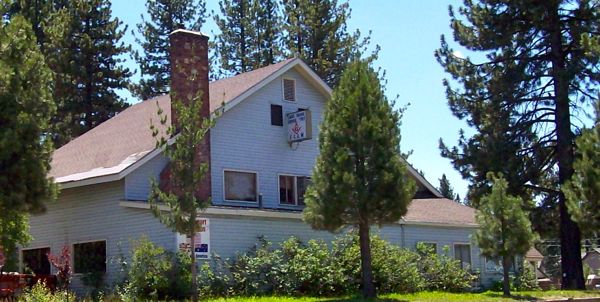
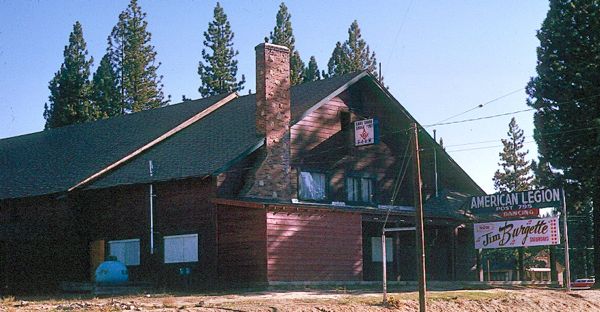
Then and now: American Legion had to be rebuilt

The American Legion building in South Lake Tahoe had a sizable auditorium and stage. It was a popular site for diverse events, including dances and performers like Jim Burgett.

The auditorium’s roof collapsed under winter snowload in the late 1960s just prior to a big teenage dance scheduled for that night.

— Bill Kingman

The American Legion today. Photos/Bill Kingman

The American Legion Hall in South Lake Tahoe in 1965.


In a warming Arctic, U.S. faces new security and safety concerns

By Kim Murphy, Los Angeles Times

BARROW, Alaska — In past years, these remote gray waters of the Alaskan Arctic saw little more than the occasional cargo barge and Eskimo whaling boat. No more.

This summer, when the U.S. Coast Guard cutter Bertholf was monitoring shipping traffic along the desolate tundra coast, its radar displays were often brightly lighted with mysterious targets.

There were oil drilling rigs, research vessels, fuel barges, small cruise ships. A few were sailboats that had ventured through the Northwest Passage above Canada. On a single day in August, 95 ships were detected between Prudhoe Bay and Wainwright off America’s least defended coastline, and for some of them, Coast Guard officials had no idea what the vessels were carrying or who was on them.

“There’s probably 1,500 people out there,” Rear Adm. Thomas P. Ostebo, commander of the Coast Guard’s 17th District in Alaska, said at a recent conference of Arctic policymakers near Anchorage. “It’s kind of spinning a little bit out of control.”

The rapid melting of the polar ice cap is turning the once ice-clogged waters off northern Alaska into a navigable ocean, and the rush to grab the region’s abundant oil and mineral resources by way of new shipping lanes is posing safety and security concerns for Coast Guard patrols.

What happens if a cruise ship gets stranded in stray ice? Or if a sailing vessel capsizes off an uninhabited coast?

“Yesterday, we saw three sailing vessels in 24 hours,” said the Bertholf’s commander, Capt. Thomas E. Crabbs.

The Coast Guard this summer ran Arctic Shield, the most extensive patrol operation it has ever mounted in the Arctic. It set up a temporary operating base and remote communications station at Barrow.

A fleet of cutters, buoy tenders, helicopters and boarding vessels deployed across the Beaufort, Chukchi and Bering seas to oversee new offshore oil drilling operations offers search-and-rescue if needed and provides notice to burgeoning ship traffic that the U.S. is monitoring its northernmost border.

The rush for riches as Russia, Norway and Canada vie with the U.S. for the Arctic’s mineral resources, and the possibility that drug dealers, arms merchants and terrorists could begin to explore transport routes near America’s largest oil fields have prompted the U.S. military to begin planning for a future in the Arctic much more substantial than it had envisioned.

The U.S. Naval War College last year conducted war games simulating the sinking of a ship carrying weapons of mass destruction from North Africa to Asia across the top of Canada and Alaska.

The Air Force has been practicing how to make food and survival gear drops to survivors of a large plane crash in the unbelievably remote Brooks Range, north of Fairbanks.

The North American Aerospace Defense Command, known as NORAD, already has gone beyond drills: F-15 fighters have been launched on interceptions at least 50 times during the last five years in response to Russian long-range bombers — not previously seen here since the Cold War — which have been provocatively skirting the edges of U.S. airspace.

Through it all, U.S. security forces are battling historically sketchy radio communications, vicious storms, shifting ice floes and huge distances from base: Coast Guard cutters must sail 1,200 miles south just to take on food and refuel.

“All of the uniqueness of operating up in the Arctic represents huge challenges for us,” said Royal Canadian Air Force Col. Dan Constable, deputy commander of NORAD’s Alaska region.

The Naval War College games in September 2011 were an early test, and not an encouraging one. Many of the scenarios rehearsed, former Navy Cmdr. Christopher Gray said, ran into problems with poor communications and trouble maintaining supplies of food, fuel and supplies.

“Does the Navy have the ability to go up and operate a number of ships, a number of aircraft, for a sustained period of time in this environment, where it’s cold, it’s got bad weather, it’s got a lot of ice, and it’s really far away from everything that supports you? What we found is that the answer is, not really,” Gray said.

The Bertholf is especially suited to summertime operations in the Far North. Though not capable of operating in ice, it is equipped with high-efficiency engines and stability systems that allow the vessel and its crew of 146 to remain in the Arctic for a month at a time — heretofore unheard of in the U.S. fleet.

“Because we’re present here and because we have the endurance to remain here throughout the season, we’re going to be able to understand who is in the maritime domain,” Crabbs said as a small vessel carrying boarding troops was launched off the Bertholf’s stern for a closer look at nearby shipping traffic.

U.S. officials say they are still several decades away from needing a full-scale military presence in the region, and with luck, there will be no need to resort to arms: The real source of conflict is the battle everyone faces — with the elements.

“If somebody were to invade the Canadian High North,” Canadian Forces chief of staff Gen. Walter Natynczyk said at the Arctic Imperative Summit, “my first problem would be to rescue them.”

The move to secure the Arctic goes well beyond domestic security. With easier access to the more than 90 billion barrels of oil and trillions of cubic feet of natural gas in the Arctic, nations are rushing to gain international recognition of territorial claims, mineral contracts and shipping routes.

On Aug. 2, the Chinese icebreaker Snow Dragon completed an unprecedented voyage across the top of the world through the Northwest Passage.

Icelandic President Olafur Ragnar Grimsson was paid a visit by a delegation of senior Chinese officials who wanted to discuss Beijing’s bid for permanent observer status in the Arctic Council, the suddenly powerful organization of eight nations with territory in the Arctic Circle.

“And China is not the only Asian country interested in the Arctic,” Grimsson said at the Arctic summit. Singapore and South Korea, he said, also want in.

The U.S. has been slow to stake out its own territory. While Russia has submitted a claim for thousands of miles of seabed, and Canada is asserting title to mineral-rich areas along the U.S. border, the United States is the only Arctic nation that has not ratified the 1982 treaty known as the United Nations Convention on the Law of the Sea — the international mechanism for brokering such claims.

The U.S. has also fallen behind on what the Coast Guard needs to patrol the new mineral development zones. The only working icebreaker is the cutter Healy, with a second being refurbished that is due to return soon. Russia, by contrast, has 25 icebreakers, according to the U.S. Congressional Research Service. Finland and Sweden have seven each, Canada six.

“I think it’s a real-time imperative for our nation to get its arms around these things,” Rear Adm. Ostebo said. “It’s critically important to understand that we do not control it. The rest of the world has a boat here, and we are late to the table.”

Endorsement: Bosetti should represent 1st Assembly District

Publisher’s note: This editorial is from the Oct. 2, 2012, Sacramento Bee.

Two conservatives with solid histories of public service are running against each other in the newly drawn 1st Assembly District. The largely rural district stretches from the Oregon border to Lake Tahoe and west to the Sierra foothills.

Rick Bosetti, a businessman and former pro baseball player, has been a member of the Redding City Council since 2006. Brian Dahle, a third-generation farmer, is a small-business owner who has been a Lassen County supervisor for 16 years. Both are Republicans and both have signed the “no-tax pledge,” which is unfortunate. It will make their ability to break through the partisan gridlock in Sacramento to solve the state’s serious fiscal problems more difficult.

Of the two, Bosetti is more pragmatic and earns our endorsement for that reason. Born and raised in Redding, he returned to his hometown after nearly a decade in professional sports and started a small technology business. Although he signed the “no-tax pledge,” Bosetti said he supports a new law backed by the timber industry that would impose a 1 percent tax on forest products to help cover the regulatory costs of timber harvest plans.

While Dahle opposes the bill on strict anti-tax grounds, Bosetti notes the bill included regulatory streamlining and lawsuit reform that he thinks will help his district’s timber industries and the jobs they support.

Redding recently faced a large deficit fueled in part by ballooning public pension costs. When unions refused to grant concessions, the City Council put a measure on the 2010 ballot that for the first time required city workers to contribute to their own pensions. A second advisory measure asked if voters thought the council should create a vesting period before city workers could qualify for retiree health benefits. Incredibly, prior to that measure, employees vested almost from the day they were hired.

It was an acrimonious campaign. The unions ran three candidates against City Council incumbents, but in the end Bosetti prevailed, emerging as the top vote getter. Voters overwhelmingly approved the pension and health care reform measures. The pension fight helps explain why Dahle has the support of police and fire unions and Bosetti does not.

To correct the many problems that beset Sacramento, elected officials from both parties will need to stand up to powerful special interests. They must also show flexibility on the revenue side. Bosetti has shown he can do both when the public’s interest is at stake.


NorCal city embraces its roots of being ground zero for breast cancer awareness

Publisher’s note: October is Breast Cancer Awareness Month. People are affected by cancer in all sorts of ways and communities do various things to shine a spotlight on various cancers. This is the last of four stories about cancer.

By Kathryn Reed

REDDING – Every shade of pink imaginable floods the streets here to show unity in bringing awareness to breast cancer.

Cars are lining up before the 6am Oct. 18 start time to release 40,000 bags filled with breast cancer information. And people are coming by after the bags are gone. People could even order 150 bags ahead of time.

Smiles are everywhere. One woman boasts of being a 20-year survivor. All are appreciative of the gang of volunteers who are up well before dawn to begin the bag brigade.

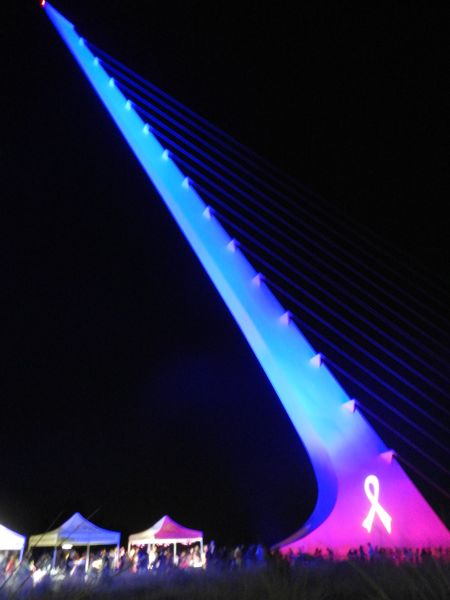
The Sundial Bridge in Redding becomes pink once a year to bring awareness to breast cancer. Photos/Kathryn Reed

A school bus comes by, so did an 18-wheel Coca-Cola truck. Each year a woman who owns a vintage pink car comes for her bag. All ages, both genders are driving up. Guys are saying they are getting their bags for the women in their lives.

This is the 16th annual Think Pink event where each year bags filled with all things breast cancer related are given out in the North State. Think Pink started in Redding and it’s the Nor-Cal Think Pink board of directors in cooperation with its partners that is able to put on Think Pink Day. (It’s always the third Thursday in October.)

Education is the key. The calendar, which is a main part of the goodies in the free bag, has a sponsor for each month. Each month also has educational material. A hanger for the shower helps remind women to perform a monthly self-breast exam.

Volunteers are in pink, but so are most of the people in the vehicles slowing down for their bags.

Pink and breast cancer are synonymous – especially during October. But it’s not just people turning pink.

The fountain in front the Redding City Hall is sending streams of pink water into the air.

The restaurant View 202 is offering deals on Pink-Tinis and select food items with a percentage of the proceeds going back to Nor-Cal Think Pink.

The board approves who can do what. Several businesses have a day, a week or all month (after all October is Breast Cancer Awareness Month) where some of the money they raise goes back to Think Pink. Every business that participates must have an educational component to the promotion.

For example, the pen MD Imaging gives out says “Mammograms Save Lives”.

At Chop Chix Salon pink hair extension are being woven in for a $10 donation. All the money goes to Think Pink. This is the fourth year the salon has participated. The first year $800 was raised. The next $2,400. Last $2,500. Their goal is to keep increasing the cash for Think Pink by $100 a year.

It’s the evening on this third Thursday of October that draws the largest crowd – 3,000 last year and estimates are more showed up this year. The iconic Sundial Bridge is awash in pink. With the pylon shooting 217 feet into the jet-black night, having it turn pink was like a ribbon in the sky.

ngg_shortcode_0_placeholder (Click on photos to enlarge.)


Carson City sheriff’s deputy hurt in motorcycle accident

By Fox-Reno

CARSON CITY — A Carson City deputy was injured in an accident Thursday on Highway 50.

On Oct. 18 at about 4pm, troopers from the Nevada Highway Patrol were dispatched to Lake Tahoe Club Drive and Old Clear Creek Road just south of Highway 50 for a single vehicle motorcycle accident involving a Carson City deputy.

The preliminary investigation indicates that a 2006 black and white, Harley Davidson motorcycle ridden by Deputy McDonald (first name not provided) was traveling southbound on Lake Tahoe Club Drive. For an unknown reason the motorcycle failed to negotiate the curve in the roadway and crossed the double yellow line, struck the northeast curb deflected off the curb, and continued traveled southbound in the northbound travel lane. The motorcycle traveled approximately 104 feet before coming to rest on its left side in the northbound travel lane. The deputy was ejected from the motorcycle and sustained minor injuries.

McDonald was transported to Renown Regional Medical Center via Care Flight where he was treated for his injuries. Speed is believed to be a factor in this accident.

The Carson City Sheriff’s Office was conducting a training exercise at Lake Tahoe Club Drive and Old Clear Creek Road.