Environmental issues divide presidential candidates

By Paul Rogers, San Jose Mercury News

Two months after taking office, President Barack Obama signed a historic wilderness bill that banned logging, mining and oil drilling across 2 million acres of scenic federal lands, including the Sierra Nevada, wildflower meadows on Oregon’s Mount Hood and vast vistas of California desert.

But today, with less than one week until Election Day, the environment as a campaign issue is as quiet as some of those remote landscapes.

“When you are looking at a high unemployment rate, most voters are not concerned about saving the planet,” said Barbara O’Connor, director emeritus of the Institute for the Study of Politics and the Media at Sacramento State. “They are much more interested in the economy and jobs — and whether they’ll have a pension or health care.”

Yet despite its relatively low profile this year, there is a Grand Canyon of difference between Obama and his challenger, Mitt Romney, on environmental issues, from public lands to climate change.

Since taking office, Obama has mostly sided with environmental groups, approving new regulations to limit pollution. Romney has criticized those actions as burdensome on industry and costly to consumers and taxpayers. On Romney’s campaign website, there are policy positions for 26 major issues. “Environment” is not on the list.

During the past four years, Obama has:

Approved several major new air pollution laws, including strict limits on mercury pollution and smog that

drifts between states.

Doubled the gas mileage rules for cars, copying California’s greenhouse gas standards to require the U.S. auto fleet to average 54.5 mpg within 12 years.

Set the U.S. Environmental Protection Agency on course to require mandatory limits on greenhouse gases from new power plants by next year.

Included $90 billion in the 2009 stimulus bill for energy projects, doubling wind and solar energy nationwide.

Romney has opposed all of those measures.

“I think the EPA has gotten completely out of control for a very simple reason,” Romney said in an appearance on Fox News during the GOP primary fight. “It is a tool in the hands of the president to crush the private enterprise system, to crush our ability to have energy, whether it’s oil, gas, coal or nuclear.”

Environmental groups say Obama did as much as he could, given opposition to new environmental rules from Republicans in Congress.

“I’d give the president a B-plus — and Romney an F,” said Michael Brune, national executive director of the Sierra Club, based in San Francisco. “He hasn’t even made an effort to discuss any strategy to clean up our air and water or use energy more efficiently.”

Obama has established four new national monuments, including one at Fort Ord in Monterey County. He tightened offshore oil-drilling rules after the BP blowout in the Gulf of Mexico. He defended the Clinton administration’s “roadless rule” banning logging in millions of acres of national forests. And he appointed leading scientists to top posts, including Monterey Bay Aquarium Research Institute director Marcia McNutt to run the U.S. Geological Survey and Lawrence Berkeley Laboratory director Steven Chu as energy secretary.

In one major area, however, environmentalists remain bitterly disappointed.

In 2009, then-House Speaker Nancy Pelosi pressured Democrats to pass a bill regulating greenhouse gas emissions that most scientists say are contributing to global warming. But the bill — which would have imposed a cap-and-trade system on major polluters similar to California’s — died in the Senate when key Democrats from coal and oil states balked, including Louisiana’s Mary Landrieu and Robert Byrd of West Virginia.

Environmental groups say Obama did not fight hard enough. And they remain frustrated that climate change hasn’t been an issue in the campaign, particularly in a year with historic U.S. droughts and wildfires.

“Truth be told, after the health care bill, they lost an appetite for another heavy lift,” said Larry Schweiger, president and CEO of the National Wildlife Federation. “I give Nancy Pelosi enormous credit, but when the bill got to the Senate, it was clear there was not a lot of interest and engagement from the White House.”

Critics of new climate laws, however, say green groups are out of touch with an American public that suffered during the recession, and they look warily at rules that could raise electricity or gas prices.

“The Obama administration is worried about the perception in certain states that there are people who believe environmentalists take their jobs — in mining states, in logging states, places that make cars,” said Kenneth Green, resident scholar in energy and the environment at the American Enterprise Institute, a free-market think tank in Washington, D.C.

Over time, some of Romney’s views on environmental issues have changed.

As Massachusetts governor a decade ago, Romney opposed new offshore oil drilling, pushed for tax credits for hybrid cars and expanded recycling laws. In 2003, he denied a request from a coal plant in Salem for more time to meet toxic air pollution rules.

“If the choice is between dirty power plants or protecting the health of the people of Massachusetts, I will always come down on the side of public health,” he said then.

This fall, however, his campaign has launched a full-throated defense of the coal industry, which has been hurt by cheap natural gas and tougher EPA rules. “We have 250 years of coal. Why wouldn’t we use it?” Romney said in one ad, flanked by Ohio coal miners.

On climate change, Romney said he believes the science but is concerned over the costs of curbing coal and oil. “I think it’s getting warmer,” he said in an interview last year. “Two, I believe we contribute to it. And three, I don’t know by how much — a lot or a little. And so I am not willing to adopt multitrillion-dollar programs to reduce greenhouse gases in America. They don’t call it America warming; they call it global warming.”

In the end, whoever wins Nov. 6 will have to deal with opposition in Congress, lawsuits and other challenges.

“People making voting decisions based on environmental and energy issues are going to be disappointed when the governance begins,” said Frank Maisano, a spokesman for Bracewell & Giuliani, a Houston firm that lobbies on behalf of refineries and utilities. “You usually can’t govern the way you campaign.”



Snippets about Lake Tahoe

• Sugar Bowl ski resort has a new website.

• The Lake Tahoe Museum in South Lake Tahoe is having a holiday open house in December. Click on the flyer for more information.

• Virginia City in a Nevada Day celebration brought together 57 hairy men so the town could be declared the state’s “most bearded community.”

• The Nevada Department of Wildlife is reminding hunters that the waterfowl hunting season will close Thursday and Friday, and reopen on Saturday.

• Show your support for Lake Tahoe News by filling out the subscriber form.


Learn about Victorian ladies

Paulette Grune, through her business Reflections of the Past, will give a costumed presentation of Victorian Ladies, Their Manners and Morals.

The free event on Nov. 13 is put on the Lake Tahoe Historical Society.

It starts at 7pm at the Camp Richardson Lodge on Highway 89 on the South Shore.


Spring Creek area pile burning to begin

U.S. Forest Service fuels management crews will conduct prescribed fire operations in the Spring Creek area near the south end of Lake Tahoe starting Nov. 1.

Crews anticipate burning 3 acres per day through the end of the week, conditions permitting.

Residents and visitors can expect to see smoke from this prescribed fire project area. The Forest Service strives to minimize the impacts of smoke on local communities. Smoke-sensitive residents should consider staying indoors and keeping doors, windows and outside vents closed.

To directly receive prescribed fire updates, send an email to pa_ltbmu@fs.fed.us.

Forest Service staff will post road signs around areas affected by prescribed fire, and update the local fire information line at (530) 543.2600, No. 6.


Opinion: California doesn’t need more taxes — no on Prop. 30

By Michelle Steel

Proposition 30, on the Nov. 6 ballot, will ask Californians to raise their own taxes by about $6.6 billion to fund California’s bloated government. Proposition 30 won’t fix our schools or stabilize the state budget; it will increase tax volatility and leave our children facing more of the same.

Proposition 30 will raise income tax rates by one to three percentage points on Californians who earn $250,000 or more, for seven years – making our top income tax rate the highest in the nation. It will also raise the state sales tax, currently the highest in the nation, by one quarter of a cent, for four years.

The rationale for the higher taxes is that top-earning Californians should “pay their fair share.” Class warfare may be a good political tactic, but it is bad policy. Proposition 30 will make life for Californians more difficult across the wealth spectrum.

The state Franchise Tax Board data released earlier this year that shows that from 2007-09, the income of California’s top 1 percent declined the most of any income class. Yet, they continued to account for over 35 percent of state tax revenue, down from about 50 percent in 2007, and now their contributions hover around 40 percent. A recent study by the California Budget Project says this group would account for 81.2 percent of Prop. 30 funds. While the CBP says that’s a good thing, the Legislative Analyst’s Office says these revenues “could be subject to multibillion dollar swings” because of economic fluctuations that affect investments much more than wages and salaries.

The lowest-income earners in California pay little to no income tax, but they pay a lot of sales tax. According to the Board of Equalization, the bottom fifth of earners spend 82 percent of their income on taxable purchases. While the tax increase on the bottom 20 percent will be small in comparison with the top 1 percent, it won’t be insignificant at a time when every penny counts.

These tax hikes will hit everybody, and they will hurt the economy. After all, an economy is made up of the business owners, employees, and consumers who participate in it. When these individuals have fewer dollars in their wallets, it becomes harder to grow a business; to get transportation to work or to buy food, clothing, and everything else we need.

With less production, less consumption, and less capital with which to increase either of those, there is less economic growth and less work available for those who need it.

Supporters of Proposition 30 claim that the money taken out of our pockets will go to schools. The supporters’ rebuttal to arguments against Proposition 30 included in the official Voter Guide says, “Proposition 30 provides billions in additional funds to reduce class sizes and restore programs like art and PE.” But there is no evidence that classrooms will benefit from the increase in funds.

Even the California School Boards Association – a supporter of Proposition 30 – has said it wants “to make it clear to the public that the governor’s initiative does not provide new funding for schools. Instead, it bolsters the General Fund with new revenue.” The money that will go to schools, because of the California Constitution’s minimum-funding requirement for education, will be spent to restore “some of the funds already owed to schools,” not increased services for students.

The higher taxes in Propositin 30 will hurt the economy by taking more from Californians, making it more difficult to save for the future, to create jobs, or to find them. It will increase state spending without increasing student performance. And it will aggravate the revenue volatility that has plagued state budgeting for decades.

Please join me in voting no on Proposition 30.

Michelle Steel is vice chairwoman of the California Board of Equalization. This column first ran in the Orange County Register.


Coke protecting meadow near Carson Pass to off-set its water consumption

By Alex Breitler, Stockton Record

It is 170 miles from the headwaters of the Mokelumne River to the Bay Area plant where Coca-Cola makes millions of bottled beverages every year.

But the world’s largest soft drink company said it has a vested interest in that river.

And it has backed that up with a $200,000 check.

Coke recently paid that sum to help the U.S. Forest Service restore fragile meadows in the Indian Valley area, nine miles southwest of Carson Pass in the Mokelumne watershed. The restored meadows will soak up more snowmelt and release it slowly over the course of the dry season, rather than all at once during the spring.

Why does Coke care about the Mokelumne? That bottle in your fridge might well be courtesy of the river, which the East Bay Municipal Utility District diverts into aqueducts burrowing directly beneath Stockton and through the Delta.

Coke said the meadow restoration will offset about 90 percent of the water in the drinks produced at its San Leandro plant. That’s part of a bigger plan to be “water neutral” across Earth by 2020.

“It does cost money, but for us we consider it an investment into our long-term sustainability,” said Jon Radtke, Coke’s water resource manager. “It’s a business decision for us. We need (the water), the whole community needs it.”

The company has been accused at times of depleting water resources in the course of producing billions of drinks.

It takes 1.75 liters of water to produce a 1-liter beverage. The extra water is needed to sanitize the bottles, Radtke said.

Coke is not pledging to offset all of the water it uses, but rather all of the water that directly goes into its beverages. Radtke said the company is about 35 percent of the way to that goal.

Far from the plant, the meadows at Indian Valley had been degraded over the years from both human activities and natural conditions. The stream through the meadow had eroded, and the groundwater level had dropped.

Restoring the meadows will replenish about 80 million gallons of groundwater a year – or 300 million liters, in terms soft drink consumers can relate to.

That’s also roughly enough water for 250 families for one year.

The Pine Grove-based Foothill Conservancy, which advocates for the Mokelumne, had long supported the restoration of Indian Valley. Conservancy President Katherine Evatt said she was pleased the money came through, not only from Coke but also the National Fish and Wildlife Foundation.

“If people want to invest in watersheds, and I’m sure everyone has their own reason for doing so, but it’s all for the good as long as the environmental goals are good and sound,” Evatt said.


New environmental curriculum corrects plastic bag information

By Susanne Rust, California Watch

The state’s Environmental Protection Agency finalized a revision of a controversial K-12 environmental curriculum on plastic bags Friday.

California Watch reported last year that whole sections of an 11th-grade teachers’ edition guide for a new curriculum had been lifted almost verbatim from comments and suggestions submitted by the American Chemistry Council, the chemical and plastics industry trade group.

That investigation spurred politicians and state regulators to demand an examination into how the controversial text was compiled and changed, and whether industry bias was present.

State schools chief Tom Torlakson issued a statement saying his office would work with Cal/EPA to examine the material and identify areas “where further review may be warranted.”

And state Sen. Fran Pavley, D-Santa Monica, also called for an investigation, to which Cal/EPA responded by saying it would review the chapter.

The new text provides more updated statistics on plastic bag consumption and recycling rates, many of which were provided by California Watch in its story on the textbook.

For instance, while the old text used a statistic offered by the American Chemistry Council indicating that 12 percent of Americans recycle plastic shopping bags, the new text notes “recycling rates specific to plastic shopping bags are not currently calculated by state or federal agencies.”

It also refers to a CalRecycle’s estimate, which suggests that recycling rates may be as low as 3 percent.

“This is the final revised version, which will be available to members of the public and teachers for download,” said Bryan Ehlers, assistant secretary of education and quality programs at Cal/EPA.

“We think the curriculum is excellent, and this process gave us the opportunity to go through it with a fine- toothed comb, getting at the same goal of producing a thoughtful and reasoned discussion about the consequences of consumption,” Ehlers said.

In 2003, a state law was enacted requiring environmental concepts and principles be taught to all of California’s K-12 public school students.

Cal/EPA outsourced the development and editing of the curriculum to Gerald Lieberman, director of the State Education and Environment Roundtable. The roundtable is a nonprofit group originally developed by departments of education in 16 states to enhance environmental education in schools.

In 2009, after the curriculum had been written, the state posted final drafts of the text online for public review. It was during that period that a public relations specialist hired by the American Chemistry Council submitted comments, edits and suggestions on the text.

Lieberman incorporated nearly all of the trade group’s suggestions, including adding a new section to the text called “Advantages of Plastic Shopping Bags.”

The California curriculum covers science, history, social studies and arts and weaves in environmental principles and concepts within 85 units and hundreds of pages. The full-color pages of the curriculum, which can be downloaded from the state’s website, mirror the look of a textbook. Teachers are encouraged to use the materials as handouts in the classroom and as reading assignments for students.

Ehlers, the Cal/EPA official, said that after the revised curriculum was posted for review, the agency received about a half-dozen comments, and none from the American Chemistry Council.

The American Chemistry Council did not reply to a California Watch request to respond to the new revisions.

According to Ehlers, the agency has now trained about 2,000 teachers with the new curriculum, which is likely to reach about 60,000 students in more than 100 school district across the state.


Letter: Bread & Broth thanks LTN

To the community,

Sponsoring their first Adopt A Day of Nourishment, Lake Tahoe News hosted the hot, well-balanced meal that was served at St. Theresa Church parish hall on Sept. 3.

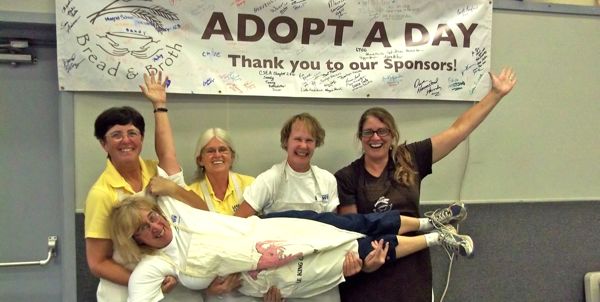
The evening dinner provided more than 100 meals to less fortunate members of the South Lake Tahoe community. In addition to donating $250 to supply the food, supplies and utilities necessary for the meal preparation, Lake Tahoe News contributors gave of their time to assist B&B volunteers during the preparation, serving and cleanup for the meal. The volunteer crew was very enthusiastic and wrote in B&B’s Adopt A Day ledger that is was: “Our privilege and pleasure to serve. Thank you for the opportunity.”

Roni Davis, Brenda Knox, Kae Reed and Kim Wyatt hold up Sue Wood after a night at Bread & Broth. Photo/Provided

Bread & Broth is very grateful for the support provided by Lake Tahoe News and the other many generous sponsors. Providing a weekly meal and distributing bags containing vegetables, baked goods and diary products donated by local community stores, is the mission that Bread & Broth has been providing for more than 23 years in South Lake Tahoe.

To find out how you can support Bread & Broth’s program, contact me at (530) 542.2876 or carolsgerard@aol.com.

Carol Gerard, Bread & Broth


What is your favorite cold weather comfort food?


Eating pizza helps Sugar Pine Foundation

Sugar Pine Foundation staff and friends who have traveled to places around the globe including Antarctica, Central Asia, Mongolia and California’s Lost Coast will share photos, films and stories as part of fund-raising event.

Lake Tahoe Pizza Co. will donate 30 percent of the night’s profits to Sugar Pine Foundation.

The event is Nov. 16 from 6-10pm. Lake Tahoe Pizza Co. is on Emerald Bay Road in South Lake Tahoe.