Vets to be honored in Placerville

Friends of the Veterans Monument will sponsor the annual El Dorado County Veterans Day Ceremony on Nov. 11 at the El Dorado County Veterans Monument, 360 Fair Lane, Placerville.

The ceremony commences precisely at 11am with the call to order and present colors. The singing of our national anthem follows, during which the distant rumbling of vintage radial engines will be heard as a flight of WWII-era war birds approaches the monument. They soar over the monument in a fly-by salute to those who have served the cause of freedom.

As part of a special tribute on Veterans Day, two engraved granite benches will be dedicated and placed in the EDC Veterans Monument Plaza:


Lake County making a name for itself in the world of wine

By Lettie Teague, Wall Street Journal

Near the end of the Civil War, the U.S. government gave away 160 acres of land to anyone willing to help settle the West. Vineyard owner Andy Beckstoffer has his own version of that Homestead Act: He has offered famous winemakers and vintners a free trip by helicopter to California’s Lake County to check out his vineyards — along with “favorable terms” for the purchase of grapes.

Beckstoffer is one of the largest — not to mention most enterprising — vineyard developers in the county. He owns about 1,000 acres in Lake County and about the same amount of land in Mendocino and Napa counties. But right now Beckstoffer is particularly focused on Lake County, which he believes has the potential to produce some very good, very reasonably priced Cabernet.

And he’s not alone; almost two months ago, the Gallo family made a very big commitment to the county with the purchase of the 2,000-acre Snows Lake Vineyard, whose 800 acres of vineyards are primarily planted to Cabernet Sauvignon. According to Gallo Senior Vice President Roger Nabedian, it’s the largest purchase that Gallo has made in at least 10 years, in terms of both money and size.

In its pre-Prohibition heyday, there were close to 3,000 acres of vineyards in Lake County, and its lakefront resorts attracted top Hollywood acts. But over the years, the vineyards were almost entirely ripped out and replaced by more-profitable walnuts and pears (and the top acts all migrated to Lake Tahoe). By the 1980s, the walnut and pear markets had dried up as well, and Lake County’s economy — and profile — declined even more.

But the past 10 years have been a time of resurgence and regrowth. There are now more than 8,000 acres of vineyards in Lake County and a few dozen wineries as well. (A few decades ago there were just four.) Five subappellations were drawn up, most notably Red Hills, Clear Lake and High Valley.

According to Beckstoffer, these subdistricts were created by growers as much to recognize their distinctive geography as to distance themselves from the less-than-illustrious Lake County name. ”

Lake County had a reputation for bad wine in the 1990s,” said Beckstoffer, naming the decade he first ventured north from Napa.

One of the reasons that the wines were so bad was the grapes were planted in “all the wrong places,” according to Beckstoffer — an opinion I heard expressed several more times from several more growers during my visit last month. The grapes — particularly Cabernet — were planted down in the valleys instead of up in the hills, and the fruit didn’t ripen properly. Valley wines also lacked the intensity of wines made from hillside fruit. Not that most wine drinkers had an opportunity to distinguish the difference between the two as most Lake County grapes were added to blends of various grapes from various places, including Napa Valley.

Beckstoffer and I had this conversation on the way to Steele Wines, one of the earliest wineries of modern Lake County, founded by Jed Steele in 1991. Steele was the much-heralded creator of Kendall-Jackson Vintner’s Reserve Chardonnay but left fame and fortune behind when he moved to Lake County and opened a decidedly low-key place of his own. The Steele winery is a world apart from his past corporate life, which is to say it’s quintessential Lake County: a low-slung building just off of the highway, across from a purveyor of farm equipment and pet food.

Although many growers, including Beckstoffer, believe that Cabernet Sauvignon will make Lake County respectable if not renowned, others, like Steele, seem to believe that the right grape for Lake County is … everything. Steele turns out a veritable alphabet of wines—from Aligote to Zinfandel and just about every varietal in between. But not all of his fruit comes from Lake County — sometimes it’s from places as far away as Washington state.

Other winemakers have backed other varietals, most notably Sauvignon Blanc or, in the case of Gregory Graham, Viognier. In fact, Graham, a Lake County pioneer, told me he thought Viognier would “rule the world” in the late 1990s. Although his Viognier is very good, that never happened, and Graham makes many other wines as well—Cabernet, Grenache, Chardonnay and Syrah.

Sonoma-based superstar winemaker David Ramey, who consults to Brassfield Winery in Upper Lake, believes that aromatic white wines like Albariño, Gewürztraminer and Roussane are the right grapes for Lake County. And he’s quite keen on Malbec, too. That red varietal has a “tremendous future” in the county, said Ramey, though there are only 25 acres of Malbec in Lake County right now.

If the absolute best Lake County grapes have yet to be determined, they are, at least, still quite reasonably priced. For example, Beckstoffer charges at least $8,000 a ton for grapes from his top Napa Cabernet vineyard, while at his Red Hills outpost in Lake (which he farms exactly the same way), the cost is $2,500 a ton for Cabernet. The Lake County average is $1,800.

And yet only about a third of the winemakers buying Beckstoffer’s fruit are making Cabernets with a Red Hills label, he estimates. Most, like winemaker Dave Guffy of the Hess Collection in Napa, are using it in blends. (Guffy uses 45 percent Lake County fruit in his Hess Select red.) The same is true for other growers — Gregory Graham estimates that he sells 60 percent of his fruit to Napa Valley wineries who bottle it into a blend. (A wine may be labeled “Napa” as long as 85 percent of the fruit is from there.)

Peter Molnar, chairman of the Lake County Wine Grape Commission, makes wine in Lake County as well as Napa and Sonoma and showcases Lake County with his wine, Obsidian Ridge. His 2009 is a wine he calls “a hillside Cabernet for the rest of us,” priced accordingly at $28 a bottle. Marked by dark fruit, currant and tobacco, it’s intense and impressive—one of the best Cabernets I tasted on my visit.

Like many of the producers I met during my visit, Molnar doesn’t live in the county, but several hours away in North Berkeley. Others commute from Sonoma and Napa. That’s another big challenge for Lake County — finding winemakers who actually want to live there. Even though an acre of land costs a fraction of what it does in Napa (about $10,000 plus the cost of developing a vineyard), there hasn’t exactly been a stampede of would-be resident vintners. Maybe it’s just a matter of time — and a few more good wines in the market with Lake County on their labels. After all, it took not one but three Homestead Acts to get the West settled.


Online classes bring higher education to all corners of the world

By Amanda Ripley, Time

On Sept. 17, the Pakistani government shut down access to YouTube. The purported reason was to block the anti-Muslim film trailer that was inciting protests around the world.

One little-noticed consequence of this decision was that 215 people in Pakistan suddenly lost their seats in a massive, open online physics course. The free college-level class, created by a Silicon Valley start-up called Udacity, included hundreds of short YouTube videos embedded on its website. Some 23,000 students worldwide had enrolled, including Khadijah Niazi, a pigtailed 11-year-old in Lahore. She was on question six of the final exam when she encountered a curt message saying “this site is unavailable.”

Niazi was devastated. She’d worked hard to master this physics class before her 12th birthday, just one week away. Now what? Niazi posted a lament on the class discussion board: “I am very angry, but I will not quit.”

In every country, education changes so slowly that it can be hard to detect progress. But what happened next was truly different. Within an hour, Maziar Kosarifar, a young man taking the class in Malaysia, began posting detailed descriptions for Niazi of the test questions in each video. Rosa Brigída, a novice physics professor taking the class from Portugal, tried to create a workaround so Niazi could bypass YouTube; it didn’t work. From England, William, 12, promised to help and warned Niazi not to write anything too negative about her government online.

None of these students had met one another in person. The class directory included people from 125 countries. But after weeks in the class, helping one another with Newton’s laws, friction and simple harmonic motion, they’d started to feel as if they shared the same carrel in the library. Together, they’d found a passageway into a rigorous, free, college-level class, and they weren’t about to let anyone lock it up.

By late that night, the Portuguese professor had successfully downloaded all the videos and then uploaded them to an uncensored photo-sharing site. It took her four hours, but it worked. The next day, Niazi passed the final exam with the highest distinction. “Yayyyyyyy,” she wrote in a new post. (Actually, she used 43 y’s, but you get the idea.) She was the youngest girl ever to complete Udacity’s Physics 100 class, a challenging course for the average college freshman.

That same day, Niazi signed up for Computer Science 101 along with her twin brother Muhammad. In England, William began downloading the videos for them.

High-end learning on the cheap

The hype about online learning is older than Niazi. In the late 1990s, Cisco CEO John Chambers predicted that “education over the Internet is going to be so big, it is going to make email usage look like a rounding error.” There was just one problem: online classes were not, generally speaking, very good. To this day, most are dry, uninspired affairs, consisting of a patchwork of online readings, written Q&As and low-budget lecture videos. Many students nevertheless pay hundreds of dollars for these classes — 3 in 10 college students report taking at least one online course, up from 1 in 10 in 2003 — but afterward, most are no better off than they would have been at their local community college.

Now, several forces have aligned to revive the hope that the Internet (or rather, humans using the Internet from Lahore to Palo Alto, Calif.) may finally disrupt higher education — not by simply replacing the distribution method but by reinventing the actual product. New technology, from cloud computing to social media, has dramatically lowered the costs and increased the odds of creating a decent online education platform. In the past year alone, start-ups like Udacity, Coursera and edX — each with an elite-university imprimatur — have put 219 college-level courses online, free of charge. Many traditional colleges are offering classes and even entire degree programs online. Demand for new skills has reached an all-time high. People on every continent have realized that to thrive in the modern economy, they need to be able to think, reason, code and calculate at higher levels than before.

At the same time, the country that led the world in higher education is now leading its youngest generation into a deep hole. According to the Federal Reserve Bank of New York, Americans owe some $914 billion in student loans; other estimates say the total tops $1 trillion. That’s more than the nation’s entire credit-card debt. On average, a college degree still pays for itself (and then some) over the course of a career. But about 40% of students at four-year colleges do not manage to get that degree within six years. Regardless, student loans have to be repaid; unlike other kinds of debt, they generally cannot be shed in bankruptcy. The government can withhold tax refunds and garnish paychecks until it gets its money back — stifling young people’s options and their spending power.

Read the whole story


Letter: McCall Realty appreciated by Bread & Broth

To the community,

Bread & Broth’s Adopt A Day of Nourishment on Sept. 24 was generously sponsored by McCall Realty. An Adopt A Day sponsorship provides a nutritious evening meal to approximately 100 needy individuals in the South Lake Tahoe community.

To serve this number of meals, B&B has a regular crew of volunteers and generally four to five volunteers from the AAD sponsor who setup, serve and cleanup. The McCall Realty sponsor volunteer crew on Sept. 24 consisted of Cynde Cain, Beatte Miering, Jill Moffett and Mike Yagi. One of McCall’s volunteers provided this comment regarding their sponsorship of an Adopt A Day “At McCall, we are committed to helping our community. The Bread & Broth program provides to those who are in need and it was our pleasure to sponsor this event and take part.”

This was the first time McCall Realty has sponsored an Adopt A Day and is looking forward to continuing their support and involvement in this program.

Bread & Broth would not be able to continue this vital service to the Lake Tahoe community without the support of businesses like McCall Realty and is very thankful for their monetary and sponsor volunteer crew contribution.

For information on any monetary donations or volunteering, contact me at (530) 542.2876 or carolsgerard@aol.com.

Carol Gerard, Bread & Broth


Letter: Thanks goes out from North Tahoe Arts

To the community,

On Oct. 21, 20 local artists volunteered their time and donated valuable pieces of their own art work all in an effort to raise money for local nonprofit, North Tahoe Arts located in Tahoe City. Attendees gathered at the Lodge at Lahontan Golf Course for A Fine Evening with Fine Art. The event raised more than $5,000.

Thanks to our local artists who donated a piece of art with a minimum value of $400 and who continue year after year to support North Tahoe Arts, this first of its kind fundraising event for NTA was a huge success. Everyone involved had a great time and felt good about supporting the arts in our community.

North Tahoe Arts has been a prominent promoter and supporter of arts in the North Lake Tahoe Communities for over 24 years.

All proceeds from the event support various art programs like ARTour in July, Kids Art Camps happening each summer and numerous Art Openings in the Galleries throughout the year. The North Tahoe Arts’ ARTisan Shop is filled with extraordinary works of art from regional artists, both nationally-recognized and emerging, with a wide variety of mediums represented.

Tickets were $300 per couple, and each couple left with a piece of artwork with a minimum value of $400. Guests spent time talking with the local selected artist and learning about his/her background while enjoying live music, appetizers and wine. Featured local artists included artwork from various mediums such as watercolor paintings, sculptures; photography, wood and much more.

A huge thank you goes to the artists who so generously gave: Susie Alexander, Jenny Antonucci, Tom Beebe, George Eisert, Carol David, Jessica Hall, Jane Jenny, Pamela Hunt Lee, Cathy McClellend, Geoff McGilvray, Jacob Morrison, Victoria Murphy, Ann Nichols, Eva Nichols, Heidi Reeves, Toni Rockwell, Andy Skaff, Jay Thelin, Loreen Thomas and Greg Zirbel.

Kellie Cutler, executive director North Tahoe Arts


Holiday bazaar in South Lake Tahoe

Zawadisha’s 2nd annual Holiday Bazaar is Dec. 1 from 10am-3pm.

Featuring local artisans and unique finds, the bazaar gives people an opportunity to shop locally and support community this holiday season.

Artists include ReviveTahoe, SquirrelsNest, and Sierra Clay Art. Zawadisha will be representing with handmade African jewelry, baskets, bags, and fabric.

There is still room for a few more artisans. Individuals interested in selling their goods should contact jules@zawadisha.org.

The bazaar is at Bona Fide HQ in Meyers. (Behind Getaway Cafe.)


Politics leading to unfriending on Facebook

By Katy Steinmetz, Time

Chris Adamson is a let-live libertarian, but he didn’t mind that most of his Facebook friends are uberliberal–until this election season. That’s when the Grand Rapids, Mich., computer programmer noticed a stream of less-than-subtle posts invading his News Feed.

The breaking point came when one of his buddies pledged to post every single day in an effort to understand “why his friends could possibly vote for” Mitt Romney. “Given the nature of my friend group, I’m getting this very one-sided argument that I don’t even want to participate in anymore,” Adamson says.

Politics, classic etiquette tells us, is a subject best avoided when friends come to dinner. It may be time to amend that advice to include Facebook. The Pew Research Center found that nearly 1 in 5 social networkers has blocked, hidden or unfriended someone over political material that was too frequent or too disagreeable.

Though social networking played a big role in the 2008 race, spurring fundraising and helping candidates get out their message, it was still the province of earlyish adopters. Since then Facebook has grown tenfold; it just hit 1 billion monthly users worldwide. Today’s bigger friend groups are also more diverse, which makes it easier to offend.

Some Facebookers have decided just to sever the online ties. Jake Sherlock, a communications coordinator in Colorado Springs, says he unfriended one of his long-distance in-laws over political chum. “The final straw for me was a post about how Obamacare requires all Americans to get chips installed in their skin,” he writes. A less drastic alternative is blocking a person’s updates from your News Feed so you don’t see their posts unless you go looking for them. Leslie Hassel, a graduate student at the University of Mississippi, says that “in an effort to salvage my relationship with my mother,” she has unsubscribed from posts by the “rabid Republican” who raised her.

Political oversharing is facilitated by what psychologists call the Internet’s disinhibition effect. John Suler, a psychology professor at Rider University in New Jersey, observes in an article for CyberPsychology & Behavior that people feel emboldened by the lack of real-time response and the sense that the things they do online are less serious than actions in the real world. We get on the Web, and “out spills rude language and harsh criticisms, anger, hatred, even threats,” Suler writes.

Etiquette gurus provide some guidelines for dealing with politics on Facebook. “Sharing what you like is generally better than sharing what you don’t,” says Anna Post, a scion of etiquette legend Emily Post. Also, now that many people can count everyone from close friends to crazy uncles to far-flung professional contacts among their Facebook friends, it’s important to keep the whole audience in mind, says consultant Jacqueline Whitmore. The original rule about politics and conversation, after all, was about having consideration for others’ feelings.

For his part, Adamson is fighting back in iambic pentameter. Every time one of his friends posts something political, he posts one line, in order, from Shakespeare’s Measure for Measure. “We’ll see if we get through the whole play by November 6th,” he announced on his wall in late September. At this point, he’s at least reached his favorite line, from Act II, Scene 1: “Some rise by sin,” the Bard wrote 400 years ago, “and some by virtue fall.”


Public given opportunity to come up with loop road ideas

By Kathryn Reed

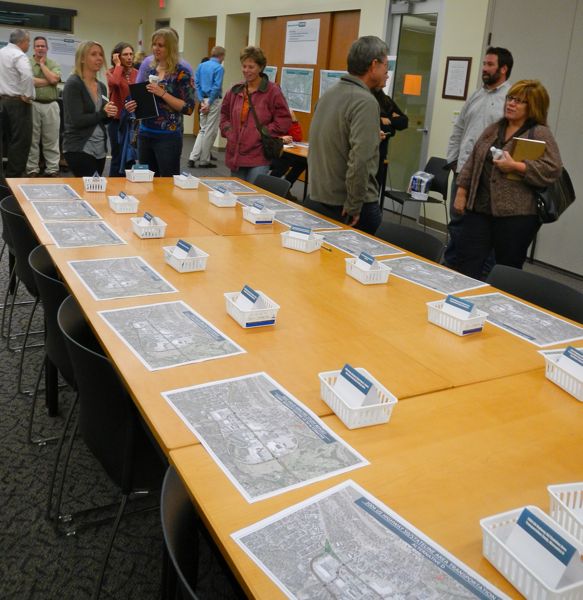
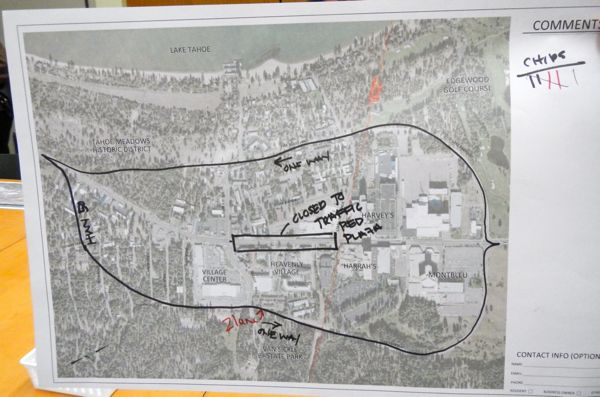
With pens in hand, people started drawing what they thought would be the best route for a loop road at the South Shore’s state line. At the other end of the table a container was filling up with those casting a vote for there never to be a loop road beyond what exists today.

Tuesday’s meeting at Lake Tahoe Community College was a bit of a do-it-yourself exercise instead of having people talk ad nauseam.

People have multiple choices for what a loop road could look like on the South Shore. Photos/Kathryn Reed

Along the walls was information detailing the history of the road that dates to the 1970s. At that time the road was to be an actual loop around the backsides of the Stateline casinos. The most recent official drawings have the road only going on the mountain side – behind Harrah’s and MontBleu.

A long table had placemat size renderings of 16 alternatives. At each one was a bucket of sorts where people could cast up to two votes for their preferred alternative(s). Those not wanting change could put their chip(s) in the 17th container.

Plenty of other people came up with suggestions that were unique or melded alternatives already on the table.

People were also asked to list their top three goals of a loop road or offer new ones. The 12 that were listed, that consultants said came from the community, were:

• Decrease traffic congestion • Improve pedestrian-bike facilities • Safer streets • Increase access to amenities • Better pedestrian amenities • Fulfill requirements of the Tahoe Regional Planning Agency Compact and area plans • Better pedestrian lighting • Have advanced forms for transportation • Encourage special events • Increase air-water quality • Improve economy • Enhance community and tourist experiences.

Some people read the list and wondered who came up with those and why people aren’t trying to achieve them even without a loop road.

Wood Rodgers is the consulting firm hired by the Tahoe Transportation District to cull all the information and run the workshops. TTD is the lead agency for the loop road.

Several people drew alternatives not already provided by planners.

While the bulk of the businesses and residents that could be displaced are in South Lake Tahoe, this project could go through even if the City Council doesn’t want it.

Proponents of a loop road want to turn the current state highway into a city street so the state line area – which includes California and Nevada – would be more pedestrian friendly. Highway 50 would be routed behind the casinos in Nevada and through existing neighborhoods and/or businesses in California.

For those who want some sort of rerouting of the highway, it’s the “where does it go in California?” that causes the most consternation. To this date, consensus has been elusive.

“We want to quantify what we’ve heard from the community,” Mark Rayback with Wood Rodgers told Lake Tahoe News.

His team will do that by coalescing the written comments, looking at which alternatives are most popular, and taking the similarities of what has been suggested to come up with what the public deems the top priorities.

A second meeting like the one Oct. 30 will be conducted Nov. 7 from 1-3pm at Embassy Suites in South Lake Tahoe. It will be the same format.

It’s possible at the Dec. 14 TTD board meeting that someone from Wood Rodgers would present a summary of findings, but with no action to be taken.

In the first quarter of 2013 a design charette is likely to occur. From there, four alternatives – though that number is not definite – could be chosen to be studied via environmental documents.


Child actors sought for ‘The Secret Garden’

The Missoula Children’s Theater via Tahoe Arts Project is having auditions for “The Secret Garden” Nov. 13 from 4-6pm at South Tahoe Middle School’s multipurpose room.

Auditions are free. If cast, there is a $35 fee per child to participate.

There are more than 50 roles for ages 5-17.

Rehearsals are Nov. 14-16 from 4-8pm, and performances are Nov. 17 at 2 and 6pm. All are at STMS.

For more information, call (530) 542.3632.


Book sale at South Tahoe library

South Lake Tahoe Friends of the Library is having a book sale Nov. 17.

The event is from 10am-3pm.

The library is at 1000 Rufus Allen Blvd.

For more info, call (530) 573.3185.