Opinion: Runaways often run into more problems

By Cheyanne Lane

What are the first thoughts that go through your mind when you see a youth on the streets? How did they get there, where are their parents, and are they safe? It’s disturbing to realize that between 1.6 million and 2.8 million youth run away annually. That’s each year.

Most youth who run away do so because of threatening environments at home, such as physical-verbal abuse, substance abuse issues, questions of sexual orientation, or escaping state care.

Unfortunately, by choosing to run away, they further subject themselves to threatening situations that impede their progress in life. Youth who have chosen to run away are at an elevated risk of pregnancy, suicide attempts, substance abuse, sexual exploitation and participating in criminal activity.

November is National Runaway Prevention Month.

It’s a public education campaign coordinated between Tahoe Youth & Family Services, National Runaway Switch Board, California Coalition for Youth, and other services agencies across the nation. The goal of National Runaway Prevention Month is to increase awareness of the issues that surround youth who have run away, and help find ways to prevent youth from running away. When a youth runs away, the impact is felt throughout the entire community.

All of us – individuals, local businesses, community groups, teachers, elected officials, and human service agencies – are encouraged to participate in National Runaway Prevention Month. If we work together to identify resources and to help youth develop life skills, it can make the difference between a youth running away and a youth finding needed resources.

Prevention means assisting youth in discovering the delicate balance of life-saving skills.

Here are four things you can do to help prevent youth/teens from running away: 1.) Awareness: Teach them what it means to run away and why running away will not solve the problem; 2.) Resources: Teach them how to build a safety net of trusted people and organizations to turn to for help; 3.) Communication: Teach them how to speak and listen effectively; 4.) Stress Management: Teach them how to reduce or manage stressors and solve problems.

Tahoe Youth & Family Services’ Drop In Centers are an excellent resource for youth who have run away, are homeless, throwaway or couch surfing. Our Drop In Center staff can assist youth with the following supportive services: food, clothing, socks, hygiene supplies, laundry services, showers, help looking for a job or filling out an application, obtaining proper identification.

We can also be there simply to listen, which often times is the most important part. The Drop In Center is a great place for youth to get recharged, resources and respect

For more information about our Drop In Centers, or how you can help runaway or homeless youth in our community, contact me (530) 541.2445, (775) 782.4202 or cheyanne@tahoeyouth.org.

Cheyanne Lane is the outreach coordinator for Tahoe Youth & Family Services.


Civil Air Patrol recruiting cadets in South Lake Tahoe

The Civil Air Patrol Blackhawk Squadron in South Lake Tahoe is enrolling local youth ages 12-19.

CAP provides leadership training, technical education, scholarships and career education to young men and women, ages 12 to 19.

CAP offers more than $200,000 in college scholarships each year, and about 10 percent of each year’s freshman class at the U.S. Air Force Academy is comprised of former CAP cadets.

If interested, contact Robert Olea at CAP.KTVL@gmail.com or (530) 541.5335.


Night out in S. Tahoe to raise money for kids to ski

Tahoe Regional Young Professionals will bring the Lake Tahoe community together to raise funds for Tahoe SkiDUCK, (SKi and snowboarding for Disabled and Underprivileged Children and older Kids) on Nov. 10 from 7-10pm at Riva Grill in South Lake Tahoe.

SkiDUCK is a grassroots nonprofit dedicated to enriching the lives of disabled and underprivileged children by sharing the joys of skiing and snowboarding. SKiDUCK is run entirely by volunteers, and all donations received will go directly to support its programs.

The inaugural Winter White Party raised $3,000 for Tahoe Youth & Family Services and TRYP hopes to raise even more this year.

The evening will be hosted by Dreu Murin and feature live music from John Chevallier and photos by Brad Scott. There will also be holiday games, and door and raffle prizes donated by local businesses. Light hors d’oeuvres will be served and drinks will be available for purchase. Attendees are encouraged to wear “winter white” (not required) to help make the evening sparkle.

TRYP will also be accepting donations of new and gently-used ski and snowboarding gear at the front door on behalf of SkiDUCK. Gloves, helmets and goggles for all sizes are needed.

Advance tickets are $10 for TRYP members and $15 for non-members. Tickets will be available at the door on a first-come, first-served basis at a cost of $20 for TRYP members and $25 for non-members.

Advance tickets are available at:

Tahoe Production House at 2291 Lake Tahoe Blvd., South Lake Tahoe and Weidinger Public Relations at 225 Kingsbury Grade, Ste. C., Stateline.


Placerville’s homeless camp to stay — for now

By Peter Hecht, Sacramento Bee

PLACERVILLE – Gene Lambert, a Navy veteran and former roofer who was disabled in a fall that crushed his skull and fractured his hip, is known among the homeless population in this old Gold Rush town as “the undertaker.”

At 56, Lambert is the tall doorman who helps maintain the peace at a city-authorized homeless encampment called Hangtown Haven. With his blue trench coat, turkey-feathered hat and a gentle nature that belies the tattooed flames flickering from his eyes, Lambert is also a guardian of Placerville’s great experiment.

Last summer, faced with local homeless people taking over city parks and lighting potentially dangerous fires in more than a dozen colonies in the woods, the Placerville City Council accepted an offer from community volunteers and a local property owner. It agreed – for 90 days – to let them erect and operate a fenced homeless encampment on a forested slope a few miles east of the city’s historic downtown.

Last week, the City Council voted to let Hangtown Haven live on, with reviews every 90 days, which could allow the homeless camp to stay open until Nov. 15, 2013.

As Sacramento and its homeless advocates grapple with proposals for a tent city or cabins for the hundreds of people who camp in the brush along the American River, Placerville has enacted at least a temporary, functional solution to the intractable homeless issues faced by numerous cities and counties.

In this town of 10,400 residents, born as a rough-hewn mining camp in 1849 and known in recent years for its rock-ribbed conservatism, sanctioning a homeless haven stirred considerable doubt.

The City Council yielded to homeless advocates by granting a permit to allow the encampment in the 1600 block of Broadway Street, a modest walk from a community center where homeless people receive counseling, job referrals and help with medical appointments. But it set a deadline: The experimental colony was to close Oct. 26.

Instead,the city granted an extended reprieve based on glowing reports. The camp – with 38 tents, 40 residents and land capacity for 60 people – had succeeded in getting homeless people out of the forest and parks without producing a din of crime or vagrancy.

“There has been a concerted effort to make this work,” said Placerville Vice Mayor Wendy Mattson as the council voted 4-0 last week to let Hangtown Haven live on. “This could have exploded in our face. But it didn’t.”

The council made clear, however, that a permanent site for the homeless colony needs to be found away from its current location near a busy transit route alongside Highway 50. It voted to reach out to El Dorado County supervisors on a regional plan to address homelessness in the county seat.

Lambert likes to think Hangtown Haven earned a stay because homeless people and supporters proved capable of maintaining a clean and orderly camp, with people in tents getting along and helping each other in the heat, cold and rain.

The Navy vet, homeless for several years, is one of six members of the Hangtown Haven camp council who seek to maintain harmony by addressing camp grievances and writing tickets for troublemakers. Get caught boozing outside your tent, that’s a ticket. Fail to clean up your mess, that’s another. Punch someone, and you’ll get written up.

Three times, camp leaders have held community votes on the fates of accused multiple offenders. In each case, Lambert said, the colony voted out bad actors “for being obnoxious,” giving them 24 hours to pack up and head out.

Placerville Police Chief George Nielsen said the camp has resulted in no overall increase in crime, though he said officers respond to about six calls there a month for public intoxication, “a couple of fights,” and to help people in medical need.

He said the colony has eased authorities’ fears of fire danger and other disruptions at camps scattered in and around Placerville. In 2010, a fight at a vagrants settlement behind a shopping center on Missouri Flat Road, just outside the city limits, ended with a 69-year-old man shot dead.

Jannette Taylor, 37, has found a sense of security at Hangtown Haven. Taylor used to run a housecleaning business. The business failed. She couldn’t pay her rent and was evicted from her apartment, she said.

Now Taylor shuttles between the camp and computers at the Community Resource Center, where showers are provided and volunteers help with résumés and job searches. Taylor said she hopes to find an assembly or cleaning job so she can reunite with two children staying with friends and family. Kids are not allowed in the homeless camp.

“This has helped a lot,” Taylor said, seated in her tent at Hangtown Haven. “It has given me an up – a way out.”

Property owner Barry Wilkinson agreed to provide 1.5 acres for the homeless colony in July, furnishing filtered well water and electricity under a lease with a local nonprofit, Hangtown Haven Inc.

Community Resource Center staff members interview would-be residents under criteria that ban registered sex offenders or people considered dangerous. Marie Cook, the resource center’s operations manager, said campers must be from Placerville. She checks recent addresses or interviews local homeless people to ensure they’re not outsiders.

Volunteers from local churches bring lunches to the camp. A nearby charity kitchen offers dinner. And campers, with donated food or shared provisions bought with food stamps, cook meals that have included hot dogs and grilled shark.

Two residents have moved on to enroll in trucking school. Some have gone into drug treatment. Meanwhile, Lambert is organizing camp Alcoholics Anonymous and Narcotics Anonymous meetings.

There are also movie nights on a 27-inch television. By camp vote, action films are a yes, romantic comedies a decided no.

Hometown Haven council member Kenneth Green, an unemployed house painter, says the camp is compliant with the Americans With Disabilities Act. Green helped carve ramps for the motorized wheelchair used by Michael Guthrie, 54, who has cerebral palsy. He moved to the colony after a caregiver passed away.

“Ken said, ‘We’ve got a nice warm tent here,'” Guthrie said. “They’ve helped me out tremendously. I’m a very spiritual person, and I know I’ve been blessed.”

But Police Chief Nielsen made clear to the City Council – and the panel agreed – that Hometown Haven eventually has to move.

Nielsen said the camp, as well as the Community Resource Center and a cluster of homeless services, is incompatible with fast-moving cars on a hilly stretch of Broadway – “a major artery in our community” – with no sidewalks.

Still, more than 30 people from the camp came to the City Council meeting last week to hail its reprieve.

They stood and waved as Art Edwards, a retired aerospace worker who formed Hangtown Haven Inc. to support the colony, announced: “The homeless men and women of Hangtown Haven have asked me to thank you.”

“It’s our haven,” echoed Lambert, “our home.”
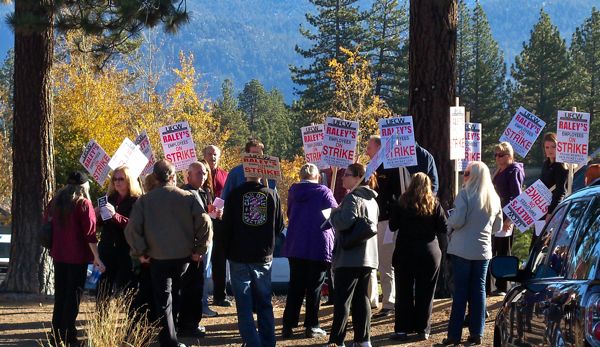


South Tahoe Raley’s workers part of strike

By Dale Kasler, Sacramento Bee

Raley’s went on strike early today, the first time in its long history, after three days of marathon negotiations failed to produce a new contract.

Leaders of the United Food and Commercial Workers told their members to head to the picket lines at 6am, when most Raley’s and Nob Hill Foods stores across Northern California opened.

The company said every one of its 130 stories would open.

Raley’s workers at the Y in South Lake Tahoe assemble about 9am to get instructions on picketing the store. Photo/Provided

“We expect all our employees who are scheduled to work on Sunday to show up for work. We have plans in place to deal with any job actions to keep our stores open and operating,” the company said in a statement shortly before 6am.

UFCW officials said health insurance remained the main sticking point. The company was proposing changes to the plan, including elimination of coverage for Medicare-eligible retirees.

“For 15 months Raley’s has tried to dictate a laundry list of takeaways including devastating members’ and retirees’ health and welfare plan and nothing has changed,” said Local 8 President Jacques Loveall in a memo to his members. “It’s clear from their actions it’s time to teach them the meaning of respect.”

Striking workers said they were willing to take concessions to help the struggling grocer regain profitability, but Raley’s demands are too steep.

“We know that things are competitive. That’s why we gave up things,” said Lori Thurm, a picket captain at the store on West Capitol Avenue in West Sacramento, barely a mile from Raley’s headquarters. “We offered numerous concessions.”

For instance, workers were willing to forego bonus pay for Sunday shifts, she said.

In his memo to workers, Loveall said it was “obvious” that the last three days of negotiations “was nothing more than a sinister and shameful delay tactic designed to allow managers more time to lie to, threaten and intimidate our members. Clearly their goal was to persuade you to abandon your union.”

Raley’s says the strike is its first in its 77-year history. The company had set a midnight Saturday deadline for reaching a deal. The talks went on another two hours, and then broke off. Raley’s then unilaterally implemented many of the terms of its “last and final” contract offer. The basic wage rate stays the same, but there will be a 2-year pay freeze and the elimination of bonus pay for working Sundays. Holiday bonus pay is scaled back.

The strike doesn’t immediately affect Bel Air stores, whose workers haven’t yet taken a strike-authorization vote. Union officials said such a vote will occur soon.

While the strike has the support of allied unions, such as Teamsters Local 150, Raley’s should be able to keep operating. Spokesman John Segale said the drivers are expected to deliver goods to the vicinity of the stores, and then store managers will retrieve items from the trucks and bring them inside.

But getting shoppers inside will be another matter. One early morning customer drove by the front of the store, realized a strike had begun, and drove off. “I support ya,” she told the pickets.

Bob Reynolds, a former Safeway executive who’s now a supermarket industry consultant in Moraga, said workers and the company will both get hurt by the strike. “Raley’s is going to be hit very hard,” he said.

Even with the stores open, some departments will probably just limp along, and even many of the most loyal Raley’s customers will go elsewhere. “You never want to show your most loyal shoppers where the alternatives are,” he said.

Yet in West Sacramento, store director Wendell Helton said his staff was working on getting the store completely operational.

Segale, the company spokesman, said, “We are continuing to provide a level of service and maintain product on the shelves.”

As of today, anyway, some customers were willing to cross the picket line.

Joel Barton of Elk Grove, who bought 12-packs of soda at the Land Park Raley’s store, said he had no reluctance to shop there. “Not a bit – Raley’s is a good company,” he said.

“I told (the strikers) on the way in they ought to be picketing Wal-Mart,” he said.

Raley’s and other traditional grocers have been losing market share to nonunion stores like Wal-Mart, which pay their workers roughly half as much as the union chains.

Raley’s top pay for union workers is $21 an hour plus benefits, although most workers aren’t at the top of the pay scale.

The UFCW did agree to concessions at struggling Save Mart Supermarkets of Modesto in September. Raley’s says its final contract offer was more generous to workers than what Save Mart employees accepted – a statement flatly denied by the union.


Number of registered voters in California hits record

By Patrick McGreevy and Evan Halper, Los Angeles Times

SACRAMENTO — The number of Californians who can now vote has surged to record levels — passing 18 million for the first time — a leap that could affect the outcome of contests across the ballot next week.

More than 1.4 million new voters have signed up, nearly 50 percent of them online under a new law that kicked in six weeks ago allowing electronic registration. They tend to be younger and more left-leaning than the state’s general voting population, according to Political Data Inc., a bipartisan firm that analyzed county reports.

That gives Democrats, who already dominate state politics, a big boost; they outnumber Republicans among the new voters by more than 2 to 1. The highest number of registered voters until now was 17.3 million, in February 2009.

The newly enfranchised could loom large in Gov. Jerry Brown’s push for tax increases, which is teetering in the polls. Brown has been pitching Proposition 30 to college students lately in a blitz of campaign appearances and social media outreach efforts expected to last until election day.

Independent voters, whose numbers also have risen, are considered key to Brown’s effort. A third of those who recently registered did so without a party preference or with a minor party.

The fresh registrants also could tip the balance in congressional races where Democrats hope to make gains in their uphill battle to retake control of the House; in more than a dozen House districts, Democratic registration rose slightly. And the new voters could help Democrats seeking to secure the state Senate and Assembly supermajorities required to raise taxes.

Online registration is the California Legislature’s answer to “voter identification” laws being promoted elsewhere with requirements that residents produce driver’s licenses or other identification before being allowed to vote. Civil-rights activists say such rules are intended to intimidate citizens and drive down election participation by the poor.

“While other states created illegitimate ways to suppress the vote, we found ways to increase the voter rolls,” said state Sen. Leland Yee, D-San Francisco, who wrote the online voter registration law. He called the program “a tremendous boost to young people and first-time voters.”

Gov. Jerry Brown signed the law last year over the objections of some GOP lawmakers, who expressed concern that electronic registration would invite fraud.

According to Political Data, a sizable share of the surge happened late. About 15 percent of the online registrants filled in their forms on the Internet on Oct. 22 — the deadline for next week’s election — amid various groups’ get-out-the-vote drives that day on Facebook and Twitter.

The numbers will rise further as some counties finish their tallies this week, said Paul Mitchell, vice president of Political Data. He predicted the final number will be about 18.4 million registered California voters when the secretary of state releases official statistics Friday.

Mitchell said online registration “created an avenue for a lot of people to register who would not have gone to the DMV and picked up a form or had someone harass them to register at Target.”

Other factors, such as a growing pool of voting-age Californians and the registration increase that typically accompanies a presidential election, were also at work, said Kim Alexander, who heads the nonpartisan California Voter Foundation. Her group promoted the new law.

She said the online effort brought in “typically underrepresented” young residents.

In some areas, registration increased by as much as 10%. That shifts the dynamic in at least two state legislative races.

In the 40th Assembly District in San Bernardino County, Democrats have reversed a GOP registration edge. Republican incumbent Mike Morrell of Rancho Cucamonga is fighting Democrat Russ Warner, also of Rancho Cucamonga, for the newly drawn seat.

And Democrats regained an advantage they had previously lost in a hotly contested race for the 31st state Senate District, in Riverside County. Republican Assemblyman Jeff Miller of Corona is running there against Democrat Richard Roth of Riverside.

Meanwhile, GOP officials had anticipated the Democratic uptick and were working to blunt its effect by scrambling to register more Republicans. They say some new GOP voters are not reflected in the Political Data report.

“We will figure out whether it makes a material difference on election day,” said Bob Huff (R-Diamond Bar), minority leader in the state Senate.

Republicans expressed doubt that the online system had effectively rooted out people not eligible to vote.

“There are not enough safeguards to prove that someone’s online identity matches their true identity,” said Assembly Republican leader Connie Conway of Tulare.

Where Republicans see safeguards, Democrats see barriers. Brown this year signed a law, also over GOP opposition, that a few years from now will allow Californians to register to vote on election day.


Workshop weeds through self-help info

Self Discovery, Not Self-Improvement is a workshop designed for those who feel overwhelmed weeding through the plethora of self-help information.

During the 90-minute session, participants will examine their personal definition of “self” and consider common elements from which people are pressured to derive their sense of identity.

Colleen Akiko Jackson, founder-director of Workshops from the Inside Out, will lead the Nov. 13, 6-7:30pm workshop at 10833 Donner Pass Road, Ste. 201, Truckee.

Register by Nov. 8 by calling (916) 781.6280.


Opinion: DA is committing crimes of his own in DiMatteo case

By Ted Long

Once again El Dorado County District Attorney Vern Pierson is using his office to discredit someone.

First, let us not forget that he dismissed all charges against Mr. [Gino] DiMatteo, and he has never offered any proof of any of the charges throughout this miscarriage of justice. He is using the federal arrest to try and make it look like he might have had something. Remember, the feds are allegedly now prosecuting for what is legal under California law.

They have “sealed” the charges; in other words kept them secret.

He also says the bribery investigation is on going. Sure, until you, the public forgets.

Ted Long

In the mean time, Angela Swanson is left destroyed and Mr. DiMatteo’s 30 employees will no doubt be out of work as his very legitimate business is being destroyed. That’s not to mention the thousands of dollars of damage to his home. All of which could have been avoided by a phone call. Mr. DiMatteo always was offering to cooperate, to sit down and talk, yet Mr. Pierson refuses.

They arrested him on Labor Day weekend knowing he can not get bailed for at least four to five days. They take him to Placerville — 90 miles away — instead of South Lake Tahoe, just blocks away to make it hard and more expensive for his attorneys to see him.

They then arrest his wife, keep her for the same weekend, releasing her with no charges. They destroy his business and his home. They actually threw a bomb in to an empty house. Now they dismiss all the charges. Oops! I guess they got even for the years he legally operate the dispensary and they could not stop him. Boy, they showed him.

Yes, I have been critical. I have tried for weeks to communicate with the DA and he has not had the courtesy to return a phone call.

Mr. DiMatteo was always ready, willing and able to cooperate with any investigation, yet the DA chose to ignore that and steamrolled his way through the county, trampling everyone’s rights, leaving destruction all around him, costing the taxpayers tens of thousands of dollars, for nothing. Now he attacks me for standing up to this violent abuse.

Vern Pierson was a friend of mine. When he first ran for DA he came to my house and asked for my support, which I gave him. He promised me he stood for justice to all. I have served three terms on the grand jury; once as its foremen. In that capacity I worked closely with him and Jim Clinchard on many cases. Vern and I enjoyed lunching together on several occasions.

When I was first told of the alleged bribery investigation, I urged Mr. DiMatteo to cooperate fully and called the DA at least six times to set up a meeting so that we could understand the situation. No call was every returned or acknowledged, no meeting held. Some have said I was entitled to at least a call saying he did not want to talk.

When I arrived at the gym [Mr. DiMatteo owns] on the day of the arrest I renewed our request to cooperate. I made it clear to all that if there were a corrupt politician, we want it exposed just as much as they did. They refused to even talk about it. It was at that point that I saw they had Mr. Di Matteo restrained and clearly in custody. I asked to talk to him as his attorney. They not only refused, but threatened to arrest me if I continued to attempt to protect his rights.

It was at this point that they told Mr. DiMatteo that they were going to arrest me also. That brings us to the tape that the DA is spreading all over the county, that of the statement of Mr. DiMatteo and my political future. If they played the entire tape for you, you would clearly hear that he was protecting me. Yes, protecting me. He did not want my involvement to be construed as any way involved with his situation. By saying what he said, he made it clear that I had no involvement, which I did not. He did not want to see me arrested also. I did not even know who he was until the dispensary issue was already over. I met him through the purchase of the gym, after which he asked me to be a business advisor and consultant.

The district attorney knows full well that I was right all along. They had no case and they used excessive force throughout this case, when no force was necessary. He is now using the resources of the county to cover his mistake at my expense, his friend, the person he broke bread with, the person he came to for his own election, the person he trusted and confided in as a dedicated citizen serving his county.

In conclusion, he would like you to think my assistance of Mr. DiMatteo was to forward my political future. I will be 80 years old at the next election. I have just recovered from my second heart attack and my wife has promised to leave me if I get involved again. Draw your own conclusions on my so called political future. The statement by Mr. DiMatteo was made to protect me as the DA was threatening to arrest me for standing up to their force that day. I find the distinct attorneys’ behavior despicable and not what is expected from our county’s highest law enforcement officer.

Perhaps I will get involved in the next election.

Ted Long is one of Gino DiMatteo’s attorneys.


Then and now: Evolution of Stateline area

The black and white photo was taken in about 1970. The Sahara Tahoe spire, which is visible, opened in 1965.

Paul Kennedy’s Steak House is at right.

Neither Harrah’s nor Harveys had built their current large hotels, yet the photo shows Tahoe’s first “high-rise”. It was Harvey’s at 12 stories in 1962.

The top floor was Harveys’ popular Top of the Wheel tiki lounge motif with Ron Rose’s music and top-shelf setting, food, and service.

— Bill Kingman

Casino heights climbed through the years. Photo/Bill Kingman

The Stateline area circa 1970. Photo/Done Lane


Review: Chevy Volt leaves skiers with cash for lift tickets

By Justin Keppler, Ski Channel

Skiers and snowboarders around the world spend millions of dollars in fuel costs every season as they travel to and from their favorite ski resorts. In fact, many would say that the hardest part about each sport is just getting up to the mountain.

With gas prices now reaching astronomical levels, enjoying a day out on the slopes is becoming more and more difficult. It’s clear that things simply cannot stay the same. In order to adapt to these ever-increasing transportation challenges, consumers have begun searching for alternative energy sources to fuel their active lifestyles.

There are a number of options currently on the market, with more than 43 all-new models being introduced through 2015. One of the standout electric vehicles on the market today is the 2013 Chevrolet Volt, developed and produced by General Motors.

“It is imperative we seek vehicles like the Chevy Volt. With the popularity of snow sports, and the increasing number of people pursuing the backcountry, this car is a vital part of the answer for the future.”

The good folks at Chevy have created the Volt to address the consumers growing concern for fuel efficiency and emission levels. One of the primary features of this electric vehicle line is its extended range. Thanks to an additional gasoline-powered motor-generator, drivers are no longer consumed with anxiety when they stray too far from the nearest EV Charging Station. Feel free to go that extra mile, because when the battery runs out, the gasoline system will automatically kick in, and your driving experience won’t miss a beat.

The EPA rates the Chevy Volt at 98 miles per gallon-equivalent while in all-electric mode. During driving situations that require a combination of gas and electric (like when you’re running late for first chair), the vehicle operates at 60 mpg. And when you deplete your battery power, due to you buddy warming up his feet while you were still on the mountain taking a few final runs, you’ll still be able to make it down the mountain at an average of 37 mpg (35 city/40 highway) while using the gasoline powered motor-generator.

“Climate change is already effecting our mountains and one of the most effective individual actions we can take to decrease our carbon footprint is to become smarter about how we get there. Battery powered transportation, like the Chevy Volt, is a realistic alternative now that will truly make a difference”.

Edmunds, a leading resource for automotive information has put the Chevy Volt to the test to determine if it can truly deliver on its eco-friendly claims. According to Senior Editor and Green Car Expert John O’Dell, ”The Chevrolet Volt’s nearly 35 miles of all-electric range will get many skiers and boarders up the mountain with no tailpipe emissions, and those who can plug in at the cabin or lodge might be able to do the whole trip gas-free. For those who live farther away from their favorite snow, the Volt’s EPA-estimated 60 mpg overall fuel efficiency – gas and electricity combined – still makes it a great green ride.”

O’Dell went on to explain, ”Using the Volt’s seat heaters instead of the cabin heater also will help save battery power and increase all-electric range while still keeping you toasty. And with front wheel drive and traction control, plus a low center of gravity, the Volt’s a good snow car when equipped with the proper tires and cables (when required).”

Anyone that knows how to enjoy a day on the snow, recognizes that it is a luxury that should never be taken for granted. To show their continued dedication to addressing climate change, ski resorts around the nation have begun implementing environmentally sustainable practices; such as energy efficient lift systems and snowmaking operations to lessen their carbon footprint. Ski resorts also appreciate that winter sports enthusiasts are typically quick to embrace cutting edge technologies – especially when they have potential environmental benefit.

One shining example is Stevens Pass, which made headlines when they installed the nation’s first EV Charging Station in a mountain pass environment. Stevens Pass has established an eco-friendly reputation by not only seeking sustainable methods to preserve and maintain its world-class snow conditions, but also by providing its community with the tools to follow their lead.

“Since we installed our two charging stations in May 2011, we’ve seen users every month of the year, and have served hundreds of EV drivers so far,” explained Ross Freeman, Environment & Sustainability Manager at Stevens Pass. “Washington State’s electrification of U.S. Highway 2 makes an all-electric trip from the city to the mountains (and beyond) entirely possible.”

Freeman went on to say, “We strive to make a real difference in reducing our carbon footprint, and supporting the use of electric vehicles puts us one more step ahead of the competition.”

The ski and snowboard industry has never been afraid of evolution. Each year, exciting changes to products are developed and new ideas are eagerly embraced. When making purchasing decisions for other important facets of life, they expect the same level of commitment to finding a better way. Chevrolet has created a vehicle that not only appeals to those residing on the forefront of innovation, but anyone with an adventurous spirit.