Party for Sierra Avalanche Center

Sierra Avalanche Center is having a Winter Stoke Throwback party on Nov. 10 at 7pm.

Vintage ski wear is encouraged because there will be a costume contest.

Live music, raffle and ski boot dance off are part of the festivities at the American Legion in South Lake Tahoe.


Raley’s workers walk the line; management keeps doors open

By Dale Kasler, Sacramento Bee

The grocery shelves were stocked, the coffee stand was open and shoppers were lined up at the deli counter for sandwiches.

On the picket line outside, morale was high and strikers said they were settling in for the long haul. They pumped their fists every time a potential customer left without going inside.

Monday was Day 2 of the strike against Raley’s, and across Northern California both sides were scrambling to put the best face on things. It wasn’t clear if labor or management had gained the upper hand.

Raley’s said it was pleased with overall operations and customer support. What’s more, spokesman John Segale said, “nearly half” of union employees showed up for work Monday.

The United Food and Commercial Workers denied that many workers crossed the picket line, but the union wouldn’t provide specifics. UFCW officials said the picketing workers succeeded in driving shoppers away.

“Raley’s customers are shopping elsewhere while the workers are on strike,” said UFCW Local 8 President Jacques Loveall in an emailed statement.

Raley’s has two stores in South Lake Tahoe. Pickets were out in force at the driveway entrances to both stores as well as in front of the store. People carrying signs were also along the highway in front of the Raley’s owned gas station at the Y.

While the company says normal operations are under way, the usual Monday donation to Bread & Broth was not received.

Company Chief Executive Michael Teel, in a radio commercial airing Monday, urged shoppers to ignore the strike.

“You can still count on us,” he said, reminding listeners of the grocer’s decades of experience.

Getting a gauge on the volume of customer activity was difficult. Segale said it was clear that some consumers “changed their shopping habits” but others were “coming out, supporting the company.”

One Sacramento customer, Dolly Rominger, said she came to the Folsom Boulevard store only because her mobility is limited and she didn’t want to drive farther. She expressed sympathy for the picketing workers.

“I feel bad for them,” said Rominger, who lives about three miles away. “I don’t like to see anybody have to stand on a picket line.”

Strikers said they walked out largely to protect their health plans. Raley’s wants to switch them to a different plan and eliminate health coverage for retired workers who are eligible for Medicare.

Not all shoppers were convinced that the strike was warranted. Vanessa Herburger, 26, her cart full of fresh fruit and vegetables, expressed mixed sentiments. Herburger, a state worker, said she has endured her share of cuts and furloughs in recent years.

“They are standing up for what they believe, and that’s good, Herburger said. “But I’m just happy to have a job.”

Maybe the Raley’s employees should be, too, she suggested, during tough economic times.

Supermarket industry consultant Bob Reynolds said Raley’s could find itself isolated, as there is no shortage of union and nonunion stores where Northern Californians can buy groceries without crossing a picket line.

“It’s not just short term, it’s long term,” he said. “You never want to show your most loyal shoppers where the alternatives are.”

The strike has put something of a strain on Raley’s operations. Store hours have been reduced at several locations. But every store is open, and Segale said logistics are running smoothly for the most part.

Although Teamsters drivers are refusing to cross the picket lines, Segale said they’re delivering products to nearby sites, where store managers can collect them. Besides, many deliveries come from nonunion vendors, he said.

“They’re able to get product to the stores … and put on the shelves,” he said.

Yet it’s typical in supermarket strikes for some products to run short eventually, Reynolds said.

Even if replacement workers are hired, as Raley’s has promised, it’s tough to keep all departments fully stocked over the long haul, he said.

The union says it has amassed a $60 million strike fund and will pay striking employees at least $200 a week. That’s a fraction of the $840 a week earned on the job by veteran employees at the top of the pay scale.

Still, the striking workers said they were committed to staying out of work for as long as it takes.

“If it lasts until the winter, and the rain is falling down, I’ll be out here,” said Brian Pickens, who was manning the picket line at the Folsom store. “I’m in for the long haul.”

Ken Jacobs, a labor relations expert at the University of California at Berkeley, said most strikers stayed off the job for the duration of the nine-month Southern California grocery walkout in 2003.

He said Raley’s proposals on health insurance could keep the workers anchored to the picket line.

“When people see their health care threatened, that’s the kind of thing that tends to keep people motivated,” he said.

This appears to be the first walkout in the U.S. grocery industry since 2010, when employees struck warehouses owned by Shaw’s Supermarkets in New England. That strike lasted four months.

— Lake Tahoe News contributed to this story.


Opinion: Setting priorities will keep Placer County afloat

By Jennifer Montgomery

All of us at Placer County can see better days ahead now that the worst of the economic slowdown is behind us.

We understand, though, the road to recovery will not be easy, and we will continue to struggle to find solutions as new, complex challenges present themselves along the way.

That is why the Board of Supervisors and county staff are working on an innovative, long-term plan to determine where Placer County should head over the next five years and how best to get there. Without identifying a target, how can you know what you are aiming for?

Jennifer Montgomery

The board has several overriding goals.

Costs must be kept under control to preserve the County’s fiscal health. That goal is vital because County revenue is beginning to rebound from recession-era lows, but not fast enough to keep pace with expected cost increases.

Priorities must be set, so that we use the county’s limited resources to meet the most important public safety and service needs.

The board must make sure its policy goals are met to place the County in a position to deal effectively and decisively with the next economic downturn.

The task is daunting, but we already are making good progress.

One of the board’s first priorities was finding someone to oversee the effort as county executive officer. Our recruitment efforts led us to new CEO David Boesch, who has just the kind of background and expertise we were looking for.

One of Boesch’s first tasks was to help oversee development of a critical piece of the puzzle: a five-year budget strategy for keeping revenue and costs in balance. Placer County already is making headway in achieving two of the strategy’s goals: reducing the use of one-time revenues to fund ongoing operations and bolstering our depleted reserve funds now that county revenue is beginning to recover.

Another important piece of the puzzle is an innovative, all-inclusive and overdue effort to identify needed infrastructure projects and to fund critical construction and maintenance projects.

Placer County has individual infrastructure plans in place for several types of projects, including facilities, public works, information technology, and fire facilities and equipment.

The new comprehensive funding plan will consider those types of projects, plus others such as open space, sewer and solid waste facilities, and the utilities needed to support county services.

On July 10, the board approved proceeding with the funding plan, authorizing Boesch to set up a county Infrastructure Investment Committee to develop criteria for use in drafting the plan.

The plan is critical because Placer County had no choice but to reduce funding for infrastructure projects during the recession years. Now, it is time for us to make infrastructure investments a higher priority again — not a top priority, but a higher priority.

The funding plan will include a focus on infrastructure projects that will help the construction industry get moving again and generate jobs. Areas of particular interest for our economic development efforts include the Sunset Industrial Area between Rocklin, Roseville and Lincoln and the Placer County Government Center in North Auburn, a complex commonly known as the DeWitt Center.

Placer County’s efforts to increase cost sharing with employees are another critical part of the drive to keep revenue and costs in balance. Employees now pick up larger shares of their pension and health insurance costs than they used to, and new hires receive fewer benefits under a two-tier system that will help the county make sure benefit costs are sustainable long term.

Placer County also is making progress in reducing its unfunded liability for medical, dental, vision and other benefits that generally are known as other post-employment benefits, or OPEB.

Under a plan approved by the board in 2006, the county placed $25 million in an interest-earning trust account over three budget cycles. It sets aside funds when new employees are hired to cover part of their projected OPEB costs and has helped reduce the unfunded liability through increased cost sharing with employees for health insurance. The County also joined the California Employer’s Retiree Benefit Trust Fund operated by CalPERS, obtaining higher investment earnings than it could get on its own.

The county is having success in another important area: trying new, innovative approaches to provide public services that are both cost-effective and high-quality. Health and Human Services is leading the way, using an entrepreneurial approach that maximizes the use of federal and state funding and contracts with private-sector partners to provide client services in many cases.

Placer County also is gearing up for another effort that will be critical in the coming years: succession planning. Many of our employees at all levels are at or nearing retirement, and the County needs to make sure our bench is deep enough for the change that is inevitable.

We are at a very important point in local government. Due to declining revenues and a shrinking employee base, we are not as capable as we once were in some areas. Looking forward, we have a chance to reorient priorities to meet changed public service needs. Public involvement will be critical and I ask for your help in moving our county forward.

Last but not least, my sincere thanks to everyone who chooses to participate in ensuring your local county government is as responsive and nimble as possible in the coming years.

Jennifer Montgomery is chairwoman of the Placer County Board of Supervisors.


Pancreatic cancer diagnosis tests Tahoe family

Publisher’s note: Denise Rury will be at this morning’s South Lake Tahoe City Council at 9 to talk about Pancreatic Cancer Awareness Month and accept a proclamation from the city.

By Denise Rury

It’s November, which for my family means its Pancreatic Cancer Awareness Month, a time of remembrance, not just awareness. It was 3½ years ago that my mother, Jeanette Criner, was diagnosed with pancreatic cancer. The gravity of this announcement was even more devastating because her father was also diagnosed with pancreatic cancer and died within three weeks.

Despite what little she knew, really what most of us know about pancreatic cancer, she knew enough to know what a formidable enemy she was up against. The statistics are pretty dismal. Pancreatic cancer has the lowest survival rate of all cancers tracked by the American Cancer Society and the National Cancer Institute: 94 percent of pancreatic cancer patients die within five years of diagnosis and only 6 percent will survive five more years. Seventy-four percent of patients die within the first year of diagnosis.

Jeanette Criner

Jeanette was diagnosed with stage one pancreatic cancer, which gave her the option of having one of the few tools available in treating this cancer — surgery. The surgery, known as the Whipple operation, where the head of the pancreas, a portion of the bile duct, the gallbladder and the duodenum is removed. It is a complicated and long surgery, but at this point it was the best option available. Tough Jeanette was understandably fearful, she was determined to do whatever it took to fight this.

The surgery seemed to have gone well, but unfortunately a few cancer cells were found outside of the pancreas and perhaps when she recovered from the surgery, gained some weight and was ready, chemotherapy was on option. This was late August 2008 and despite all the efforts of Jeanette with physical therapy, the care and attention of her medical staff, the love and support from her family, she continued a downhill battle that lasted seven months.

I watched my mother having gone from an active woman that at the age of 72 still worked, baked, tended to her garden and enjoyed hikes in and around her beloved Lake Tahoe to becoming a frail, depressed patient who lost hope when it became obvious that her best efforts just weren’t working. Jeanette spent her last couple months surrounded by family, at various times from all across the country, even the world, which was of great comfort. She had the love and support at all times of her family here in Tahoe and would still get out and about to enjoy another favorite activity — coffee with her children or grandchildren to chat about the funny or mundane, anything but pancreatic cancer.

As her health continued to deteriorate, she made the decision to stop cancer treatments and start hospice care. I remember the last time she was outside, taking in the beauty of the lake and knowing it was the last time she would ever see Lake Tahoe. I remember how hard, even in the face of the obvious, trying to encourage her to keep fighting, have a reason, some reason to still be here but that day, with her staring out the window, looking at the lake, it was apparent that this was it. It was only a week or so later that she left for good.

Denise Rury is a resident of South Lake Tahoe.


Discounted chipping available in Placer County

Placer County’s chipper program continues to be available for local residents seeking to reduce their fire hazards and improve defensible space around structures.

Chipping rather than burning reduces the impact of smoke. Another benefit of chipping is that the woody material can be used for landscaping or ground cover.

The program, managed by the Placer County Resource Conservation District, is a low-cost curbside chipping service, supported in part by state and federal grants. The program also can assist qualified Placer County homeowners with financial or physical limitations to access the chipping program through fee waivers.

Under direction from the Board of Supervisors, the county worked with the resource conservation district to establish a reasonable and sustainable cost-share rate structure to keep the program running. The full cost of the chipper service is estimated at $80 per hour. With the applicable cost-share rate, the minimum charge is $40 for up to one hour of service.

The low-cost chipping service is available for Placer County residents who live west of Serene Lakes.

To arrange for chipping services or request information, call (530) 889.0111, ext 3. Follow the message prompts.


TOCCATA sets dates for holiday concerts

Tahoe Symphony Orchestra and Chorus will present five performances of its annual holiday production which includes selections from parts 1 and 3 of Handel’s Messiah and favorite carols.

Performances are Dec. 7, 14, 16, 19, and 23 in and around the Tahoe-Reno area.

Contact TOCCATA at (775) 313.9697 for more information.


LTWC in talks with investors to grow rehab facility

By Kathryn Reed

The sound of hope fills Tom Millham’s voice when he talks about the possibility of investors coming forward who could transform Lake Tahoe Wildlife Care into a sustainable enterprise for generations to come.

For more than 30 years Tom and Cheryl Millham have been rehabbing wild animals in their spacious backyard. Long ago they outgrew the facility that is in El Dorado County, on the edge of South Lake Tahoe. And all those years they have been looking to move to a more suitable location that would also allow them to create an education component to the center.

Reason after reason the center has stayed put.

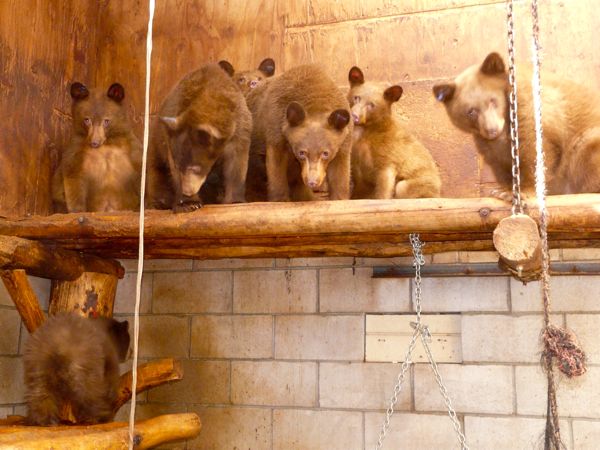
Lake Tahoe Wildlife Care is caring for a record number of bears. Photo/LTWC

At tonight’s LTWC board meeting, the volunteers of this nonprofit will be updated on the two people who have expressed interest in putting up what could be millions of dollars to buy a 3,700-square-foot house on 16-plus acres that back up to U.S. Forest Service property at the bottom of Old Meyers Grade, as well to pay for the work needed to make LTWC more than it is today.

“We haven’t heard that part yet,” Tom Millham said of what the investors might want in return for their cash. “None of that has been discussed yet. We are still in the initial stages of discussions, but at least we have someone now we can focus on.”

Millham would not discuss who the potential investors are so as not to jeopardize negotiations. He said one is from the region, while the other is out of the area.

He told Lake Tahoe News if things progress smoothly and quickly, the rehab part of the operation could move to the Echo Creek Estate location by the end of next summer. This is assuming a decision by the backers is made by the end of the year.

“We know we can rebuild these nine cages in a fairly short amount of time,” Millham said.

Ben Fagan has been sketching some designs for possible cages.

The next phase would be the education center.

“It would have an amphitheater for shows and things like that; a store for retail; café; upstairs will be the board room, offices and living quarters for the person living on site; and custodial,” Millham explained.

The amphitheater may seat up to 200 people. It would be used to show educational films about wildlife, the facility, be a place for lectures, and also be a venue for community gatherings.

The idea is one person or a family would live onsite. It will not be the Millhams – they’ve had enough of that experience.

Mike Dill with Aspen Environmental Services has been working with the Tahoe Regional Planning Agency. The original permit on the property was to have expired last month, but a two-year extension has been granted.

Millham relayed that TRPA and El Dorado County have been working cooperatively to make the wildlife center a reality at the Meyers location.

The need for this type of facility keeps increasing based on the numbers of animals LTWC rehabilitates each year. This season, which is usually wrapped up by now except for getting bears to hibernate, has been busy. The eight bears and six bobcats were each a record number.

The bears alone cost $3,000 a month to feed. That will taper off soon as they transition to hibernation.

“It’s not stopping. We got a red tail hawk on Saturday,” Millham said. Two golden eagles still remain, with the likelihood of one starting to exercise next week for release. The other is not likely to make it back to the wild so it will need to find another home.

One of the bobcats will also not return to the wild. It had become too comfortable around people. It’s next home could be Six Flags Marine World in Vallejo. Folks from that facility were in town Monday to take a look at the little guy.

While Lake Tahoe Wildlife Care has interested investors, the Millhams know it could fall through. That is why they are continuing to seek out others who may be interested in helping LTWC evolve. Then, there’s always the need for donations to keep the animals fed.

More info about LTWC is online – including webcams of the bears.


Opinion: West Coast needs to learn from Sandy

By Alexandra Le Tellier, Los Angeles Times

Watching super storm Sandy ravage New York and New Jersey made two things abundantly clear. It’s time to stop double-guessing climate scientists, and it’s time to start focusing on building a modern-day infrastructure to accommodate our climate-changed reality.

Of all the horror stories that played out in Sandy’s path of destruction, one of the most shocking was the meltdown of two Manhattan hospitals — New York University Langone Medical Center and Bellevue Hospital — which not only suffered power outages but also couldn’t rely on backup generators. At Bellevue Hospital, 17 million gallons of seawater collected in its basement, compromising the generators. Think about that. At both hospitals, critical-care patients had to be evacuated.

Piers Morgan used his CNN soapbox to take Alan Aviles, president of the New York City Health and Hospitals Corp., to task for facilities that were unprepared, jeopardizing patients’ health and safety. He argued:

THEN AND NOW: Devastation from super storm Sandy

I find it quite shameful that two of New York’s major hospitals have suffered complete power outages, given the fact that there’ve been hurricanes before, from Irene onwards, which have threatened; that they’re on the water, these hospitals; there must be an ongoing threat. And then it was a week to prepare for what everybody was saying was the biggest storm New York would ever see. […]

 But whichever way you explain this, it doesn’t change the fact that you have got hundreds of patients, many critically ill, many mothers with newborn children, all being ferried on Monday night, for example, from NYU into the eye of the worst storm ever. I can’t think of anything worse for a mother with a newborn child than to be ferried down nine flights of stairs by harassed nurses and then have to go out into a hurricane.

 It does beg the question, if this was to happen again next year, would you have a different system that didn’t have, for example, pumps with oil in the basement, which then get drowned so much you can’t use them? I mean, what are the lessons that get learned here so that mothers who may be coming into these hospitals next year don’t have to worry that if there’s another hurricane, they’re going to be out in the middle of it? […]

 Is it not your job as the president of New York City Health and Hospitals Corporation to think the unthinkable? And isn’t this just part of the unthinkable — in other words a major attack through water? You are based near the water there. It can hardly be that unthinkable. But it has come in and has affected your power system to the extent that you have to evacuate hundreds of people. That is part of your job, isn’t it?

“It is very easy to make that judgment from a ringside seat,” Aviles said by way of defense. True. But we still ought to listen to this critique and find answers to the questions this fiasco raised before the next big disaster, wherever it may hit.

That’s especially true for us in California, where we have earthquake faults, nuclear power plants and the Pacific Ocean to contend with. And one place we can’t cut corners: medical facilities.

In an op-ed that ran in 2011’s Los Angeles Times opinion pages, Assemblywoman Bonnie Lowenthal, D-Long Beach, questioned the wisdom behind cutting annual maintenance funds to our state’s three mobile hospitals, or “hospitals in a box,” which can be set up just about anywhere in case of emergency and are fully loaded: ventilators, respirators, antivirals, digital X-ray machines, oxygen concentration unit, hundreds of beds and separate emergency rooms, among other crucial amenities.

“California has about 73,000 acute-care beds among its 321 brick-and-mortar hospitals. A whopping 75 percent of those hospitals are in earthquake zones. State officials have identified nearly 600 separate hospital buildings that pose a real risk of collapse during a seismic event,” wrote Lowenthal, who also warned that these field hospitals would be as good as useless if we don’t spend the money — a little less than $2 million annually — needed to maintain them.

Sandy wreaked havoc on the East Coast, devastating people in New York and New Jersey. For some, there’s no silver lining in sight. But for us, on the West Coast, we should use Sandy as a call to action to prepare for worst-case scenarios, and that includes making sure that we don’t skimp on the most important things, like healthcare.


S. Tahoe doggie daycare helping victims of Sandy

Tahoe Best Friends, a cage free doggie daycare and home-style boarding center in South Lake Tahoe, is supporting the efforts of two relief organizations in wake of devastation from superstorm Sandy.

On Nov. 10-11, Tahoe Best Friends will offer free doggie daycare between 7am and 7pm. In exchange for free doggie daycare, Tahoe Best Friends is accepting donations that will all go directly to the Red Cross Relief of Hurricane Sandy and the ASPCA Hurricane Sandy Relief funds.

If you bring your best friend in for some fun, you will get a charitable tax receipt.

This offer for a free doggie daycare is for anyone with a dog-friendly dog that is fully vaccinated.

Make reservations online or call (530) 542.2336.


Truckee police calls to be routed to sheriff’s office after hours

The Nevada County Sheriff’s Office has assumed operation of the Regional Dispatch Center in Nevada City.

Sheriff’s office dispatchers will answer all 911 calls and handle all radio traffic for the sheriff’s office and the Nevada City, Truckee and Grass Valley police departments.

Each agency’s regular business telephone line will be answered by the respective department during regular business hours, 8am to 5pm Monday through Friday.

After hours and on holidays, calls to the business lines will be forwarded to the Regional Dispatch Center and answered by Nevada County dispatchers.

 — Sacramento Bee