Whittemore’s attorneys file for dismissal

By Jeff German and Francis McCabe, Las Vegas Review-Journal

Defense lawyers for Harvey Whittemore filed court papers Friday seeking to suppress evidence in the high-profile federal case charging the one-time power broker in a scheme to unlawfully funnel $138,000 in campaign contributions to Senate Majority Leader Harry Reid.

The lawyers argued the evidence – including a note from the Nevada Democrat thanking Whittemore – was unlawfully obtained without a warrant.

The court papers included motions to dismiss the case against the longtime legislative lobbyist because of a lack of evidence.

Whittemore, 59, who once wielded influence within the state’s political hierarchy, faces four felony charges, including making excessive campaign contributions, making contributions in the name of another and making a false statement to a federal agency. His trial is set for Feb. 26 before U.S. District Judge Larry Hicks in Reno.

In a motion to suppress, Las Vegas attorney Dominic Gentile sought to toss out all evidence found without a court-approved warrant in 81 boxes taken from Whittemore’s offices after his business partners cut ties with him.

The boxes contained documents identifying the surrogate contributors Whittemore is alleged to have used in the scheme and his reimbursements to the contributors, a book about campaign finance law, a note to Reid and a note from Reid.

An FBI agent told the grand jury Reid authenticated his note to Whittemore that read, “Harvey, you’re a man of your word” and “You are a true friend now and for all days.”

According to the indictment, Whittemore duped Reid’s campaign committee into believing the contributions came legally from family members and associates.

Reid has distanced himself from Whittemore since the Las Vegas Review-Journal first reported in February that he was the subject of a federal investigation.

In one defense motion seeking to dismiss the case, Gentile argued the government cannot prove Whittemore knowingly violated the campaign laws.

“The indictment is devoid of any factual allegations that Mr. Whittemore knew the specific laws with which he is charged of violating,” Gentile wrote. “Thus, the court should dismiss the indictment in full because the government has failed to allege the essential facts constituting the element of willfulness.”

The indictment alleges Whittemore met with Reid in February 2007 in Las Vegas and agreed to raise $150,000 by the March 31, 2007, campaign finance deadline.

Whittemore unlawfully used family members and associates as conduits for contributions to the senator’s campaign and then reimbursed them, the indictment alleges.

But Gentile argued Whittemore’s conduct supports the conclusion that he did not believe he was breaking the law.

“These are all people that Mr. Whittemore cared deeply about and would be the last people that he would put in harm’s way, if he believed his conduct was illegal,” Gentile wrote.

“It is unfathomable that he would knowingly and willfully expose his children to criminal liability just to make a few extra campaign donations.”

Evidence presented to the grand jury included testimony about the boxes filled with the contents of Whittemore’s offices with his former company, Wingfield Nevada Group Holding Co., according to the suppression motion.

After Thomas and Albert Seeno, two wealthy California brothers who partnered with Whittemore in Wingfield Nevada, removed him from the company, his offices were sealed, and the contents were boxed and delivered to the Las Vegas law firm of Pisanelli Bice.

James Pisanelli told a county judge hearing a lawsuit over the failed business partnership that the FBI had subpoenaed the boxes and ordered the firm to keep them, according to Gentile’s motion.

Gentile argued that Whittemore was never served with the “purported subpoena” that allowed the FBI to examine the boxes.

Because the search “led directly to the alleged discovery of the very acts and transactions which are the basis” of the indictment, all evidence derived from the illegal search must be suppressed, Gentile wrote.

The investigation became public Feb. 9, as FBI agents fanned out across the state at some 30 locations to serve subpoenas on Whittemore business associates, family members and employees.

Allegations had surfaced that employees of Wingfield Nevada and its subsidiaries were used to donate to political campaigns and were later reimbursed by Whittemore with company money.

In recent years, Whittemore turned his attention away from lobbying to land development.

At the time of his big push to contribute money to Reid’s campaign, Whittemore was orchestrating the development of Coyote Springs, a master-planned community in Southern Nevada.

With the help of Reid and other members of the Nevada congressional delegation, Whittemore sought to overcome several government hurdles because of county water and federal land issues.

But in 2008, the 43,000-acre development stalled because of the housing crash and economic recession and has languished ever since.



Bread & Broth needs help with Thanksgiving dinner

The Bread & Broth program at St. Theresa Catholic Church is observing its 24th anniversary of serving meals to community members in need by offering a special Thanksgiving dinner on Nov. 19 from 4-6pm in the Grace Hall.

Community support is needed in the form of key ingredients for the meal: celery, carrots, onions, oranges, fresh cranberries, fried onion topping, sausage, canned sweet potatoes, marshmallows, and butter. Cash donations are also greatly appreciated.

Make arrangements to drop off your contributions by Nov. 16 by calling Kathi at (530) 541.2551 or leave donations at the church rectory on weekdays between 9am-noon and 1-4pm.

Bread & Broth expects to serve 300 diners that night.

St. Theresa is located at 1401 Lyons Ave. The meal is open to all members of the community just as it has been every Monday at Grace Hall since 1989.

For more info, contact Diane Weidinger at (775) 588.3993 or dianeweidinger@yahoo.com.


Raley’s, union back at negotiation table

By Dale Kasler, Sacramento Bee

Raley’s and the United Food and Commercial Workers on Sunday announced they have resumed negotiations in San Francisco as the two sides seek an end to a week-old strike.

UFCW Local 8 in Roseville said Raley’s initiated the talks, a move that Raley’s spokesman John Segale confirmed.

“It is abundantly clear to us Raley’s desire to return to the (bargaining) table has been driven by the success of our picket lines and consumer support for our members,” the local told members on its website. “Raley’s chief negotiator contacted your bargaining team with a request to resume negotiations.”

Union officials urged their members to continue picketing despite the resumption of talks.

“While this is a positive development, it is no time to let down our guard,” UFCW Local 5 in San Jose said in a message posted on its website.

Few details were available about the new negotiations.

“Both parties have agreed to not discuss the progress of these talks while the current negotiations are ongoing,” Raley’s said in a prepared statement.

Raley’s workers went on strike a week ago rather than agree to the company’s demands for wage and benefit concessions.

The main sticking point is Raley’s proposal to alter the health insurance plan, including the elimination of health care for retirees eligible for Medicare.

Both sides have been claiming success so far. Raley’s has said sales, while reduced, have improved day by day, and that some union members have returned to work.

Union officials say they’ve kept picket lines intact and persuaded the vast majority of Raley’s customers to shop elsewhere. About 80 stores are affected.


‘Government Control of News’ — book outlines chilling reality

By Kathryn Reed

Should the federal government be in the business of regulating news?

An emphatic exclamation point filled “no” would be my answer. But it has been and could be again.

Broadcasters until 1987 were subjected to the Fairness Doctrine. This in many ways a direct slap across the face to the Founding Fathers who in the First Amendment protected a free press.

Network television is different than cable stations because the latter are not licensed by the FCC, so they were never subjected to the Fairness Doctrine.

Corydon B. Dunham, who was NBC-TV’s legal counsel for 25 years, warns in his book, “Government Control of News: A Constitutional Challenge,” that media censorship rules have not disappeared because of the Localism, Balance, and Diversity Doctrine that could impact the Internet.

Both doctrines come under the Federal Communications Commission.

The FCC contends it wants oversight to make sure there is fair and balanced coverage. Others say the Fairness Doctrine achieved the opposite and anything like it again would be just as detrimental.

In the book Dunham quotes the circuit court that upheld the FCC revocation of the Fairness Doctrine: “The Fairness Doctrine in operation disserves both the public’s right to diverse sources of information and the broadcasters’ interest in free expression. Its chilling effect thwarts its intended purpose ….”

Dunham does a good job of making the case why the government should not be in the news business. Admittedly, in my case, he was preaching to the choir.

While the book is important to read, to know the history of the Fairness Doctrine and what could be on the horizon, it is not an exciting read. But is an important book for anyone who cares about an independent media – be it print, broadcast or Internet.


Tahoe Tails — Adoptable Pets in South Lake Tahoe

Ping Ping is a beautiful black cat who came to the shelter with his mother Bebe, who is pure white.

They have lived with small dogs and children, and are used to being indoor cats. Both are very friendly cats who will adapt to just about any household.

Ping Ping is neutered, microchipped, and vaccinated. He is at the El Dorado County Animal Services shelter in Meyers, along with many other dogs and cats who are waiting for their new homes.

Go online to see photos and description of all pets at the shelter.

Call (530) 573.7925 for directions, hours, and other information on adopting a pet.

For spay-neuter assistance for South Tahoe residents, go online.

— Karen Kuentz


Opinion: Eastern District deserves full slate of judges

By Carl Tobias

Last week, Eastern District of California Judge Anthony Ishii assumed senior status after 15 years of valuable service. This means that the Eastern District will experience two openings in six judgeships. The Administrative Office of the U.S. Courts has designated both as emergencies because of the substantial caseloads that the district’s judges carry.

These vacancies, which are one-third of the Eastern District positions, undermine justice. Thus, President Obama must swiftly nominate, and the Senate promptly confirm, judges for the empty seats.

Obama has robustly sought advice from Republicans and Democrats where openings arise before nominations. He has proposed nominees of even temperament, who are intelligent, ethical, industrious, independent and diverse in terms of ethnicity, gender and ideology. A quintessential example is Eastern District Judge Kimberly J. Mueller.

Sen. Patrick Leahy, D-Vt., the Judiciary Committee chair, has expeditiously scheduled hearings and votes, forwarding nominees to the floor where many languish for months. On Aug. 3, the Senate recessed without acting on 22 qualified nominees whom the panel reported because the GOP would not vote and again on Sept. 22 without considering 19 exceptional nominees.

Republicans should cooperate more. The major bottleneck is the floor. Sen. Mitch McConnell. R-Ky., the minority leader, has rarely agreed to votes. Most troubling has been GOP unwillingness to move noncontroversial, strong nominees – inaction that conflicts with Senate traditions. When the chamber has ultimately voted, it easily approved most nominees, like Stephanie Rose, who won 89-1 appointment on Sept. 10.

The two Eastern District vacancies are essential. Obama has nominated one well-qualified individual. He should keep cooperating with Leahy and Sen. Harry Reid, D-Nev., the majority leader, who sets floor votes, and their Republican analogues to facilitate confirmation while nominating a superb candidate for Judge Ishii’s opening.

Obama must also continue working closely with California Democratic Sens. Dianne Feinstein and Barbara Boxer. Each has created merit selection commissions, which seek applications, interview prospects and make suggestions to the senators who correspondingly forward recommendations to the White House.

These efforts led Obama to nominate on June 25, Sacramento County Superior Court Judge Troy Nunley for the seat that opened when Judge Garland Burrell assumed senior status on July 4. The nominee earned the qualified American Bar Association rating. Nunley served as a deputy district attorney in Alameda County from 1991 to 1994 and in Sacramento County from 1996 to 1999 and served as deputy attorney general in the California Attorney General’s Office from 1999 to 2002 when he joined the bench.

Leahy expeditiously scheduled a Sept. 19 hearing for Nunley at which Feinstein and Boxer voiced their strong support. Sen. Charles Grassley, R-Iowa, the ranking member, questioned the nominee, who acquitted himself well, and Grassley seemed satisfied with the judge’s responses. However, the Judiciary Committee has not voted on Nunley because the Senate recessed on Sept. 22.

When senators return on Nov. 13, the panel must swiftly vote and McConnell must agree to a prompt vote on the nominee because he is well-qualified and the Eastern District desperately needs all six judges to effectively resolve its enormous docket. Eastern District judges have carried twice the average caseload of judges in the remaining 93 federal districts for many years. The U.S. Judicial Conference, the courts’ policy-making arm, has recommended that Congress authorize six new judgeships for the district. These suggestions are premised on conservative estimates of case and work loads. However, more judgeships will help little, if the Senate cannot confirm nominees.

Obama should rapidly nominate a talented candidate for Ishii’s vacancy. The White House is not currently evaluating suggestions from the California senators, so the administration might encourage Feinstein and Boxer to quickly tender names. Once the president has nominated a fine candidate, the Senate must expeditiously process the nominee.

The two Eastern District of California openings undermine justice. Thus, Obama must swiftly nominate and senators must promptly approve excellent judges, so that the court can deliver justice.

Carl Tobias is the Williams Chair in Law, University of Richmond. This was written for McClatchy Newspapers.


Snippets about Lake Tahoe

• Fresh Ketch’s annual Pray for Snow party is Nov. 15. Music starts at 7pm.

• Sugar Bowl will open with weekend operations on Nov. 17.

• Lake Tahoe Education Foundation’s Food Fest raised more than $33,000.

• Kiwanis Club of Lake Tahoe again sponsored the Coats for Kids program. Just at South Tahoe Middle School more than 100 coats were distributed last week.

• Jonn Melrose is now Placer County’s veterans service officer.


2-day TRPA meeting before Regional Plan vote

By Kathryn Reed

One month from today the Tahoe Regional Planning Agency Governing Board is expected to vote on the much-anticipated, much-overdue Regional Plan update.

This voluminous document is the planning bible for the Lake Tahoe Basin. It was last updated in 1987. However, it was supposed to be updated in 2007, but got bogged down because of a multitude of reasons.

More than 5,000 people have weighed-in on the plan in the last five years, with others and many of the same who show up each meeting expected to talk some more on Wednesday and Thursday.

Lake Tahoe’s environmental and economic future are tied to the TRPA Regional Plan update. Photo/LTN file

This week two sessions of the Governing Board will be all about the update. But everything is not a done deal.

Board members Mara Bresnick and Byron Sher at the October meeting raised some questions. Concerns that some people believe could have been brought up months ago so they could have been carefully vetted instead of having the potential to derail the process. Plus, Bresnick was asked to be on the Regional Plan Update Committee, but said she was too busy.

“I’m hesitant to assign a motive (for Bresnick and Sher’s late comments),” Kristi Boosman, TRPA spokeswoman, told Lake Tahoe News. “I think everyone on the Governing Board is committed to the well-being of Lake Tahoe and there are some differences on how to achieve that end.”

Here are Bresnick and Sher comments from the October meeting. Bresnick is the California Assembly speaker appointee and Sher is the California Senate Rules Committee appointee.

“If the state of California would like to monitor everything that comes out of our decisions here, then I suggest that the economy be a measurement because the economy is absolutely critical for what we are suggesting,” Claire Fortier, South Lake Tahoe’s rep to the Governing Board, said at the Oct. 25 meeting. “We recently completed the Tahoe [environmental] forum where both governors supported a public-private partnership to increase the environmental gain as well as the economic sustainability of this community. There is no measurement of that.”

Local and state reps from California and Nevada who are appointed govern the bi-state board.

The two states have been bickering for almost the entire 40-plus years TRPA has existed. It came to a head in the last couple years with Nevada threatening to pull out of the federally created agency if changes were not made.

Since then, top officials in each state have been meeting to help foster a better, more cohesive relationship.

John Laird (California Natural Resources secretary) and Leo Drozdoff (Nevada Department of Conservation and Natural Resources director) wrote a letter to the TRPA board that in part said, “The states of California and Nevada take seriously our unique and shared roles at Lake Tahoe. Through our personal engagement we believe we have fostered a bi-state relationship that is healthier now than in recent memory and has engendered stronger trust among the stakeholders and represents a new start.”

Clearly, not all the board members share that view.

—–

Notes:

• Nov. 14, public comments will be taken at 10:30am at the Chateau in Incline Village.

• Nov. 14, in the afternoon the Regional Plan Update Committee will convene to discuss issues recently raised by Bresnick and Sher.

• Nov. 15, public comments will be taken at 1pm at Harveys in Stateline. In the morning, it’s likely the board will discuss what the update committee talked about the day before.

• Dec. 12, Governing Board meeting starts at 9:30am at Harveys in Stateline.

• For $15 TRPA staff will have USB thumb drives available for purchase at this week’s meetings that contain the final draft Regional Plan update and associated documents.

• Here is the agenda for the meetings this week.


League sponsors night of fun plus education

Step into the Blue is a social event series created by the League to Save Lake Tahoe to engage Tahoe enthusiasts and increase awareness about the footprint left behind while living and playing at Lake Tahoe.

The next gathering is Nov. 14 from 6-8pm at Naked Fish in South Lake Tahoe.

This event will feature music, games and activities, and happy hour specials.

For more information, contact events@keeptahoeblue.org or (530) 541.5388.


4-day experiment to test Lake Tahoe’s currents

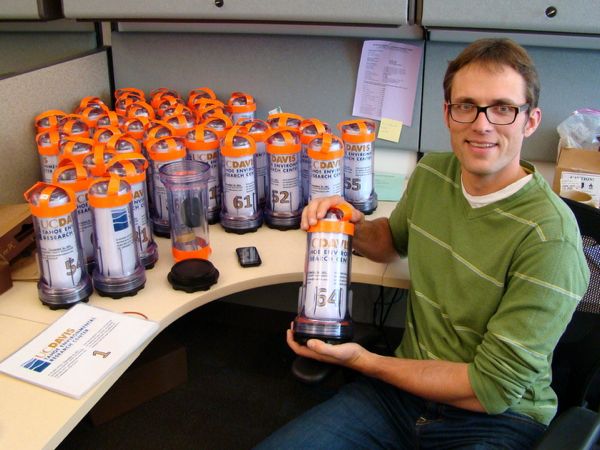
Sixty-four containers each about the size of a 2-liter soda bottle are about to be thrown into Lake Tahoe.

Called drifters, these devices will track the water motion at 1-minute intervals by recording and transmitting their changing GPS location. They are submerged at the water level (to the approximate level of the orange tape visible in the photo) so that their motion is driven by lake currents.

UC Davis research engineer Alexander Forrest programs the drifters that will be used to track Lake Tahoe surface currents. Photo/Provided

Researchers at the UC Davis Tahoe Environmental Research Center in collaboration with UC Berkeley want to better understand the surface currents of Lake Tahoe. The experiment will run Nov. 12-15.

Scientists say understanding surface currents of Lake Tahoe is important because currents are responsible for the transport of contaminants, invasive species, urban stormwater and floating debris.

The drifters will be released on north-south and east-west lines. On the first day, 32 drifters will be deployed. After two days they will replaced by another 32 drifters. The positions of the drifters will be mapped over the entire four-day period.

If the units are not retrieved by the end of the day Nov. 15, they will lose battery power and will no longer be able to be tracked.

What the drifters might do to Tahoe if left to float around a while, is not being revealed. But the scientists would like them back if anyone finds one after Nov. 16. Just call (530) 902.2272 or email gschladow@ucdavis.edu.