Santa Paws benefits pets in need

The 26th annual Santa Paws Benefit for Local Animals in Need is Dec. 1 from 11am to 4pm at the South Lake Tahoe Recreation Center, 1180 Rufus Allen Blvd.

Pets and family pose with Tahoe’s exclusive Santa Dog. Bows and antlers provided. Multiple poses on a photo CD cost $20.

There will also be a raffle, pet gifts, refreshments and pet nail trims. The 2013 Tahoe Pets calendar will also be for sale.

Pets must be on leash or in carrier.

Pet Food Bank donations are welcome. Dry cat and dog food, and cat litter are needed.

Call (530) 542.2857 for more information.


1 person killed in Tahoe City traffic accident

By KCRA-TV

A driver died in a wreck on Highway 89 near Tahoe City on Monday morning, the California Highway Patrol said.

The crash was reported about 7:45am Nov. 26. A vehicle went off the road and into several trees, according to the Truckee CHP.

Part of Highway 89 was closed so a tow truck could access the scene.

The roadway is now open.

No other vehicles were involved.


3 regional outdoor projects receive state funding

Three Lake Tahoe area projects will be receiving a share of the $34 million the California Natural Resources Agency is giving out for river parkway projects statewide.

“Our river parkway grants help communities connect children with nature, promote public health by providing families with greater outdoor recreational opportunities, and protect the rivers that provide us with clean water,” Secretary for Natural Resources John Laird said in a statement released Nov. 26. “The river parkways program is a great example of local agencies working together with the state to create increasingly sustainable communities in California.”

Regionally, Truckee is getting the largest sum — $2.9 million.

This will be for the Truckee River Legacy Trail Phase 3B. The money will be used to construct approximately 1.5 miles of class 1 bicycle/pedestrian trail, continuing the Truckee River Legacy Trail from the town of Truckee east just across Martis Creek where a trailhead will be constructed. The project will also install signage interpreting the natural and cultural resources of the Truckee River.

Tahoe City Public Utility District is getting $344,263 for the Truckee River Restoration and Access Project. This will create three formal access points to the Truckee River and the Truckee River Bike Trail along Highway 89, north of Tahoe City; restore degraded riparian habitat on riverbanks and wet meadows, create staging areas and install directional and interpretive signage.

In Alpine County, $136,000 has been granted for the 6-acre Markleeville Creek acquisition. The money will also be used to restore riparian habitat, re-establish historic floodplain and provide passive recreation in Markleeville.

In 2006, California voters passed Proposition 84, the Safe Drinking Water, Water Quality and Supply, Flood Control, River and Coastal Protection Bond Act, which authorized the Legislature to appropriate funds to benefit river parkway projects.

The California River Parkways Program, a competitive grant program administered by the secretary for natural resources, awards funds to public agencies and nonprofit organizations to develop river parkways in their communities. Thirty-three projects received funding in this round.

 — Lake Tahoe News staff report


Ski report: A ton of sun

Be sure to bring sunscreen and proper eye protection to the slopes. Temps will be in the 50s today.

Here is the Nov. 26 ski report.

— Curtis Fong


Tahoe Tails — Adoptable Pets in South Lake Tahoe

Jupiter is a pure bred bull terrier with all the fun and challenges that breed provides.

He is about 3-years-old and is house trained. Jupiter likes to play with other dogs and would like to meet any that are already in your family. He has lived with children and cats.

Bull terriers are fun, comical, people-loving dogs, and have lots of energy. They can be a bit independent and stubborn, and the shelter suggests that potential adopters research their personality traits before considering adopting Jupiter.

Jupiter is neutered, microchipped, and vaccinated. He is at the El Dorado County Animal Services shelter in Meyers, along with many other dogs and cats who are waiting for their new homes. Go online to see photos and description of all pets at the shelter.

Call (530) 573.7925 for directions, hours, and other information on adopting a pet.

For spay-neuter assistance for South Tahoe residents, go online.

— Karen Kuentz


Letter: Heavenly provides cash, help to Bread & Broth

To the community,

As always, an awesome group of Heavenly volunteers was how the Heavenly Mountain Resort Adopt A Day sponsor crew was described by the B&B volunteer coordinator for the Nov. 5 evening meal.

Due to their repeated stints of Bread & Broth volunteering, most of the Heavenly sponsor crew members are seasoned AAD helpers and their experience is greatly appreciated by the regular Bread & Broth volunteers. The evening’s Heavenly AAD volunteer team was manned by Pete Sonntag, general manager; Eric Anderson, base operations supervisor; Phil Demus, facility maintenance manager; Tom Fortune, director of base operations; and Tom Maugeri, security manager.

Along with the B&B volunteer crew, the Heavenly crew helped bag baked goods, fruits and vegetables donated by local stores for take home, served more than 100 meals and assisted with the evenings cleanup.

Bread & Broth is extremely thankful for Heavenly Mountain Resort’s support in providing a hot, well balanced meals to needy members of the South Lake Tahoe community. B&B would like to salute Heavenly and their employees for their dedication to providing a unique and exhilarating skiing experience and their generous commitment of time and money to the community of South Lake Tahoe.

To become a sponsor of an Adopt A Day, contact me at (530) 542.2876 or carolsgerard@aol.com.

Carol Gerard, Bread & Broth


LTN subscribers can help feed Tahoe’s less fortunate

For every paid subscriber form Lake Tahoe New receives between now and the end of the year, we are going to give one non-perishable food item — might be a can, might be pasta, might be rice or something else — to entities in the basin that are in need.

Paid subscribers help Lake Tahoe News in two key ways — the more forms we have, the better for attaining adjudication, and cash keeps electric bills paid so the computers stay on and reporters get paid.

A benefit to being a paid subscriber is that you become part of the NEWS Team. From time-to-time we give away things — with the last being two tickets to the Soroptimist wine tasting.

Credit goes to longtime LTN supporter Old Long Skis for coming up with the subscriber-food drive. He’s even volunteered his truck to deliver all the goods. He’s that confident LTN will have that much food to donate after all the subscriber forms come in.

Here is a copy of a subscriber form. LTN is getting a bag of food together to donate no matter how many forms come in.

— Kathryn Reed, LTN publisher


Redevelopment agency dissolution gets stickier, more complicated in South Lake Tahoe

Updated Nov. 28 2:30pm: The oversight committee has been changed to Dec. 7 at 2pm at Lake Tahoe Airport.

——

By Kathryn Reed

The agency left dealing with South Lake Tahoe’s redevelopment issues is fighting the state Department of Finance regarding nearly a half million dollars.

The DOF on Nov. 9 wrote a letter to city officials saying the $426,210 must be given to the taxing entities and not kept in the Low and Moderate Income Housing Fund, as the oversight board voted to do.

The oversight committee at its Thursday meeting has on the agenda a discussion and possible action item regarding the yet-to-be scheduled meeting with the DOF regarding this issue. The agency is appealing the DOF’s decision.

“I’m not surprised the Department of Finance wrote a letter supporting the conclusions in my report. I understand that the city is appealing that decision. Regardless, very soon we need to focus on how the bond payments are going to be made,” El Dorado County Auditor Joe Harn told Lake Tahoe News.

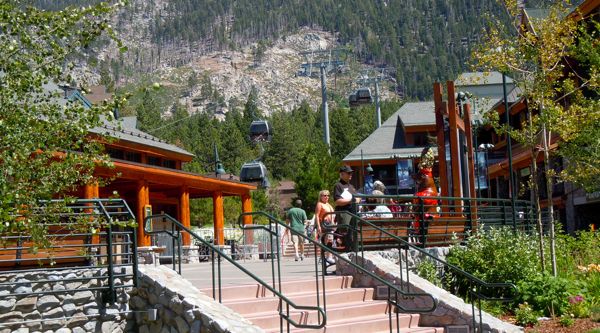
Heavenly Village is one redevelopment area in South Lake Tahoe that comes with outstanding debt. Photo/LTN file

Bondholders from redevelopment projects throughout South Lake Tahoe are owed more than $100 million. The problem is there is likely not going to be enough revenue to pay those bonds.

Harn believes that is where the successor agency should be focusing its attention and not trying to keep the $426,210 for housing.

“I agree with (Joe Harn) when he argued to the state. The revenue should go to pay all bond debt and not distributed to taxing entities. What we disagree on is the revenue,” South Lake Tahoe City Manager Nancy Kerry told Lake Tahoe News. “The Redevelopment Agency borrowed it from its own housing fund account, so it’s an internal loan. It’s not between the city and Redevelopment Agency.”

Part of the successor agency’s arguments to the state is that in addition to disputing the $426,210, the agency believes any money should go to bondholders and not the taxing entities, as the DOF would like to happen.

When California officials decided to disband redevelopment agencies throughout the state they didn’t fully think through what happens if there is remaining debt and what happens to items like stormwater basins that are owned by the redevelopment agencies. No one is going to buy those basins. And as the process went along the Legislature passed a few contradicting laws. So, depending on when an action was taken, it may have been the correct protocol at the time, but not so a few months later. Timing plays into the dispute between the local successor agency and the state.

Kerry said if cash is not in hand to pay bondholders the successor agency can seek a loan from the county or Department of Finance.

But Harn said there is no guarantee either entity would grant such a loan.

Then what?

The state in the Assembly Bill 26 decision promised the California Supreme Court that debtors, bondholders and everybody would be made whole – meaning they would all get their money. Where the state would come up with the money, though, is the big unknown.

—–

Note:

The successor agency meets Nov. 29 at 3pm at Lake Tahoe Airport in the downstairs conference room. Here is the agenda.


Victims identified in Hwy. 50 fatal crash

By Loretta Kalb and Kim Minugh, Sacramento Bee

Officials released the names Sunday of four people, including two children, who were killed in a two-car collision on Highway 50 just east of Placerville.

The crash happened about 6pm Saturday, when a 2004 Toyota Prius headed west in the Apple Hill area veered across four lanes of traffic and into the path of a minivan.

Three people in the Prius who died at the scene were identified by the El Dorado County Sheriff’s Office as 38-year-old Sheng Kun Su, who was driving; 39-year-old Shu Zhen Zhao; and 8-year-old Shawn Su, all from Oakland.

The other occupant of that vehicle, identified as 10-year-old Elly Aili Su, was hospitalized with severe injuries, CHP Officer Sean Ricci said.

A 4-year-old Pollock Pines girl riding in the minivan, Nora Elizabeth Temple, was pronounced dead at a hospital, Ricci said.

The collision left two other people – the 35-year-old driver, identified as Danielle Marie Temple; and passenger Will John Temple, 52 – with minor to moderate injuries. Twin 1-year-old boys, John Maxwell Temple and John James Temple, were also in the minivan but were not injured, Ricci said.

The minivan was headed east in the slow lane of Highway 50 when the Prius crossed its path. Ricci said he did not know the speeds of the two vehicles or what caused the Prius in the westbound slow lane of Highway 50 to veer across the fast lanes in each direction and into the minivan’s path.

The crash occurred along a stretch of Highway 50 that does not have a center divider. Ricci said El Dorado County has been erecting road dividers in recent years tied to location and traffic level.


Community colleges attracting people with college degrees

By David Koeppel, Fortune

In the aftermath of the Great Recession, thousands of students have learned the bitter lesson that the college degrees they paid for do not guarantee a steady job. In response, many have opted for grad school to give their status, pay, and job security a bump.

Then there are those who seem to be taking a step backward. It may seem counter-intuitive but some graduates are choosing to pursue community college associate degrees, after their bachelor’s.

“There is a lot of anecdotal evidence that this is on the rise as a phenomenon,” says Doug Shapiro, executive research director of the National Student Clearinghouse Research Center.

The National Post Secondary Student Aid Study (NPSAS) estimates that during the 2007-2008 academic year, 8 percent of entering community college students had already completed their bachelor’s degrees. This data was collected before the surge in enrollment at community colleges in recent years, says Norma Kent, senior vice president at the American Association of Community Colleges.

Some of the returning students are recent graduates who have found that their sociology or philosophy major has not been enough to find gainful employment. They are now training for careers as nurses, IT specialists, or medical technicians. Radiation therapists and registered nurses with associate’s degrees earn median salaries of $74,200 and $63,800 respectively, according to a 2009 report from the Bureau of Labor Statistics.

“Many of these students have graduated fairly recently and the job market didn’t pan out the way they expected, says Felix Matos Rodriguez, the president of Hostos Community College in the Bronx. “Some say their initial choice of major was not the right one. For some folks that were laid off, it was a wake-up call.”

Baby Boomers are also among those returning for associate degrees to improve their marketability in their current careers, or to retrain for a new one after getting laid off.

Associate degrees often take two years or less to complete, cost considerably less than public or private graduate programs, and offer greater flexibility for those who work full-time. In 2010-11, the average public two-year college tuition was $2,713, compared to $7,605 at public four-year institutions, according to a 2011 report by the College Board.

Over the past three years, Matos Rodriguez says that each semester, between 35 and 60 college graduates have enrolled at Hostos to earn associate’s degrees, when previously there had been virtually none.

Matos Rodriguez believes that the economy has fueled this trend, but also credits the Obama Administration’s role in promoting and investing in community college programs. In September, the Department of Labor announced the second $500 million grant to community colleges as part of a four-year, $2 billion job training initiative. Since the recession, community colleges have seen a spike in overall enrollment.

According to the National Center for Education Statistics, 849,000 associate’s degrees were awarded during the 2009-2010 academic year, a 50.4 percent increase from 10 years earlier. Associate’s degrees in health and related fields saw a 105 percent jump during that same period.

“Community college programs train people for more career-oriented fields, and that has resonated,” Matos Rodriguez says.

In January, Camille Mcintosh, 28 of Liverpool, N.Y. enrolled at Bryant & Stratton College in Syracuse to get an AAS degree in human resources. Mcintosh graduated in 2006 from Devry College in Miramar, Fla. with a BS in technical management and a concentration in hospitality management.

Mcintosh says she felt frustrated working a series of entry-level jobs at companies like Hard Rock and Marriott (MAR). She realized that she wanted to pursue a career in human resources. In 2011, she spent months searching unsuccessfully for an entry-level HR job. “The bachelor’s degree without the HR experience didn’t help me at all,” she says. “This was the way to get my foot in the door.”

She says she discovered that, with her college credits, she could complete Bryant & Stratton’s HR specialist program in just under a year. Most importantly, the program offered her an HR internship with the Adecco Group, a staffing corporation that employs more than 500,000 people worldwide.

At first, she admits, she was embarrassed by the stigma of going back to get an associate’s degree after her bachelor’s. “Sometimes you have to take a step back to go forward,” she says.

Mcintosh says she still has $40,000 in debt from her four-year college and will incur about another $15,000 in her current program. The average debt for all student loan borrowers in 2011 was $23,300, according to the Federal Reserve Bank of New York. Ten percent owe more than $54,000, while 3 percent owe more than $100,000.

“A fair number of students with bachelor’s are worried about the debt they’ve accumulated,” says Robert Templin, the president of Northern Virginia Community College (NOVA). He calls the combination of a bachelor’s and associate degree “a powerful cocktail” and says he has witnessed this trend at his own school for the last four or five years.

Depending on major and school, associate’s degrees and post-secondary certificates can be more economically beneficial than a bachelor’s degree. Mark Schneider, a vice president at the American Institutes for Research and the president of CollegeMeasures.org, recently compared the earning power of graduates with associate’s and bachelor’s degrees in Virginia, Arkansas, and Tennessee, and found that “an associate’s degree can have a payoff that exceeds that of a bachelor’s degree.”

In Virginia, graduates of occupational or technical associate’s degree programs with an average salary of just under $40,000 “out-earned not only non-occupational associate’s degree graduates, by about $6,000, but also bachelor’s degree graduates, by almost $2,500 statewide.”

Schneider says it’s understandable for bachelor’s degree graduates to return to school for associate’s degrees. “It doesn’t reflect badly on students who did something they loved at 18 years old, but five years later they can’t find a job, and now they have to feed themselves,” he says.

Younger students aren’t the only former graduates assessing their careers and going back for associate degrees. College graduates over 50 are returning to community college in record numbers; 388,000 were enrolled nationwide in fall 2009, according to the AACC, a 12 percent increase from 2005.

Cathy Webb, 61, of Roanoke, Va., a nursing student at NOVA, returned to school in 2010 and is six months away from graduation day. Webb received her BA in 1973 from Longwood University in Farmville, Va. She started her career as a music teacher. By the 1980s, she had moved into medical sales. She ultimately became a mortgage broker. When the mortgage crisis hit in 2008, she lost her job and her career “came to a screeching halt,” she says. Soon after, Webb contracted meningitis.

As she recovered from her illness, Webb says she began to consider returning to school to become a nurse. When she was younger, Webb had wanted to go to medical school and now she saw an opportunity to at least fulfill part of that dream by pursing a health care career. She plans to begin working as a nurse when she graduates and then continue her studies to become a nurse paramedic.

Matos Rodriguez of Hostos says there’s not enough data yet to know how well these graduates will do with their hybrid bachelor’s and associate’s degree. He says he worries that those who make the decision to return strictly based on the job market could find that their emotional skills may not match jobs like nursing. “I’ll be happy if these students finish on time, don’t take on too much debt, and go into the labor market earning between $50,000 and 70,000.”