‘Red flag’ warning issued for Tahoe, western Nev.

A “red flag” warning has been issued for most of western Nevada, as well as South Lake Tahoe and Truckee for June 12 from 8am-11pm.

The National Weather Service in Reno says it will be windy and dry through Friday.

The strongest winds are expected Thursday afternoon and evening. Low humidity adds to fire danger. The conditions mean fires can grow rapidly in size and intensity.

Officials are asking people to avoid activities that may spark a fire, like yard work, target shooting or having a campfire.


Learn to canoe on Carson River

Nevada Division of State Parks is putting on what it calls relaxation and nature canoe trips that will start just below the Lahontan Dam and runs along the Carson River to the Irrigation Diversion Dam.

These events are good for beginners who can learn the basics of canoeing. Canoes, paddles, and life jackets will be provided, but participants will need to bring sun block and drinking water.

Space is limited; call 775.867.3500 for reservations.

Trips are June 14, June 26, June 27 ad June 28 from 9am-2pm.

Lahontan Dam River Camp is at 16799 Lahontan Dam Road, Fallon.

The event is free and entrance fee is waived for participants.


Obama signs $12.3 bil. water projects bill

By Jim Kuhnhenn, AP

WASHINGTON — Capping a rare instance of congressional compromise, President Obama signed a $12.3 billion water projects bill Tuesday, financing improvements ranging from a harbor expansion in Boston to flood control in Iowa and North Dakota.

Obama praised the work of Democrats and Republicans and said he hoped it set a pattern for agreement for more spending on capital works projects across the country.

“Right now we should be putting a lot more Americans back to work rebuilding our infrastructure,” he said. “There are a lot of guys with hardhats sitting at home.”

The new law will pay for 34 new projects over the next 10 years. Its price tag is half the amount of the last water projects bill seven years ago. Congressional leaders have praised the bill for containing no pet projects from lawmakers, the kind of targeted, congressionally directed spending that had angered the public and helped fuel the tea party movement.

All of the projects were recommended by the Army Corps of Engineers.

Obama singled out the bill’s main negotiators — Democratic Sen. Barbara Boxer of California and Republican Sen. David Vitter of Louisiana, Republican Rep. Bill Schuster of Pennsylvania and Democrat Nick Rahall of West Virginia.

“They set aside politics, they focused on what was important for the country and what was important for their communities,” he said. “And as a consequence we have a piece of legislation that is really going to make a good difference.”

He urged lawmakers to use the same spirit of compromise to act on a massive transportation bill. He warned that without action, 100,000 projects could come to a standstill, affecting 700,000 jobs.

“The fact that this bill received some bipartisan support I think hopefully sets a pattern for additional work,” he said.

Though some conservative groups argued the bill still contained unnecessary spending, it had broad support from state and local officials and business groups such as the U.S. Chamber of Commerce.


Books to teach kids about outdoors

Using children’s books, Lahontan State Recreation Area in Fallon is putting on events to inspire an appreciation for nature through literature, nature walks, activities and crafts.

Once Upon a Trail will be the second and fourth Saturday this summer.

The cost for this program is free and park admission fees will be waived for those participating. Sturdy footwear, water, and sunscreen are recommended for nature hike activities. The trail is not ADA accessible nor stroller friendly. Note: some of the crafts can be a little messy.

Events include:

June 14: Learn about birds by listening to the reading of the book “Feathers for Lunch” by L. Ehlert.

June 28: Learn about animals that live in the woods by listening to the reading of the book “The Mitten” by Jan Brett.

July 12: Learn about animals that live in the water by listening to the reading of the book “Box Turtle at Long Pond” by William T. George and Lindsay Barrett George.

July 26: Learn about the kind of tracks animals leave behind by listening to the reading of the book “Whose Tracks are These?” by Jim Nail.

Aug. 9: Learn about animals that change as they grow by listening to the reading of the book “The Caterpillar and the Polliwog” by Jack Kent.

Aug. 23: Learn what animals eat by listening to the reading of the book “A Fly Went By” by Mike McClintock.

For more info, contact Tabitha Coughlin at 775.867.3500.


Latest Meyers Area Plan released

The third draft of the Meyers Area Plan is available online.

There will be a meeting about it June 26 from 6-8pm at the California Conservation Corps in Meyers.

El Dorado County is evaluating the establishment of a Community Services District elected by Meyers residents, which would review proposed projects, initiate future revisions to the plan, and direct some funding for local improvement projects. This Community Services District would fulfill the role of the Meyers Advisory Council described in the plan.

The county and Tahoe Regional Planning Agency are working to complete an assessment of the environmental effects of the revised plan. That assessment is expected to be completed within the next couple weeks at which time the environmental documentation will be circulated for a 30-day comment period.


SummerFest features nationally known musicians

Metropolitan Opera Star Matthew Polenzani and U.S. Billboard Classical Chart best-selling pianist Simone Dinnerstein will be the soloists for the 2014 Lake Tahoe SummerFest.

Performed the first three weekends in August, the classical concert series will offer two evening concerts, Friday and Saturday at 7pm, and a new chamber music series called Meet the Music on Sundays at 4pm. The festival runs weekends Aug. 1-17.

Polenzani will headline the classical music festival, Aug. 1-3 and Dinnerstein will be featured Aug. 7-9.

The individual musicians’ home symphonies include the Metropolitan Opera Orchestra, the Los Angeles Philharmonic, the symphonies of San Francisco, Seattle, and Vancouver, among others.

Now in its third season, the 40-member orchestra performs in a 500-seat acoustical tent pavilion on the campus of Sierra Nevada College in Incline Village.

Repertoire highlights this season include Beethoven’s 4th Symphony; the rarely-heard Britten’s Serenade for tenor, horn and strings; Mozart Symphony No. 40; Beethoven Piano Concerto No. 2; Strauss Concertino for clarinet, bassoon, strings and harp; a newly-orchestrated Concerto for timpani and orchestra; and Mendelssohn’s Scottish Symphony.

For tickets and season subscriptions information, go online.


Blown transformer causes outage at Northstar

Power is expected to be out for many Northstar residents for the next few hours.

A transformer blew and is not expected to be fixed until about 5pm June 11.


NHP raising money for Special Olympics

Several troopers from the Nevada Highway Patrol, as well as other employees for the Department of Public Safety, will be volunteering their time to raise money for Special Olympics Nevada and California on June 14 in the Hard Rock Café inside Harveys.

Troopers will serve as volunteer waiters and waitresses as they assist the restaurant staff that day while they work for “special tips.” Each volunteer will leave an envelope with each table for those wishing to make a donation. These tips are in addition to the regular server’s gratuity.

All of the extra tips will stay in Northern Nevada and Northern California to pay for the sports training and competition activities for athletes enrolled in Special Olympics Nevada/California programs.

Additionally, law enforcement officers and firefighters will be competing in a chicken wing eating contest about 4pm that same day.


Lean retirement looms for Gen X

By Jeanna Smialek, Bloomberg

Vera Johnson from Seattle is barely making do, let alone saving for retirement.

“I try to remain in the present moment and not live in fear of the future,” said Johnson, who has neither retirement savings nor a college fund for her two children. “My property is underwater, the properties around me are underwater, I’m not building equity in my home.”

The 45-year-old almost lost her home to foreclosure in 2010 after the housing-market collapse in the worst recession since World War II. She embodies the financial challenges facing America’s Generation X, those born between the mid-1960s and 1980, which lags behind other generations in building assets.

Good timing is not the age group’s forte. Many took out mortgages just before prices plunged, making them the most disadvantaged by the housing crisis, while the 2008 stock-market slump dealt them a further setback. Only one-third of Generation X households have more wealth than their parents, even though most earn more, according to the Pew Charitable Trusts.

When their working years end, Gen-Xers might have to live on just half of their pre-retirement income, compared with 60 percent for the Baby Boom generation, Pew said last year.

“Generation X is at this really critical historical spot,” said Diana Elliott, a research officer in financial security and mobility at Pew, a nonprofit global research and public policy organization in Washington. “They are not doing well relative to the last generation. It should give us concern as a country.”

Read the whole story


‘Saving Lake Tahoe’ not the easiest read

By Kathryn Reed

Sometimes I read a book and I’m left wondering who the author thought was going to read it.

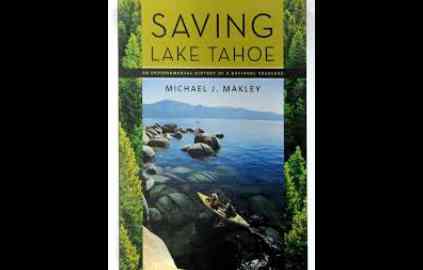
Such was the case with “Saving Lake Tahoe: An Environmental History of a National Treasure” by Michael J. Makley.

Usually history and environmental books can captivate me. This, in some ways, felt like reading a regurgitation of facts, at times like a textbook.

For people who have lived the story, I can’t see them wanting to read this because that’s how I felt about the last half the book. I want to read something I don’t already know so I can learn.
saving lake tahoeAnd for those who don’t know this aspect of Tahoe’s past, I think they would likely become overwhelmed with all the facts.

I know the book was not completely factual because I found errors. When this happens in a book I am then left questioning what else is not accurate.

For instance, Makley said the day the Angora Fire started in June 2007 there was a controlled burn. This is completely wrong. There were no controlled burns that day on the South Shore because it was a “red flag” day.

He also said the area was reseeded via hydromulch. Hydromulching did occur to stabilize the soil. Seeds and fertilizer were not part of the mix.

Then Makley references Lake Tahoe News for a May 2009 article. LTN didn’t launch until September of that year.

Where were the editors and fact checkers at the University of Nevada Press? Yes, authors get things wrong. But they should not be the last line of defense.

Makley would have been better served to have taken on a narrower topic and developed it in more detail.

It was a bit alarming to read how much development was proposed and how what is here got approved. It’s easy to see why environmental groups don’t trust local governments to protect the environment, which includes the lake.

Part of the book was like reading a history of the Tahoe Regional Planning Agency. With that in mind, you know Makley could write many sequels. And the agency’s history is interesting. It’s certainly tied to the philosophy of the two states.

The book showed how the dispute between California and Nevada has been going on for what seems like forever – at least to the early 1900s as documented by Makley. It has been an unstable relationship for most of that time.

One can only wonder what the Lake Tahoe Basin would be like today had the scientists had a louder voice.

“The scientists’ recommendations conflicted with pressure to continue economic growth, stemming from gambling, real estate, and recreation. This emphasized the fact that the State of California, as represented by the restructured CTRPA, tended to back the scientists, while local governments and the State of Nevada generally supported the economic interests,” Makley wrote.

Plus, it was in the 1980s that scientists said fine sediment is a problem for lake clarity. More than 30 years later and we still haven’t fixed that issue.

The sad part is that history just seems to keep repeating itself. And this includes the fact that those with money can save or destroy Lake Tahoe – with an acknowledgement that “save” and “destroy” are defined differently by people. I do have new respect for William Hewlett – of Hewlett-Packard fame — after reading the book.