Supreme Court rules government may be liable for flooding

By Terry Baynes and Jonathan Stempel, Reuters

WASHINGTON — The Supreme Court ruled on Tuesday that the federal government may be required to pay damages when it releases water from a dam that causes temporary flooding for a property owner downstream.

The case addressed the politically charged issue of when government activity that affects private property constitutes a “taking” that requires payment to a landowner. Under the 5th Amendment to the U.S. Constitution, the government must pay owners of private property that it takes for public purposes.

Writing for a unanimous court, Justice Ruth Bader Ginsburg said temporary flooding of private land by the government is “not categorically exempt” from liability under the 5th Amendment’s Takings Clause.

There is “no solid grounding in precedent for setting flooding apart from all other government intrusions on property,” Ginsburg wrote.

The Arkansas Game & Fish Commission, which operated the 23,000-acre Dave Donaldson Black River Wildlife Management Area, had complained about water releases by the U.S. Army Corps of Engineers from the Clearwater Dam in Missouri, about 115 miles upstream.

It claimed that releases between 1993 and 1998 led to six years of flooding, causing the death or weakening of nearly 18 million board feet of timber and making it harder to operate.

A federal judge awarded $5.7 million for lost timber and to regenerate forestry, but the U.S. Federal Circuit Court of Appeals overturned that award in March 2011, saying the flooding was only temporary and required no compensation.

The government had argued that the releases had only incidental consequences, and that it had the right to balance the “benefits and burdens” of such releases, which could also be used to protect crops or avert flooding in specific areas.

The Supreme Court cautioned that its ruling was not meant to “credit all, or even many, such claims.” Rather, lower courts would have to weigh numerous factors in deciding whether to award landowners compensation for temporary flooding, including the degree to which the damage was intended or foreseeable, recurring or severe.

The commission’s appeal was supported by a variety of advocates for fish, forestry and wildlife groups, as well as private property advocates. Justice Elena Kagan recused herself from the case, likely because she worked on the case in her former role as U.S. solicitor general.


Climate changing taking a toll on California ski industry

By Mark Glover, Sacramento Bee

A warming climate is melting California’s winter tourism dollars.

That’s the conclusion of a new economic analysis released Thursday.

The study – titled “Climate Impacts on the Winter Tourism Economy in the United States” and written by two University of New Hampshire researchers – said California and 37 other states have lost an estimated $1 billion and up to 27,000 jobs over the last decade alone due to less snowfall and shorter winters that research indicates are linked to global climate change.

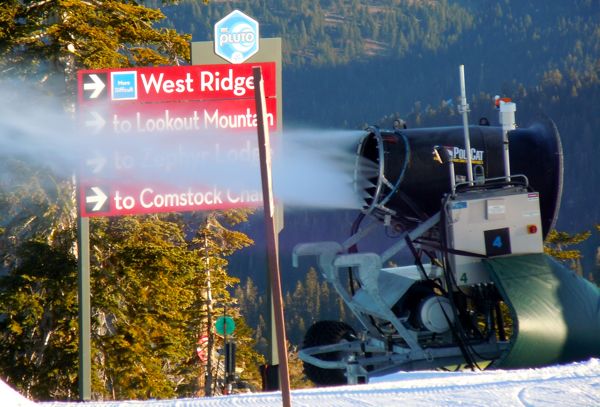
Snowmaking at Tahoe resorts helps supplement the natural white stuff. Photo/LTN file

The report warned that a continuation of the global warming trend could result in the loss of thousands more jobs at ski resorts and create numerous related economic setbacks, costing billions in lost revenue and tax dollars.

The report, released by the advocacy groups Protect Our Winters in Pacific Palisades and the Natural Resources Defense Council in New York, offered this grim look at the future: “Without intervention, winter temperatures are projected to warm an additional 4 to 10 degrees Fahrenheit by the end of the century, with subsequent decreases in snow cover area, snowfall and (a) shorter snow season. Snow depths could decline in the West by 25 to 100 percent ….”

The related effects would include economic and job losses in the restaurant/hotel industries, grocery stores and gas stations, as well as a reduced tax base, possible winter resort closures and sharp declines in sales of winter sports equipment.

The report calls for the winter tourism industry to press federal lawmakers and the Obama administration for further action to reduce carbon pollution. Officials particularly focused on a revised pollution standard for large power plants.

The report cited an industry survey that said 50 percent of responding U.S. ski areas opened late in 2011 and 48 percent closed early.

“This spells significant economic uncertainty for a winter sports industry deeply dependent upon predictable, heavy snowfall,” said Elizabeth Burakowski, co-author of the report.

For California’s winter sports industry, the potential downfalls are significant.

During the 2009-10 winter sports season, the most recent measured by the report’s authors, nearly 24,000 jobs were supported by the industry in California, providing an economic boost of $1.37 billion statewide. Labor income alone that year was put at $787 million.

The report cited evidence of reduced activity as a result of low snow years. It said California saw a nearly 5 percent loss in skier visits to resorts between high and low snowfall years from November 1999 to April 2010, with a projected economic loss of $75.2 million over that period.

Burakowski said California stands to be one of the most affected states, noting that “snow is currency.”

The Lakewood, Colo.-based National Ski Areas Association released a statement Thursday saying that “resorts nationwide are taking meaningful steps toward combating climate change.”

That includes reducing greenhouse gas emissions through investments in wind, solar, geothermal micro-hydro and other sources.

“Ski areas have not been on the sidelines when it comes to climate change,” said Michael Berry, NSAA president.

“The ski industry took a leadership role on this issue over a decade ago, and we continue to advance that mission.”

Berry added that the industry remains optimistic about the future. He said U.S. winter resort areas have enjoyed the best 10-year average on record, with 57.5 million skier and snowboarder visits on average nationally.


Barbie gets makeover with more dads doing toy buying

By Stephanie Clifford, New York Times

For the first time in Barbie’s more than 50-year history, Mattel is introducing a Barbie construction set that underscores a huge shift in the marketplace. Fathers are doing more of the family shopping just as girls are being encouraged more than ever by hypervigilant parents to play with toys (as boys already do) that develop math and science skills early on.

It’s a combination that not only has Barbie building luxury mansions — they are pink, of course — but Lego promoting a line of pastel construction toys called Friends that is an early Christmas season hit. The Mega Bloks Barbie Build ’n Style line, available next week, has both girls — and their fathers — in mind.

“Once it’s in the home, dads would very much be able to join in this play that otherwise they might feel is not their territory,” said Maureen O’Brien, a psychologist who consulted on the new Barbie set.

Consumer surveys show that men are increasingly making the buying decisions for families, reflecting the growth in two-income households and those in which the women work and the men stay home. One-fifth of fathers with preschool-age children and working wives said they were the primary caretaker in 2010, according to the latest Census Bureau data. And 37.6 percent of working wives earned more than their husbands in 2011, up from 30.7 percent 10 years earlier.

“Kids are going to grow up with dads that give them baths and drive them to soccer and are cutting up oranges for team snacks,” said Liz Ross, president for North America of BPN, part of the IPG Mediabrands holding company, which recently completed a study on male consumers. “What will go away, albeit slowly, is the image or the perception of the befuddled dad.”

The change is having consequences beyond toys. Consumer products have traditionally been marketed to appeal to women, and stores have been designed for women’s sensibilities. Now, some brands and stores are catering directly to male decision-makers. Sears is reorganizing stores to put tools next to work wear, for instance, based on men’s preferences. Procter & Gamble is working on men’s grooming aisles at top retailers, a nod to the fact that women are no longer choosing shampoos or shaving creams for their husbands. With the selling point that it helps girls develop spatial reasoning, the Barbie set, a joint effort of Mattel and the toy company Mega Bloks, is also meant to pique fathers’ interest.

“Dad is a bigger influencer in terms of toy purchases over all, and this sets up well for that, because the construction category is something Dad grew up with and definitely has strong feelings and emotions about,” said Vic Bertrand, chief innovation officer of Mega Brands, Mega Bloks’ parent company.

Construction sets for girls are a speedy growth category, thanks to Lego’s introduction of its Friends line in January. Despite criticism that those sets were sexist — themes include a beauty shop and a fashion studio — Lego’s chief executive said in August that the company sold twice as many of the sets in the first half of the year as it had expected, and retailers like Amazon and Target have named them hot holiday toys.

Anne Marie Kehoe, vice president of toys for Walmart U.S., said that, with the Barbie addition, construction toys aimed at girls will represent about 20 percent of the toy construction category by the end of this year, while last year there were just a handful of products.

Research shows that playing with blocks, puzzles and construction toys helps children with spatial development, said Dr. Susan C. Levine, chairwoman of the psychology department at the University of Chicago and co-principal investigator at the National Science Foundation’s Spatial Intelligence and Learning Center. Even controlling for other skills such as verbal and numerical skills, she said, children with better spatial thinking are more likely to eventually go into mathematics, engineering, science and technology.

She said that a set aimed at girls could be beneficial, if only because it might increase girls’ likelihood of participating in construction activities.

O’Brien, the consultant on the new Barbie set, said adults had traditionally been “the limiting factor” in why girls have not played with those toys as often.

Recently, she said, there has been a shift in attitudes, as parents study research on development and spatial play. “For this particular product, one of the advantages is you can appeal to both moms and dads,” she said of the construction set.

During her research, O’Brien said, she watched a grandfather jump in to explain building principles to his granddaughter, who was playing with the Barbie. Still, the construction set is not exactly dump trucks and dirt. It remains “unapologetically all girl,” said Stephanie Cota, senior vice president of global marketing for Barbie, girls’ brands and games at Mattel.

The Mega Bloks building pieces are pink (Pantone 219, the signature Barbie color), and the construction choices are scenes like a fashion boutique, a mansion and an ice cream cart. Each set comes with a small Barbie figure that can be snapped into the scene.

Mattel, the world’s largest toy maker, still leans heavily on Barbie, one of its most popular and longest-running franchises. However, pressure to update Barbie has been high — Mattel has introduced Barbies with video cameras and digital cameras in recent years.

Yet sales of Barbie in North America through September fell 1 percent, even as sales of Mattel’s other girl brands, like Disney Princess dolls, rose 44 percent. Mega Brands makes just a fraction of what its larger rival Lego does, and had revenues of about $376 million last year.

The Barbie brand, which tends to raise feminists’ ire for its overly sexualized dolls, not to mention the 1992 version saying “Math class is tough,” has already taken some high-arched steps toward gender equality. A computer-engineer Barbie was introduced two years ago, for instance, with the support of the Society of Women Engineers.

This time, though, the introduction appears to be a response more to market changes than to critics.

Girls “don’t necessarily care about, ‘That’s a boy toy; that’s not for me,’ ” said Cota of Mattel. “Now, more so than ever, girls are looking at what’s fun, what they like.”



Stateline casinos follow state trend of minimal revenue gains

Nevada casinos eked out small gains in October. Revenue was up 1.8 percent to $978.8 million compared to 2011, the Gaming Control Board reported today.

Stateline casinos were up 0.7 percent, with revenues of $15. 8 million.

Washoe County dropped 7 percent, Carson City was done 5.5 percent.

 — Lake Tahoe News staff report


Ski report: More terrain opening

More lifts and terrain are opening today — including Alpine Meadow.

Heavenly opens upper California side with Sky Express and Canyon Express. (No access from California base.)

Sierra-at-Tahoe opens the back side today.

Kirkwood will open the entire mountain on Saturday — the first Tahoe area resort to have all its lifts running. Mammoth opens its entire mountain today.

Northstar opens Zephyr Express today.

Here is the Dec. 7 ski report.

— Curtis Fong


Minimize the waste that often comes with Christmas

By Mandy Kendall

Christmas can be expensive enough with all the gifts and food without the added cost of decorating and gift-wrapping. The more eco-conscious of us might balk at all the waste that goes on with gift-wrapping because it is just torn off and thrown away. However, with a little thought and creativity, wrapping can be as much fun as the gifts themselves and decorations can help you do your part in helping to protect our wonderful planet.

So here are a few more holiday Qwik-e tips on different ways to get your house and your gifts ready for Christmas:

Mandy Kendall

Have kids help out — Entertain the kids and get them to help out at the same time. Recycled paper can be turned into unique wrapping paper by young hands and some crayons, glue and glitter. Homemade plastic bag bows are a great way to re-use plastic bags, are easy for kids to do and make for great looking gifts. Check out this website.

Multipurpose wrapping — Putting gifts in boxes or containers that can be used again and again helps reduce the amount of wrapping waste that so often happens at Christmas. I still have a beautiful box my aunt gave me years ago which was the container for her gift to me. I don’t remember what the gift was, but I use the box for my jewelry and I still think of her every time I see it. Get creative. Fill a watering can or sturdy basket with gardening items for the gardener on your list. Fill pretty glass jars (hand painted perhaps) with unusual soaps or bath salts for someone who needs a little pampering. A bucket can be filled with useful gifts for that handyman in your life. You could use a pashmina or large scarf as part of the gift and it’s wrapping too. Furoshiki is Japanese gift-wrapping that uses material as the wrapping paper. Here for some nifty wrapping ideas.

Recycle gift bags — Our family has recycled and r-circulated the same few gift bags for a few years now. It has become a competition to see how long we can make them last. We each bought large sturdy gift bags and each year our gifts are given in those bags (no matter what size the gift is). We now recognize each other’s gift bag designs, which helps in knowing who the gift came from too! If you end up with wrapping paper to recycle, just ask the family to peel off the tape before it goes into the recycle pile. Lots of recycling plants won’t accept paper with tape on it.

You could have a competition with your family to see who can come up with the most creative, eco-friendly wrapping with the winner being awarded a special gift from the rest of the family, or maybe even a trophy to be kept until next year’s competition.

Decorating

Go green on lights — LEDs are by far the most economical and environmentally friendly lights. They don’t burn out and use much less electricity than conventional bulbs. Electric candles can look pretty authentic and also take care of any concerns over health issues and accidental fire dangers.

Trees — Let’s face it, Christmas trees are lovely but they are really only a foundation upon which to hang all our treasured baubles and decorations. With all the artificial options these days, there is no reason to chop down a tree to decorate your house anymore. As well as the huge array of realistic looking artificial trees that can be used year after year, there are many other options you could try for something a bit different. You could go very environmental and use a large herb bush as the basis for your tree. If you do decide to have a natural tree, try and make sure it comes from a sustainable source and find out where it can be recycled.

Keep it natural — You could bring a little of the outside inside to help decorate. Pine cones (sprayed silver or gold) make for great centerpieces and fireplace decorations. Dead twigs and small branches can be twisted together for the basis of garland and wreaths. Obviously, the idea is to pick up stuff that is already lying around and not to start chopping live foliage down… just make sure you shake off any live creepy crawlies that might be attached. Fresh fruit and nuts make very festive additions to table decorations, piled high in a bowl or on a cake stand around a large candle. Tied bundles of cinnamon sticks and dried candied fruits can add a festive scent to your designs too.

Happy Holidays!

Until next time.

Mandy Kendall operates Health Connective in South Lake Tahoe, which aligns wellness seekers with their ideal wellness provider. If you have questions, would like some advice, or would like to request some Qwik-e tips on any health and well-being topic, drop her an email at connect@healthconnective.com or keep an eye out on Lake Tahoe News for regular Qwik-e tips on how to make healthy changes one Quick and Easy step at a time.


Opinion: Focusing on climate change at Lake Tahoe

By Geoff Schladow

Some of the most important questions we currently face at the UC Davis Tahoe Environmental Research Center relate to the impact of climate change on restoration efforts at Lake Tahoe. Our past studies suggest that climate change will reduce the extent of lake mixing, and in particular the mixing of oxygen, down to deep water. How true this really is remains an open question at Tahoe and lakes world-wide.

Starting in 2013 we will have the opportunity to start answering that question. A custom-designed thermistor and dissolved oxygen “chain” will be installed in 400 feet of water off the west shore of Lake Tahoe. This instrument chain will measure tiny fluctuations in temperature and oxygen over this entire depth, allowing us to understand how the wind and currents interact to produce mixing under continually varying conditions.

The instruments will take measurements every 10 seconds and the measurements will be instantly transferred to shore via a lake-bed cable. By having this real-time data, we will be able to observe the evolution of key mixing events as they happen and have the opportunity to dispatch boats to take a host of supplementary measurements. The data will also be used as the basis of real-time exhibits at TERC’s education centers and at other locations such as the Tahoe Maritime Museum.

Geoff Schladow

How does TERC fund this kind of project? Part of the support for this cutting edge research is from a new initiative by the UC Center for Information Technology Research in the Interest of Society. Part is through philanthropic support that TERC receives from private donors who have a desire to invest in science to save Lake Tahoe. And part is through in-kind support provided by our many partners around the lake. In this case we are particularly grateful to Obexer’s Boat Company, which is working with us to originate the lake-bed cable at their marina and providing the power to run the instruments.

All of these groups are essential to making science happen at Lake Tahoe and to keep the restoration efforts firmly based on science.

I want to thank all those who helped us with the many things we were able to accomplish this year. This ranges from our incredibly dedicated staff, our volunteer docents, the many students and interns that work through TERC, our partners in other research institutions and in the numerous Tahoe agencies, those who visit our education centers, and those of you who have helped fund our research and education programs and partnered with us in unique way.

Geoff Schladow is director of the UC Davis Tahoe Environmental Research Center in Incline Village.

—

Note: Geoff Schladow will present the State of the Lake on Dec. 13 at 6pm at the Tahoe Center for Environmental Sciences building, 291 Country Club Drive, Incline Village.


Decorated South Tahoe fire truck to parade through neighborhoods

It’s that holiday time of year and the South Lake Tahoe Fire Department would like to encourage everyone to think of those less fortunate members of our community.

At all the city fire stations, you can drop off any new or like-new condition used toys into the Christmas Cheer barrels. Any donations will be gratefully forwarded to needy households this holiday season.

Also, the city fire department will again be handing out candy canes from the decorated fire truck driving throughout the community. Starting on Dec. 10 and continuing through Dec. 23 the holiday truck will make its way through specific sections of the city.

These scheduled dates will be dependent on the weather, and may be changed due to driving conditions or emergency responses.

The South Lake Tahoe Firefighters hope to see many of you on our routes this holiday and would like to wish everyone a safe and joyous season.

Truck schedule:

Day Date Area
Monday Dec. 10 Keys/Venice
Tuesday Dec. 11 Glenwood
Wednesday Dec. 12 Keys Blvd / State Sts
Thursday Dec. 13 South Y /Tata
Friday Dec. 14 Barton / Tahoe Island
Saturday Dec. 15 Al Tahoe Blvd
Sunday Dec. 16 Springwood/Bijou Pines
Monday Dec. 17 Main Areas  /  Hwy 50
Tuesday Dec. 18 Stateline / Hotels
Wednesday Dec. 19 Heavenly Valley
Thursday Dec. 20 Sierra Tract
Friday Dec. 21 Gardner Mtn
Saturday Dec. 22 Ski Run Area
Sunday Dec. 23 Stateline/Pioneer Tr


Flu season taking its time reaching Lake Tahoe

By Kathryn Reed

It’s beginning to feel and sound a little like flu season.

“Although seasonal influenza seems to be hitting other parts of the country early this year, we have had very low rates of influenza so far in Tahoe,” Greg Bergner, physician at Barton Urgent Care, told Lake Tahoe News.

The Centers for Disease Control and Prevention is reporting a high number of flu cases in Southern states.

Typically Lake Tahoe’s flu season goes from before Christmas to late March or early April.

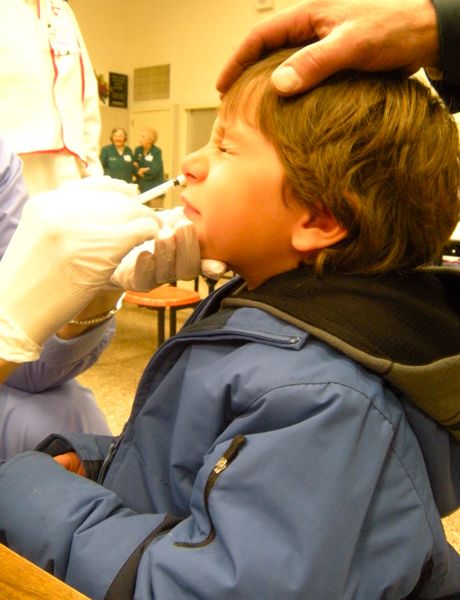
A South Lake Tahoe boy winces when receiving the mist vaccine during a previous flu season. Photo/LTN file

While the flu can be deadly, that’s not usually the case in the basin.

“It is very rare for anyone from Tahoe to die from influenza for a number of reasons. Because of Tahoe’s geographic isolation, our altitude, and our rougher winter weather we have fewer patients living here with serious chronic diseases,” Bergner explained. “Tahoe’s population is generally healthier and consequently less likely to die from influenza infections. Also, children less than 2 years with any serious health conditions are normally transported promptly to tertiary care facilities, where the full cadre of pediatric subspecialty care is available.”

The flu and colds are different animals, though some of the symptoms are the same. Doctors can perform a test to tell the difference. Flu can sometimes be treated with anti-viral medication. Drugs are the most beneficial if taken within the first 72 hours.

“Influenza is nasty. Typically it includes a bad headache, light sensitivity, unusually bad muscle aches, a cough and fever. The common cold has similar symptoms, but in lesser severity,” Bergner said.

Doing all the things mom said to do is what the doc recommends – get plenty of sleep, drink lots of fluids, and Advil or Tylenol will help with the headache and/or fever.

“Although the influenza A virus of today is much like a ‘nasty cold’, the concern from public health officials stems from the possibility that the virus can someday mutate into a much more virulent viral strain, with a much higher death rate,” Bergner said.

Of course, there is always the flu shot or nasal spray to help ward off the chance of getting sick. Through the years Barton officials have noticed a steady increase in the number of people opting for a dose of prevention.

But it’s not an exact science when it comes to developing the vaccine each year.

“The flu shots clearly work and have been scientifically proven to do so. The problem is that the influenza virus has a propensity to change its molecular shape periodically. This change in viral shape can make a vaccine less effective, though not totally ineffective,” Bergner said. “The vaccine must be modeled a year in advance in order it to be manufactured and then distributed. This means that there is always a possibility that the vaccine won’t be as effective as hoped, if the virus changes its shape in that intervening time.”

This is the first year El Dorado County Public Health is mandating healthcare workers wear masks while providing patient care if they have not been immunized for influenza. Vaccinated Barton staff members have a bright green sticker on their ID badge.

Here are tips for not getting and not spreading the flu:

• Don’t visit hospitalized patients if you are ill – especially if you have respiratory symptoms.

• If you visit any health care facility with flu-like symptoms, ask for a mask.

• Get immunized with the influenza vaccine.

• Wash your hands often.

• If you have the flu or any other respiratory illness, be sure to cough or sneeze into your elbow.

• Avoid close contact with people who are sick.

• Stay home from work, school and other activities if you are sick.

Who should be immunized:

• Children aged 6 months to 18 years receiving long-term aspirin therapy and who therefore might be at risk for experiencing Reye syndrome after influenza virus infection;

• Residents of nursing homes and other chronic-care facilities;

• American Indians/Alaska Natives;

• People who are morbidly obese (body-mass index is 40 or greater);

• Health-care personnel;

• Household contacts and caregivers of children aged younger than 5 years and adults aged 50 years and older, with particular emphasis on vaccinating contacts of children aged younger than 6 months;

• Household contacts and caregivers of persons with medical conditions that put them at higher risk for severe complications from influenza.

Those who should not be vaccinated:

• People who have a severe allergy to chicken eggs;

• People who have had a severe reaction to an influenza vaccination;

• Children younger than 6 months of age (influenza vaccine is not approved for children in this age group);

• People who have a moderate to severe illness with a fever (they should wait until they recover to get vaccinated);

• A history of Guillain-Barré Syndrome (GBS) within 6 weeks following receipt of influenza vaccine is a precaution for the use of influenza vaccine.


Brubeck’s legacy includes a summer on the South Shore

By Lee Vestal

Dave Brubeck, one of America’s great jazz legends passed away this week. Did you know he and his band spent a summer playing at Globin’s Al Tahoe Hotel in 1941?

While researching my walking tour of the Al Tahoe neighborhood of South Lake Tahoe I came across Fred Hall’s 1996 biography of Brubeck, “It’s About Time: The Dave Brubeck Story.” According to Hall, they performed at the lake that summer and it makes for an interesting story.

According to Hall, Brubeck, while a student at the University of the Pacific in Stockton he had put together a large band and was playing at many locations around Stockton and San Francisco. In the summer of 1941, during Brubeck’s senior year, Frank Globin (Globini according to Hall) hired Brubeck and his band to be the house band for the summer. Brubeck was to play at the hotel (now Rojo’s) and at Globin’s Chalet on the Al Tahoe pier.

Dave Brubeck circa 1965

Brubeck’s brother, who played in the Del Courtney band, had played at Al Tahoe a couple of years before and warned Brubeck of what to expect. Globin would fire the band after the first night and offer them low paying jobs around the hotel; they would play their music for free. Sure enough, Globin fired the band after the first night’s performance. Brubeck though, having been warned by his brother, negotiated a better deal. The band would be given sleeping quarters above the dance pavilion at the Chalet and would be paid the door receipts from Saturday night performances. They’d get meals in return for playing in the hotel dining room.

The large band didn’t last long in the dining room. Globin complained that the horns were too loud and told Brubeck to “put sand in the horns.” Brubeck muted the horns, but Globin wasn’t satisfied and told Brubeck to “get rid of the horns!” Brubeck complied; the large band played only on the weekends at the Chalet, while a piano trio played in the dining room. The trio playing the dining room earned meals for the entire large band, which according to Hall was, “rice and green curried lamb, twice a day, for the rest of the summer.”

I don’t know if Frank Globin and his Al Tahoe Hotel can take credit for busting Brubeck out of the big band and into the small jazz ensemble that made him famous or not, but just like Brubeck’s music, the idea sounds good to me.

I think I’ll “Take 5” and listen to some music.

“It’s About Time: The Dave Brubeck Story” by Fred M. Hall is available at online retailers.

Lee Vestal is a tour docent at the Lake Tahoe Museum in South Lake Tahoe. He may be contacted at lthstours@sbcglobal.net.