Pile burning to take place on West Shore

U.S. Forest Service fuels management crews will resume prescribed fire operations on Lake Tahoe’s West Shore near Tahoma and in Ward Canyon on Dec. 10.

Crews expect to burn 50 acres in both locations, weather permitting. Operations are expected to continue through the week.

Residents and visitors are advised that due to the size of each project, plumes of smoke may be visible. The Forest Service strives to minimize the impacts of smoke on local communities. Smoke-sensitive residents should consider staying indoors and keeping doors, windows and outside vents closed.

To directly receive prescribed fire updates, send an email to pa_ltbmu@fs.fed.us.

Forest Service staff will post road signs around areas affected by prescribed fire, and update the local fire information line at (530) 543-2600, No. 6.


LTN subscribers help buy pre-filled bags of groceries for needy

Lake Tahoe News is happy to say the subscription forms are rolling in. This means we keep contributing to the community to help those who are hungry.

This week we took Safeway up on its easy way to help feed those in need. At every Safeway (it’s not just a Tahoe thing), people can purchase a pre-filled $10 bag of items that will be donated to a local organization that feeds those who need some help putting food on the table. The Every Bag Counts food drive runs through Dec. 25.

Lake Tahoe News’ paid subscriber-food drive runs through the end of the month. For every form we receive, we are using part of the funds received to help feed people.

Paid subscribers help Lake Tahoe News in two key ways — the more forms we have, the better for attaining adjudication, and cash keeps electric bills paid so the computers stay on and reporters get paid.

A benefit to being a paid subscriber is that you become part of the NEWS Team. From time-to-time we give away things — with the last being two tickets to the Soroptimist wine tasting.

Credit goes to longtime LTN supporter Old Long Skis for coming up with the subscriber-food drive.

Here is a copy of a subscriber form.


Diet plays role in reducing risk of second heart attack

By Jennifer Corbett Dooren, Wall Street Journal

Patients with heart disease frequently assume that medication is enough to forestall a repeat heart attack or stroke, but a large new study shows the preventive power of a healthy diet.

The findings from a report released last week looked at the impact of diet in addition to the medicines routinely used to treat cardiovascular disease. Although it is widely accepted that healthy diets are powerful tools to prevent cardiovascular disease, less is known about the impact of diet on people who already have the disease.

People with the healthiest diets — those with the highest intakes of fruit, vegetables, whole grains, nuts, and a higher intake of fish relative to meat poultry and eggs — were 35 percent less likely to die from a repeat heart attack or stroke during the length of the study, compared with those with the least healthy diets, according to the five-year study of 32,000 people in 40 countries.

They also were 28 percent less likely to develop congestive heart failure, 14 percent less likely to have an additional heart attack and 19 percent less likely to have a stroke.

Patients in the new study, published in the American Heart Association’s medical journal Circulation, previously participated in two studies designed to look at certain medicines used to treat high blood pressure.

“At times, patients don’t think they need to follow a healthy diet, since their medications have already lowered their blood pressure and cholesterol—that is wrong,” said Mahshid Dehghan, a study author and a nutritionist at the Population Health Research Institute, McMaster University in Hamilton, Ontario. “The more healthy you eat, the healthier you are.”

The drug and diet studies were funded by the German pharmaceutical company Boehringer Ingelheim.

Study participants were at least age 55 or older and had a prior history of heart disease, stroke or had Type 2 diabetes that was severe enough to have damaged organs.

The goal of the diet research was to see whether healthier diets had any impact on the rate of cardiovascular events such as heart attacks and strokes.

Participants in the diet-portion of the studies were followed for almost five years.

Dehghan explained that researchers used two diet indexes to measure diet quality and to rank people into five groups according to the healthiest to least-healthy diet.

People were asked how often they consumed dairy, meat, fish, fruits and vegetables. They were also asked about consumption of fried foods and whole grains. Portion sizes weren’t recorded.

Researchers controlled for other factors that can influence the progression of cardiovascular disease such as weight, exercise and smoking.

However, Steven Nissen, chairman of the cardiovascular medicine department at the Cleveland Clinic, said that while eating healthy is a good idea, the study itself “doesn’t prove anything.” Nissen said people with the healthiest diets are more likely to practice other healthy habits such as exercise and said the study authors “cannot adjust for all of these other known and unknown behaviors.”

Dehghan said researchers also looked at diet quality and the risk for other things, such as cancer, fractures and non-heart related hospitalizations and didn’t find any associations related to diet.

Heart disease is the top killer of Americans, according to the American Heart Association.

The group considers a heart-healthy diet to include more than four cups of fruits and vegetables, and at least three servings of whole grains daily, in addition to limiting intake of sodium and sugar-sweetened beverages.

At least two servings of fish and four servings of nuts or seeds are recommended each week, along with limiting processed meat to no more than two servings a week.


Tips for making sure Christmas tree is not a fire hazard

South Lake Tahoe firefighters would like to wish everyone a Merry Christmas and to remind you that when decorating your home, please inspect your lighting strings and extension cords for broken, frayed or damaged wires.

Be careful not to overload an electrical circuit with the use of multiple plug connections or splitters.

Finally, remember to discard your Christmas tree soon after Christmas before it becomes a tinder dry fire hazard.

Happy holidays from the city of South Lake Tahoe firefighters.

— Sallie Ross-Filgo


Jackson Rancheria’s local appeal keeps people coming back

By Dale Kasler, Sacramento Bee

JACKSON – Name another casino in America where a total stranger can walk up to the boss, pull on his mustache and ask, “Is that real?”

This is Rich Hoffman’s world. The portly chief executive of Jackson Rancheria Casino Resort, instantly recognizable from the casino’s comical TV ads, is routinely swamped with handshakes, hugs and autograph requests whenever he strolls through the venue.

“We’re the kingdom for the common guy,” said Hoffman, wearing a fedora and faded jeans during a walkaround last week. “People feel comfortable here.”

Hoffman personifies the un-Vegas, down-home strategy of Jackson Rancheria, the smallest and least glitzy of the four Indian casinos in greater Sacramento. Its business is dwarfed by big competitors such as Thunder Valley, but after a couple of rough years, Jackson weathered the recession comparatively well. It just unveiled an $80 million remodel of its hotel, casino and restaurants, with a new VIP room for high rollers.

Industry consultants say Jackson Rancheria has built up a strong and steadfast following. Customer loyalty helped the casino withstand a series of infrastructure problems. It could also serve as a firewall if, as expected, more Indian casinos come to Amador County.

“It’s just like kind of a family affair,” said customer Dar Drittenbas, a retiree from Pioneer who gave Hoffman a hug.

The casino’s owners, the Jackson Rancheria Band of Miwuk Indians, paid for the remodel with cash on hand, according to Hoffman. Not one cent was borrowed.

“The tribe has always been very conservative,” Hoffman said.

Jackson’s situation contrasts sharply with that of the struggling Red Hawk Casino in Shingle Springs, a relative newcomer to the market, which a year ago deferred principal payments on a $66 million startup loan and is now trying to restructure its finances.

That doesn’t mean Jackson Rancheria has been immune to problems. The remodel, which took five years, was launched in part to remedy a series of major construction defects in the old facility.

Half the casino was shut down in 2008 after the discovery of water and mold problems that forced the temporary relocation of hundreds of slot machines to another building.

A year later, inspectors uncovered potential fire hazards that temporarily closed most of the resort’s hotel.

Hoffman said Jackson Rancheria collected $50 million by suing its contractors, but the damage done to the facility was considerable. Just moving slot machines around was disruptive to customers, many of whom are loyal to a particular machine, he said.

“You couple that with the economic downturn – it was a rough couple of years,” Hoffman said.

The soft economy prompted Jackson to lay off 265 workers and eliminate another 100 jobs through attrition. The remodel created 150 new jobs, and Jackson now employs 1,200 full- and part-time workers.

Other potential challenges lie ahead, in the form of new competition.

Two tribes are proposing to build major casinos within 15 miles of Jackson: the Buena Vista Rancheria of Me-Wuk Indians and the Ione Band of Miwok Indians.

While Amador County is fighting both proposals in court, Hoffman acknowledged the possibility that his corner of the casino universe could get more crowded.

“Any time you split the pie into more pieces, it’s a challenge,” he said.

Still, Hoffman said his casino could handle the newcomers but questions if their plans will be fully realized.

“With our position in the marketplace, and the good will we’ve created, it would be tough for them competitively to do a very large project,” he said.

The rancheria casino’s financials are a closely guarded secret. But Hoffman said its 1,600 slot machines take in an average of more than $200 a day. That translates into at least $116 million in annual revenue from slots alone.

Hoffman said he expects business to grow 8 percent next year, due to the improving economy and the effect of the remodel.

Jackson Rancheria was one of the first tribes in California to explore gambling. Under the leadership of the late Margaret Dalton, the tribe opened a bingo hall in 1984.

The remote location – several miles off Highway 49 – was and still is something of a handicap, and the bingo hall closed several times. A full-fledged casino didn’t emerge until California voters approved Vegas-style gambling in 2000.

Getting into the business early paid off for the tribe, which has 20 members. Its gambling compact with the state, signed by Gov. Gray Davis in 1999, lets Jackson Rancheria keep more of its profits than many other casino tribes – especially those like Red Hawk that signed compacts with Davis’ successor, Arnold Schwarzenegger. Members of the tribe get profit dividends from the casino, but Hoffman wouldn’t say how much.

Even as it has grown, analysts say Jackson Rancheria will never challenge high-end properties such as Thunder Valley, the dominant player in Sacramento’s casino industry.

But Jackson does occupy a sweet spot in the marketplace. It has developed strong ties in the community as a “locals casino” and has resisted the temptation to overbuild or overreach, said Ken Adams, a consultant in Reno.

“They understood where (the customer) was going to come from,” Adams said.

Jackson runs some charter buses from the Bay Area but relies mainly on middle-class customers living between Galt and Modesto, Hoffman said.

“We tend to see people two, three, four, five times a week,” Hoffman said.

In some respects, Hoffman himself is part of the attraction. The Fresno State graduate has been working at Jackson Rancheria since 1997. Since 2004 he’s been CEO of the entire tribal enterprise, not just the resort.

Thanks to the casino’s goofy commercials, Hoffman has become the unlikely face of Jackson Rancheria – donning a leprechaun’s hat for St. Patrick’s Day, stumbling around a baseball diamond to promote the “Grand Slam of Cash,” donning a ridiculous toupee to play a TV weather forecaster.

“I love your sense of humor, you’re doing a great job,” customer Bob Escobar told Hoffman as the CEO was touring the casino the other day.

Escobar, a retiree who lives near Arnold, got Hoffman’s autograph and wished him “a prosperous December.”

He said he sometimes visits Black Oak Casino in Tuolumne. But Jackson will always be his favorite.

“They know my name here,” he said.



Ski report: Wind will be picking up

Wind could be an issue as the day progresses. Dress in layers.

Here is the Dec. 9 ski report.

— Curtis Fong


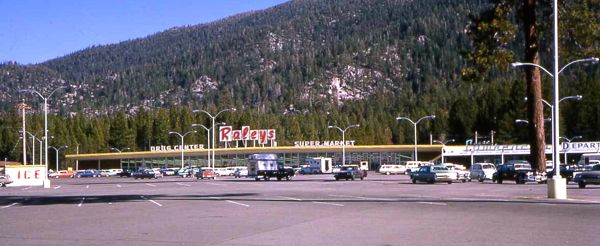
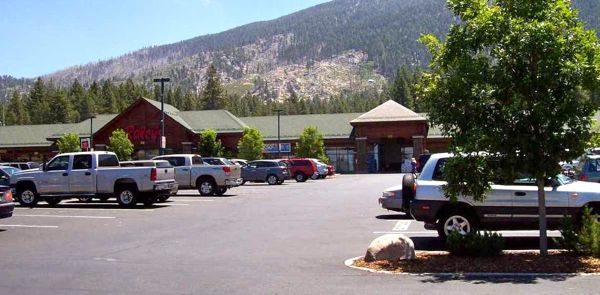
Then and now: Raley’s center near Stateline changes through time

The 1965 photo, at left, shows Raley’s, an original occupant in the then-named Crescent V Center near Stateline, built in 1962.

Adjacent was Lawrence’s Department Store in the space now occupied by Sports LTD.

Beyond the right of the photo was the Cream Puff Bakery, U.S. Post Office, Candlewick Gifts, coffee shop, I. Magnin, Tahoe National Bank and others.

Later in the 1960s at the left end of Raley’s was added Perry Boys’ Smorgy restaurant.

Lawrence’s had moved from its original building now occupied by Chevy’s Restaurant on Highway 50 near Ski Run Boulevard. I recall that the original Lawrence’s building then became Lawrence’s Economy Store, later an arts and crafts store, then Epominanda’s (Eppie’s) Restaurant, Carlos Murphy’s, and now Chevy’s.

The Crescent V Center was totally rebuilt with added retail buildings in the last decade and now is named Village Center.

The 2012 photo shows the remodeled Raley’s.

— Bill Kingman


Opinion: Rural fire fee needs to be overturned

By Ted Gaines

I am pleased to announce that I introduced legislation that would repeal the fire tax.

This $150 fire tax is illegal and unfair – plain and simple. Many rural property owners already pay local fire agencies for protection so it is clearly double-taxation and it is being dumped on the backs of rural Californians when the state has 10 percent unemployment and families are struggling to make ends meet.

Senate Bill 17 would reverse the governor’s and legislative Democrats’ decision to raise $84 million in taxes by charging rural property owners a “fee” for fire prevention services as part of the 2011-12 budget.

Ted Gaines

These communities are located in “State Responsibility Areas” designated by CalFire, even though their property taxes already contribute to the service contracts that counties have with CalFire.

This tax has been imposed on the owners of more than 800,000 properties in the state. According to Census and CalFire data, my largely rural district includes nearly 25 percent or approximately 200,000 of the properties whose owners will be subject to the fee.

I have been a leading critic of the fire “fee” since its inception, leading a referendum attempting to overturn the tax and co-authoring legislation last session to see it reversed. I’ve also strongly supported the Howard Jarvis Taxpayers Association’s class action lawsuit to overturn the fire fee.

The fire tax attempts to sidestep Proposition 26, which prevents the Legislature from disguising taxes as “fees” and circumventing constitutional requirements for passing higher taxes.

I vow to fight this in every way possible and encourage everyone who might get stuck paying this phony fee to get in the arena and fight it too. The answer to fire protection in California is not illegal taxes, but budgets that invest in core government services that protect every citizen in the state – rural, urban and suburban.

I will keep you updated on the status of this bill as it makes its way through the legislative process.

Ted Gaines, R-Roseville, represents Lake Tahoe in the California Senate.


Study: Slot players aren’t just in it to win money

By Ron Sylvester, Las Vegas Sun

For people who play slot machines, time is more important than money.

Instead of focusing on hitting a big jackpot, they spin the reels to relieve stress, entertain themselves or kill time.

That’s according to a new study from Oregon State University.

The results are important because they help gaming executives understand — and market to — the slot players who provide the most profit to casinos.

“Casinos can cater to different types of gamblers,” said Sandy Chen, an assistant professor of hospitality management at Oregon State University-Cascades and one of the study’s authors. “Instead of having a long line of slot machines, for example, they can be arranged in a circle to maximize socialization for those who are motivated by that aspect. Socialization may be a major reason for people to continue going to casinos instead of choosing online gambling options.”

About three-quarters of casino revenue comes from slot play. Between 70 percent and 90 percent of American gamblers say they prefer to play slot machines rather than table games.

Additionally, more than 60 percent of slot players say they’d rather win small, frequent payouts than large, sporadic jackpots. Only 33 percent of gamblers surveyed said they prefer progressive machines, which tend to offer the biggest jackpots.

Chen said slot players typically aren’t in a lower-income bracket and looking for big wins. Rather, they are more affluent and seeking entertainment.

Players most likely to be found at slots are women ages 55 to 60 who are homeowners with some college education and a household income of more than $55,000.

Chen said her study showed that women tend to play slots for the experience while men hope to make money.

“Women are more into functional motives — the social experience, the excitement and the fun,” Chen said.

Slot players typically fall into four groups: bored people looking for something to do, players seeking a buzz, people who want to have fun and people looking to relieve stress. The last group, the “relaxation gamblers,” tends to be the most educated and affluent. Those players make up the majority of gamblers in the United States, according to surveys by slot manufacturers.

As for specific games, almost three-quarters of progressive players said their favorite game is “Wheel of Fortune.” “Jacks or Better” was by far the most popular video poker game.

Relatively unpopular — contrary to information reported by manufacturers — are slot machines with complex story lines and colorful characters. Fewer than 1 in 5 players sought those types of games, Chen said.

Co-authors of the study included Stowe Shoemaker and Dina Zemke, from the Harrah College of Hotel Administration at UNLV.


Sledders unite to keep space open for their sport

By Kathryn Reed

With the greater Lake Tahoe area being in the news regarding access to public lands for snowmobilers and human-powered recreationists, the California-Nevada Snowmobile Association is having its convention in Stateline.

Greg McKay, a member of the Tahoe Sierra Snowmobile Club, told his group at a Dec. 6 meeting that discussions with Snowlands Network have been amicable, and that more meetings are scheduled for February before the March 1-3 convention at MontBleu.

“We are talking about how to co-exist. We have the right to ride the same area they want to play in,” McKay said.

Two representatives from the U.S. Forest Service were at Thursday’s gathering of snowmobilers at Tep’s restaurant in South Lake Tahoe.

Hanna Bernard of South Lake Tahoe rides as often as she can. Photo/Jeff Schauer

For now, the current level of access to sleds remains the same. This could change in the coming years depending on the outcome of the Forest Plan for the Lake Tahoe Basin Management Unit.

Snowmobiles are not allowed in wilderness areas. And there was a push by some folks to increase the wilderness designation in Tahoe. However, the LTBMU staff at meetings regarding the plan did not advocate doing so.

(The Forest Plan may be out for comment in late summer/early fall, with a decision in early 2014.)

An updated map for where snowmobilers may ride in the basin is being printed. It will be available by the first of the year at the South Lake Tahoe office or online.

Copies of the Carson Ranger District Winter Recreation Guide, which includes Alpine County, were distributed.

Dan Morris with the Humboldt-Toiyabe National Forest tried to explain why some routes are open to off–highway vehicles, but not to snowmobiles.

“We manage over-the-snow separately from OHV,” Morris told the group. He said the state has different definitions for the user groups.

When it comes to why Sonora Pass access is cut off in April even in heavy snow years, Morris explained that sensitive species live in the area and therefore biologists have found that habitat disturbance can occur.

A change coming to Nevada is that as of July 1, 2013, all Silver State residents must register their sleds – just like a car.

Frank Machler with the LTBMU knows firsthand what is going on in the woods because he’s on a sled patrolling the forests.

“I find my biggest issue is with people not taking responsibility to know what the rules and regulations on the land are,” Machler told Lake Tahoe News.

Much like operating a boat, no special license is needed to operate a snowmobile so the riders don’t have to pass a written or driving test before turning on the ignition. This can contribute to not knowing the rules.

But through groups like this club, information is passed along. What is open and closed is often posted on the Tahoe Sierra Snowmobile Club’s Facebook page so sledders can stay in the know.

While there is no snow at lake level, there is white stuff to ride on just a little higher up, according to many in the room who’ve already been out riding.