Finger pointing turns to gaming industry as hopes dim for online poker bill

By Karoun Demirjian, Las Vegas Sun

The top policy-making senators on online poker are agreed: The chances that a federal online poker bill will pass before the end of 2012 are pretty much nil.

“Two weeks before Christmas, without being vulgar, what the hell would I put it on?” Sen. Harry Reid said this week, referring to his effort to find a bill to which he could attach a poker amendment.

For months, Reid has complained that Republicans have not come up with the votes necessary to advance legislation legalizing online poker through Congress.

But now, his top policy adviser has another bone to pick: with the industry.

“The AGA had met with a lot of people and claimed they’ve done a lot of other visits,” said David Krone, Reid’s chief of staff. “But unfortunately, I haven’t seen that turned into votes.”

The American Gaming Association does not represent every casino interest on the Las Vegas Strip, much less every gaming stakeholder in the country. But in Washington, it is the unofficial leader of a body of lobbyists who have spent the past four years pushing for an online poker bill.

In that time, the poker industry has been near-unanimous in its support for some form of federal intervention to legalize betting in Internet poker games and clarifying that poker is the only form of online gambling that is allowed.

But even lobbyists admit that the industry has not been speaking with a single, clarion voice about what that fix should look like — leaving room for doubt that those on the fence about online poker can wallow in.

“This is an industry of entrepreneurs. So saying we’re all going to think alike is not going to happen,” said Jan Jones, a lobbyist for Caesars Entertainment, likely the most active of the Nevada casinos angling for an Internet poker bill. “It’s big personalities, big thinkers. Harnessing this into one cohesive mind is a near impossibility.”

It has been especially hard over the past two years, as the casino industry has contended with a march of dramatic and jarring events. In the spring of 2011, online poker outfits Full Tilt, Absolute Poker and PokerStars were charged in federal court, sending lawmakers scrambling to divest themselves of any associations with those companies or their affiliates, and casting a pall over the issue of online poker in general.

Then, at the end of 2011, a new reading of the 1961 Wire Act from the Justice Department set states racing to approve their own, in-state online lotteries, significantly upping the pressure on the pro-poker lobby to push their issue through the federal process or miss their chance entirely.

Shortly after that, influential Republican donor Sheldon Adelson declared himself opposed to legalizing online poker, giving Republican lawmakers an opportunity to distance themselves from the issue, and exposing conflicts in the casino industry to the country at large.

“I don’t think everyone’s working in lockstep toward the same goal,” Jones added. “But I think the AGA has done a very good job of trying to keep their members informed and moving along a path.”

The AGA’s members reject the suggestion that the efforts — either in messaging or emphasis — were anything less than satisfactory.

Instead, lobbyists pointed an accusing finger back toward Congress as a whole and the body’s well-documented inability, these past two years, to get much legislation accomplished.

Las Vegas-based casino companies such as MGM Resorts International and Caesars Entertainment are pushing for federal legislative regulating online poker.

“I think this is sort of typical of politicians: It’s never Congress’ fault that they didn’t get their act together; there’s always some other reason,” said Alan Feldman, spokesman for MGM Resorts International, a member of the AGA. “If you’re a Democrat, it’s the Republicans’ fault; if you’re a Republican, it’s the Democrats’ fault; and if you’re trying to toe the line with both, it’s someone else’s fault. If someone wants to use that as an excuse for why this won’t happen, fine, but it doesn’t change the fact there’s clearly a need for federal action.”

“There have been some very good lobbyists who have been retained by the companies on this — but it’s like, you could have the best yachtsman in the world sailing into a headwind and he’d have difficulty navigating,” said Mike Sloan, a lobbyist with Fertitta Entertainment, which owns Station Casinos. It is not a member of the AGA. “Nothing is getting done, and that’s where we are.”

Lobbyists point out that lawmakers never actually developed a bill they felt they could peddle around.

Reid and Sen. Jon Kyl, R-Ariz., were sharing a draft of a poker bill with Sen. Dean Heller as early as last summer. But Kyl insisted the draft not be shared outside of the small group.

Since September, however, the text of that draft has been public. Reid, Kyl and Heller have all expressed confidence that the legislation is adequate to both walk back the 2011 Wire Act reading and address concerns about the security of Internet poker. In public, they continue to maintain it’s only a draft.

“I don’t know where things stand as far as a final piece of legislation. Within the last few weeks was the first time that any type of actual language on a bill had ever really surfaced,” said Whittaker Askew, a lobbyist with the AGA. “Being out there talking about the issue without a tangible product, which up until the last few weeks has been the case, that makes it a little more of a challenge.”

Because of that, Askew said, the AGA focused its efforts on educating lawmakers about poker instead of aggressively whipping up votes.

“It’s important for us to have spent a lot of time giving background, educating members and their staff,” Askew said. “We’ve been focused on this education effort for the last 18 to 20 months. So this is certainly nothing new, but it is certainly a big effort.”

Still, that effort has been mostly behind the scenes. Askew detailed the public outreach part of the AGA’s work as essentially boiling down to a few press releases and two videos intended for social media: one produced in 2011 and one produced in 2012.

Lobbyists say public perception of their efforts doesn’t really matter.

“Just because it flares up in the press, doesn’t mean there hasn’t been a consistent effort,” Jones said. “If you’re really working a legislative process … you cannot let that define the path that you’re on.”

However, every casino has its own style.

“I don’t think there is really a dime’s worth of difference between our position and those of most of our colleagues,” Sloan said. “The difference may be in effort.”

Not every company that supports online poker appears to be putting equal skin in the game.

Companies like Caesars have been a visible force working with lawmakers to advance a poker bill on Capitol Hill: Over the past two years, the company spent an industry-leading $5.8 million lobbying Congress on Internet poker and other issues, according to a compilation by opensecrets.org.

But companies like Wynn Resorts — which isn’t opposed to online poker — have spent a total of $315,000 on lobbying. Many involved in the online poker effort said Wynn’s lobbyists really haven’t been very actively involved in the discussions on Capitol Hill.

A spokeswoman for Wynn Las Vegas did not return a call for comment.

Meanwhile, companies like MGM, which has spent about $1.1 million on lobbying over the past two years, are somewhere in the middle.

Whatever the discrepancies in the industry’s lobbying efforts, all Nevada casinos are likely to profit from the bill if it passes because the legislation favors casinos with a proven track record of running responsible gaming operations for the first federal online poker licenses.

That gives them at least as much incentive to break through the congressional gridlock as Nevada’s representatives.

“It’s up to the industry to make the case, and it’s up to legislatures to understand the consequences of not moving the legislation,” Jones said. “I can’t blame this on Congress or on the industry. It’s just a function of time and timing. It just is. If you don’t find it this time, you just keep working after it.”

And though opportunities are diminishing, the industry is refusing to admit defeat.

“We absolutely believe this is good policy. And that’s not going to change whether we have 20 different opportunities that don’t get passed,” said Larry Epstein, vice president of government relations for Ultimate Fighting Championship, which has been working with Fertitta Entertainment to advance online poker legislation in Congress. “It’s frustrating that nothing’s happened, but in my view, I don’t think it compromises the potential of passage.”


Childhood obesity rates on the decline

By Sabrina Tavernise, New York Times

PHILADELPHIA — After decades of rising childhood obesity rates, several American cities are reporting their first declines.

The trend has emerged in big cities like New York and Los Angeles, as well as smaller places like Anchorage, Alaska, and Kearney, Neb. The state of Mississippi has also registered a drop, but only among white students.

“It’s been nothing but bad news for 30 years, so the fact that we have any good news is a big story,” said Dr. Thomas Farley, the health commissioner in New York City, which reported a 5.5 percent decline in the number of obese schoolchildren from 2007 to 2011.

The drops are small, just 5 percent here in Philadelphia and 3 percent in Los Angeles. But experts say they are significant because they offer the first indication that the obesity epidemic, one of the nation’s most intractable health problems, may actually be reversing course.

The first dips — noted in a September report by the Robert Wood Johnson Foundation — were so surprising that some researchers did not believe them.

Deanna M. Hoelscher, a researcher at the University of Texas, who in 2010 recorded one of the earliest declines — among mostly poor Hispanic fourth graders in the El Paso area — did a double-take. “We reran the numbers a couple of times,” she said. “I kept saying, ‘Will you please check that again for me?’”

Researchers say they are not sure what is behind the declines. They may be an early sign of a national shift that is visible only in cities that routinely measure the height and weight of schoolchildren. The decline in Los Angeles, for instance, was for fifth-, seventh- and ninth-graders — the grades that are measured each year — between 2005 and 2010. Nor is it clear whether the drops have more to do with fewer obese children entering school or currently enrolled children losing weight. But researchers note that declines occurred in cities that have had obesity reduction policies in place for a number of years.

Though obesity is now part of the national conversation, with aggressive advertising campaigns in major cities and a push by Michelle Obama, many scientists doubt that anti-obesity programs actually work. Individual efforts like one-time exercise programs have rarely produced results. Researchers say that it will take a broad set of policies applied systematically to effectively reverse the trend, a conclusion underscored by an Institute of Medicine report released in May.

Philadelphia has undertaken a broad assault on childhood obesity for years. Sugary drinks like sweetened iced tea, fruit punch and sports drinks started to disappear from school vending machines in 2004. A year later, new snack guidelines set calorie and fat limits, which reduced the size of snack foods like potato chips to single servings. By 2009, deep fryers were gone from cafeterias and whole milk had been replaced by one percent and skim.

Change has been slow. Schools made money on sugary drinks, and some set up rogue drink machines that had to be hunted down. Deep fat fryers, favored by school administrators who did not want to lose popular items like French fries, were unplugged only after Wayne T. Grasela, the head of food services for the school district, stopped buying oil to fill them.

But the message seems to be getting through, even if acting on it is daunting. Josh Monserrat, an eighth-grader at John Welsh Elementary, uses words like “carbs,” and “portion size.” He is part of a student group that promotes healthy eating. He has even dressed as an orange to try to get other children to eat better. Still, he struggles with his own weight. He is 5-foot-3 but weighed nearly 200 pounds at his last doctor’s visit.

“I was thinking, ‘Wow, I’m obese for my age,’” said Josh, who is 13. “I set a goal for myself to lose 50 pounds.”

Nationally, about 17 percent of children under 20 are obese, or about 12.5 million people, according to the Centers for Disease Control and Prevention. The CDC defines childhood obesity as a body mass index at or above the 95th percentile in comparison to children of the same age and sex in the center’s growth charts, a reference population based on children in the United States primarily from the 1960s and ’70s.

Obese children are more likely to be obese as adults, creating a higher risk of heart disease and stroke. The American Cancer Society says that being overweight or obese is the culprit in one of seven cancer deaths. Diabetes in children is up by a fifth since 2000, according to federal data.

“I’m deeply worried about it,” said Francis S. Collins, the director of the National Institutes of Health, who added that obesity is “almost certain to result in a serious downturn in longevity based on the risks people are taking on.”

Obesity affects poor children disproportionately. Twenty percent of low-income children are obese, compared with about 12 percent of children from more affluent families, according to the CDC. Among girls, race is also an important factor. About 25 percent of black girls are obese, compared with 15 percent of white girls.

Some experts note that the current declines, concentrated among higher income, mostly white populations, are still not benefiting many minority children. For example, when New York City measured children in kindergarten through eighth grade from 2007 to 2011, the number of white children who were obese dropped by 12.5 percent, while the number of obese black children dropped by 1.9 percent.

But Philadelphia, which has the biggest share of residents living in poverty of the nation’s 10 largest cities, stands out because its decline was most pronounced among minorities. Obesity among 120,000 public school students measured between 2006 and 2010 declined by 8 percent among black boys and by 7 percent among Hispanic girls, compared with a 0.8 percent decline for white girls and a 6.8 percent decline for white boys.

“The needle is actually moving,” said Gary D. Foster, director of the Center for Obesity Research and Education at Temple University.

He first noticed the change while conducting a study of middle school students. Even children who made up the control group that did not take part in anti-obesity measures had a weight drop of nearly 4 percent, compared with 5.5 percent for those who did.

Here at William H. Ziegler Elementary in Northeast Philadelphia, where most students qualify for free or reduced-price lunch, the day begins with a nutrition tip over the loudspeaker. Teachers give out colorful erasers and stickers instead of Tootsie Rolls. Fund-raising events feature fruit smoothies instead of chocolate.

Some students had never seen broccoli or cauliflower, so Jill Dogmanits, a sixth-grade teacher, started taste tests to acquaint students with those vegetables and healthy snacks like hummus, fresh pineapple and whole-wheat bagels.

But school is only part of the day. Children buy an average of 350 calories worth of snacks in corner stores every day, according to a study by Foster’s center at Temple University. About 640 corner stores are now part of a program of stocking healthier food, according to the Food Trust, a nonprofit group that runs it.

“Parents tell their kids, ‘Take this money and go buy a snack,’” said Josh, as children streamed into a store across from his school where crayon-colored sugar drinks called Hugs sell for 25 cents and generic soda is 40 cents.

Donald F. Schwarz, a pediatrician who is the city’s health commissioner, said: “I think we are beginning to turn the tide with the many things that have gone on now for a decade.”

It is too early to tell whether the trend will hold.

“I’d like to see another year of measurement before I go out and party over this,” said Mary Currier, Mississippi’s state health officer.

And some public health experts say that without broader policy actions like a soda tax, which Philadelphia tried but failed to pass in 2010 and 2011, deeper change will be difficult. Still, new data from Philadelphia — from more than 20,000 children in first through sixth grades — show a further 2.5 percent obesity decline from 2011 to 2012, Foster said.

Josh lost weight this summer, exercising outside with his stepfather, an Army reservist. But now that it’s cold he has gained some back. Still, he believes he can influence others. His 2-year-old cousin now asks for bananas instead of chips at the corner store. Josh takes full credit.


Candlelight vigil in South Tahoe to honor school shooting victims

There will be a candlelight vigil Dec. 15 at 5pm at Heavenly Village in South Lake Tahoe (near the base of the gondola) to mourn for the lives lost in Connecticut, and to stand for a peaceful world free of violence for all children.

The event is being hosted by Small World.


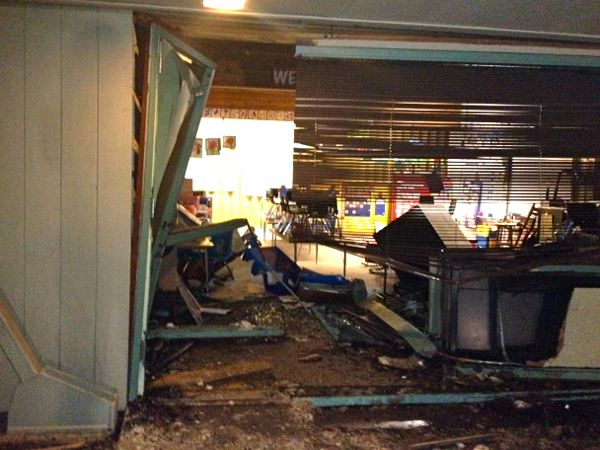
Vehicle plows into classroom in Meyers

A vehicle doing doughnuts at the magnet school in Meyers on Friday night lost control and took out the entire front wall of a kindergarten classroom.

No one was injured in the 9:30pm Dec. 14 incident.

According to Lake Tahoe Unified School District officials, the person was in the parking lot and and back field. No one is in custody.

A vehicle on Dec. 14 slammed into a classroom in Meyers. Photo/Provided

On Saturday morning maintenance personnel were framing and constructing a new exterior wall.

The summer remodel plans include adding barriers in the front to prevent another such incident.

School officials believe it was a large white truck or SUV judging from the extent of the damage.

The California Highway Patrol is investigating. Anyone with information is asked to call (530) 577.1001.

 — Lake Tahoe News staff report


1 person dies in 2-car collision in S. Lake Tahoe

A South Lake Tahoe man was killed and two others injured in an early morning traffic collision.

A Honda Accord driven by Roberto Olazaba, 22, of South Lake Tahoe broadsided a GMC Yukon driven by Noe Corea, 26, of South Lake Tahoe, according to South Lake Tahoe police officers.

William Olazaba, 26, was a passenger in his brother’s Accord. He died at Barton Memorial Hospital.

An accident Dec. 15 killed a South Lake Tahoe man. This vehicle landing on the power box knocked out electricity on Ski Run Boulevard for five hours. Photo/Provided

Roberto Olazaba was at Barton under observation, according to officers. A passenger in Corea’s vehicle was treated and released from the hospital.

The accident occurred at 1:35am Dec. 15 at Pioneer Trail and Ski Run Boulevard.

Police believe alcohol was a factor.

This is the third fatal traffic accident in South Lake Tahoe in four months.

Anyone who may have witnessed this collision is requested to contact Officer John Speath at (530) 542.6100.

 — Lake Tahoe News staff report


Helmets don’t have to be standard off-the-rack plastic

By Berne Broudy, Outside

In the 1990s, Dan Coyle started making wooden helmets for himself and his buddies for whitewater kayaking, as well as wooden eyeglass frames and paddles. It was a hobby, a use for Coyle’s chainsaw and grinder.

Coyle noticed that, structurally, wood is similar to rigid, closed-cell foam. That means it can, with impact, deform and absorb shock like EPS in a traditional bicycle helmet. In fact, Coyle discovered, almost any wood is capable of absorbing more energy than polycarbonate and the ABS plastics typically used in bike, skate, motorcycle, and ski helmets, while also being more durable.

A wooden shell provides protection over a greater spectrum of impact energies, according to Coyle’s tests. Add a cork liner and the comfort level compares to other helmets currently on the market.

Now, Coyle has turned his hobby into a business. Using everything from Doug Fir to black walnut, Coyle custom builds one-of-a-kind sports helmets. The hardwoods and most of the softwoods he uses are salvaged.

And all of the sawdust, chips, and splinter byproducts of his work are returned to the ground to decay and re-enter the natural cycle.

Each finished product is unique.

With business growing, Coyle did his due diligence and tested his wood/cork technology at an accredited impact lab. But because they are custom made, Coyle’s helmets are not certifiable.

Helmets start at $375.

Check out his website.


White launches quest for 2014 pipe, slopestyle gold at Dew Tour

By Jason Blevins, Denver Post

BRECKENRIDGE — Shaun White has been a pro snowboarder for half his life, becoming the most recognized action sports athlete of all time through 13 years of driven competition.

At 26, the lines on his face are a tad deeper, his perspective more aged — and his posse now includes a French bulldog named Steve. Yet the drive to win that defines his board riding hasn’t faded an iota.

As he prepares for gold in Sochi’s 2014 Olympic halfpipe and slopestyle contests — starting this weekend at the Dew Tour in Breckenridge — he’s scheming bigger tricks, even bigger than the back-to-back double-cork 1260s that earned him a perfect score in the X Games halfpipe in Aspen last winter or his famous double McTwist 1260s.

“I see tons of possibilities. There’s a lot of things that are happening in slopestyle that can be taken over to the halfpipe,” he said Friday morning, with his red mane in a tight bun, and looking dapper in a tie and signature tight trousers during a series of interviews at Breckenridge. “What else can be done? It’s my job to take it a little further. I’ve already set things in motion to try to one-up everything I’ve done so far.”

With a reserved run in the Thursday semifinals, White qualified second for Saturday’s halfpipe finals behind Scotty Lago. While White says he won’t be throwing his craziest tricks Saturday — the first competition of the season — his bag of tricks has never been deeper.

“I don’t really know where the halfpipe tricks are going,” White said. “A lot of the judging is off amplitude, so I’m just trying to go as big as I can with certain tricks and variations.”

Despite owning more medals from slopestyle than halfpipe, White took off the creative slopestyle training for two seasons in 2009 and 2010 as he focused on halfpipe in preparation for that year’s Winter Games. That was because slopestyle was not a medal sport in Vancouver.

His comeback in slopestyle was slow. He failed to qualify in the 2011 Winter X Games slopestyle contest in Aspen and dropped out of the 2012 Aspen slopestyle competition after qualifying last. But then in March, he won slopestyle gold at the Winter X Games in Tignes, France, with three double corks, including back-to-back double-cork 1260s.

Still, after knee surgery this spring and taking off from skateboard competition this summer, White said he is easing into the season.

He won’t compete in Sunday’s slopestyle contest in Breckenridge, but he will in every other slopestyle contest this season.

“That’s where I’ve got to make my biggest stand: slopestyle,” he said.

White said he spent the spring and summer “doing something I don’t normally do: living my life.” He hung out at his new beach house in Encinitas, and went to New York City for two months, playing music with pals and searching for inspiration.

“You can definitely tell I get influenced by where I’m at,” said the longtime clothing designer with a collection he developed with sponsor Target. “I like being influenced by different places, different things. You can tell it shows in the way I ride, what I wear on the mountain and what I’m wearing off the hill.”

In September, White made less glowing headlines when he was arrested after a fracas at a Nashville hotel. Despite his handlers asking Dew Tour media to avoid asking about the incident, White said, “Let’s focus on it.”

According to the police report, “White appeared to be extremely intoxicated and smelled strongly of alcohol.” He was cited for public intoxication and vandalism. He refuted reports that he was getting some sort of treatment for alcohol abuse.

“There was an assessment that was done, and everyone took that that I’m getting treatment for all these things,” White said. “And it’s more like, ‘Hey you had a mistake. Did you learn from it? OK. Let’s move on.’ And I moved on. I learned my lesson.”

Missing the skateboard season means a slower entry to snowboarding for White. He has spent only five days on snow this winter. Last year, it was the skateboard that opened doors to the new tricks that contributed to last winter’s 100-point score in Aspen.

“The technical aspect of skateboarding helps snowboarding with balance and focus and being precise,” he said. “I learned double corks on jumps onto a foam pit on a skateboard. That was a direct impact.”

Today, White spends his off-mountain time developing his creative style in clothing, videos with GoPro, snowboarding camps at Vail Resorts’ Northstar ski area and even two flavors of gum with Stride.

He parted ways last year with Red Bull after a four-year partnership that included the energy drink giant sculpting a private superpipe at Colorado’s remote Silverton Mountain ski area.

Almost 18 months later, he has yet to enlist a new beverage sponsor, revealing his very particular and intensive approach to sponsorship. His individual brand is likely the biggest in action sports, and he works to keep it vibrant.

“The majority of my process is not based on money. Otherwise, I’d be with Red Bull. We just didn’t see eye-to-eye on certain things. They do things a certain way, and it just wasn’t lining up with where I was heading. That’s why I haven’t jumped on a new one yet,” he said. “It’s quality over quantity for me. I just want to make sure I can give each partnership and things that I do the right amount of attention. The list that gets said no to is massive compared to the list we agree to.”


Men from Squaw miss downhill podium in Italy

By USSA

VAL GARDENA, Italy — Do you believe in Steven? The Utah downhiller put a mark on his comeback returning to the site of his 2006 Audi FIS Alpine World Cup win to do it again.

Steven Nyman (Sundance, Utah) came out of the 37th start position to steal a victory on the foggy, snowy Saslong Classic after hours of delays on Saturday. It was his second career win and fourth podium.

Travis Ganong (Squaw Valley) had a career best 10th.

Nyman’s last podium came in 2007 at Beaver Creek. Nyman missed all of the 2012 season with a torn left Achilles.

Marco Sullivan (Squaw Valley), who was third in the season opening downhill, finished 18th.


Power restored to Ski Run area in South Tahoe

Many people along Ski Run Boulevard in South Lake Tahoe probably woke up to flashing clocks.

This is because a vehicle took out a Liberty Utilities switch on Pioneer Trail and Ski Run at about 2:30am Saturday.

Randy Kelly with the utility told Lake Tahoe News the vehicle was sitting on top of their equipment.

Power was out from Pioneer Trail down Ski Run, including Embassy Vacation Resort.

— Lake Tahoe News staff report


Ski report: Season is just getting better

Get out today to experience the best conditions of the season.

Resorts continue to open terrain.

Here is the Dec. 15 ski report.

— Curtis Fong