Meteorite fragments found in El Dorado County a scientific gold mine

By Matt Weiser, Sacramento Bee

The meteorite fragments that crashed down in El Dorado County in April contain some of the best-preserved elements from the dawn of the solar system ever recovered, according to a study.

The Sutter’s Mill meteorite, as it has been called, entered Earth’s atmosphere at about 8am on April 22 with the force of a 4-kiloton bomb. The explosion when it broke apart could be heard as far away as Washington state, and it produced a fiery streak seen across large areas of Northern Nevada and California.

The meteorite weighed about 100,000 pounds and was as big as a minivan. The 77 fragments recovered on the ground weigh only about 2 pounds.

Yet those 2 pounds are proving to be among the most significant meteorite finds in history, according to the study published in last week’s issue of the journal Science, which includes nine co-authors from UC Davis.

The meteorite arrived at a record entry speed of nearly 18 miles per second, and it broke apart at a record altitude of about 34 miles above sea level. Much of it would have disintegrated in the heat of the entry.

“The entry was very violent,” said Peter Jenniskens, an astronomer and senior research scientist at the Search for Extraterrestrial Intelligence Institute, and also lead author of the study. “We think that’s why there were no big chunks, because this object came in with such a high speed.”

It was called the Sutter’s Mill meteorite because most of the fragments were found near the towns of Lotus and Coloma along the American River, where the Gold Rush began in California in 1848. Jenniskens himself found one piece in the parking lot of Marshall Gold Discovery State Historic Park.

The study, which includes 69 co-authors from around the globe, found that the meteorite fragments are the most pristine samples ever collected of a rare type of carbonaceous chondrite, an amalgam of minerals that formed about 4.5 billion years ago when the solar system was taking shape.

Doppler weather radar was used to track the meteorite’s arrival – a relatively new technique. As a result, researchers know more about where this meteorite came from than most meteorites.

They believe it came from an asteroid belt with a highly eccentric orbit that passes between Jupiter and Mars, then swings close by the sun. They also believe it broke off from a larger object, likely an asteroid, between 15,000 and 19,000 years ago – very recent in meteorite terms.

“Among the known asteroid orbits, this one might be the most eccentric,” said Qing-Zhu Yin, a geology professor at UC Davis and a co-author of the study. “As a result, its orbit may have had its outmost point all the way to Jupiter.”

The meteorite contained evidence of its travels through the solar system. Among the elements detected in the fragments, using specialized equipment at UC Davis, was oldhamite, a sparkly brown crystal-like mineral thought to have originated in the solar nebula when the solar system formed.

Oldhamite is very reactive and can disappear just from being breathed on. It often vanishes before it can be examined in recovered meteorites.

In this case, Jenniskens and a few local residents were able to recover and preserve fragments within hours of their falling from the sky. Rain that fell the next day would likely have erased the oldhamite. It marks the first time oldhamite has been detected on a recovered meteorite.

“We are suspecting that the oldhamite originated in a different type of meteorite, normally associated with Earth and Venus and not in an area of primitive asteroids from farther out …” said Jenniskens. “It’s telling us a story about mixing in the early solar system.”

The meteorite contains compounds picked up from very different regions of the solar system: one that is relatively cold and wet, and another that is hot and dry. This is unusual, indicating that parts of the meteorite had very different histories.

And according to an accompanying news article in today’s issue of Science, the researchers more recently found diamonds in the meteorite, which don’t belong in either type of environment.

Analysis by UC Davis scientists also shows evidence that minerals in the meteorite once had contact with flowing water, possibly on a parent asteroid.

This is not unusual in meteorites, Yin said, but nevertheless fascinating. Earth is thought to have originally acquired a water supply from crashing meteorites.

“You can say with one little piece in your hand, you are holding the entire solar system,” said Yin. “There’s a lot of excitement with this meteorite.”

NASA as well as the European and Japanese space agencies are all planning to land probes on asteroids over the next decade. One goal is to look for water. The first of these is a NASA probe expected to launch in 2016, Yin said.

“It so happens the target they identified, based on remote sensing, resembles this meteorite,” he said. “Basically, this material gives us an early glimpse of what we might find.”




S. Tahoe council to discuss how to fill vacancy

How will the vacant seat on the South Lake Tahoe City Council be filled?

That is the sole item on the agenda for a special meeting of the four remaining members. The meeting is Dec. 27 at 9am at Lake Tahoe Airport.

Claire Fortier abruptly, though not unexpectedly, resigned last week. The council options for how to replace her are dictated by state and local laws.

It is possible the council will decide next week how to move forward. But it’s also possible another special meeting could be called before the regular Jan. 8 meeting.

— Lake Tahoe News staff report


Zero tolerance for vehicles obstructing snowplows

With the winter storms lined up for this weekend, the El Dorado County Sheriff’s Office is reminding residents and visitors to be mindful of the local parking regulations.

In the county it is unlawful to park on the roadway during snow removal conditions or in any manner which obstructs traffic. This is defined as any vehicle obstructing the normal flow of traffic under normal driving conditions.

It is also illegal for any vacation rental to park vehicles in the roadway when snow conditions exist.


Drinking too much can quickly ruin holiday season

By Carolyn Butler, Washington Post

’Tis definitely the season to eat, drink and be merry. Some of us, however, take those festive guidelines a wee bit too seriously — particularly with eggnog, mulled wine, champagne and other alcoholic beverages.

Why do people drink too much during the holidays?

“A lot of traditions at this time of year involve alcohol,” says Virginia clinical psychologist Diane Hoekstra. “You’re with friends and family who you may not see all the time, and you really want to have a good time, and so you celebrate with a few drinks, which isn’t harmful as long as you’re aware of your limits.” Unfortunately, that can be more difficult when you’re not used to drinking a lot, as well as when you’re guzzling seasonal cocktails that you’re not particularly accustomed to.

“Most of us don’t drink Champagne or cognac or eggnog on a regular basis,” explains Daniel Z. Lieberman, a professor of psychiatry and behavioral sciences at George Washington University. “I may know that three to four beers is my limit, but I have no idea what it is with brandy or eggnog, so it’s possible to lose track much more easily.”

The strife and strain that often build during the holidays can also play a role in overdrinking. “Sometimes you’re at parties or getting together with extended family that maybe people don’t necessarily feel totally comfortable with, and drinking is a way to grease those wheels a little bit,” says Lieberman. “There is so much pressure to be happy during the holidays, so much pressure to be with loved ones, that if you’re going through a difficult time, like with a divorce or a loss or you don’t have someone in your life at this period of time, it’s really magnified.”

Hoekstra agrees, adding that mental health concerns, stress and distress all go up during the holidays because of family conflicts, financial concerns and any number of other issues, especially for those with preexisting depression. “Unfortunately, many people medicate their pain or depression with alcohol, or use it as a potential stress release,” she says. “I often see people who don’t have a real alcohol problem drinking and doing things they wouldn’t normally do at this time of year.”

While it may seem as though the only consequence of too much eggnog is the occasional pounding hangover at work or at the holiday pageant at your kid’s school, boozing can have serious ramifications, starting with the documented uptick in drunken driving accidents and fatalities in the Christmas/New Year’s period.

Beyond that, Lieberman notes that frequent drinking on the holiday party circuit can run your body down and hamper immunity during cold and flu season, not to mention damage your liver in the long term. Hoekstra adds that another major concern is getting so blitzed at an office holiday celebration that you say or do something you regret.

“Your judgment is seriously impaired when drinking, which I think we all know can lead someone to engage in appalling, embarrassing, inappropriate behaviors that have potentially dangerous repercussions on the job, especially with [the rise of] Facebook and other social media,” she says.

Boozing can also play a role in holiday weight gain. Registered dietitian Cheryl Harris, of Harris Whole Health in Alexandria, points out that a glass of wine has approximately 100 calories, while many mixed drinks are in the 200-to-300-calorie range and eggnog is 400 or so calories per glass.

“It adds up pretty quickly,” she says, noting that there’s also a “tendency to forget about all your other food plans after you’ve had a few,” and thus to binge on Christmas cookies, pigs in blankets or whatever other goodies are in front of you.

For anyone who’s interested in trying to curtail their cocktail habit this Christmas or beyond, Harris offers a few simple tips that work no matter what your motivation for cutting back:

● Alternate sparkling water (or something else nonalcoholic) with any alcohol you consume.

● Go for a wine spritzer, or add ice to wine or other drinks. You’ll feel as though you’re having more alcohol than you actually are, and you’ll be drinking at a slower pace.

● Figure out beforehand how many drinks you will actually enjoy without feeling lousy the next day. It’s easier to say no when you know that the third rum punch will give you a nasty hangover.

● After setting a drink quota for the night, spread them out over the course of the evening.

● Don’t make drinking the focus of your partygoing. Choose something else, such as dancing, catching up with friends or taking pictures.

● Have a distinctly flavored hard candy in your mouth whenever you don’t want to be drinking. Since flavors such as peppermint and cinnamon would taste atrocious with most alcoholic beverages, it will be an easy reminder that you’ve decided to stop.

● Always have some of what you love. Studies have shown that when people know they are not allowed to have a certain food, cravings for that food increase. So even though eggnog is a calorie and fat bomb, have a small cup and enjoy it fully if that’s what makes your holiday season complete, and then skip something else.


Letter: Thanks to Lakeside Inn for helping elementary school

To the community,

Zephyr Cove Elementary School would like to thank Lakeside Inn & Casino for donating the turkey to our fourth annual Sharing Feast.

It is businesses like Lakeside that makes this town a special place to live.

Kelly Krolicki, Stateline


Ski report: Powder days are coming

The storm is coming and the snow will be here in feet.

The wind is here and is affecting lift operations.

Here is the Dec. 21 ski report.

— Curtis Fong


Snippets about Lake Tahoe

• Après Wine Co. in South Lake Tahoe and Petra Wine Bar at Northstar are recommended as places to visit in the January issue of Ski magazine.

• John Wagnon, marketing guru at Heavenly-Kirkwood, is now on the Nevada Commission on Tourism. He is filling the remainder of his boss Blaise Carrig’s term, which expires June 30, 2014.

• January is National Skating Month – as in ice skating.

• The January-February issue of Via magazine recommends JT Basque Bar and Dining Room in Gardnerville as a place for fine food with a side of history.

• Amador County’s Terre Rouge & Easton Wines is on Wine Spectator’s list of 100 outstanding values of 2012 for its Easton 2010 Zinfandel Amador County.


Buses free on popular South Lake Tahoe routes

By Kathryn Reed

Offer a free bus ride and people will jump on board.

That is what BlueGo officials discovered in September when two routes through South Lake Tahoe were free for five days. Ridership jumped 60 percent, according to Curtis Garner, who runs the transit system.

What isn’t known is if the riders were locals or out-of-towners.

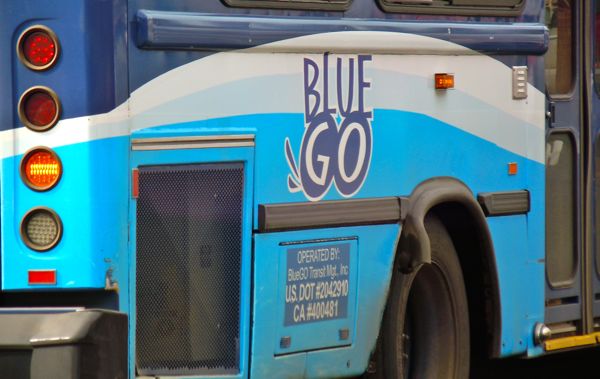
BlueGo buses will be free on two routes Dec. 22-Jan.6 Photo/LTN file

“The long-term goal of the program is to get people to use public transportation a few times, discover how convenient it is, educate them about the benefits of public transit, whether it’s economic or environment, and increase ridership for the long run,” Garner told Lake Tahoe News.

Starting Saturday, routes 50 and 53 will be free. Part of the reason for picking the Dec. 22-Jan. 6 time period is because this is when a huge influx of vehicles will be in town for the holidays. The goal is to get visitors out of their cars and onto the bus.

These are essentially what metropolitan areas call spare the air days.

“We hope to have a decent impact on congestion this year,” Garner said.

Route 50 goes from the transit center at the Y to the transit center at Heavenly Village – all on Highway 50. Route 53 is from the Y, through Bijou, along Pioneer Trail and ends at the transit center on Kingsbury Grade.

Garner said those two routes transport approximately 70 percent of the riders who use the bus system.

Normally it costs $2 one-way on either of these routes.

BlueGo will be reimbursed through Congestion Mitigation and Air Quality funds. The Tahoe Transportation District, which oversees BlueGo, is eligible for the state funds because Lake Tahoe’s air is substandard.

“CARB, or the California Air Resource Board, determined many years ago that our carbon monoxide levels were too high. Steps have been taken to bring the area into compliance, but as of this time CARB has not changed our designation,” Garner explained.

Lake Tahoe is what’s a called a “non-containment area” because the air is “worse than national air quality ambient standards,” Garner went on to say.

Future of free buses

Mayor Tom Davis has long been vocal about wanting to develop a free bus service in town like other resort areas have. He is hoping the data collected from these free trial periods will help his cause.

The South Shore bus service has a budget of $4.5 million. Of that, $700,000 comes from the fare box.

Carl Hasty, executive director of Tahoe Transportation District, told the City Council this month, “In order to continue the service we have today and to make it free all the time it’s that $700,000 from the fare box (that needs to be funded). It would need to be more if you want to increase service.”

Councilwoman JoAnn Conner brought up the fact that there is no service to Meyers.

While ridership is increasing throughout the system, buses are not full. That is one reason the free rides can also be offered – there is room for people without adding buses.

In September, ridership increased by 8 percent compared to September 2011, and it was up 6.7 percent in October compared to October 2011.

——

Notes:

• Schedule and bus stop information is online, as well as at the transit centers and on buses.

• Free rides are Dec. 22-Jan. 6; only on routes 50 and 53 of BlueGo on the South Shore.


Tahoe tow driver offers some advice for winter travel

By Bill Donahue, Via

Black ice, fog, snowbanks, sleet—dangers are ever present on winter roads. So slow down, use extra caution, and keep your car in tip-top shape. AAA tow druck driver John Baker, owner of Emerald Bay Towing in South Lake Tahoe has been rescuing members in the state’s snowiest highlands since he was 16 years old. He shares more winter wisdom.

Q I’m headed out on a winter road trip. What are my first steps?

A Check the weather conditions. If there’s a pending storm, wait. Know your route and let someone else know it too.

Q A flashlight, a charged phone, extra clothing and blankets, water and food—anything else I need in my emergency road kit?

A An ice scraper with a brush.

Q Why is that so important?

A You have to clear all the snow off the car’s top and hood, not just the windows. People drive with four feet of snow on top. The heater will turn that into an ice ball. When you hit the brakes, it’ll fall forward, completely blind you, and tear the arms off your wipers.

Q Any recommendations on tires and chains for bad weather?

A People think tires labeled mud and snow are fine. But the question is, is it a traction tire? Get the right chains for your car. Don’t get the big beefy ones you see on trucks for a small car. Check with your manufacturer. And remember, the speed limit for driving with chains is 25 mph.

Q Besides staying in the car, what else should I do while waiting for a tow to arrive?

A If the car is running, don’t run the heater full blast. The battery can’t keep up. Be patient. People panic—a minute can feel like two or three hours.

Q What was your most intense rescue?

A A friend called to tell me that my wife got buried in an avalanche while driving. She went from 35 mph to zero within 10 feet; the snow busted out her passenger window and cocooned her in darkness. It took 10 of us to dig her out. She was fine. Luckily, she had made a point of driving with a pack of cars, so people could call for help right away.

Q Advice for ski vacationers?

A Always put your key in a zippered pocket or keep it in a locker while you’re skiing. There’s a lot of snow up there — drop your key and it’s lost forever.


Unknown suspects making threats against schools

Schools across the country, including in Lake Tahoe, are on heightened alert as threats are being made that violence will erupt on Dec. 21. Some are saying this has to do with the Mayan calendar as well as potential copycats after last Friday’s shootings in Connecticut.

“Although there have been several rumors circulating throughout LTUSD (Thursday), we have not had any credible reports of incidents from the South Lake Tahoe or Douglas County (law enforcement), nor has any other school in El Dorado County according to the county superintendent’s office,” Angie Keil, spokeswoman for Lake Tahoe Unified School District, wrote in a mass email.

The district went so far as to leave telephone messages about 6pm Dec. 20 alerting people to the rumors and that the district is following up on every threat.

The FBI is also involved.

Washoe County sheriff’s deputies are also on heightened alert.

“Enhanced patrols in and around Washoe County schools will occur during the entire school day on Dec. 21. In addition, the Northern Nevada Counter Terrorism Center will be providing participating agencies with intelligence information, as it monitors conditions across the nation,” the department said in a press release. “While no credible threats have been received in Washoe County, area law enforcement is working together to ensure the safety and security of students and faculty.”

Extra security, including uniformed officers, is expected at LTUSD schools on Friday.

 — Lake Tahoe News staff report