Nearly 12,000 caught using phone on Nevada highways

Troopers from the Nevada Highway Patrol in 2012 issued nearly 12,000 traffic citations to motorists observed talking, texting or reading non-voice communication while driving.

And for some, this was not their first offense.

Last year was the first year Nevada banned the use of cell phones while driving.

The total fine for a first-time offense is $112.00 with zero points assessed against a driver’s license while the second, third and subsequent offenses each have four demerit points added to the monetary fine. When convicted, a second offense will cost a violator $192 while third and subsequent offenses each will total $352.

The following details the total number of citations issued for each month in 2012:

MON-YEAR

1ST OFFENSE

2ND OFFENSE

3RD OFFENSE

01-2012

1,122

1

4

02-2012

1,188

0

2

03-2012

1,149

0

3

04-2012

1,168

4

3

05-2012

1,265

2

2

06-2012

876

1

1

07-2012

864

4

1

08-2012

1,063

3

2

09-2012

1,052

4

6

10-2012

1,008

5

0

11-2012

747

3

1

12-2012

435

3

0

TOTAL

11,937

30

25

— Lake Tahoe News staff report


Snippets about Lake Tahoe

• January is National Learn to Ski and Ride month.

• Calling, downloading apps and surfing the web on the Verizon Wireless network is easier and faster for residents and travelers in El Dorado County thanks to a new cell site in Placerville. The site improves wireless coverage and capacity along Highway 49, Bar Crest Road, Wallace Road, Gold Hill Road and Lotus Road.

• For the second year in a row Sugar Bowl Ski Resort has received a “Best of Weddings” award by the Knot, the nation’s most visited wedding planning website.

• Swedish Olympic skier and former World Cup champion Jesper Rönnbäck knows being in the elements is hard the face. That’s why he created Recipe for Men, a line of skin care products for men.

• What was the world searching for in 2012? Google tells us in this video.


Missing Petaluma woman’s friend: She wasn’t acting like herself

Santa Rosa Press Democrat and Lake Tahoe News

A Petaluma teen who vanished more than two days ago while in South Lake Tahoe for a three-day music festival remained missing Thursday afternoon amid mounting concerns for her safety and a sense that something wasn’t quite right.

Friends who saw Alyssa Byrne, 19, shortly before she disappeared said she wasn’t acting like herself when she unexpectedly left a New Year’s Eve concert an hour before midnight and later passed on a chance to visit with old high school friends at her hotel.

Alyssa Byrne

The last friend to see her, Micah Alex of Petaluma, said it was his impression that Byrne was altered by alcohol or drugs when they embraced and greeted each other near the lobby of the Horizon casino before she went missing.

“She just seemed like something was wrong with her,” Alex said Thursday, “like she wasn’t all there, you know?”

But no one foresaw days of waiting and worrying as law enforcement got involved in the effort to find the missing Casa Grande High School grad, and details about her last interactions with friends mixed with confusion and misunderstanding.

A resident in the Christmas Valley area of the South Shore received a call from Douglas County Sheriff’s Office about noon today saying there were reports Byrne had been seen in that vicinity and to be on the lookout. However, Douglas County and El Dorado County law enforcement told Lake Tahoe News they have not made any such calls and there have been zero sightings of Byrne.

“There’s a lot of snow up at Lake Tahoe. The weather is cold,” Douglas County sheriff’s Sgt. Pat Brooks said.

Douglas County Search and Rescue has been activated to assist in the search.

The circumstances to her disappearance are unknown — meaning law enforcement doesn’t know if foul play is involved or if Byrne went somewhere willingly.

The 19-year-old had attended SnowGlobe in South Lake Tahoe on New Year’s Eve. She left the event at Lake Tahoe Community College via the bus shuttle prior to her friends.

However, her friends have told authorities they last saw her just after midnight New Year’s Day at the Horizon casino in Stateline. They all had a room at the hotel there.

The Douglas County Sheriff’s Office is seeking the public’s help in developing any suspects or leads. A reward of up to $1,000 is available for information leading to the location of Byrne.

Anyone with information regarding this incident is urged to call Secret Witness at: (775) 782.7463 or DCSO at (775) 782.9905.

Also working the case are official from the South Lake Tahoe Police Department, El Dorado County Sheriff’s Department, FBI, Douglas County Search and Rescue and air support from the Washoe County Sheriff’s Office.


SnowGlobe attendee from Petaluma missing

Updated Jan. 3 4pm with investigation time line information.

Updated: Jan. 2 at 5:25pm

By Kathryn Reed

A 19-year-old Petaluma woman has not been seen since the last night of SnowGlobe.

“Our best hope is she is with somebody and she is safe. It is not like her not to respond or to try to get a hold of us to let us know she is OK,” Kim Miller-Byrne told Lake Tahoe News of her daughter, Alyssa Byrne.

Alyssa Byrne came to the South Shore on Dec. 29 to attend the three-day music festival in South Lake Tahoe. She and friends were staying at the Horizon hotel-casino in Stateline.

Alyssa Byrne

Family members say the last text the 19-year-old sent to a friend was several hours before midnight on New Year’s Eve.

South Lake Tahoe Police Chief Brian Uhler told Lake Tahoe News the initial report came to his department at 9:26pm Jan. 1. He said South Tahoe officers made contact with the missing woman’s friends who had been with her at the Horizon who said they saw Byrne at the casino between 12:30 and 1am New Year’s Day.

The case has been turned over to Douglas County Sheriff’s Department because the casino is in that department’s jurisdiction.

Sgt. Pat Brooks with Douglas County told Lake Tahoe News casino tapes are being pulled so investigators can see if Byrne is on any of them and if so, who else is with her.

Uhler told LTN, “We sent a teletype to DCSO, (which is) standard procedure at 0010 hours [12:30am Jan. 2] just 3½ hours after we learned she was missing. Between the time she was reported to us and we learned that she was at the Horizon, we actively looked for her and tracked information which led to our discovery about her being seen in Horizon. We learned this minutes before sending the teletype. Further, complete report information was sent to DCSO shortly after the start of the business day the following morning.”

Douglas County officially took the lead on the investigation at 3pm Jan. 2.

Earlier Uhler said a sweep of the surrounding area was made each night to look for anyone who may have fallen into a snowbank or had some other mishap.

Miller-Byrne said the last text her daughter made to a friend said she was catching the shuttle back to the hotel.

Byrne had been texting her parents every day as a way to check in.

“(Tuesday) she did not text. We texted her and got no response. We called her cell phone. It goes straight to voicemail,” Miller-Byrne said.

“The friends she went up with looked for her and could not find her. They left and brought all of her belongings, including her cell phone charger.”

The missing woman’s parents contacted police in South Tahoe on Jan. 1. Her dad, Kevin, is in town now.

“My husband has been going from casino to casino to try to get her picture out and get as much information out as possible,” Miller-Byrne said. “I just want her back.”

Byrne is 19, 5-feet-3-inches tall, about 125 pounds, blue eyes, dyed black hair, fair complexion, and was last wearing all black.

Anyone with information, should call Douglas County Sheriff’s Office at (775) 782.5126.


Ski report: Sunscreen necessary

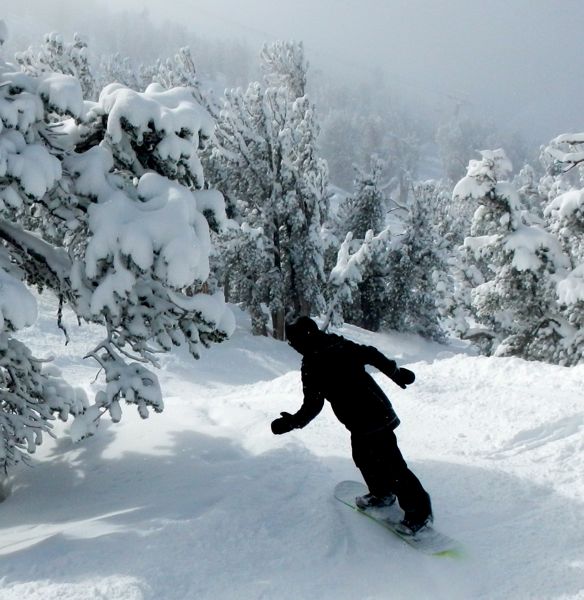
Temps are warming up a bit. Don’t forget to use sunscreen.

Here is the Jan. 3 ski report.

— Curtis Fong


Letter: The disorder of government

To the community,

Another year begins. Issa, the Japanese poet, said, “Old stupidities repeated, new errs invented.” Perhaps. It’s been a rough year for local government. The hit and run artist Tony O’Rourke left the city in a mess. And the mayor, Claire Fortier, made her contribution to political local disorder by waiting until after the City Council election to resign. Ill will to all.

Which brings me to the main point. In the Olmstead case, Justice Brandeis dissenting said, “Our government is the potent, the omnipresent teacher for good or ill, it teaches the whole people by its example.”

Bill Crawford

How true at the federal, state and local levels. By the behavior of government at all levels, we the people are left out of the picture. At all levels faction brawl over the cliff, over the loop road.

And who will be appointed to the vacant seat on the City Council? A new bone to chew on. Thanks Claire, we needed that. Seems like the Ouija board in control.

Bill Crawford, South Lake Tahoe

PS: About three years ago Claire Fortier’s dog bit me. Fair warning, I guess. No, I didn’t sue. Claire and her spouse brought over a good bottle of red wine. All’s well that ends ….


Guided snowshoe trek near Camp Rich

Winter Trails Day on the South Shore will include a guided snowshoe hike featuring wildlife habitat and forest health, the watershed and water quality impacts, and historic aspects of Camp Richardson and the surrounding area.

All snowshoers should meet at Camp Richardson adjacent to the Winter Sports Center located on Highway 89. The trek is easy to moderate and appropriate for adults and children 10 and older.

The event is Jan. 12 at 10am.

For more info, call (530) 542.6056.


CA snowpack water content 33% above average

By Kathryn Reed

PHILLIPS STATION – While the state is faring well when it comes to water content from the snowpack, the measurement closest to South Lake Tahoe is just average this time of year.

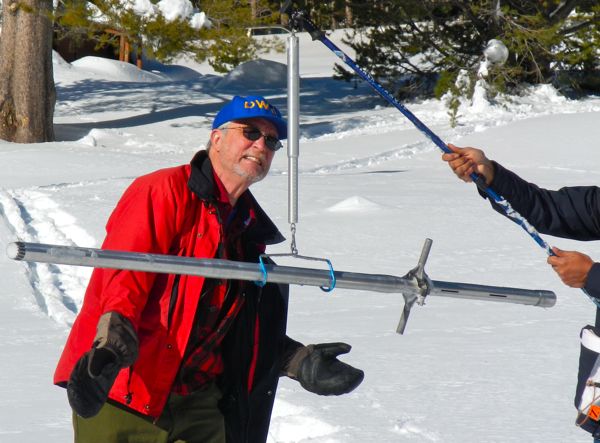
In the field paralleling the road to Sierra-at-Tahoe, Frank Gehrke with the state Department of Water Resources on Jan. 2 took a series of samples to determine there is 12.1 inches of water content in the 48.6 inches of snowpack. This is 101 percent of average.

Statewide, though, the water content is 133 percent of average.

Frank Gehrke on Jan. 2 measures the water content of the snowpack at Phillips Station. Photo/Kathryn Reed

A year ago on the first survey of the season, Gehrke almost didn’t bring his equipment out of the truck. There was one patch of snow to measure. This year snowshoes were required to break trail along the route.

“It’s a good, encouraging start, but it’s just average,” Gehrke said.

While ski resorts rejoice in the immediacy of snowfall and at this point could fare OK if there were an extended break between storms because of what is on the ground, water managers downstream don’t celebrate this time of year. It’s too early.

It’s the April reading that counts most to them because after that the snowfall is negligible. The snowpack fills reservoirs throughout Northern California, which allows water to be sent to points south for drinking and to irrigate farmlands.

According to the Department of Water Resources, the white stuff accounts for about one-third of the water for California households, farms and industry users.

The theory is the snowpack will keep growing between now and the last reading in April. Had this been the April reading, the state average would be at 49 percent.

While the storms in early December brought rain to the Lake Tahoe Basin, they were also filling up reservoirs. This in some ways is a bonus for the water system.

Lake Oroville in Butte County, the State Water Project’s principal reservoir, is at 71percent of capacity, 113 percent of average for the date; while Shasta Lake near Redding, the federal Central Valley Project’s principal storage reservoir, is at 73 percent of capacity, 115 percent of normal for the date.

Right now there is a lull between storms, which isn’t uncommon in January in Tahoe.

Gehrke said it’s hard to find any definitive trends with snowpack and water content totals in this area because there can be dramatic swings from year-to-year. And he wasn’t about to make predictions for what the water content will be like as the winter progresses.


Festival of Trees and Lights’ attendance, revenue spike

The fourth annual Lake Tahoe Festival of Trees and Lights is growing in multiple ways.

During its inaugural year in 2009, the festival saw about 1,800 attendees and raised more than $45,000 for the expansion and renovation of Barton’s Community Clinic. This year, the festival was host to nearly 4,000 attendees, raising more than $55,000 for the future home of Barton Memorial Hospital’s Level III trauma center.

Barton Foundation Executive Director Kindle Craig said in a statement, “Doubling attendance within four years is an amazing feat. It’s becoming a household name and family tradition for many locals and visitors.”


Opinion: Will legislators create a reserve with the surplus?

By Dan Walters, Sacramento Bee

A half-decade ago, as California’s economy was being hammered by a severe recession and the state budget was awash in red ink, then-Gov. Arnold Schwarzenegger and legislators created a blue-ribbon commission to study revenue “volatility” and recommend ways to offset it.

The state had experienced wild swings of revenue for years, and its politicians, including Schwarzenegger, had compounded their effects by overspending periodic windfalls, only to see serious deficits when revenues later declined.

Dan Walters

Dan Walters

Creation of the “Commission on the 21st Century Economy” was an implicit admission that politicians, on their own, were incapable of curbing that irresponsible tendency.

However, the commission, headed by wealthy businessman Gerald Parsky, divided into two camps.

One, headed by Parsky, advocated changes in the tax system to reduce volatility – reducing the very high proportion of taxes paid by a few wealthy Californians whose incomes were especially volatile, and placing more load onto middle-income taxpayers.

The other, more liberal faction said that such tax changes would be unfair to the nonwealthy. It advocated, instead, mitigating the effects of volatility, if not volatility itself, by diverting windfalls into reserves that could then be tapped to avoid deficits when revenues dropped.

Read the whole story