South Lake Tahoe shooting victim identified

The name of the man who killed himself on a South Lake Tahoe street has been released.

South Lake Tahoe resident Perry Russell Coe, 50, died Jan. 5 from a self-inflicted gunshot wound.

No one else was injured that night.

Police have not released any more details.

— Lake Tahoe News staff report


Ski report: White stuff in the forecast

Chance of snow coming through.

Strong gusty winds are expected later today. Sky Express at Heavenly is starting the day on wind hold.

Here is the Jan. 9 ski report.

— Curtis Fong


Squaw giving tour of Olympic sites

Learn about Squaw Valley’s past, including its Olympic history on Jan. 20 at noon.

Local Olympic historian David Antonucci will lead a walking tour of the 1960 Winter Olympics site in Squaw Valley as part of the 2013 North Lake Tahoe Olympic Heritage Celebration.

A few of the sites are the Olympic Village Lodge (athlete’s housing), California and Nevada Welcome Centers, as well as race courses, the site of Blyth Arena, ski jump hill remnants, IBM computer building, media center, and other historic sites.

The event is free. Meet at the information kiosk in front of the tram.


Bear biologist to give talk in South Lake Tahoe

California Department of Fish and Game bear biologist Mario Klip is giving a talk Jan. 12 at 10am in the Aspen Room at Lake Tahoe Community College.

South Lake Tahoe’s American Association of University Women is putting on the free event.

Klip has a background in business and always had a strong affinity for wildlife. After obtaining an MBA and working in high tech for 10 years, he started working with wildlife in 2008.

He has a master’s in biology, is a doctoral student at UC Berkeley and is a Tahoe bear biologist focusing on research, aversive conditioning, outreach and education. His talk will cover bear biology and Tahoe urban-wild black bear research.

Klip will be bringing his trained Karelian bear dogs, Villa and Sasha, who are used to help avert bears from populated areas around Lake Tahoe.


Opinion: Children should have to earn their rewards

By Ruben Navarrette Jr.

I often describe it as my most important job. It’s the one that is the most difficult, and yet the most fulfilling. It consumes the most time, and it’s the one where I most often feel as if I’m in over my head. It’s also the one where the stakes are highest.

The job is being a parent to my three young children – ages 3, 5 and 7. And this New Year’s, my resolution is to do it better.

There are no raises, promotions or awards for good parents. In fact, if you earn the title, most people won’t even notice. The only evaluations that matter will come from your children, and the jury could be out for years.

But if you’re a bad parent, the effects will be obvious and felt long after you’re gone. As your children go through life, they’ll be like a human billboard that announces your parenting “score” to the world.

There are countless ways to be a bad parent. Abandoning or failing to provide for your kids tops my list. Yet you can also get there by abusing, neglecting, smothering, bullying or belittling.

Yet what has me worried lately – both with my own kids, and with the rest of society – is that we’re producing in the next generation a sense of entitlement. We’re teaching kids that desiring something is the same as deserving it.

Along the way, we’re diminishing the importance of what experts call “earned happiness” and replacing it with a system that gives awards and rewards across the board based solely on needs and wants.

These days, it seems as if parents and teachers are more reluctant to reward good behavior in children, let alone punish bad behavior. In fact, in an era where building a child’s self-esteem is the ultimate goal, we’ve become terrified of words like “good” and “bad.”

The problem seems to be that we’re confusing good or bad behavior with being a good or bad person. We must never tell our children that they are bad people – i.e., “You’re a bad boy.” But we can’t be afraid to explain to our kids what it means to engage in bad behavior and make clear that we expect them to refrain from it. In trying to not be too hard on our kids, I fear we’ve gone too far in the opposite direction.

I knew this was happening in our society – that too many parents were surrendering their expectations, throwing in the towel and forgetting how to be parents. I recognized that the word “bad” had been shelved along with a host of other negative words that many parents today are reluctant to use – “no,” “don’t,” “stop.”

But I needed to hear it from a third party. When listening to a radio show, I recently heard a professor of psychiatry insist that even Santa Claus has been co-opted. He noted that it used to be natural for Santa to sit a child on his lap and ask: “Have you been a good girl?” This doesn’t seem to happen much anymore, he said.

He’s right. I crossed paths with several Santas during this holiday season, and I don’t remember a single one making that inquiry. Instead, children – mine included – would walk up and Santa would ask only one question: “What do you want for Christmas?” What happened to the idea of a child earning his or her present through good behavior? You know, the difference between being naughty and nice.

That idea is gone. In our shopping-mall culture of materialism and consumerism, every child gets a present. Just like, in sports, everyone gets a ribbon. We can’t leave anyone out, so we no longer expect anything from anyone. In fact, now the tables have turned, and it is the recipient who expects something for nothing.

This parenting business is tricky. You want to give your kids nice things, but you have to be careful not to give them too much. You don’t want to tear them down, but you can’t demand too little. Being a good parent is a balancing act. It’s more art than science. A pinch of this, a dash of that. Most of us will never get it exactly right. Mistakes come with the territory.

Even so, this year, I’ve got to do a better job of it. And it starts not with settling for less but with expecting more – from my kids, and from myself.

Ruben Navarrette Jr. writes for the Washington Post Writers Group.


Where is the best place to hang out after of day of skiing at Lake Tahoe?


LTCC, LTUSD boards close to deciding on future of elections

By Kathryn Reed

Big changes are in the works for how members are elected to the Lake Tahoe Community College and Lake Tahoe Unified School District boards.

To meet the 2002 California Voting Rights Act regulations, the two South Lake Tahoe districts may stop having at-large elections and instead have trustee elections. This means the five from each board would represent specific geographical areas.

The purpose of the state mandate is to ensure all ethnicities are represented and that minority groups have a realistic opportunity to be elected. Both education institutions did an analysis that determined at-large elections could open them up to a lawsuit.

What isn’t known is what happens if no candidate comes forward for a specific trustee area.

On Jan. 8 the college board went over maps that had been created for LTUSD. While the two boards don’t have to have the same trustee areas, officials believe it would be less confusing if they do. The college board picked alternative 3 as well as expressed a desire to look at a map that would not have one of the districts go from the state line to the western edge of the district’s boundary.

To ensure consistency, lines are drawn with an eye toward where current board members live.

If alternative 3 were chosen for the college district, it would mean Karen Borges and Fritz Wenck would be in the same area.

“I don’t have a problem being in the same district as Karen because I may be coming to an end of my term,” Wenck said. Wenck, with Roberta Mason, was elected in 1974 to the first college board.

Committees from both education systems have been meeting to figure out how best to move forward. On Wednesday they will meet to discuss going forward with even-year elections.

The LTUSD board is expected to vote on moving elections to even years on Jan. 22, and the LTCC board on Feb. 12. Some board terms would be extended by a year. This would mean instead of an election this year, the next one would be in 2014.

The change to even-year elections would give districts time to inform the public about the changes, save money by having sharing costs with more entities, and would likely draw more voters.

LTUSD board members in December agreed to go forward with trustee elections. The college board is expected to take action Jan. 22.


Study: Business travel spending should increase in 2013

By Charisse Jones, USA Today

U.S. companies are expected to spend more on business trips this year, a sign that they may be feeling more optimistic about the economy, a new business travel forecast being released today finds.

A pent-up need to sit face to face with clients, coupled with increased spending on international trips and off-site meetings, is projected to boost overall business travel spending in the U.S. by 4.6 percent this year, to $266.7 billion, according to a report from the Global Business Travel Association, a group of business-travel and meetings managers.

“At the end of the day, companies need to find ways to grow … revenues and see their performance increase year over year, and quarter over quarter, ” says Mike McCormick, executive director of the GBTA. “So there’ll be this pressure to make investments and spend on business travel.”

The GBTA estimates that for every $1 spent on corporate travel, companies on average have seen $20 in additional profits.

But he says the growth, expected to make its greatest surge in the last half of the year, largely hinges on the outcome of ongoing debates about the federal deficit, corporate tax rates and other economic issues.

“If we don’t see those resolutions happen, we don’t continue to build corporate confidence,” McCormick says, and “we may revert back to the … anemic growth rate.”

While spending is predicted to be up, the number of business trips is projected to be down 1.1 percent from last year, reflecting the desire by many companies to make the most of their staffers’ time on the road.

“Companies, and generally the travelers themselves, are trying to find ways to be more efficient about use of time so that means adding more into a trip,” he says. It’s “maybe doing multiple stops, to multiple cities in the same itinerary.”

GBTA’s forecast dovetails with the latest findings of a new survey by the Travel Leaders Group, a corporate travel management company.

Its survey finds that almost 80 percent of the groups’ agents who deal primarily with business trips predicted their clients will be on the road as much or more than they were in 2012.

Being economical while on a corporate trip was also the No. 1 priority, according to the survey. In it, 42.1 percent of agents say cost savings was most important to their business travel customers, and 33.7 percent say the most critical issue was cost control.

The survey, taken between Nov. 19 and Dec. 16, polled 335 U.S. agency owners, managers and industry experts who handle a significant amount of business travel.


NRA not joking about schools with armed guards

By Dan Freedman, Hearst Newspapers

WASHINGTON — The head of the NRA’s controversial bid to place armed guards in schools nationwide said the effort is serious and not simply window dressing in the wake of the Newtown school shootings.

Responding to criticism that the National Rifle Association was “tone deaf” in proposing deployment of qualified volunteers in schools, former Rep. Asa Hutchinson, R-Ark., said he is solely interested in preventing repetitions of Newtown, in which a rifle-wielding gunman killed 20 children and six adults at Sandy Hook Elementary School.

“I don’t have to participate in the political debate,” said Hutchinson, a former administrator of the Drug Enforcement Administration and high-ranking Department of Homeland Security official, in an interview Friday. “My focus is on the safety side of the issue. The political discussion can happen at a different level.”

Asked why even modest gun-control proposals were not part of the NRA’s proposal, Hutchinson said: “You can pass all the laws you want, but you won’t make schools safer. What will make a difference is better security and people there to protect children.”

After the Newtown shootings Dec. 14, the 4-million-member NRA went dark for a week, declining to comment while rage over weakened firearms laws and outcries for greater gun control were cresting. When the NRA finally convened a news conference Dec. 21, it was to announce that Hutchinson would head the organization’s new National School Shield Program, the centerpiece of which was recruitment of a corps of trained former police officers and military personnel to serve as an armed presence in schools.

The announcement drew wide ridicule from the White House and Democrats on Capitol Hill, with President  Obama telling NBC, “I am skeptical that the only answer is putting more guns in schools.”

In the interview, Hutchinson insisted armed volunteers in schools is one of a laundry list of ideas that he and his team will consider as it prepares a set of recommendations on best security practices for schools to consider.

“What’s important to me is that we don’t start into this study with a closed mind,” Hutchinson said.

Another option, Hutchinson said, is arming school personnel — teachers and administrators — who are interested in firearms training.

The idea of armed volunteers and teachers has evoked much caustic criticism from gun control proponents.

“Given the number of times the most highly trained law enforcement officers hit the wrong target, it’s scary to think of what a volunteer or teacher might do in a situation they’ve never experienced before,” said Jonathan Lowy, director of the legal action project at the Brady Center to Prevent Gun Violence.

Yet another option, Hutchinson said, is the expansion of school resource officers, on-duty armed police who perform a wide range of tasks in schools that include interacting with students, teachers and administrators and helping implement security measures.

Hutchinson estimated the cost of putting a resource officer in every school at $2 billion to $3 billion a year, which he acknowledged would be hard to fund in lean budgetary times.

In the 2009-10 school year, 23,200 armed security personnel were in schools nationwide, 28 percent of all schools, according to the National Center for Education Statistics.

Mo Canady, executive director of the National Association of School Resource Officers, based in Hoover, Ala., estimated there were about 10,000 resource officers working in schools.

Interviewed on Thursday, Canady said he had not received a call from the NRA about his organization’s 23 years of experience in helping train police officers to work in schools.

“We’d feel more comfortable if we had a clearer picture of (the NRA’s) intentions,” said Canady, himself a retired police officer. “Working in school is a unique assignment for police officers. You have to have the proper temperament and you have to be properly trained. It’s not the right job for every police officer.”

After an inquiry to the NRA by Hearst Newspapers, Hutchinson called Canady on Friday.

“I look forward to sharing with anyone — not just the NRA — who wants to know what we’ve done the last 23 years,” Canady said after the call. “We’re not perfect, but I feel like we’ve done things that were very successful.” Legal experts say there’s a wide gap between having on-duty police officers at schools and recruiting a corps of volunteers whose training and ability levels might vary.

“A lot of good comes of having school resource officers in schools,” said Francisco Negron, general counsel for the National School Boards Association. “Our comfort decreases as training for individuals with weapons decreases.”

With school districts facing increased liability exposure, the NRA should consult “local school districts, school board members, PTAs and superintendents,” Negron said. “One size fits all rarely is a good idea.” An officer or volunteer who fired a weapon in school might prompt a lawsuit, for instance, if they accidentally hit an innocent person.

“The police officer would be able to assert entitlement to qualified immunity from civil rights claims,” said Thomas Brandt, a Dallas lawyer who represents local governments and school boards in Texas.

But a volunteer, much like a “bouncer in a bar,” might not have that protection in the eyes of the law, he said. The NRA’s proposal “may work itself out to be a good idea ultimately, but there’s a lot of distance between here and there.”

Hutchinson said liability would be part of his team’s research. “The liability concern is always there,” he said. “The key is you have to make available to school districts the best national strategies for safety and training.”

Hutchinson declined to attach a pricetag to the NRA effort. “I’ve been told by the NRA, ‘you give us a budget and we’ll back you up.’ “


2012 — hottest year on record

By Juliet Eilperin, Washington Post

Last year was the hottest on record for the contiguous United States, shattering the previous mark set in 1998 by a wide margin, the National Oceanic and Atmospheric Administration announced Tuesday.

The average temperature was 55.3 degrees, 1 degree above the previous record and 3.2 degrees more than the 20th-century average. Temperatures were above normal in every month between June 2011 and September 2012, a 16-month stretch that hasn’t occurred since the government began keeping such records in 1895.
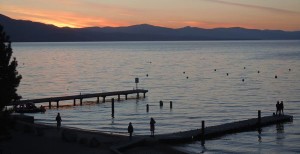
Sunset on Tahoe’s South Shore in 2012. Photo/LTN file

Federal scientists said that the data are compelling evidence that climate change is affecting weather in the United States and suggest that the nation’s weather is likely to be hotter, drier and potentially more extreme than it would have been without the warmer temperatures.

Last year’s record temperature is “clearly symptomatic of a changing climate,” said Thomas R. Karl, who directs NOAA’s National Climatic Data Center. Americans can now see the sustained warmth over the course of their own lifetimes — “something we haven’t seen before.” He added, “That doesn’t mean every season and every year is going to be breaking all-time records, but you’re going to see this with increasing frequency.”

Alaska and the Pacific Northwest didn’t experience record-setting heat last year; a cool-weather pattern over the Pacific Ocean kept temperatures lower.

Although the new analysis focuses on the United States, it has triggered an intense debate over whether global temperatures will reach dangerous levels by the century’s end. In 2009, the world’s leaders pledged to keep global temperatures from rising above pre-industrial levels by 2 degrees Celsius, or 3.6 degrees Fahrenheit. Now many academics and policymakers say that goal may be out of reach.

“We have to begin the conversation about cruising past 2 degrees, because we’re on course for that,” said John Podesta, who chairs the liberal think tank Center for American Progress. “It’s hard to contemplate and scary to contemplate, but it has to be addressed at this point.”

Vanderbilt Law School professor Michael Vandenbergh said today’s leaders will be judged harshly by future generations for not focusing on climate change.

“A hundred years from now, they’re not going to be talking about health care or the fiscal cliff,” he said. “But they will ask, ‘What did you do when we knew we were going to have serious climate change?’ ”

John R. Christy, who directs the Earth System Science Center at the University of Alabama in Huntsville, said some researchers are exaggerating the severity of the threat. He said that the right climate target is “in the mind of the beholder,” given that rising energy demand is a sign that many poor people are struggling “to be lifted out of their current condition.”

“No one in Washington can stop that,” he said. “And, right now, carbon is the most accessible and affordable way to supply that energy — so CO2 emissions will continue to rise because of the undeniable benefit carbon energy brings to human life.”

Last year, the United States experienced several weather events — including extreme storms, a historic drought and wildfires — that many scientists say can be exacerbated by climate change.

Some scientists, however, think it is premature to blame droughts or hurricanes on human-caused warming. Georgia Institute of Technology atmospheric scientist Judith A. Curry said in an e-mail that the global average temperature for 2012 will not set a record — last year will probably be the eighth warmest. “Natural variability continues to dominate the occurrence of extreme weather events,” she said.

Nonetheless, many scientists are worried about rising emissions. The International Energy Agency estimated last month that coal will come close to surpassing oil as the world’s top energy source in 2017 , when an additional 1.2 billion metric tons will be burned annually. In late November, the World Resources Institute reported there are nearly 1,200 proposed coal plants around the globe, three-quarters of which are planned for China and India.

By Jan. 1 of this year, the Kyoto Protocol was supposed to have cut the world’s greenhouse gas output by 5 percent compared with 1990 levels. While the signatories as a whole are likely to meet that target, in part because of the shutdown of Eastern European factories during the 1990s, global carbon emissions overall rose 54 percent during that same period, according to the Global Carbon Project.

As a result, many experts are engaged in a discussion over whether they should continue pressing for ambitious carbon cuts in the near term or adjust their goals in the face of the prospect of a much warmer world.

In 2004, Princeton University professors Robert Socolow and Stephen Pacala wrote an influential paper outlining how the world could stabilize its greenhouse emissions by mid-century through a series of “wedges,” using current technology, such as sharply increasing nuclear power worldwide, eliminating deforestation and converting conventional plowing to no-tillage farming.

Now, Socolow has published an article in the Vanderbilt Law Review that he describes as his “let’s get real here” lecture, in which he outlines what the world can realistically achieve over the next four decades. Environmentalists “don’t think it’s time to start the bargaining” on what’s an appropriate climate target, Socolow said, but they need to adjust some of their goals in light of the projected temperature rise.

Compromises include capturing and storing carbon from power plants, he added, “since I don’t think we can put the fossil fuel industry out of business.”

At the same time, some researchers are pushing for much steeper emissions cuts. On Wednesday, the journal Environmental Research Letters will publish a paper showing that although Socolow and Pacala projected emissions could be stabilized by cutting 175 billion tons of carbon emissions over 50 years, accelerating emissions over the past decade mean that it could require more than 500 billion tons of avoided emissions to achieve the same goal.

Steven Davis, a UC Irvine earth system science professor and the study’s lead author, said he and his colleagues were seeking a “way to describe the magnitude of the challenge” in tackling climate change.

Chris Field, who directs the Carnegie Institution for Science’s global ecology department at Stanford University, noted that although it is impossible to say whether the world will be “safe” if it limits the temperature rise to 2 degrees Celsius, he compared it to “the number of flat tires I can tolerate on a road trip in my car.”

“With even one flat, there is a risk of a serious accident. But because I am a careful driver, and I have a spare, one is probably ok,” he wrote in an e-mail. “With two flats on the trip, I know I don’t have a spare for the second one, and I understand that the risk of a serious accident is increased. . . . For more than two flats, things get really messy.”

Several activists who track international climate talks identified the next three years as critical, saying negotiators need to forge a new pact by 2015 in order to lock in needed carbon cuts. Alden Meyer, who directs strategy and policy for the Union of Concerned Scientists, said major emitters will not agree to meaningful cuts until they view it as in “their national self-interest.”

In the United States, a combination of high temperatures and dry conditions last year took a serious toll on the nation’s agricultural sector. NOAA’s Karl noted that the Midwest had been relatively wet for several years, which had curbed the impact of warmer temperatures.

In 2012, he said, “both the day and the nighttime temperatures were breaking their all-time records,” and that combined with drier conditions amounted to “a double whammy.”

The warmest March on record meant vegetation levels were 25 percent higher than normal that month, but many of those crops dried up because 39 percent of the United States experienced severe or extreme drought in 2012.