Opinion: Demography underlies big issues in California

By Dan Walters, Sacramento Bee

The legislative session that reconvened this month faces no shortage of big issues, but underlying all of them is demographic change that is dramatically altering the face of California.

New data frame the change:

• Recent reports from the U.S. Census Bureau and the state Department of Finance agree that our historically high population growth has dropped to under 1 percent a year, a third of what it was in the 1980s.

• The slowdown stems from a virtual halt to foreign migration, a net outflow to other states and a rapidly decreasing birthrate – factors which, if continued, could see California’s population start to decline in a few years.

• A new study by the Lucile Packard Foundation for Children’s Health says that due to the declining migration and birthrates, the number of California children under 10 years old dropped by nearly 200,000 between 2000 and 2010 and is expected to decline by another 100,000 during the current decade.

“These trends are not yet widely recognized, but they should be a wake-up call for policymakers,” said report author Dowell Myers, a USC demographer.

“We will be increasingly dependent economically and socially on a smaller number of children. They are more important to the state’s future success than ever before.”

• Latinos now constitute more than half of the state’s children, and both the Packard Foundation and the Center for the Next Generation, in another new report, raise the specter of increasing child poverty. In fact, a recent Census Bureau study, measuring poverty by a new method, says California has the nation’s highest rate.

“We can’t honestly separate our state’s economic future from current poverty rates among our kids,” Ann O’Leary, co-author of the latter report, said. “Our ability to thrive as the world’s ninth-largest economy depends on having an educated, healthy and stable next generation of workers. We’re headed in the opposite direction.”

• Meanwhile, the state’s white population is declining (it will drop below 40 percent this year) and aging rapidly as the baby-boom generation moves from middle age (the youngest boomers are nearly 50) into retirement (the oldest will turn 67 this year).

• These California trends emulate states in the Northeast and upper Midwest, such as New York and Michigan, more than they do those in the South and Southwest. While California’s under-10 population was declining by nearly 200,000 between 2000 and 2010, for instance, Texas was adding nearly 600,000.

Gov. Jerry Brown understands that California is being buffeted by a demographic storm and reflects that knowledge in his new budget. “This is an aging society, and inequality is growing,” he said.

But do others in the Capitol grasp the stark challenge it presents?


In California, it’s U.S. vs. state over marijuana

By Adam Nagourney, New York Times

STOCKTON — Matthew R. Davies graduated from college with a master’s degree in business and a taste for enterprise, working in real estate, restaurants and mobile home parks before seizing on what he saw as uncharted territory with a vast potential for profits — medical marijuana.

Federal agents raided two of Davies’s dispensaries and this warehouse, where 2,000 marijuana plants were grown, in 2011.

He brought graduate-level business skills to a world decidedly operating in the shadows. He hired accountants, compliance lawyers, managers, a staff of 75 and a payroll firm. He paid California sales tax and filed for state and local business permits.

But in a case that highlights the growing clash between the federal government and those states that have legalized marijuana for medical or recreational use, the United States Justice Department indicted Davies six months ago on charges of cultivating marijuana, after raiding two dispensaries and a warehouse filled with nearly 2,000 marijuana plants.

The United States attorney for the Eastern District of California, Benjamin B. Wagner, a 2009 Obama appointee, wants Davies to agree to a plea that includes a mandatory minimum of five years in prison, calling the case a straightforward prosecution of “one of the most significant commercial marijuana traffickers to be prosecuted in this district.”

At the center of this federal-state collision is a round-faced 34-year-old father of two young girls. Displaying a sheaf of legal documents, Davies, who has no criminal record, insisted in an interview that he had meticulously followed California law in setting up a business in 2009 that generated $8 million in annual revenues. By all appearances, Davies’ dispensaries operated as openly as the local Krispy Kreme, albeit on decidedly more tremulous legal ground.

“To be looking at 15 years of our life, you couldn’t pay me enough to give that up,” Davies said at the dining room table in his two-story home along the San Joaquin River Delta, referring to the amount of time he could potentially serve in prison. “If I had believed for a minute this would happen, I would never have gotten into this.

“We thought, this is an industry in its infancy, it’s a heavy cash business, it’s basically being used by people who use it to cloak illegal activity. Nobody was doing it the right way. We thought we could make a model of how this should be done.”

His lawyers appealed this month to Attorney General Eric H. Holder Jr. to halt what they suggested was a prosecution at odds with Justice Department policies to avoid prosecutions of medical marijuana users and with President Obama’s statement that the government has “bigger fish to fry” than recreational marijuana users.

“Does this mean that the federal government will be prosecuting individuals throughout California, Washington, Colorado and elsewhere who comply with state law permitting marijuana use, or is the Davies case merely a rogue prosecutor out of step with administration and department policy?” asked Elliot R. Peters, one of his lawyers.

“This is not a case of an illicit drug ring under the guise of medical marijuana,” Peters wrote. “Here, marijuana was provided to qualified adult patients with a medical recommendation from a licensed physician. Records were kept, proceeds were tracked, payroll and sales taxes were duly paid.”

Holder’s aides declined to comment, referring a reporter to a letter from Wagner to Davies’s lawyers in which he disputed the depiction of the defendant as anything other than a major-league drug trafficker.

“Mr. Davies was not a seriously ill user of marijuana nor was he a medical caregiver — he was the major player in a very significant commercial operation that sought to make large profits from the cultivation and sale of marijuana,” the letter said. Wagner said that prosecuting such people “remains a core priority of the department.”

The case illustrates the struggle states and the federal government are now facing as they seek to deal with the changing contours of marijuana laws and public attitudes toward the drug. Colorado and Washington legalized marijuana for recreational use last year, and are among the 18 states, and the District of Columbia, that currently allow its medical use.

Two of Davies’s co-defendants are pleading guilty, agreeing to five-year minimum terms, to avoid stiffer sentences. Davies, while saying he did not “want to be a martyr,” decided to challenge the indictment with a combination of legal and public-relations measures, setting up a Web site devoted to his case and hiring Chris Lehane, a hard-hitting political consultant and former senior aide in Bill Clinton’s White House.

Among Davies’s advocates here in California are Paul I. Bonell, who was the president of the Premier Credit Union for 21 years before Davies hired him in early 2011 to oversee his businesses’ fiscal controls. After the businesses were raided in October that year, Bonell took a position as the head of the Lodi Boys and Girls Club.

“I had some reservations going in,” he said of Davies’s enterprise. “But the industry was exploding. Matt wanted to have internal controls in place. And we thought: This was a legitimate business. If the State of California deems it legitimate, we want to be the best at it.”

Davies’s accountant, David M. Silva, said he set up spreadsheets to keep track of inventories, revenues and expenses. “I’ve been a C.P.A. for 30 years,” Silva said. “What I saw was a guy who was trying to run an operation in an up-and-up way.”

The federal authorities said they stumbled across the operation after two men were spotted apparently breaking into Davies’s 30,000-square-foot Stockton warehouse. The police said they smelled marijuana plants. Federal agents conducted a raid and confiscated 1,962 plants and 200 pounds of marijuana.

Davies, who is free on $100,000 bail, greeted visitors to his gated home by asking them to speak softly while walking through the entryway so as not to awaken his sleeping infant. He called out to his wife when asked when he was indicted: “Hey, Molly — we were indicted on your birthday, right? July 18.”

Davies referred to marijuana as “medicine,” and himself as a turnaround expert.

“We were basically pharmacists for medical marijuana — everything was in full compliance with state law,” he said. “We paid our employees. We paid overtime. We had people going for unemployment if we fired them.”

“Why are they coming after me?” he asked. “If they have such a problem with California, why can’t they sue California?”

Stephanie Horton, 25, who went to work for Davies after going to one of his dispensaries to obtain medical marijuana to help her deal with ovarian and cervical cancer, said she was devastated by the arrest of employers she described as among the best she had ever had — not to mention the loss of her job.

“I’d go back and work there in a heartbeat,” Horton said. “I totally trusted them. We’re not criminals. I’ve never been arrested my whole life. I need that medication, and so do a whole lot of people.”

But federal prosecutors offered a much less sympathetic view of Davies. The authorities shut down the warehouse and two dispensaries but said that Davies had ties to a total of seven dispensaries in the region, which they said yielded $500,000 in annual profits. Davies’s lawyers disputed those assertions.

“Mr. Davies is being prosecuted for serious felony offenses,” Wagner wrote to Davies’s lawyers. “I understand he is facing unpleasant alternatives. Neither a meeting with me nor seeking a review in Washington will change that reality.”

This is as much a legal clash as a cultural clash. Recreational marijuana use is common across this state, and without the legal stigma attached to it in much of the country. The federal government is viewed as a distant force.

“It’s mind-boggling that there were hundreds of attorneys advising their clients that it was O.K. to do this, only to be bushwhacked by a federal system that most people in California are not even paying attention to,” said William J. Portanova, a former federal drug prosecutor and a lawyer for one of Davies’s co-defendants. “It’s tragic.”



Skyland fire contained to chimney

Tahoe Douglas firefighters were able to keep a chimney fire from spreading to the rest of the house Monday night.

The call came in about 6pm Jan. 14 that a house in the Skyland area was on fire.

“This was extinguished without damage to the structure,” Fire Marshal Eric Guevin told Lake Tahoe News.

He said green, uncured wood is the worst because it excretes the most amount of creosote. It’s creosote build up that leads to chimney fires. He added that burning paper is frowned upon because it burns fast and can ignite the creosote.

Guevin recommends people sweep their chimneys annually to help prevent chimney fires.

— Lake Tahoe News staff report


Frozen pipes cause damage at 4 Stateline casinos

By Kathryn Reed

After three days of record-breaking low temperatures, many pipes in the Lake Tahoe Basin had enough and started doing some breaking of their own.

The four major casinos in the Stateline casino corridor have all had burst pipes. The damage started Jan. 13 at Horizon when a pipe near the loading dock froze and broke.

Harrah’s, Harveys and MontBleu each had frozen pipe issues Monday. This has kept maintenance departments as well as Tahoe Douglas firefighters busy.

At Harrah’s Lake Tahoe at about 8am Jan. 14 a stand pipe that is a fire department connection broke on the 18th floor and flooded the tower with several thousands of gallons of water.

“It incapacitated the elevators for some time,” Tahoe Douglas Fire Marshal Eric Guevin told Lake Tahoe News.

Stateline casinos are mopping up after pipes burst from extreme cold. Photo/LTN file

Water went into the restaurants on the upper floors and down the elevator shafts. Most people chose to stay in their rooms.

Three hours later a sprinkler head froze and discharged in the high limit gaming area. Some of the high rollers had to be evacuated.

“The engineering department was quick to respond in all the issues and make it safe for everyone and minimize the water damage and get the fire system back online for the safety of patrons,” Guevin said.

The role of the fire department is to make sure the fire lines are working as soon as possible, help maintain the safety of everyone during the crisis, assist with evacuations and set up contingency plans in case there is a fire when the sprinkler system is inoperable.

The next pipe to go was at 11:30am at Harveys. A fire head discharged over an employee at a jewelry store. The gaming floor then began to flood.

At 3pm another head froze at Harveys; this time near the elevator lobby of the casino floor.

Harrah’s-Harveys spokesman John Packer was unavailable for comment.

“The cold definitely got inside the building and affected those pipes. Those systems have held up well over years, but this definitely challenged them,” Guevin said.

The record cold in South Lake Tahoe on Jan. 14 was minus 11 degrees. The previous record of minus 7 was set in 1997. (The National Weather Service in Reno predicts a warming trend – with the low on Jan. 15 forecast to be 5 degrees above zero, which would be 12 degrees off the record.)

At MontBleu on Monday afternoon a zone near the casino area by the front doors had frozen pipes.

“They were designed not to freeze,” Guevin said.

He expects crews will be working into Tuesday morning to get those systems working. In the meantime, a “fire watch is in place,” Guevin said.

Edgewood Tahoe Golf Course had issues on Monday, too. At 8am a frozen sprinkler head broke in the maintenance shop.

“The main significance of all of this is that it’s very cold and it affects the fire lines that are designed to save lives and property. This time they did discharge, but they are still important systems to have to save lives. That is undisputed,” Guevin said.


Truckee man arrested on domestic violence charge

A 52-year-old Truckee man was arrested Saturday on domestic violence charges.

Truckee officers responded to a 911 call for assistance from a female on Beacon Way on Jan. 11. She had been involved in a physical struggle with the suspect.

Police were called back to the residence the next day.

Officers contacted the original victim who reported she had been locked in a room all night by the suspect and was denied access to a phone to call for assistance.

Officers located the suspect, Douglas Fleming, hiding with their 3-year-old child in a closet. Fleming was arrested. The child was unharmed.

— Lake Tahoe News staff report


Free pancakes at IHOP

IHOP is celebrating National Pancake Day on Feb. 5 by giving out free pancakes.

It’s also a day to raise money for Children’s Miracle Network Hospitals. The goal is to raise $3 million.

During National Pancake Day more than 1,500 IHOP restaurants — including South Lake Tahoe — invite guests to enjoy a complimentary stack of IHOP’s signature delicious buttermilk pancakes from 7am-10pm. Guests will be encouraged to make a voluntary contribution to the local Children’s Miracle Network Hospital or other local charities. One hundred percent of the donations will help local charities provide vital equipment, life-saving procedures and critical care for sick and injured children.

For more information on National Pancake Day, or to learn about Children’s Miracle Network Hospitals and make an online donation, go online.


Full moon ski, dinner benefits Winter Discovery Center

A full moon yurt dinner on Jan. 25 and Jan. 26 is a fundraiser for the Winter Discovery Center at Tahoe Cross Country.

Douglas Dale of Wolfdale’s will be the chef both nights.

The evening adventure starts with a moonlit ski or snowshoe from the Tahoe Cross Country Ski Area to the trailside warming hut on Yellow trail where skiers will enjoy fireside hot mulled wine and hot chocolate. Dinner will be in the yurt. When the meal is complete you are within walking distance from your car.

Limited tickets are available at $65 per person. This includes the three-course meal, tax, a beverage, ski or snowshoe equipment and trail pass. This is an evening out for adults only.

Reservations can be made at Tahoe Cross Country Ski Area or can be purchased over the phone by calling (530) 583.5475. This event is a snow or no snow event. The event is from 6-9pm.


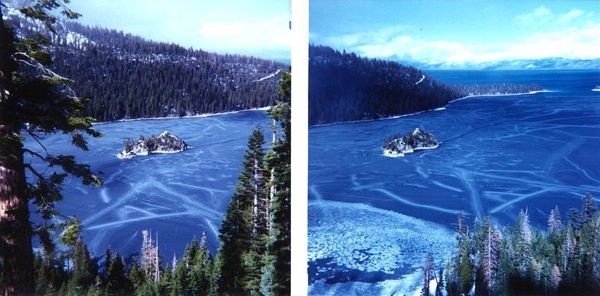
Icy temps have caused Emerald Bay to freeze

South Tahoe has had overnight lows of below zero for several days.

Twenty years ago, in January 1993, we hit minus 28 degrees in South Tahoe. Emerald Bay froze over. That occurred also in February 1989 at minus 29.

At such temperatures, many frozen pipes and subsequent water damage wouldn’t be realized until those cracked pipes thawed, sometimes many days later and then flooding homes.

The least cold January since 1969 was last year’s January at 9 degrees.

Emerald Bay becomes a block of ice in 1993 and 1989. Photos/Bill Kingman

— Bill Kingman


Praise for TRPA plan rolls in as others contemplate lawsuit

By Malia Wollan, New York Times

Deep in the Sierra Nevada, 39 trillion gallons of crystalline water straddles the border between California and Nevada.

That water, Lake Tahoe, can be as smooth as glass, but the politics of land-use planning along the lake’s 72-mile shoreline are some of the most contentious and muddled in the country.

Lawmakers from the two states tend to have very different ideas about how to manage development around the lake, to say nothing of the more than 50 federal, state and local agencies with jurisdiction in the basin.

But last month, after nearly a decade of wrangling, the Tahoe Regional Planning Agency, the bistate agency that regulates development, approved a new plan that will guide building there.

“The infrastructure around the lake was built in the 1950s and ’60s, and it’s failing the communities and it’s failing the lake,” said Todd Ferrara, deputy secretary of the California Natural Resources Agency. “California and Nevada have this shared treasure, and the stakes are too high not to work together to protect it.”

The new regional plan encourages ripping down and rebuilding the area’s aging infrastructure, removing buildings from environmentally delicate areas near marshes, streams and rivers, and constructing denser urban centers. It also streamlines the permit process for construction projects in the basin, which gets three million visitors a year.

For many of basin’s 55,000 full-time residents, the fact that the agency’s governing board — made up of seven Nevadans and seven Californians — reached consensus came as a great relief.

“We’re very happy that a plan has finally been passed, because without concrete regulations, nobody wins and the lake suffers,” said Darcie Goodman Collins, executive director of the League to Save Lake Tahoe, an environmental advocacy group.

While the plan has broad support on both sides of the state line, some environmental groups say it will result in taller buildings and denser development, which could ultimately harm the ecosystem of the lake.

“This new plan is a plan for improving the tourist economy, not a plan for improving the environment,” said Laurel Ames, conservation co-chairwoman for the Tahoe Area Sierra Club, which is considering a lawsuit to halt it before it is carried out on Feb. 11.

But policymakers counter that replacing aging infrastructure would be a major step toward restoring the lake’s ecosystem and quintessential clarity.

“The idea is to get rid of this strip development that causes sediment to run off into the lake and rebuild,” said Lew Feldman, a lawyer who represents developers in the area.

Beginning in the 1950s, developers hurriedly built in preparation for the 1960 Winter Olympics in Squaw Valley and to support the burgeoning gambling industry on the Nevada side.

In just a few decades, whole sections of shoreline were rapidly transformed from stands of Ponderosa pine trees and willow-filled marshes into a kind of continuous strip of low-slung motels, casinos and budget restaurants.

By the late 1960s, sewage was leaking into the lake, resulting in the growth of microscopic algae that clouded the lucent waters.

“Every little pebble was distinct, every speckled trout, every hand’s-breadth of sand,” Mark Twain wrote of his unimpeded glimpse into Lake Tahoe’s depths in “Roughing It.”

When scientists first began testing the lake’s clarity, in 1968, they could see down more than 102 feet into the water. By 2011, the most recent year with complete data, visibility was 69 feet and the summer clarity was the second worst on record.

To control the runaway development in the Lake Tahoe basin, Congress approved a bistate compact between Nevada and California in 1969, creating the Tahoe Regional Planning Agency.

“The focus is on water quality restoration,” said Joanne Marchetta, the agency’s executive director. “The lake is the canary in the coal mine: if the lake is healthy, the surrounding environment and economies can be healthy.”

The agency’s last regional plan, carried out in 1987, capped development and established standards for environmental quality in the basin.

“The bistate compact was created in an effort to strangle the uncontrolled growth that was undeniably polluting the lake, and it succeeded,” said Ross Miller, Nevada’s secretary of state.

In fact, the compact restricted growth so rapidly it had the effect of freezing the lakeside communities in time. Much of the infrastructure still looks like it did when Elvis Presley spent summers there playing at the Nevada casinos in the early 1970s.

Other economic forces also hampered development. Beginning in the 1990s, the growth of Native American gambling in California sent Nevada’s casinos into a tailspin of lost revenue and empty hotel rooms.

By 2011, Nevada lawmakers became so frustrated with the agency’s strict development regulations that they passed legislation to withdraw from the compact in 2015 if a new regional plan was not approved.

“It is time for Nevada to stand alone in serving Nevadans and the valuable natural resource Lake Tahoe,” state Sen. John Jay Lee, who sponsored the bill, said at the time.

Since the agency approved the new plan on Dec. 12, some Nevada lawmakers, including Miller, say that as long as the plan does not stall in the courts, they will rescind the bill and recommit to bistate management.

“The different states and stakeholders all come with different perspectives,” Marchetta said. “But they share a passion for the lake and a desire to preserve it.”


Ski report: Excellent conditions

Cold temps keep the snow in good condition. And it’s still really cold in Lake Tahoe.

Here is the Jan. 14 ski report.

— Curtis Fong