Teller nails ski cross win in France

By USSA

MEGEVE, France – After battling weather delays and multiple schedule changes John Teller (Mammoth Lakes) took the top spot Jan. 16 at the Audi FIS Freestyle Ski Cross World Cup in Megeve, France.

Teller, an X Games champion, won his first World Cup nearly two years ago to the day in St. Johann, Austria. Teammate Joe Swensson (Niantic, Conn.) finished in seventh for the team USA Ski Cross.


4 file for S. Tahoe council seat; 5th application on its way

Two former councilmembers who left on their own accord, a planning commissioner who has twice run for the council unsuccessfully, and a political newbie/college instructor are vying to be the fifth member of the South Lake Tahoe City Council.

The four are — Kathay Lovell, Bill Crawford, Austin Sass and Scott Valentine.

A fifth candidate has told Lake Tahoe News he is definitely going to submit an application — that would be another former councilman, Bruce Grego.

“I assure you I will be filing. There is no question in my mind,” Grego said Jan.16.

Anyone else wanting to be a candidate has seven working days to file for the vacancy created by Claire Fortier’s early departure. Jan. 25 at 5pm is the deadline to apply.

Interviews will be at the Jan. 29 9am council meeting, with swearing in likely that day. If the four electeds can’t decide on a person, there will be an election in June.

— Lake Tahoe News staff report


Climate assessment delivers a grim overview

By Neela Banerjee, Los Angeles Times

WASHINGTON — The impacts of climate change driven by human activity are spreading through the United States faster than had been predicted, increasingly threatening infrastructure, water supplies, crops and shorelines, according to a federal advisory committee.

The draft Third National Climate Assessment, issued every four years, delivers a bracing picture of environmental changes and natural disasters that mounting scientific evidence indicates is fostered by climate change: heavier rains in the Northeast, Midwest and Plains that have overwhelmed storm drains and led to flooding and erosion; sea level rise that has battered coastal communities; drought that has turned much of the West into a tinderbox.

“Climate change, once considered an issue for a distant future, has moved firmly into the present,” the report says. “Americans are noticing changes all around them. Summers are longer and hotter, and periods of extreme heat last longer than any living American has ever experienced. Winters are generally shorter and warmer.”

Written by 240 scientists, business leaders and other experts, the draft assessment arrives days after the National Oceanic and Atmospheric Administration issued its annual State of the Climate Report, which noted that 2012 was the hottest year on record. Together, the two major reports and a year of drought, wildfires, floods and freak storms have created for President Obama the chance to take substantial steps on climate change, environmentalists said.

The report explicitly addresses the most controversial question in the global warming issue, saying that consumption of fossil fuels by humans is the main driver of climate change.

“The findings in the report are a three-alarm fire,” said Rep. Henry A. Waxman, D-Beverly Hills. “Climate change is already causing widespread disruption across the nation. We are in deep trouble if we don’t act forcefully this year.”

But with the White House working on so many economic, foreign and domestic policy fronts, it remains unclear if the president will speak up more on climate, let alone spearhead new initiatives.

The Obama administration has implemented several regulations to curtail emissions of carbon dioxide and other greenhouse gases that scientists say have stoked global warming. But the president seldom speaks of climate change.

The White House declined to comment on the National Climate Assessment report, saying it had not had a chance to review it.

The report, issued by an independent, interagency group operating under the president’s National Science and Technology Council, first came out in 2000 but went on hiatus during the Bush administration. It does not offer policy proposals to reduce greenhouse gas emissions or to help specific communities adapt to climate change. Instead, it details the risks they face.

The Southwest, including California, produces more than half of the country’s “high-value specialty” crops that are heavily dependent on irrigation. But a projected decline in snowpack and stream flow and increased competition for the water could threaten California’s agricultural communities. Higher temperatures could disrupt regional electricity grids and create public health emergencies in Southwestern cities, where 90% of the region’s population lives.

Flooding and sea level rise are already damaging some coastal California communities during storms and high tides, the assessment says, and water would come farther inland as erosion worsens.

The final assessment will be issued in early 2014. Public comment on the draft will be accepted until April 12.


Swim program trains athletes for triathlons

The Tahoe Tri Club meets for swimming at the South Lake Tahoe Parks and Recreation Complex on Fridays from 4:30–5:30pm and 5:30–6:30pm, as well as Sundays from 5:30-6:30pm.

Cost is $6 per hour at the city pool located at 1180 Rufus Allen Blvd. All ages, kids and adults (in different lanes) are welcome, but must be independent swimmers who can comfortably swim 25 yards.

Tri Swim is a training program targeted specifically toward the swim portion of triathlons: efficiency, endurance, and open water swimming. A coach prepares drills that emphasize the building blocks of a swimming style suitable for triathlons.

For more information, contact Alex Furrer at alex@tahoetriclub.com or (530) 208.9758.


Ski report: Get out the sunscreen

Plenty of sun for everyone. Temps are rising.

Wind is blowing some places — especially Kirkwood where it’s affecting upper mountain lifts.

Here is the Jan. 16 ski report.

— Curtis Fong


Cardiologist to talk about living at higher elevations

Barton Health’s Wellness Lecture Series, now in its third year, resumes Feb. 6.

There will be 20 lectures in 2013 addressing a variety of topics.

The first lecture of 2013 will be given by cardiologist David Young from Barton Cardiology on Feb. 6 from 6 to 7pm at Lake Tahoe Community College in the Aspen Room.

Young will discuss cardiovascular adaptations of high altitude living.

The lectures are free.


Bear aversion study under way at Lake Tahoe

By Kathryn Reed

Bears are smart animals. They learn where easy food is, but they can also learn they aren’t wanted in houses, dumpsters or vehicles.

“The alternative is a lead bullet,” Mario Klip, bear biologist with the California Department of Fish and Game, said if bears don’t learn their lesson.

Klip is working with his two Karelian bear dogs in the wild on aversion techniques. He believes a nip in a bear’s butt by one of the trained dogs is better than any type of bullet fired at a bear.

He likes using what he calls a “hard release” of a bear that has been trapped and then is released. His dogs, Villa and Sasha, chase the bear, nipping at it, barking. The idea is to create an experience the bear doesn’t like.

Klip said people need to create a less than welcoming environment for neighborhood bears. The obvious is to not leave trash out for bears to get into.
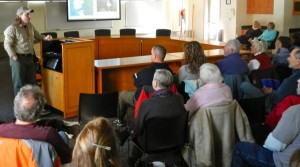
Mario Klip with the California Department of Fish and Game talks Jan. 12 about bears. Photo/LTN

“You need to make sure the animal knows it’s your (house). That you don’t want them. You need to make the bear feel uncomfortable,” Klip said. “You want to limit the undesirable behavior.”

Bears like high caloric foods and ones that smell good. Ice cream, peanut butter and syrup are three of the favorite foods they like to forage for in houses and garbage.

Besides bears’ being a nuisance and distributing garbage about, they take the debris into the woods. This can alter the ecosystem a bit because they are dragging food scraps into the woods instead of eating berries or some other natural food source.

However, in Klip’s studies he has found bears are not solely reliant on garbage, that their scat shows they are eating food that would be normal in their diet.

Nearly 50 people turned out Jan. 12 to hear Klip talk about the work he is doing in Tahoe with bears. The American Association of University Women sponsored the presentation at Lake Tahoe Community College.

Klip is using his research at Tahoe on bear aversion techniques to help him obtain a doctorate from UC Berkeley. While other places in the world are using dogs for bear aversion, he is the only in California doing so.

“There is a global phenomenon that people believe wildlife have intrinsic value. You can’t kill it just because it annoys you,” Klip said.

While the state agency he works for has a rule on the books that a black bear can be killed if it attacks a human, the reality is humans have usually done something to anger the bear. It could be that a bear is in a house, but a person is blocking the exit so the bear takes a swipe. The bear can then be put down. Or it could be a person has food in their tent and a bear goes after it – and inadvertently the person. Again, the bear can pay the ultimate price.

Klip said bears in Lake Tahoe don’t stalk people. However, that’s not true in other states.

“In more remote areas humans are prey,” Klip said, like Alaska. These are places where bears haven’t see humans, and therefore see them as a potentially tasty morsel. “Every bear in California has seen a human.”

The biologist believes coyotes are more dangerous than bears.

It’s estimated between 300 and 500 bears are in the basin.

While hunting bears caused an outcry when Nevada changed its rules a couple years ago, the state allows 10 bears to be killed, while California’s total is about 2,000, Klip said.  New in California as of Jan. 1 is the ban on using dogs during a hunt to tree a bear.



Why should MLK, Presidents Day, Columbus Day and the like be recognized?


History: Tahoe boats leave long wake

Publisher’s note: The following is reprinted with permission from the Lake Tahoe Historical Society’s July 1989 newsletter.

There is no doubt that soon after Lake Tahoe was discovered, some adventurer found his way onto its surface in some kind of water craft. Sailboats, steamers, tugs and barges were busily at work on the lake by the late-19th century. By the turn of the century, when Tahoe was becoming a resort community, a number of people were ready for adventures on the lake just for pleasure using the internal combustion engine to facilitate the ride.

Lake Tahoe, with its twenty mile length of open, smooth water, was natural for speedboating. A commercial activity moved off the lake and onto trains and highways, the lake became the province of pleasure boats. New craft were developed with new engines capable of faster and faster speeds. New styles were designed which have become classic. Speedboat racing, tourist treks and rides on the lake just for the thrill of speed soon became popular attractions of a Tahoe summer.

In the early years of the 20th century motorboats had been narrow-beamed launches with small engines often converted from other uses. By 1920, a new kind of runabout was produced by companies such as Chris Craft, Gar Wood and many others. When they arrived at Lake Tahoe, they found a home. By the 1930s, commercial ventures crisscrossed the lake once again carrying passengers to scenic and noteworthy spots, not in 19th century steamers but in speedboats or turnabouts. Races and regattas that featured this new style of boat were held every year.

The new craft were narrow-beamed, sharp stemmed wooden boats with gleaming mahogany finish, polished brass fittings and raised, overhead decks and windshields. They were generally from twenty to forty feet long, though some exceeded these limits. They sported engines from fifty to three hundred horsepower that helped them fly across the water! These classic-styled boats became synonymous in the west with our lake that many westerners to this day call them “Lake Tahoe Boats”. To the enthusiast of course, they are Chris Craft, Gar Wood, Belle Isle or Hackers or any one of a number of other makes. They are sometimes called “woodies” but this is hardly a dignified name for such a thoroughbredcraft.

These beautiful boats, lovingly restored, are still displayed at annual boat shows around the lake in places like Carnelian Bay, Tahoe Keys and Tahoe City.


Opinion: Time to implement TRPA’s new plan

By Joanne Marchetta

The terrific start to Lake Tahoe’s winter season is a fitting introduction to a year of positive progress for the lake and the communities that surround it. By the time spring breathes renewed life into Lake Tahoe’s ecosystem, many property owners around the basin will be aiming to start some renewal of their own with new rules adopted by the Tahoe Regional Planning Agency Governing Board at the end of 2012.

Approval of the updated Lake Tahoe Regional Plan was a turning point of its own, coming on a wave of unprecedented cooperation and near-unanimous agreement that we must move this basin forward. I want to explain what happens next and settle some misconceptions about what the TRPA board approved in December.

Joanne Marchetta

First, adopted changes fall into two categories — those that take effect this winter and those that are only effective once area plans from local governments are in place. Area plans are the next generation of community plans and they will be reviewed by the Governing Board in a public process. I also want to emphasize that no development projects were approved by the board in December and that regional growth caps for the Tahoe basin remain firmly in place.

While we hope the updated plan helps many lake-saving projects go from the drawing board to a public forum, environmental redevelopment projects in Lake Tahoe’s town centers will take careful consideration by the community, local governments, land managers, and others. To facilitate more ecosystem restoration on private properties, these projects must use transferred development rights from sensitive stream zones or outlying areas in order to access new height and density incentives in existing town centers. Such projects can be proposed only after the adoption of area plans. There are a limited number of areas, about 10 commercial centers around the lake, where these types of projects would be concentrated in order to foster walkable, bikeable communities.

For residential properties, important improvements are being brought online that are planned to be in effect this summer for properties that have already completed their best management practices for stormwater and erosion control. These amendments allow modest home improvements for some residential properties that were previously impossible. Within certain site constraints, property owners who have a BMP completion certificate can make modest enhancements without exceeding their property’s land coverage, which is the limiting factor for the total square footage of development allowed on each parcel in the Lake Tahoe Basin. With a BMP certificate, disabled access ramps, temporary backyard sheds, and up to 500 square feet of new decking will not count toward a property’s coverage limit. More information on these incentives will be featured in workshops this spring.

For properties that don’t have a BMP completion certificate, you can get started this spring installing simple measures that infiltrate stormwater and help reduce the fine sediment entering Lake Tahoe by contacting your local conservation district or go online.

Changes that only come into effect with an area plan may not be too far away in some locations and a few local governments are expecting to bring their plans to TRPA for review this year. For an area plan to be adopted, it must meet environmental standards and be consistent with the Regional Plan. However, area plans can also propose more innovative ways to regulate land coverage, provide further direction on local community character, and can streamline project permitting to a one-step process — all the more reason for you to contact your city or county planning department and get involved in bringing an environmental plan for your community forward.

I want to be sure the community understands that the purpose of TRPA’s updated plan is to increase environmental restoration and the well-being of Lake Tahoe’s communities. As the Tahoe basin comes together to move out of the negative spiral of decline, TRPA is working to implement land use policies that connect more people to recreation with less reliance on the private automobile. New zoning changes at Heavenly and Edgewood on the South Shore, for example, are intended to do just that, and any projects proposed there in the future will undergo significant environmental review and public input to assure these outcomes.

The positive momentum from the 2012 adoption of the Regional Plan update is a product of the creativity and cooperation of the many people who worked for years to establish a new approach to Lake Tahoe’s continued restoration. We’re poised for the next round of environmental gains to be made and for Lake Tahoe communities to play a greater role in the important work to protect and restore this world-famous region.

Joanne Marchetta is executive director of the Tahoe Regional Planning Agency.