South Shore transit case goes to mediation

By Kathryn Reed

It took the judge in the MV Transportation-STATA court case the entire day to finally tell all the parties they are going to mediation.

U.S. Bankruptcy Court Judge Gregg Zive on Jan. 17 also ruled on a slew of motions. All parties have until Feb. 19 to let Zive know who the mediator will be and when the sessions will begin.

“I’m hopeful for mediation. I think there are paths forward through that process,” Scott Lichtig, Tahoe Regional Planning Agency attorney, told Lake Tahoe News. “I would like to see it wrapped up in months and not years.”

TRPA is also represented by outside counsel.

South Lake Tahoe City Attorney Patrick Enright would not comment at this point on whether he believes mediation is a feasible resolution for the city.

Jessica Woelfel, who is representing MV, declined to comment for this story.

Fairfield-based MV Transportation used to run the South Shore bus system known as BlueGo. STATA – South Tahoe Area Transit Authority – was the overseer of the transit company. STATA was made up of public and private entities that had financially contributed to the bus system. STATA filed for bankruptcy; MV in 2010 filed a complaint to be paid.

El Dorado County is the only member of STATA to settle with MV.

One of the things that has protracted this case is each defendant has legal counsel, so there are multiple filings on the same motion.

Zive’s decision to send the case to mediation in part is because he recognizes the time and money that has been spent to date on the case.

However, if the parties cannot resolve their differences, litigation would be the next step.

In mediation it is likely the various parties will meet together and separately with MV and the mediator.

On Thursday the Reno judge denied:

• The motion by the private members of STATA (the casinos, Ridge Tahoe, Heavenly Mountain Resort) to dismiss the breach of contract/alter ego claim and the breach of the implied covenant of good faith and fair dealing claim.

• The motion to dismiss claim by all defendants regarding third party beneficiary, conspiracy and intentional interference with contractual relations.

• Tahoe Transportation District’s motion to dismiss the successor liability claim on the basis that MV’s allegation based on a fraud theory was plausible.

The only motion Zive dismissed was the negligent misrepresentation claim.

David Thompson, the federal bankruptcy trustee appointed by Zive, represents STATA – even though the agency doesn’t exist because the members dissolved it. But the question of STATA’s assets is pertinent to the case, which is why it is represented in the proceedings.

The defendants also submitted a series of motions to dismiss STATA’s cross claims. Zive denied all but the fraudulent transfer claims against the defendants except for TTD.


S. Tahoe resident becomes model for Army statue

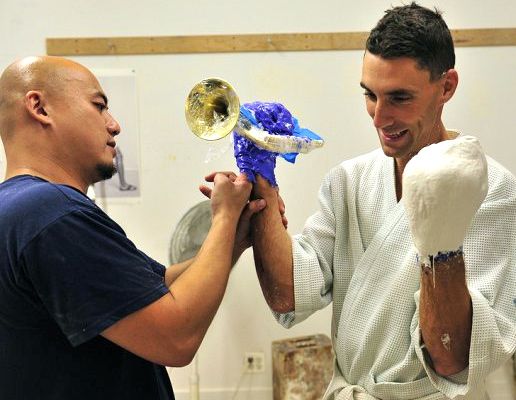
Even though South Lake Tahoe resident Jesse Tubb is on active duty with the Army, he is never leaving Arlington National Cemetery.

On Sunday, a statue honoring the Army’s buglers will be unveiled. The cast of the statue is of Tubb.

The 36-year-old staff sergeant is a member of the U.S. Army Band. Part of his job is to play Taps on his bugle at military funerals. The statue is to honor that iconic symbol — the bugler.

Staff Sgt. Jesse Tubb of South Lake Tahoe, right, begins the second phase of the statue casting process. Photo/Provided

Tubb traveled to New York City four months ago for the casting session.

“They cast me in three sections. They did my head first, and they completely encase it. It took about 15 minutes. Then they did the lower body and the upper body,” Tubb said in a press release. “When the head was done, [there] was complete sensory deprivation. They cleared away two little spots for the nose [to breathe] and that’s all I had. They put this seaweed composite material [on me], and then it got wrapped in plaster strips.”

The statue will be something people will see when they first walk into the visitors center.

 — Lake Tahoe News staff report


K’s Kitchen: Popcorn for dinner — why not?

By Kathryn Reed

Popcorn by itself is a fairly healthy snack. Air popped has 31 calories per cup.

I eat popcorn by the bowl. Not like a soup bowl, but a bowl a family might share. I also don’t just eat popcorn. It must have butter on it. Real butter. Fattening butter. Salted butter.

Then I call my bowl of buttered popcorn a meal.

I don’t count my calorie intake on those nights.

And I don’t like to share, but I will make a separate bowl if I’m asked to.

Today is National Popcorn Day. Though, clearly I don’t need a day to give me permission to indulge.

When I told my mom I was writing about this, she immediately sent me the recipe below and an article form TV Guide from Aug. 16, 1975. The article has Paul Newman saying butter must be “spattered” with a knife to get each layer.

While I don’t use a knife, I do apply the butter as it’s popping into the bowl so it’s all covered. And then when I’m getting close to the end of eating the bowl, I take the popcorn and rub it into any butter that may have pooled at the bottom.

There is actually a national Popcorn Board. The website says there is some confusion to the exact Popcorn Day. It’s always been toward the end of January and used to be associated with the Super Bowl. But now that the game is in February (Feb. 3 this year), popcorn aficionados don’t seem to know when their day is.

They should do like me – eat it pretty regularly.

According to the board, about 4 billion gallons of popcorn are consumed in the U.S. each year. I’m sure I ingest more than my 13 gallons worth each year.

I have cut back a bit because I know all that butter is not good for me. And I’m not about to give up the butter.

It makes me wonder if it’s the butter I want or the popcorn. I say this because I even like the weird yellow stuff squirted onto popcorn at movie theaters. I’m not sure that’s butter – but instead some greasy butter flavoring.

It must be a Reed thing to not treat popcorn as a healthy snack. One of my dad’s favorite ways to eat popcorn was when it was turned into carmel corn.

With the Super Bowl coming up, this is a good snack to serve. The recipe below is from Janet Robinson, a friend of my sister Jann’s.

 Carmel Corn

2 C brown sugar

1 C melted butter

½ C light corn syrup

1 tsp salt

1 tsp soda

1 T vanilla

7 quarts popped popcorn

Bring first four ingredients to a boil for about 5 minutes. Stir occasionally.

Add soda and vanilla.

Put popcorn in one large pan or two 9 x 13 pans. Pour mixture over evenly.

Bake at 200 degrees for one hour; stir every 15 minutes.

Store in tightly covered containers.


Snippets about Lake Tahoe

• El Dorado County will no longer maintain an older version of its website address. The website address www.co.el-dorado.ca.us will be decommissioned Jan. 31. The county’s current website address, www.edcgov.us, will remain unchanged.

• The Nevada Small Farm Conference is Feb. 21-23 at John Ascuaga’s Nugget in Sparks. For more info, contact (775) 351.2551 or email ann.louhela@wnc.edu.

• Parents affiliated with Whittell High’s grad night are organizing a fundraiser at the Raw Bar. “Whittell’s staff is not involved, nor is this a school sponsored activity,” Principal Crespin Esquival is letting LTN readers know. Other parents have raised concerns about the location of the fundraiser.

• Whittell High School’s Winter Formal, which is for all grades, is Feb. 8 at the Presbyterian Conference Center at Zephyr Cove. Tickets are $30 per couple for students in grades 9-12, and $10 per person for students in grades 7-8.  The high school dance is from 8-11pm, and middle from 5:30-7:30pm.

• “Vagina Monologues” is Feb. 22-23 at 7pm at the Blue Angel Cafe in South Lake Tahoe. Tickets are $15. The money goes to CASA, Live Violence Free, Tahoe Youth & Family Services, and Zawadisha. Tickets are available through CASA and at the door.


Heavenly celebrates Safety Week with myriad events

Heavenly Mountain Resort’s theme for National Safety Week is All in for Safety.

Highlights of the Jan. 19-26 Safety Week events include: sweep Mott Canyon with a ski patroller; avalanche beacon competitions in Milky Way Bowl; tours of the gondola and tram motor rooms; tours of the Prinoth Beasts; tours of CalStar’s helicopter ambulance; photo opportunities and rescue demonstrations by the avalanche dogs; snowmaking demonstrations; and safety expos.

For specific times and events, go online.


Dynamic pricing keeps consumers guessing

By Bill Saporito, Time

Maybe you didn’t notice it in the Christmas crush, but a huge shift took place this holiday shopping season: merchants changed the price of goods online more quickly than at any other time in retail history. How often? According to Eric Best, CEO of Mercent, a Seattle firm that creates and manages automated pricing programs, the most aggressive sellers were jiggling prices in 10-to-15-minute windows. That’s why they call it dynamic pricing.

You’re probably most familiar with dynamic pricing from buying airline tickets. The model, introduced by American Airlines in the ’80s, is designed to shift capacity risk (i.e., empty seats) from the airline to you in exchange for a discount on the full fare while giving the carrier a better shot at a profit. It works in that you can pretty much always find a seat, even if you end up paying twice the price of the passenger next to you. Win some, lose some.

More and more businesses are adopting this model. Sports teams like the St. Louis Cardinals once charged the same amount for the same seats at every game. But demand for a Saturday-night matchup with Philadelphia is greater than for a Thursday-afternoon contest with San Diego. So the Cards tease the price to attract the most customers, just like airlines, because if a seat goes empty, the revenue is lost forever. (In one sense, the Cards are replacing the scalpers’ market outside the stadium.) Theaters, golf courses and other businesses with time-perishable inventories are doing likewise.

Now the action is moving deeper in retailing, setting up a battle between consumers wielding shopbots like mySimon and algorithm-armed sellers and resellers. The retailers are trying to avoid losing value. Lego’s Epic Dragon Battle, for instance, has a manufacturer’s suggested retail price (MSRP) of $119. But the toy’s so hot, Amazon sellers are pricing it closer to $140, which means Lego is leaving money on the table. That’s why some merchants are abandoning MSRPs, instead setting a floor and letting dynamic-pricing programs take over. They monitor variables such as inventory levels, item velocity, competitors’ pricing and advertising. “The effort that the consumer had to go through in an eBay auction has been taken on by the retailer,” says Best, a former Amazon executive. “They are the ones that are determining perfect market value.” (Some sellers are also looking at behavioral variables by tracking your Web searches. That’s more controversial, but you can prevent them from doing it.)

The good thing for us is that pricing engines have to compete with one another and with our ability to gather information. And Amazon and Google want to kill each other, bringing pricing transparency to most products. That leaves sellers with the choice of being hyperefficient and duking it out on the price front, like Walmart and Amazon, or offering unique products and experiences, á la Apple and Disney. It’s a future in which many transactions–for milk, Uggs, baseball tickets–could follow the stock market’s bid/ask system. Think electronic price tags in brick-and-mortar stores that change as you approach, on the basis of your shopping history. Also gaining: consumer intermediaries like Decide.com that allow you to reverse-engineer the price engines. They predict the price of a camera, say, and recommend that you buy it at a certain amount; if you do and the price drops, they’ll pay you the difference. Some credit cards are offering price protection too. So is Target.

Pricing expert John Zhang of the Wharton School at the University of Pennsylvania says retailing is coming full circle. Before supermarkets, merchants–from Middle Eastern suqs to London shops–sized up their customers and priced goods accordingly. They cut personalized deals and made trade-offs. Today’s merchants simply use a different method. “Personal-identification storage technology has enabled the sellers to go back into the dynamic pricing they were doing for a century,” Zhang says. Expect it in the frozen-food aisle soon.


El Dorado County teen accused of murder

By Bill Lindelof, Sacramento Bee

An 18-year-old is in jail on suspicion of homicide after the stabbing death of another young man Wednesday night in El Dorado County.

El Dorado County sheriff’s deputies said they responded to the area of Brown’s Road and Cold Springs Road, just north of Placerville, about 4pm Wednesday where they were told a person had been stabbed.

They were also told that the person who stabbed 20-year-old Matthew Steele of Auburn had fled on foot. Paramedics arrived and transferred Steele to Marshall Hospital where he died about two hours later.

Deputies took Wesley Hampshire, 18, of Placerville into custody at his home on Brown’s Road. He was later booked into county jail on suspicion of homicide.

Details on what lead up to the stabbing were not available.


Asian immigrants outpacing Hispanics in California

By Stephen Magagnini and Phillip Reese, Sacramento Bee

The face of new Californians – once predominantly Latino – is increasingly Asian American, census data show.

A seismic shift in immigration has occurred in California over the last decade, with Asia replacing Latin America as the primary source of the state’s immigrants.

“This is a pretty astounding change over a short period of time,” said Hans Johnson, co-director of the Public Policy Institute of California, citing census data.

“For the first time in decades, the number of Asians coming to California exceeded the flow from Latin America, and it exceeds that flow by a lot – 2 1/2 times greater.”

To have Latino immigrants eclipsed by those from Asia over the past five to 10 years “could represent the end of an era,” Johnson said.

In 2001, 42 percent of immigrants coming to California were from Latin America, primarily Mexico, while 37 percent were from Asia. In 2011, 57 percent of new immigrants were from Asia, and just 22 percent were from Latin America, census data show.

California’s new faces were on display at a swearing-in ceremony at the Sacramento Convention Center on Wednesday. Of the 774 area residents who took the oath of citizenship, about 450 were born in Asia, compared with roughly 160 who were born in Latin America, according to the U.S. Citizenship and and Immigration Services.

They included 119 people from Mexico, 100 from India, 94 from the Philippines, 63 from Vietnam, 35 from Ukraine, 33 from the People’s Republic of China and 29 from Laos.

Among those celebrating their newly minted citizenship was Melody Malliet, who dressed in a crisp white suit to take the pledge of allegiance. She came here from the Philippines four years ago to marry an American citizen and is now a nursing assistant in Calaveras County. “It feels so good to be a U.S. citizen,” Malliet said with a huge smile. “I’m part of the greatest country in the world.”

Filipinos – the largest Asian ethnic group in Sacramento – often come here to fill jobs in health care.

The changing needs of California’s economy since the start of the recession explain much of the shift from Latin America to Asia. “Part of what we’re seeing is the changing face of California’s labor market, which has been increasingly demanding more highly educated workers,” Johnson said.

Unemployment has gone up at all levels, “but it’s gone up the most for people with high school degrees or less,” Johnson said. “Immigrants from Asia, particularly India, tend to be much more highly educated, much more likely to have earned a bachelor’s degree.”

While 74 percent of recent arrivals from India have at least bachelor’s degrees, 59 percent of Mexican immigrants have less than a high school degree, and there are now fewer jobs for less-educated immigrants, Johnson said.

The census doesn’t ask for a person’s immigration status, but the declining Latino numbers reflect a drop in undocumented immigrants, Johnson said. A substantial number of newcomers are sponsored by California businesses that help skilled immigrants obtain H-1B visas and other types of work authorization, he said.

“High-tech firms are arguing in Washington, D.C., that the number of work visas needs to be increased because they’re having a hard time finding people trained in computer sciences, and those jobs have often gone to Asian immigrants,” he said.

The number of foreign students coming to California also has risen. For example, there are now more than 1,500 students and scholars from China and Taiwan at UC Davis.

Asian Resources, which helps immigrants find jobs, has seen a large influx of immigrants from Mongolia, China, Laos and India, said executive director Stephanie Nguyen.

They include doctors, architects and professors seeking a better life, added placement counselor Sheng Lo. “Over the last three years, I’ve seen a lot of refugees from Iraq and Iran who came here as asylees or refugees seeking political or religious freedom,” Lo said. “And we had a couple from India – a teacher and pharmacist – who came looking for a better life for their kids. They learned they’d have to be retrained here.”

Overall, the U.S. Census Bureau estimates that the number of new immigrants coming to California went up slightly between 2010 and 2011, from 257,359 to 277,304. The Sacramento area also saw a slight boost in legal immigrants, from 8,047 to 9,469, federal immigration officials said.

But the number of new immigrants coming to California from Latin America annually has plummeted 65 percent since 2001, going from roughly 147,000 to 60,000 in 2011, Johnson said.

The drop began in earnest around 2007, when California’s economy began to falter ahead of the lengthy recession. Since 2006, the number of Latin American immigrants arriving each year in California has dropped by about 70,000.

Meanwhile, the number of Asian immigrants coming to California has grown, particularly from China and Taiwan. In 2001, about 129,000 immigrants came to California from Asia; by 2011, that number had risen to 160,000.

Immigrants coming each year from China and Taiwan grew 45 percent over the last decade, going from 25,000 to about 38,000. The biggest jump occurred from 2010 to 2011, when 10,000 more Chinese came to California than during the previous year.

The number of Koreans coming here each year has also grown sharply, going from about 13,000 in 2001 to 17,000 in 2011.

At Wednesday’s citizenship ceremony, hundreds of new immigrants waited in line for Social Security numbers.

Huy Tran, an 18-year-old senior at Florin High who arrived from Hue, Vietnam, in 2006, said he wants to help people with asthma, something he’s struggled with.

Ye Her, a Hmong refugee from Sacramento accompanied by her daughter May Saechao, 24, proudly displayed her citizenship certificate. “I’ve never felt this happy in my life before,” she said.


Discounted Alpine-Squaw lift tickets benefit nonprofits

Squaw Valley and Alpine Meadows are providing lift tickets to five local nonprofits to sell at a discount. Skiers and riders can show their goodwill by purchasing a lift ticket from Arts for the Schools, KidsZone Museum, Sierra Senior Services, Sierra Avalanche Center or Truckee Tahoe Humane Society. Tickets are valid Feb. 3-8 at either resort.

Squaw Valley and Alpine Meadows provided 300 lift tickets to each of the participating nonprofits – a total donation of $148,500 at ticket window rates.

Rates for the tickets start at $30 per ticket – a savings of up to $69. Tickets must be purchased directly from the organizations.


Study: Berries good for the heart

By Melissa Healy, Los Angeles Times

Younger women who ate at least three servings per week of strawberries or blueberries reduced their likelihood of suffering a heart attack by one-third compared with their sisters who incorporated fewer of the colorful berries into their diet, a study says.

The berry benefit was sufficiently strong that it held even after researchers adjusted for age, high blood pressure, family history of heart attack, body-mass index, exercise, smoking, and caffeine or alcohol intake. Researchers suggested that a group of dietary flavenoids called anthocyanins, which give blueberries and strawberries their jewel-like colors, may be responsible for the health benefits seen in the study’s large sample of subjects.

Anthocyanins are known to dilate arteries and counter the buildup of plaque that causes atherosclerosis.

The latest finding, published in the American Heart Association’s journal, Circulation, comes from the Nurses’ Health Study II. In that study, about 93,600 women ages 25 to 42 answered detailed surveys about their diets every four years for 18 years.

During the study period, 405 heart attacks occurred — a rate that is predictably low because the women in the study had not yet reached the age at which heart disease is most likely to show up in women. But the study subjects who ate the most strawberries and blueberries, three or more servings weekly, were 32 percent less likely to be among the group who suffered early heart attack than were women who ate fewer berries — even women whose diets were otherwise rich in fruits and vegetables.

“This simple dietary change could have a significant impact on prevention efforts,” said Dr. Eric Rimm, professor of nutrition and epidemiology at Harvard School of Public Health and senior author of the paper. Rimm and his coauthors surmised that if berry consumption showed such measurable health effects early in life, its benefits were likely to show up later as well, when women’s heart attack rate more closely approximates that of men.

The authors said they looked specifically at strawberries and blueberries because they are the most commonly consumed berries in the United States. But other berries, including raspberries, may have similar effects, they said.