Funds from Measure R allocated for South Shore bicycle trail, ball field improvement

By Joann Eisenbrandt

The South Lake Tahoe Recreation Joint Powers Authority met Jan. 25 in the City Council chambers to decide how to allocate the estimated $450,000 in previously unspent Measure R money.

Shay Navarro, chairperson of the Bicycle Advisory Committee, presented her committee’s funding requests. That committee in conjunction with the city, California Tahoe Conservancy, El Dorado County and Lake Tahoe Bicycle Coalition identified trail building and maintenance needs within the JPA’s jurisdiction, to, as Navarro put it, “work alongside the city’s efforts to make this a world class, year-round bicycle destination.”

The committee requested the following allocations of Measure R funds:

• $100,000 to South Lake Tahoe to match the grant of $475,452 received from Caltrans through the Bicycle Transportation Authority, which is contingent upon the release of these JPA funds. Funds would be spent in the five bicycle trail rehabilitation zones as outlined in a detailed memo to the JPA from Jim Marino and John Upton.

• $88,000 for TREX (or similar) decking for the bicycle trail bridges over the Truckee River and Trout Creek. (In July, $30,000 was allocated for this, but the improvements were not made.) Additional research concluded that an additional $58,000 would be needed.

• Up to $45,000 for a bridge to raise the portion of trail behind McDonald’s that seasonally floods.

• An endorsement by the JPA of the Bicycle Advisory Committee letter to South Lake Tahoe and El Dorado County requesting creation of a collaborative agreement for a regularly-scheduled bicycle trail maintenance program (striping, sweeping and snow removal) among the city, El Dorado County, Caltrans and the Lake Tahoe Bicycle Coalition. This does not include any funding request.
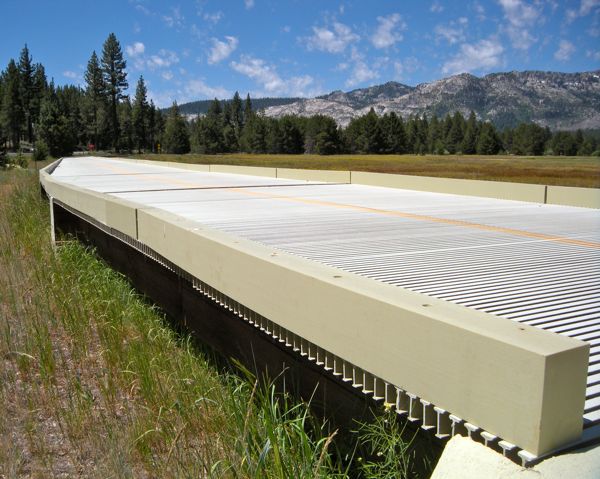
The South Shore can expect more bike trail improvements like this one at Sawmill and Highway 50. Photo/LTN file

Following Navarro’s presentation, bike committee member Chuck Nelson expressed concerns that the BAC’s recommendations on funding priorities as well as specifics on the creation of a collaborative bike trail maintenance program may not be carried out as envisioned.

“The Bicycle Advisory Committee has a very important role under Measure R in providing recommendations to the JPA,” he insisted. “We want to make sure it’s done right.”

He asked that the motion approving the allocation of the $100,000 to the city require acceptance of the BAC’s recommendations.

El Dorado County Supervisor Norma Santiago responded that she supported the allocation of the $100,000 but could not support imposing such requirements on a jurisdiction, adding that everything she’d heard from the BAC indicated there had been and would continue to be an openness on the city’s part and that if any recommendations needed changing, the BAC would be involved in that process.

City Councilwoman JoAnn Conner, the South Lake Tahoe’s JPA representative, told Nelson, “You sound accusatory. It’s unfair to categorize the city as uncooperative. There’s nobody on the City Council who doesn’t believe in this … I suggest you work from a position of trust with the city. We’re committed to getting this process done.”

After additional discussion, the JPA unanimously approved all four of the Bicycle Advisory Committee’s requests.

Fields Advisory Committee member Ken Riegel then presented a PowerPoint outlining his committee’s requests for Measure R funding. They were:

• $134,000 to the Lake Tahoe Unified School District to rehabilitate the field at Sierra House Elementary School, which he described as “a dangerous, uneven field.”

• $90,000 to LTUSD for varsity softball field No. 2 at South Tahoe High School. He noted the school district has already done substantial work there and these funds would be used to complete that work.

• $20,000 to LTUSD for planning only at this time for the construction of an added multi-used softball field at the Al Tahoe fields site. Additional funding for the projects themselves would come and be used in 2014 and 2015. These fields, he noted, are the most highly used with over 300,000 children using them annually for softball, baseball and soccer. Because so many families are involved, he indicated that, “many volunteers and professionals are also available to rally on completing these projects.”

• Designate future JPA funds in the following amounts for additional fields projects: $134,000 for constructing an added field at Al Tahoe; $29,150 for relocation of the T-Ball field at Al Tahoe; and $92,600 for upgrading the existing fields at Al Tahoe.


Riegel also listed additional “unfunded projects” identified by the FAC at the magnet school in Meyers, Tahoe Valley Elementary, Bijou Community School and South Tahoe Middle School. The magnet school was identified as their top priority.

FAC member Marilyn Breisacher spoke to the importance of the “gender-neutral” improvements that have been made to fields in the community, specifically referencing the amenities to the fields at South Tahoe High School for girls. Her daughter, she explained, had to play in the past on a field with “no restrooms, concession stand or adequate seating,” adding that the improvements won’t just help local players but will also help bring in more girls softball tournaments.

The JPA approved all four FAC requests as presented. The next Recreation JPA meeting will be in July. The Bicycle and Field Advisory Committees will be meeting later this quarter and will bring updates to the July JPA meeting.

The three-member JPA consists of Santiago, Conner, and Tahoe Paradise Park Improvement District Board Member Judy Clot. The latter two are new to the board, with Friday being each of their first meeting.

Measure R was passed in November 2011 with the intention of changing and expanding the locations and services that could be funded by the Community Facilities District originally established by Measure S when it passed in September 2000. Measure S provided for a $5.8 million bond to construct an ice rink, four ball fields adjacent to Lake Tahoe Community College, improving Tahoe Paradise Park and opening it to the public, and maintaining 25 miles of new bike trails. Measure S also provided for yearly maintenance funding for the new athletic fields by LTCC, Tahoe Paradise Park and the newly constructed bicycle trails. Under Measure S, each single-family home in the district is assessed $18/year. Measure S/R will sunset in 2030.

In reality, only about eight to 10 miles of bike trails were built. The unused remainder of the annual Measure S allocation of $125,000 continued accumulating, but was unspendable. Measure R unlocked those funds by adding to the authorized improvements and services funded by Measure S to include the renovation and maintenance of Class 1 bicycle trails existing prior to Sep. 19, 2000, and the renovation of youth ball fields within the Community Facilities District. It created a Bicycle Advisory Committee and a Fields Advisory Committee to make recommendations to the JPA as to costs and priorities of future improvements and maintenance for sports fields as well as bicycle paths in the district.



‘Babysitting a Billionaire’ leaves reader wanting more

By Kathryn Reed

My biggest complaint – it’s a novella and not a novel.

The 88-page “Babysitting a Billionaire” by Nicky Penttila is a page-turner. I read it in one night.

But the characters and erotic scenes need more development. The books starts well in setting the stage for the romantic tryst, has a twist or two, and a fairly strong ending, but it feels rushed.

What had me laughing at the start is the main characters name is May Reed. And references to Miss Reed were a bit jarring. Obviously this is not going to be an issue for most readers.

This is Penttila’s second book. Unlike “A Note of Scandal”, “Babysitting a Billionaire” is set in modern day.

On the heat scale, according to the publisher, it is a 3. Penttila’s previous book was a 2. This one did not seem steamier to me, but I’m not the one giving out the ratings.

Both books are available online. The newest one is just $3.99 — which feels a bit like stealing.


Editorial: Time for bold steps in Nevada

Publisher’s note: This editorial is from the Jan. 20, 2013, Las Vegas Sun.

In his State of the State speech this past week, Gov. Brian Sandoval showed pictures of second-graders as he spoke. They were, he said, members of the “class of 2023.”

“It is my hope that the faces of these children will inspire us as we consider both the short- and long-term realities of our state,” Sandoval said.

Cynics might scoff, given that invoking policies for the good of the children is a tired political cliche, but we believe Sandoval is sincere. His use of the class of 2023 was a nice reminder of what adults — particularly politicians, educators and parents — are supposed to be doing: making things better for the generations to come.

Sandoval didn’t stop there. He noted that the work the Legislature does “will shape the future of our great state,” and he urged lawmakers to think beyond the next two-year budget cycle, which is typically what lawmakers and governors focus on.

“Our greater challenge is helping a Nevada that is still on the horizon,” Sandoval said. “It awaits us in the future. Not too far off, but far enough that we must consider what we can be.”

Again, cynics might scoff because speeches like this are typically filled with references to the future, but Sandoval’s call is relevant and necessary given the damage Nevada suffered in the Great Recession.

The nation’s economic woes exacerbated Nevada’s long-standing problems, including a poorly ranked education system and a threadbare network of social services.

The question this year is whether the state can make significant strides for not only the class of 2023 but also for the current generation.

Despite his call to consider the future, Sandoval’s budget is modest. There are some welcome increases, including those to education and social services, but they are hardly enough to restore previous cuts. There also is a business tax cut and a demand of no new taxes.

That’s hardly a bold leap into the future.

The excuse for not taking more dramatic steps is the economy. The state hasn’t recovered from the Great Recession, the boom times may never return, and the revenue isn’t there and no one wants to raise it.

But it’s worth noting that the good times — even those of a decade ago — were never good enough to make the investments needed. The state’s problems were routinely pushed into the future.

The results of that have been evident: The state hasn’t made needed investments in public programs, and Nevada ranks near or at the bottom in national rankings for education, children’s services and health care.

It’s dumbfounding that rankings like this have been acceptable for so long, but lawmakers and governors have come and gone with little significant change. Public apathy and small budgets, along with a fierce aversion to taxes, have resulted in political inertia. What passes for progress typically comes in small, incremental steps that are often later erased by budget cuts.

Something has to change if Nevada wants to see improvements. Obviously, real change doesn’t come overnight, but it takes bold action.

What will Nevada look like in 10 years for the students coming out of high school? Will it offer, as Sandoval called for, “an educated and healthy citizenry, a vibrant and sustainable economy, safe and livable communities, and an efficient and responsive state government”?

The question that he and the Legislature will have to ask is not only whether their actions take significant steps in that direction but whether that is the best they can offer to the members of the class of 2023.


Barton limiting access to hospital because of flu

Due to an increase in flu activity in the South Lake Tahoe area, Barton Health is taking precautions to protect patients. Effective Jan. 25, Barton Memorial Hospital has implemented the following guidelines for hospital visitors, during the height of flu season:

Anyone under the age of 12 is not permitted to visit patients.

Siblings of newborn infants may be allowed in the Family Birthing Center after careful screening, but must remain in the patient room at all times.

No more than two visitors per patient at any one time.

Any individual with a fever, cough, sore throat or other respiratory symptoms may not visit patients at the hospital.

Exceptions may be made on a case-by-case basis, such as visiting a terminally ill patient.


9 people want to fill 1 S. Tahoe council seat

Nine people have applied for the one South Lake Tahoe City Council seat.

The four council members will interview the candidates Tuesday starting at 9am.

City Clerk Suzie Alessi conducted a random drawing to determine the order of interviews. Applicants will be interviewed in the following order: Howard Bittner, Kathay Lovell, Joan Walthall, Brooke Laine, Bruce Grego, Austin Sass, Billy Crawford, Scott Valentine, and Kay Ogden.

At the start of the Jan. 29 9am meeting, the council will discuss the process in which interviews will be conducted. Interviewing could include a set of questions that all applicants will be asked; or the council may wish to hold more of a “free form” interview process; or any other type of process they agree on.

All applicants will be present in the council chambers, unless the council decides otherwise.

If the council cannot pick a fifth member to fill out the two-year term left on Claire Fortier’s term, the voters would decide June 4.


TRPA tweaks summer boating program

The Tahoe Regional Planning Agency’s Governing Board approved an annual update to the Aquatic Invasive Species Watercraft Inspection Program on Wednesday.

The approval keeps nearly all boater fees the same and is designed to improve efficiency of service at watercraft inspection stations around the Lake Tahoe Basin in an effort to keep the $1.4 million inspection program in the black.

The jointly-managed inspection program annually certifies more than 15,000 motorized watercraft as being free of invasive species before launching into Lake Tahoe to help prevent the introduction of non-native species that could devastate Lake Tahoe’s fragile ecosystem and native fisheries and impact boats and recreation areas.

The updates maintain hours of operation during the busiest boat inspection times at the five roadside inspection stations around the Tahoe region. Inspection stations in Meyers, at Spooner Summit and Alpine Meadows will begin closing at 5:30pm Sunday-Wednesday this summer, but close at 8pm Thursday-Saturday.

Homewood and Northstar inspection stations will be open Thursday through Sunday and will operate from 8am-5:30pm

For additional information, call Jeff Cowen at (775) 589l5278 or email jcowen@trpa.org.


Meeting set for Truckee area floodplain project

The Truckee River Watershed Council is hosting a presentation on the Coldstream Canyon Floodplain Restoration project on Feb. 12th from 6 to 7:30pm at the Cedar House Sport Hotel.

Coldstream Canyon is located in Donner Memorial State Park, adjacent to Truckee. Current land uses in the canyon include recreation, railroad corridor, timber harvest in the upper watershed, and residential development. Today the majority of the canyon is under the management of the Tahoe National Forest and California State Parks.

The restoration project is designed to reduce pollution from excess sediment.

RSVP is required by Feb. 7 to Michele Prestowitz at (530) 550.8760. ext.4, or mprestowitz@truckeeriverwc.org.


Safety of ski resort terrain parks questioned

By Elyce Kirchner, Jeremy, Carroll and Kevin Nious, NBC Bay Area

When skier Kenny Salvini, 23, took off on a terrain park jump at more than 35 miles an hour, it changed his life forever.

“The landing ramp was way too short,” Salvini recounted of the 2004 accident. “It dropped me down onto flat ice instead of dropping me down on to more of the slope landing which in theory would have prevented the injury that I got.”

Salvini was paralyzed from the neck down.

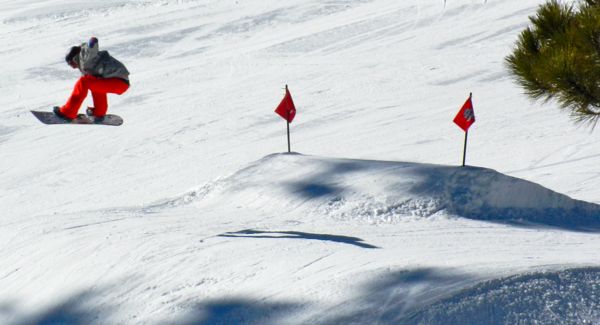
A snowboarder catches air at Heavenly earlier this month. Photo/LTN

In recent years, terrain parks have become an increasingly popular attraction at ski resorts. These skate parks on ice are equipped with rails, ramps, and jumps that provide riders with all the thrills of a high speed roller coaster, without any of the restraints.

But as the NBC Bay Area Investigative Unit has learned, many of the jumps at these terrain parks have been designed absent any engineering or safety standards. Most ski resorts, like the ones found in Tahoe, have these terrain parks.

Now, experts within the engineering community are working to increase the oversight of the design of these jumps which now have the potential to launch jumpers as high as 90 feet in the air.

UC Davis engineering Professor Mont Hubbard has written several papers on the safety and design of terrain park jumps.

“You want to minimize that impact, or control it in some sense,” Hubbard said. “Typically, you can’t do that by just pushing snow around and hoping that it’s the right shape.”

Hubbard has served as an expert witness in several lawsuits against various ski resorts, including Salvini’s case against The Summit at Snoqualmie in Washington.

Hubbard believes that a properly engineered jump can be designed to reduce the impact of a jumper’s landing, preventing some of the more serious injuries.

“It accommodates for any place you want to land, and it makes it so that he lands equally softly everywhere,” Hubbard said.

According to a recent survey by the National Ski Areas Association, terrain parks can be found at 90 percent of ski resorts in the United States.

Chris Gunnarson is the president of Snow Park Technologies in Verdi. Gunnarson has been designing terrain parks at resorts like Northstar, Squaw, and Heavenly for over a decade.

“It’s impossible to design a safe jump,” Gunnarson said.

Snow Park Technologies is also responsible for dreaming up and constructing the jumps for professional competitions like the X Games and the Dew Tour.

Gunnarson argues that there are too many variables involved in designing a terrain park to accurately calculate how a jumper will land.

“As an industry there are not standards because the snow changes all the time. It’s kind of impossible to have standards.”

While there are no set safety standards or calculations involved in the design process, Gunnarson maintains that there is a lot of thought put into how the jumps are designed.

Skiing and snowboarding accident data is kept private by the resorts.

However, a recent study presented at a conference held by the International Society for Safety in Skiing, found that the rate of spine and head injuries at terrain parks is double that compared to other areas at a resort.

Hubbard says the key to preventing serious accidents like Salvini’s is calculating the distance from the jump to the landing.

“I had no idea that these jumps had almost little to no design involved with them,” Salvini said.

After his accident, Salvini received $14 million in damages in his suit against The Summit at Snoqualmie.

Salvini said the judgment came as a shock to the ski industry since resorts are rarely found liable for injuries on the slope.

Salvini’s case was the exception as jurors found that he was injured in part because the jump constructed by the ski area was not reasonably safe.

While the jump has since been removed from the park, Salvini fears that jumps at other parks are similarly flawed.

“Something has to be done, but it doesn’t mean you need to tear down all these parks. With a little bit of science and some common sense, I think that these terrain parks can be built safely,” Salvini said.

NBC Bay Area reached out to The Summit at Snoqualmie for comment, however our calls were not returned. At the time of the trial, the company released a statement saying in part that “Voluntary participation suggests that a skier or rider accepts the risk associated with the activity.”

NBC Bay Area also reached out to several ski resorts in the Lake Tahoe area to for comment on the issue to discuss the safety of terrain parks. None of them would agree to an interview on-camera.

The American Society for Testing and Materials has formed a committee to help determine whether a standard for terrain parks is possible.

The committee is made up of ski resort operators, engineers including Hubbard, and park designers including Gunnarson.

“I would certainly be willing to try,” Gunnarson said, “but there is no proven model out there out there yet.”


Brown calls for lofty goals in California

By Normitsu Onishi, New York Times

SACRAMENTO — Emboldened by a brighter fiscal horizon, Gov. Jerry Brown on Thursday recommitted himself to two ambitious projects, a high-speed rail line and a huge water tunnel system, in an optimistic State of the State speech that sought to secure California’s long-term future as well as the three-term governor’s legacy.

Grasping at California’s vision of itself as a land of opportunity and a model for the rest of the nation, Brown said the state was rebounding financially after a difficult period. In a speech citing sources as varied as the Bible, Montaigne and Yeats, Brown said the state’s budget was now sound, but he also warned of profligacy, a remark that seemed directed at the Democratic lawmakers listening to him in the State Capitol here.

“The message this year is clear: California has once again confounded our critics. We have wrought in just two years a solid and enduring budget,” Brown, a Democrat, said in his third State of the State address since returning to office in 2011. “Against those who take pleasure, singing of our demise, California did the impossible.”

Brown spoke of wanting to reform school financing by empowering local school districts, and of continuing to lead efforts to fight climate change, like the cap-and-trade system for carbon emissions that went into effect recently.

Recalling the big infrastructure projects in the state’s past, Brown also voiced strong support for two big-ticket items that have drawn strong opposition: a bullet train that would eventually link Los Angeles and the Bay Area, and two tunnels that would funnel water directly from Northern California to more populated areas in the south.

“The London Olympics lasted a short while and cost $14 billion, about the same cost as this project,” he said of the tunnels. “But this project will serve California for hundreds of years.”

Brown’s speech came at what many are describing as a turning point for California after years of economic turmoil. The state’s economy is continuing to show signs of strengthening, with job growth and a housing market revival.

Fiscally, after years of ballooning budget deficits, the state is now projecting a balanced budget. In November, Brown surprised many by winning a hard-fought campaign to pass Proposition 30, a temporary tax surcharge that will pour $6 billion a year into the state treasury for the next seven years.

Still, Brown has repeatedly warned about the need to control spending. With Democrats now having supermajorities in the Senate and the Assembly, they can pass tax increases unilaterally. As experts predict that Democratic legislators will face pressure to increase spending, many are now describing Brown, long known as “Governor Moonbeam” for his eccentricities, as the only adult in the room.

Citing the story of Genesis and Pharaoh’s dream of seven cows, he said: “The people have given us seven years of extra taxes. Let us follow the wisdom of Joseph, pay down our debts and store up reserves against the leaner times that will surely come.”

In interviews, Brown, who served two terms as governor from 1975 to 1983, has brushed aside talk of his legacy. But in recent months, Brown, 74, who was treated recently for prostate cancer, has spoken about his mortality, mentioning the death of a close friend.

“This is my 11th year in the job, and I have never been more excited,” he said.


Mom, daughter found in Amador County pond

By Cathy Locke, Sacramento Bee

The bodies of an Amador County woman and her 5-year-old daughter reported missing earlier this week were found Thursday morning in an ice-covered pond on their Pine Grove property.

Divers recovered the bodies of Karen Diane Anderson, 46, and Amelia Noelle Arago, 5, about 30 feet from the shore of the pond, according to an Amador County Sheriff’s Office news release. Officials said there was no evidence of trauma or foul play.

The Sheriff’s Office received a report about 3pm Monday of a loose llama at 14130 Spring Canyon Lane in Pine Grove. A deputy and a county animal control officer secured the llama, but they were unable to locate anyone at the home. About 12:43 p.m. Tuesday, a deputy was dispatched to to the same address to conduct a welfare check of the residents after neighbors reported that they hadn’t been seen all day. The deputy did not observe anything suspicious at the residence, officials said.

Tuesday evening, a neighbor called to report that the residents still had not been seen and no one had tended to animals on the property. The neighbor said he had checked the property and found a large hole in the iced-over pond north of the home.

On Wednesday, sheriff’s detectives conducted an investigation into the possible disappearance of the residents. They searched the property, including the pond, using a canine. No one was located, but officials said the dog indicated interest in the pond.

Thursday morning, sheriff’s search and rescue personnel assisted by canine teams from Wilderness Finders Search Dogs and California Rescue Dog Association searched the surrounding areas and the shoreline around the pond. These dogs also indicated interest in the pond.

CHP aircraft conducted an aerial search, while a dive team from the El Dorado County Sheriff’s Office trained in ice-covered water recoveries began an underwater search of the pond.

The divers found a rope, which neighbors indicated was used as a lead for the llama. The divers then located the bodies of Anderson and her daughter in the same area. Authorities said the water was about 8 feet deep and the water temperature was 38 degrees.

The Amador County Sheriff Coroner’s Office reported that a forensic pathologist will examine the bodies to determine the cause and manner of their deaths.