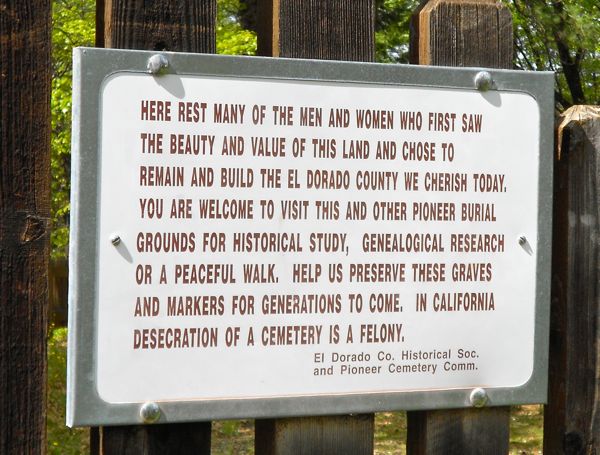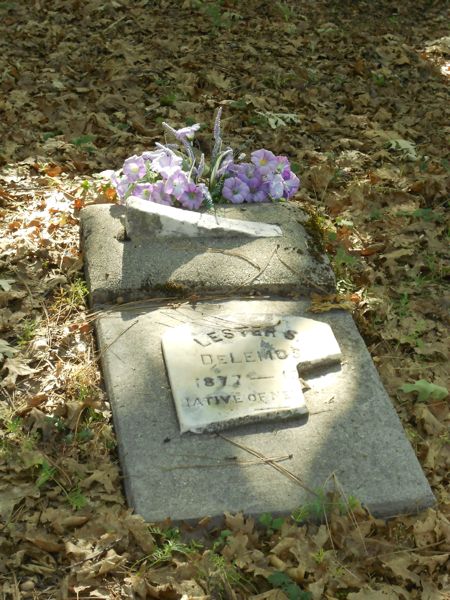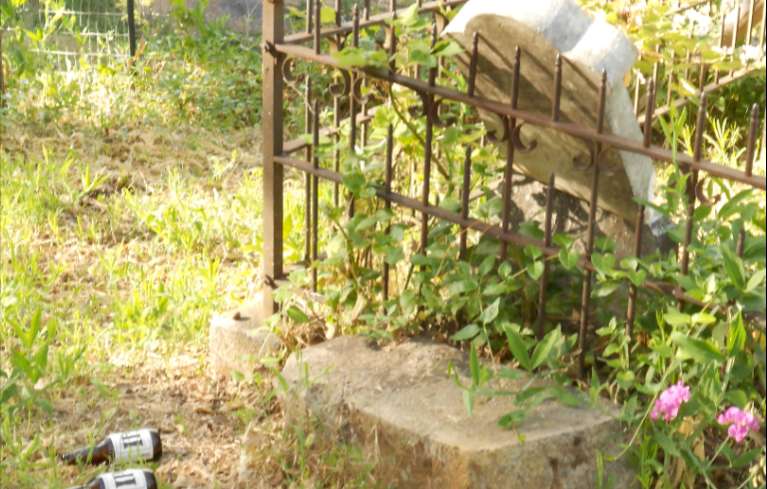
Bottles and a fallen grave marker indicate the rundown nature of Old City Cemetery in Placerville. Photos/Joann Eisenbrandt
Publisher’s note: This is the second of two stories about El Dorado County’s pioneer cemeteries.
“As you walk through these burial grounds, walk softly, quietly, and with deep respect. The Pioneer Spirit is sleeping here. The spirit which founded a nation of freedom, and tamed the west.”
— “Burial Grounds of El Dorado County, 1849-“, Betty C. Laarveld
By Joann Eisenbrandt
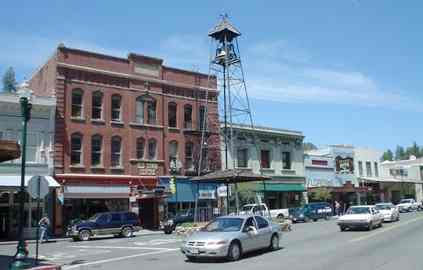
PLACERVILLE — The foothill regions of El Dorado County and Placerville have taken visible pride in their roles as ongoing custodians of the Pioneer Spirit that built them. Preservation of the historic buildings along Main Street and the elaborate gabled wooden homes and humble hewn-block blacksmith shops that line Placerville’s narrow, hilly streets, as well as pioneer-era structures in the unincorporated areas of El Dorado County outside the city limits, is a priority, and is carefully regulated and supported by public agencies, private businesses and nonprofits alike.
But the task of being custodians of the pioneers themselves has proven to be much more daunting. The problem began with the Gold Rush emigrants themselves. Recordkeeping for the early cemeteries was minimal or nonexistent. The grave markers, where they existed at all, were often made of wood and simply disintegrated over time.
Camps, roadhouses, and their accompanying small cemeteries were often abandoned and forgotten. A 1910 fire destroyed all prior official death records in the El Dorado County Recorder’s Office, forcing the county to attempt to reconstruct them from Mountain Democrat obituaries and articles and pioneer family histories. Vandalism of the cemeteries with damage or destruction of many grave markers has been a significant issue even from Gold Rush times.
Today, one city, one county and a variety of nonprofit, church and historical societies have the maintenance, preservation, restoration or updating of records of the area’s pioneer cemeteries as either a part of their legal duties or stated missions.
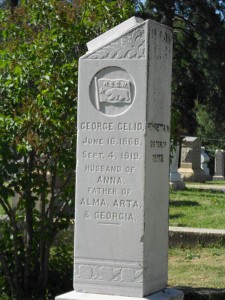
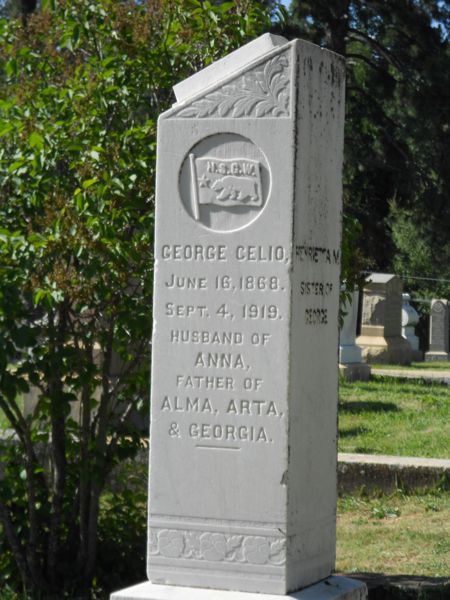
Descendants of the Celio family are buried in the Placerville Union Cemetery.
Many pioneer cemeteries that have survived almost intact or have been restored in more recent times by public or private entities, but many are in the same condition as Old City Cemetery. Looking over the sturdy low wooden fence that lines its entrance on Chamberlain Street, there are few gravestones visible. Dating from the 1850s, and designated an historic landmark in 1983, it stretches from Chamberlain more than two blocks down a gentle slope to the wire fencing and sharp cliff overlooking bustling Main Street.
In winter and early spring, luxurious green weeds cover the grounds and blackberry bushes which tendril around and obscure the few remaining intact headstones. In summer, before the yearly brush trimming, tall dry grass full of prickles and scurrying small creatures crunches under your feet. Broken shards of white marble and piles of weathered red bricks lie scattered around; broken or twisted scrollwork iron borders or cement copings surround the obvious indentations of gravesites which no longer hold any clue to who is buried there.
A few gravestones remain intact, but many more are nonexistent, broken or illegible. Some have been cemented into the ground to preserve what remains of them. A few empty beer bottles and colorful crushed tin soda cans lie at the feet of the pioneers who rest there.
Placerville Union Cemetery has fared much better. Located up a steep hill on Bee Street several blocks above and north of Highway 50, the spacious grass-covered cemetery sits in a quiet and shady neighborhood surrounded by streets dotted with historic homes. Although it had its share of problems, falling for a time into serious disrepair and suffering some effects of vandalism, the overall appearance is remarkably peaceful. Walking across its gentle slopes, outlined by oaks and pines, reading the inscriptions on tombstones dating back to the 1850s, you could forget just what century you were in.
El Dorado County maintains 17 other cemeteries, some small, some larger, some public and some private. Given the county’s Cemetery Ordinance’s definition of a cemetery as, “a place used or intended to be used and dedicated for cemetery purposes, and in which six or more human bodies are buried,” undiscovered cemeteries might remain.
According to El Dorado County Cemetery Administrator Bonnie Wurm, the county is now in the process of updating its Cemetery Ordinance and looking to clearly define the types of cemeteries, who owns or maintains them and whether or not they are active, still accepting burials, or inactive and no longer taking them.
Volunteers at the El Dorado County Historical Museum are also working to update the records of individual early cemeteries.
The state Health and Safety Code requires all active cemeteries have current plot maps, accurate recordkeeping of burials and basic maintenance of the grounds. It gives to governing bodies of cities or counties the power to further define the regulation of the public and private cemeteries they control to “assure decent and respectful treatment of human remains, or prevent offensive deterioration of cemetery grounds, structures, and places of interment.”
In the case of the pioneer cemeteries, poor early recordkeeping, changes of ownership, spotty or deferred maintenance and the destruction of grave markers caused by vandals have complicated the task. Vandalism is not a new problem. A Mountain Democrat article from Oct. 10, 1858, laments, “Yesterday, as a gentleman was passing through the city grave-yard (Old City Cemetery), he observed the iron railing around one of the graves had been misplaced by some means, and upon close examination, discovered that the iron rods, which had held it together, were removed. The inference is that some scoundrel has stolen them.”
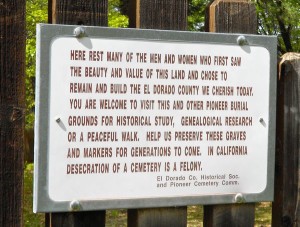 The problem remains today. A Mountain Democrat headline from an Aug. 25, 2008, laments, “Vandals knock over tombstones in Placerville Union Cemetery.” Thomas DeLange, the cemetery’s Grounds Maintenance supervisor, told the reporter, “It’s not just this cemetery, sometimes it’s other cemeteries. But this one – lots of the other cemeteries, the graves stones are missing and the one in Middletown, that one is pretty abused. People hang out there and drink. They’ve actually stolen a bunch of the markers.”
Bonnie Wurm confirmed that just a year ago the fountain in the center of the mausoleum at Placerville Union was stolen. The large cement pool constructed to catch the gently falling water sits dry and forlorn.
Over the years, efforts have been made to clean up and to inventory the records of the area’s many pioneer cemeteries. In 1975, Betty Laarveld, a field representative for the El Dorado County Department of Public Works, was hired to locate and survey all the burial sites in El Dorado County. Acknowledging at the outset that, “most of these burial sites will never be known,” Laarveld used county death records, cemetery markers, and information from churches, funeral homes, historical organizations and the descendants of pioneer families. The results are chronicled in her book “Burial Grounds of El Dorado County, 1849-.”
Laarveld found that few of the active cemeteries had accurate plot maps, and the smaller private cemeteries, often overseen by volunteers, did not understand or meet state requirements for either recordkeeping or maintenance. The report gave a brief overview of the current condition of each cemetery. Some, like Pleasant Valley, had fared well. She described it as, “well maintained and has a picturesque setting on top of a little hill . . . It is a cemetery the local residents can take just pride in.” Others not so well. Of Middletown Cemetery, she wrote, “(it) represents the epitome of parsimony. The entrance to the cemetery is unsafe … the grade of the access road is in such a steep incline that the driver is unable to see the road ahead of him.”
For several others she noted the continued presence of active rattlesnake dens.
Her report also included cemetery chains of title, survey maps of cemetery locations, and a facts and findings section detailing her recommendations for what needed to be done, which included setting up uniform maintenance requirements, assessment reports with photos showing each cemetery’s actual condition, thorough yearly inspections, and a way to mark graves for which families could not afford gravestones so they could be identified in the future. To accomplish this, she included samples of all the needed forms.
In 1996, the nonprofit El Dorado County Pioneer Cemeteries Commission was formed, as their website notes, “To identify pioneer cemeteries in El Dorado County, to determine those which are in crises, to address protection, preservation, restoration and conservation needs, and work together to accomplish these tasks.”
They also hoped to monitor development which might impact pioneer cemeteries, install interpretive signs with the history of each area and coordinate with area chambers of commerce to produce materials about the pioneer cemeteries to encourage public appreciation of the sites and to lobby the county for the establishment of a cemetery board to provide protection for pioneer cemeteries and create stiffer penalties for vandalism and desecration.
In 1996, Lyn Mizell, a member of that group, proposed a project to the Roots and Gold Dust Genealogical Society of El Dorado County to be done in conjunction with the 1998 sesquicentennial of the discovery gold. The project would research and update the inventory of the Old City Cemetery.
Mizell described Old City at that time as, “a lovely hilltop setting with many old oaks scattered throughout … sadly, the cemetery is quite bare of markers. Would estimate only one quarter to half of the ground has markers, coping or clearly defined graves. Many of the gravestones are broken. Some markers were obviously patched years ago and are lying flat imbedded in concrete slabs.”
Mizell and another group member, Kathy Fleming, walked the cemetery and plotted the graves, checked county burial permits, the county library and the 1850 and 1860 Census records, and compiled it into a report titled, “Old City Cemetery–Rector and Chamberlain Streets.”
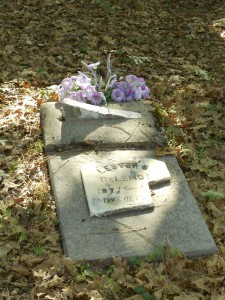
Flowers are rare.
The report recommended Old City be officially closed to further burials, gravestones cleaned up, broken markers, ironwork and coping repaired, yearly maintenance initiated, historic signage added with warnings against vandalism and nearby homeowners contacted to set up a “Cemetery Watch.”
In 1998, Mizell made a formal proposal to the Placerville City Council for the restoration of Old City Cemetery, including a cleanup by local Eagle Scouts and monument repair by Roy Rukhala of Rukhala Monuments, that she would pay for. The cleanup occurred and the monuments were repaired, but within a year most of the monuments had again been vandalized.
In 2002, the county’s Cemetery Advisory Committee was created to, “draw upon the advice and expertise of trained, knowledgeable, and interested individuals within the local community.” Led by Bonnie Wurm, they are currently providing input into the update of the county’s Cemetery Ordinance and are reviewing the status of the more than 100 entries on the county’s list of known cemeteries. The task of backtracking through records to identify chains of title is a slow and complex.
Between 2002 and 2004, the county contracted with outside geophysical consultants for the use of ground penetrating radar to identify potential unmarked graves, land surveying services and the preparation of burial maps for Pilot Hill, Bryant, Camino, El Dorado, Frenchtown, Jayhawk, Uniontown, El Dorado County Hospital, Shingle Springs, Smith Flat, Dickinson (in Mosquito), Skinner, Diamond Springs, Spanish Dry Diggings, Middletown, Fair Play, Mormon Island, and Georgetown Pioneer cemeteries.
Old City and Uppertown, the two cemeteries owned by Placerville, have long been inactive. Steve Youel, director of Community Services for Placerville, noted that there is little funding to maintain them. Current maintenance consists of a once-yearly cleanup of brush and hazardous tree trimming, contracted out this year to the CalFire crew from Growlersburg.
The city has a Historical Advisory Committee, but it is focused on the preservation of buildings, not cemeteries. As committee member JoAnne Rogers told Lake Tahoe News, they only become involved with cemeteries if there is, “any proposed construction or alterations of buildings within the city limits that is within 300 feet of a cemetery and which might alter or change it.”
Views on the level of success in communication and cooperative efforts between local governmental agencies and the many nonprofit groups focused on historical preservation varies depending on who you talk to. Steve Youel said he hasn’t been approached recently by nonprofit groups or volunteers to become involved in the maintenance of the city’s two cemeteries. Bonnie Wurm said she would welcome it if a group came forward and formed a nonprofit focused on Placerville Union Cemetery and its 6,700-plus graves.
The close family connections to the pioneer cemeteries that existed when those who lived here had relatives buried in them is also much less common.
“New people are moving in,” Marilyn Ferguson, Manager of the Fountain & Tallman Museum on Main Street and founder of the nonprofit Heritage Association of El Dorado County, told Lake Tahoe News. “Many older people are gone, or have died. The new people have no connection to the cemeteries.”
—-
More information:
Marilyn Ferguson’s nonprofit
Roots & Gold Dust Genealogy Site
Pioneer Cemeteries Commission
El Dorado County Historical Museum
El Dorado County Historical Society
El Dorado County Cemetery Administration