Stateline casinos lead the charge in December gaming win

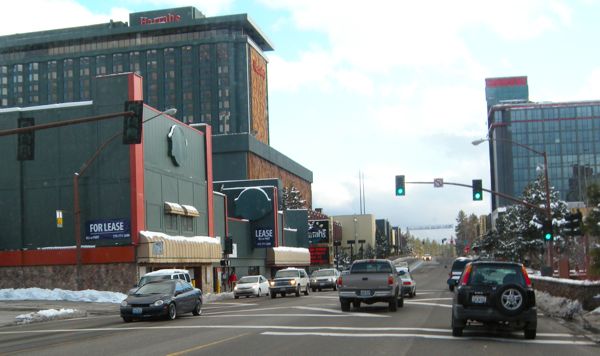
Stateline casinos had a spectacular December when it came to raking in money from gamblers.

Revenues were 57 percent higher than 2011 at $21 million.

The Nevada Gaming Control Board on Friday released its figures for the last month of 2012. Statewide revenue was up 10.24 from the previous December to $943.3 million.

In this same time period Reno casinos were down 4 percent with $40 million in revenue.

— Lake Tahoe News staff report


Ski report: Layer of fresh snow

Enjoy the fresh snow. More white stuff is expected today.

Here is the Feb. 8 ski report.

— Curtis Fong


Mancuso leads U.S. women in slalom with 8th place

By USSA

SCHLADMING, Austria — Despite a significant mistake in the downhill portion of Friday’s FIS Alpine Ski World Championships super combined, super G bronze medalist Julia Mancuso (Squaw Valley) clicked with her best slalom performance of the season to finish eighth.

Teammates Laurenne Ross (Bend, Ore.) was 11th and Stacey Cook 18th (Mammoth Mountain) behind German Maria Hoefl-Riesch, who captured gold for her first medal of the championships.


Snippets about Lake Tahoe


• Curtis Fong, who provides Lake Tahoe News’ daily ski report, is on a quest to ski 51 resorts this year to mark his 51st year of skiing. Follow his adventure online.

• Autumn Garcia has joined Gateway Urgent Care in Truckee as a physician assistant.

Kid-O-Rama returns to Squaw Valley Feb. 15-23.

• Tod Young was sworn in Feb. 1 as a District Court judge in Douglas County. Gov. Brian Sandoval appointed him to fill the two years of Judge David Gamble’s 6-year term.

• The Wanderlust Festival is coming to Squaw Valley July 18-21.


Lack of oxygen in Lake Tahoe could adversely affect people who have heart conditions

By Kathryn Reed

Living at higher elevations has health benefits and drawbacks.

Thin air means an increase in red blood cells, which is one reason athletes like to train at high altitudes. They tend to perform better when they return to sea level. But mountain sickness hits some who gain too much elevation or do so too fast. Then there is the issue with the inability to get enough oxygen.

David Young with Barton Cardiology spoke before a crowd of more than 80 people Wednesday night at Lake Tahoe Community College about issues of the heart when it comes to living at 6,200 feet and higher.

The South Lake Tahoe doctor said he started seeing signs of sleep apnea with many of his patients. But these weren’t overweight people who would be more prone to that condition. These were fit Tahoe-ites.

David Young with Barton Cardiology talks Feb. 6 about how sleep apnea affects the heart. Photo/Kathryn Reed

“Clearly there was something happening to their respiration at night,” Young said.

Signs of central sleep apnea include:

• Restless sleep

• Poor concentration

• Nocturnal angina

• Frequent urination at night

• Awakening with sensation of gasping-choking

• Mood swings.

Not getting adequate oxygen can affect people who have a heart condition. People with severe sleep apnea are nearly three times more likely to have hypertension, Young said.

“Treatment of sleep apnea abolishes bradyeardia and asystole,” Young said. These are two types of heart conditions.

Atrial fibrillation is the most common malfunction with the heart. Between 32 and 82 percent with it also have sleep apnea.

“There’s a high rate in particular with what we see in Lake Tahoe,” Young said. “If I don’t correct the apnea, there is an 82 percent likely recurrence of the atrial fibrillation.”

He went on to say, “Sleep apnea is present in 76 percent of the patients with heart failure.”

It used to be that overnight sleep studies were the only way to deal with sleep apnea. Now people can use at-home monitors that are strapped to a finger and include being hooked to oxygen.

Young said the sure-fire ways to stay healthy living at higher elevations are to not be overweight, don’t smoke because that puts even more stress on the lungs, stay hydrated, limit alcohol and caffeine intake, and get a CalStar membership just in case.

—-

Note: Young will be repeating this lecture Feb. 13 at Sierra Nevada College in Incline from 6-7pm.


Former Thunder Valley Casino manager going to prison

A former Thunder Valley Casino employee is going to prison for 18 months.

Erika Michele Carlton, 38, of Roseville is guilty of embezzling from the tribal government.

According to court documents and admissions made in court, as human resources manager at Thunder Valley in Rocklin  she embezzled and stole up to at least $236,050 in cash and property between Nov. 12, 2006, and March 9, 2011.

Carlton had access to Thunder Valley credit cards and other sources of funds that she could use to buy items for the casino’s employees. For instance, Carlton would use Thunder Valley funds to buy raffle prizes that were given out at employee functions such as Christmas parties. These prizes included gift cards from local merchants, electronics such as televisions, iPods, PlayStations and DVD players, and other consumer goods.

Along with these authorized purchases, Carlton also bought store merchandise and gift cards using Thunder Valley money for her own use.

Once out of prison she will be on three years of supervised release and will have to pay $236,050 in restitution.

— Lake Tahoe News staff report


Opinion: Obama unraveling Reagan coalition

By Robert Reich

Soon after President Obama’s second inaugural address, John Boehner said the White House would try “to annihilate the Republican Party” and “shove us into the dustbin of history.”

Actually, the GOP is doing a pretty good job annihilating itself. As Louisiana Governor Bobby Jindal put it, Republicans need to “stop being the stupid party.”

The GOP crackup was probably inevitable. Inconsistencies and tensions within the GOP have been growing for years – ever since Ronald Reagan put together the coalition that became the modern Republican Party.

All President Obama has done is finally find ways to exploit these inconsistencies.

Republican libertarians have never got along with social conservatives, who want to impose their own morality on everyone else.

Shrink-the-government fanatics in the GOP have never seen eye-to-eye with deficit hawks, who don’t mind raising taxes as long as the extra revenues help reduce the size of the deficit.

The GOP’s big business and Wall Street wing has never been comfortable with the nativists and racists in the Party who want to exclude immigrants and prevent minorities from getting ahead.

And right-wing populists have never got along with big business and Wall Street, which love government as long as it gives them subsidies, tax benefits, and bailouts.

Ronald Reagan papered over these differences with a happy anti-big-government nationalism. His patriotic imagery inspired the nativists and social conservatives. He gave big business and Wall Street massive military spending. And his anti-government rhetoric delighted the Party’s libertarians and right-wing populists.

But Reagan’s coalition remained fragile. It depended fundamentally on creating a common enemy: communists and terrorists abroad, liberals and people of color at home.

On the surface Reagan’s GOP celebrated Norman Rockwell’s traditional, white middle-class, small-town America. Below the surface it stoked fires of fear and hate of “others” who threatened this idealized portrait.

In his first term Barack Obama seemed the perfect foil: A black man, a big- spending liberal, perhaps (they hissed) not even an American.

Republicans accused him of being insufficiently patriotic. Right-wing TV and radio snarled he secretly wanted to take over America, suspend our rights. Mitch McConnell declared that unseating him was his party’s first priority.

But it didn’t work. The 2012 Republican primaries exposed all the cracks and fissures in the GOP coalition.

The Party offered up a Star Wars barroom of oddball characters, each representing a different faction — Bachmann, Perry, Gingrich, Cain, Santorum. Each rose on the strength of supporters and then promptly fell when the rest of the Party got a good look.

Finally, desperately, the GOP turned to a chameleon — Mitt Romney — who appeared acceptable to every faction because he had no convictions of his own. But Romney couldn’t survive the general election because the public saw him for what he was: synthetic and inauthentic.

The 2012 election exposed something else about the GOP: it’s utter lack of touch with reality, its bizarre incapacity to see and understand what was happening in the country. Think of Karl Rove’s delirium on Fox election night.

All of which has given Obama the perfect opening — perhaps the opening he’d been waiting for all along.

Obama’s focus in his second inaugural — and, by inference, in his second term — on equal opportunity is hardly a radical agenda. But it aggravates all the tensions inside the GOP. And it leaves the GOP without an overriding target to maintain its fragile coalition.

In hammering home the need for the rich to contribute a fair share in order to ensure equal opportunity, and for anyone in America — be they poor, black, gay, immigrant, women, or average working person — to be able to make the most of themselves, Obama advances the founding ideals of America in such way that the Republican Party is incapable of opposing yet also incapable of uniting behind.

History and demographics are on the side of the Democrats, but history and demography have been on the Democrats’ side for decades. What’s new is the Republican crackup — opening the way for a new Democratic coalition of socially-liberal young people, women, minorities, middle-class professionals, and what’s left of the anti-corporate working class.

If Obama remains as clear and combative as he has been since Election Day, his second term may be noted not only for its accomplishment but also for finally unraveling what Reagan put together. In other words, John Boehner’s fear may be well-founded.

Robert B. Reich is chancellor’s professor of Public Policy at UC Berkeley and he was secretary of Labor in the Clinton administration.


El Dorado County Citizens Academy to start in March

El Dorado County is looking for residents to participate in the 2013 Citizens Academy.

The academy is a way to learn the many facets of the sheriff’s office.

By the end of the academy, citizens will have developed a better understanding of the guidelines under which an officer functions and why officers handle situations the way they do. Also discussed is the role of law enforcement and how members of the community can come together to address serious crime and social issues.

The academy is offered periodically and continues for 14 weeks. The class runs one night each week, (typically Tuesdays) from 6-9pm. The next academy is scheduled to begin March 19 and will end June 25. The academy is in Placerville.

For general academy questions, contact Sgt. Jeff Leikauf (530) 621.7400, ext.8211 or leikaufj@edso.org. For questions regarding the application process contact Teresa Wren at (530) 621.6533 or wrent@edso.org.


Nevada looking at small farms being economic engine

By Anne Knowles, Northern Nevada Business Weekly

Small farms need to flourish if Nevada’s new emphasis on agriculture is to produce results.

Gov. Brian Sandoval said he is revising the state’s economic development plan to focus on farming as one of several industries vital to Nevada’s future.

“Agriculture is a primary economic engine for the great state of Nevada,” Sandoval said at a Carson City breakfast hosted by the Northern Nevada Development Authority last month. “Agriculture is going to be part of the huge growth the state will see.”

Many large farms and ranches dot Nevada’s landscape, especially in Elko and Eureka counties, where the average-size operation is 4,573 acres and 9,110 acres, respectively, according to a new state report on agriculture.

The report estimates the economic impact of agriculture in the state at $5.3 billion. Northwest Nevada accounted for $2.2 billion of that total; northeast Nevada for $235.1 million.

But due to nature’s constraints, expansion will have to emanate largely from farms ranging in size from one acre to 500 acres.

“Almost all the valleys, the hydrologic basins, are closed basins,” says Jay Davison, specialist, alternative crops and forage, University of Nevada, Reno, Cooperative Extension. “You can’t start a large farm because of these limitations on water.

You can’t go from sagebrush to alfalfa.”

A peek at the future of agriculture in the state will come during the Small Farm Conference Feb. 21-23 at John Ascuaga’s Nugget in Sparks.

The conference highlights crops new to Nevada — hops, for instance — and technologies such as hoop houses to bolster high-desert farming. Hops is being tested right now in northern Nevada by Neal Workman, a Fallon farmer, who with the help of UNR’s Cooperative Extension, planted more than 600 hops plants of multiple varieties on about one acre of his 300-acre farm.

“My dad and I talked about it, doing something different, diversification,” says Workman. “We have our necks out a little bit, but it is sort of fun. It should be interesting.”

Workman has spoken to Great Basin Brewery in Reno and sees some interest from Northern California breweries that prefer a locally-grown crop. But, like grapes, hops takes three years to assess, says UNCE’s Davison, who is working with Workman and is also planning on planting some hops at the Main Station UNR farm in Reno.

Workman says his brother is successfully growing teff, another crop highlighted in the state report.

Desert Oasis Teff, owned and operated by Dave Eckart and John Getto in Fallon, has seen demand for the grain double to more than a million pounds last year. The company farms its own grain and works with interested farmers to grow teff as a rotation crop on existing farms. According to UNCE’s Davison, Desert Oasis Teff recently purchased property in which to begin milling and processing the teff, one of the gaps in the state’s agricultural industry identified by the state’s report.

One of the biggest hurdles for small producers is finding a market for their product because lower their smaller volumes can sometimes mean less interest from the distribution channel and buyers.

“If you’re going to supply somebody and tell them I’ll give you X amount of cantaloupe, for example, you better be able to supply them with it,” says UNCE’s Davison.

Some small farmers sell a specialty crop such as carrots directly to other larger farms, such as Fallon’s Lattin Farms, says Davison, or directly to local restaurants and consumers through farmer’s markets and so-called community-supported agriculture subscriptions.

Grow For Me Sustainable Farm takes the community-supported concept a step further, or a step backward to its roots. The 97-acre farm on the California border 25 minutes outside Reno offers tomatoes, lettuce, okra, apples, pears and other produce, as well as chicken, lamb, pork and beef to about 25 members who come on Sundays to pick their own food.

The farm’s subscribers, who apply for membership, also have a say in what gets grown.

“I’ve been doing it five years now and most of the families rejoin,” says Wendy Baroli, owner of the farm dubbed Girlfarm by one of its restaurant customers, Dish Café. “They have a commitment to how you eat and prepare food. I manage your farm for you.”

Baroli and others hope the state stands by its stated commitment to agriculture by helping to nourish the small farmers it needs to grow the industry. She’s waiting to testify before the Reno City Council in March when it considers whether to rezone the UNR farm near Mill Street and McCarran Boulevard for commercial development.

“When you think about the governor’s statement, it is almost counterintuitive to look at the extension station as an ATM,” says Baroli, who says the UNR farm is vital for the training of new farmers and providing a place for them to experiment. But she says the governor has the final say in whether the property is developed no matter what the City Council decides.

The Nevada Legislature may also have a say in helping small farmers when it considers two bills that would let farmers use home kitchens to turn their crops such as raspberries into value-added products such as raspberry jam.

“A small farm can’t compete on prices due to economics of scale,” says NevadaGrown’s Louhela. “This opens up their opportunities.”


Federal grand jury indicts Poland

South Lake Tahoe police Officer Johnny Poland was indicted Thursday by a federal grand jury on four similar counts to what he was charged with last month.

Three counts relate to tampering with a witness, victim or informant, and one count deal with obstruction of an official proceeding. He could be sent to prison for 20 years on each count if he were found guilty.

Johnny Poland

For now, he is out on bond. He is on unpaid leave from the department. Poland had been receiving a check up until the date of his arrest Jan.23.

Poland is scheduled to be arraigned Feb. 14 in U.S. District Court in Sacramento.

Here is a copy of the Poland indictment.

 — Lake Tahoe News staff report