Realtors in Nevada want Legislature to clarify ‘robosigning’ law

By Eli Segall, Las Vegas Sun

With the Nevada Legislature back in session, a real estate lobbying group has a slate of issues it wants lawmakers to consider.

The most important is whether to change the state’s controversial “robosigning” law. The Nevada Association of Realtors is pushing for changes to the law while at the same time trying to downplay its impact on business.

AB284 forces banks to provide a signed affidavit saying they have personal knowledge of a property’s document history before they can foreclose on a house.

Real estate brokers have blamed the legislation for reducing the inventory of homes for sale.

One in every 37 housing units in Nevada received a foreclosure filing last year, down almost 57 percent from 2011.

While AB284 tops the Association of Realtors’ agenda for the legislative session, association officials recently told Vegas Inc. that the law has not been nearly as destructive as many people think. They said foreclosures are falling for a number of reasons, including the improved economy and last spring’s $25 billion National Mortgage Settlement between the nation’s five largest mortgage service companies, a coalition of federal agencies and 49 state attorneys general.

Under the settlement, which sought to address lending and foreclosure abuses, the banks must offer at least $17 billion in homeowner relief and $3 billion to refinance underwater borrowers. As a result, the banks now have little incentive to seize homes because they get credit under the settlement for short sales and principal reductions, not foreclosures, association members said.

Also on the agenda:

The association, which has 15,000 members statewide, wants Carson City to adopt criteria this session to help define whether a house is vacant or abandoned.

It cautioned against adopting a homeowners’ bill of rights, saying a balance needs to be struck between consumer protection and banks’ ability to lend money.

And it wants lawmakers to more closely examine how real estate lawyers handle property transactions. According to members, many law firms have overstepped state statutes by “pushing clients into loan modifications or bankruptcy when, in reality, a short sale is the best step for the consumer.”

Short sales soared to record levels last year and now account for nearly half of all sales in the region. The association last July released its “Face of Foreclosure” survey that showed that Nevadans are divided on whether it’s OK to willingly default on a mortgage loan.




Towns on way to Lake Tahoe want a 4-year college

By Loretta Kalb, Sacramento Bee

Cordova Hills, the newly approved 2,700-acre development in southeast Sacramento County, isn’t the only locale aiming to lure a private university.

Cordova Hills won 4-1 approval last week from the county Board of Supervisors, based at least in part on the appeal of the developer’s plan to seek a university campus.

And while developer Ron Alvarado has said he will continue to work to attract another university after one candidate withdrew, a check with other jurisdictions in the region shows he’ll have to get in line.

The mayor of Folsom, in a letter to Supervisor Roberta MacGlashan last week, wrote that the city has been aggressively pursuing development of a four-year university for the last three years.

On Friday, Folsom Mayor Steve Miklos said a couple universities have shown serious interest in Folsom and one is likely close to a decision.

Several communities in Sacramento and Placer counties are making such efforts to draw four-year campuses.

The strategy: Attract institutions that can diversify local economies, spawn entrepreneurship, produce higher-paying university jobs and bring the cachet that comes with higher learning.

Miklos said the presence of two-year Folsom Lake College, with its importance to the city and its growing amenities, has buoyed his optimism that his city will soon be named the winning candidate for a private university.

Large universities in the region, when they do come, will likely look for strategic sites along the Interstate 80 and Highway 50 corridors, he said.

“You are probably not going to put one in Folsom and one in Cordova Hills,” Miklos added. “That probably doesn’t make a lot of sense.”

Of course, not all universities are made the same.

Clark Whitten, Mather program manager for Sacramento County, said the possible universities run the gamut, with differing focuses and enrollment, so there is no rule of thumb about how close campuses can be.

Sacramento County already is in contract with a partnership of California investors, Mather South LLC, to develop about 800 acres at the south end of Mather. About 175 acres are planned for a university.

The recruitment effort hasn’t yet begun. But when it does, Whitten said, “That will test, nationwide, what the appetite for a university at our location is.”

The city of Roseville is in discussions with a half-dozen universities – Sierra College, Drexel University, University of the Pacific, Brandman University, William Jessup and the College of Continuing Education at Sacramento State – on a plan for a 40,000- to 100,000-square-foot learning center, perhaps in downtown Roseville.

The aim, said Mike Isom, project manager for Roseville’s higher education efforts, is to increase access for residents and businesses to higher learning at a central site. One university would serve as landlord, with the other participants having access for teaching space.

The Van Hook University Center at the College of the Canyons in Valencia operates such a program, with 23 “smart” classrooms, two computer laboratories, six meeting/seminar rooms and a lecture hall/theater at the disposal of its constituent universities and their students.

In Elk Grove, Mayor Gary Davis said his goal is to attract a university to the city’s southeast area, along the Highway 99 corridor south of Elk Grove Boulevard and north of Kammerer Road.

Even the infrastructure for the defunct Elk Grove Promenade site – the mall that former owners General Growth Properties partially built before seeking bankruptcy protection – could be a potential higher education site, he said.

Outreach done so far, Davis said, shows that universities “expect free land or close to it.”

Providing land was Placer County’s plan in 2008, when the county Board of Supervisors adopted a 1,300-acre specific plan for West Placer that included 600 acres for a university.

The idea, Supervisor Kirk Uhler said, was that a four-year university such as Drexel would accept donation of the entire 1,300 acres and then sell the non-university land for planned housing and commercial uses. Proceeds from that, he said, would help pay for at least part of the university construction.

Drexel was interested, but withdrew in 2011.

Uhler said that, nevertheless, the site will work for other private universities.

Is it possible, or practical, for all of the jurisdictions to land a university?

Uhler likes the concept.

“I would love to see us all start sprouting university opportunities,” Uhler said. “I’d love for Placer County to have a good, thriving university environment. I think it only helps overall with educational and economic development opportunities to have more than one.

“You’re not just serving the local needs, which is what we need to do,” he added. “We currently export the vast majority of our kids to other areas.

“So we need to serve the local, indigenous population and actually begin importing these finer young minds and the business and research opportunities that come with that.”


Rotary gearing up for St. Patrick’s Day

The 45th annual St. Patrick’s Day Celebration hosted by the Rotary Club of Tahoe Douglas is March 15.

This event includes a traditional Irish buffet, wine tasting, entertainment and one of the biggest silent auctions

Harrah’s Lake Tahoe will be the scene of the festivities from 6-10pm.

All proceeds go right back into the community through grants, scholarships, donations and work projects. Event chairperson, Todd Poth, has set the lofty goal of raising more than $50,000. He will dye his beard green if the goal is met.

Tickets are $60. Each ticket also includes one entry for a trip to Hawaii. Additional raffle tickets are available for $5 each and one need not be present to win. Raffle tickets may be purchased throughout South Lake Tahoe from agencies and groups that the Rotary club supports. Contact club members, Boys and Girls Club, Tahoe Youth & Family Services, Lake Tahoe Shining Stars, Tahoe Regional Young Professionals as well as many other groups.

The silent auction is also available for people not attending the March 15 event. All items are posted on an auction site. Bidders may bid on items through March 10.

Harrah’s is also offering a room rate of $79 for all ticket holders.

For more information on tickets or donations email spdc@tdrotary.com or call 800.576.8372.


Ski report: A bit windy

Wind could be a problem on the upper lifts this morning.

Here is the Feb. 11 ski report.

— Curtis Fong


Tahoe Tails — Adoptable Pets in South Lake Tahoe

Abby is a very playful gray and white medium hair cat who loves to rub up against everyone and everything.

She is about a year old, loves dogs and likes to play with other cats. She would be happy in a home with other pets and well behaved children.

Abby is spayed, microchipped, and vaccinated. She is at the El Dorado County Animal Services shelter in Meyers, along with many other dogs and cats who are waiting for their new homes.

Go online to see photos and description of all pets at the shelter.

Call (530) 573.7925 for directions, hours, and other information on adopting a pet.

For spay-neuter assistance for South Tahoe residents, go online.

— Karen Kuentz


Farm conference recognizes growing microbrews in Nevada

Hops and local beer will return to the annual Nevada Small Farm Conference with a pre-conference workshop on Feb. 21 from 10am-4pm at John Ascuaga’s Nugget in Sparks.

The conference is Feb. 22-23.

Featured speaker Ron Godin of Colorado State University brings expertise from 10 years of hops research and production with western-state producers. Jay Davison of the University of Nevada Cooperative Extension, will highlight new hops production in Northern Nevada. New processing techniques, producer challenges and market development are also on the agenda.

Local brewery owner and conference sponsor Tom Young of Great Basin Brewing Company will host a brewery tour and beer tasting at his Sparks restaurant at the conclusion of the workshop.

For details and registration information, contact Ann Louhela, (775) 351.2551 or ann.louhela@wnc.edu.


El Dorado County public defender retiring

By Kathryn Reed

When Rick Meyer wakes up a week from today he won’t be getting dressed for court, or even the office. And while his days as a criminal defense attorney will not be over, they will be when it comes to working for El Dorado County.

On Feb. 15, he retires as chief public defender, a position he has had since 1999. Meyer, 59, started working in the El Dorado County Office of Public Defender on Sept. 12, 1983.

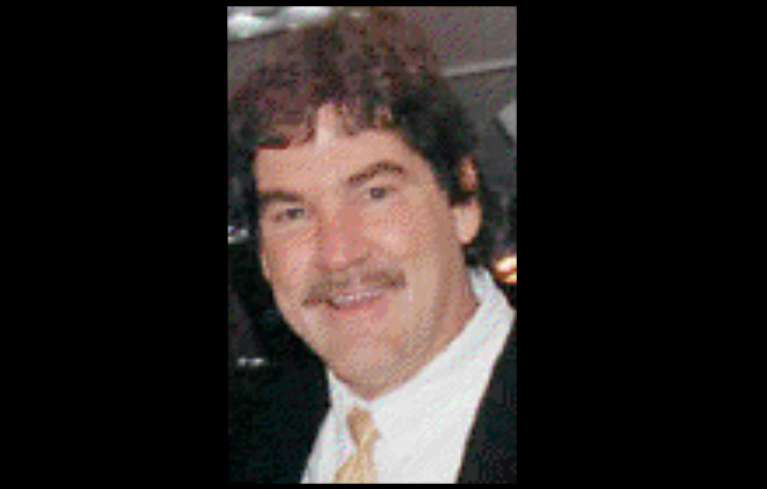
Rick Meyer, El Dorado County public defender, will retire on Feb. 15. Photo/Provided

He has had his share of notorious clients through the years, pointing to the Coddington and Platz cases as two of the more memorable. Meyers described them both as challenging, and ones that consumed numerous hours.

Herbert James Coddington, who was in his 20s at the time, murdered two women at his residence in the Tahoe Verde Mobile Home Park on May 16, 1987, and kidnapped and sexually assaulted a 14-year-old and 12-year-old girl. He is sitting on death row.

In 2003, Lisa Platz was found guilty of the 2001 murder of her 9-year-old daughter, Rebbeca Aramburo. The child was found with her throat slashed inside a tent at Campground by the Lake. Platz was sentenced to life in prison. Her boyfriend James Csucsai hanged himself in jail.

“The public doesn’t always understand the intricacies of these things, how when you get these clients they are real live human beings you develop relationships with,” Meyer told Lake Tahoe News. “We are defending the constitutional rights of these people. Ninety-nine percent are good people who have done something wrong.”

While the number of residents and tourists in town has declined in the nearly 30 years Meyer has been a public defender, the caseload has remained fairly steady. A change is that in the 1980s and 1990s he said there were more drug cases than there are now.

Meyer started his professional career with a private law firm in Placerville after graduating from law school in 1978. He was recruited to join the Public Defender Office in 1983. He started off in South Lake Tahoe. When he was offered the top job in the department he said he’d take it as long as he could stay in Tahoe.

(Meyer is the only county department head based in South Lake Tahoe. When a replacement is named that person will be working out of Placerville.)

El Dorado County Superior Court Judge Suzanne Kingsbury first knew Meyer as a colleague. Meyer hired Kingsbury to work for him in the early 1990s.

“It was Rick that encouraged me to run for an open seat on the Superior Court that became available when Judge Terry Finney retired. I was not, nor am I now a political person, and the thought of running for office was abhorrent to me. I wasn’t sure that I could do it, or that it was the job for me,” Kingsbury told Lake Tahoe News. “Rick’s harping, hectoring and cajoling eventually wore me down. Those same persuasive powers have served him well during his legal career.”

Meyer, now that he is leaving and has nothing to gain by going on the record, spoke of his mutual respect for Kingsbury and the other jurists who are or have been on the local bench.

“We are very blessed in this community to have really fine judges. They all care about people and are uncommonly willing to go out of their way to do the right thing,” Meyer said.

Meyer has long been a champion for those who don’t always have a loud voice.

Beyond the courtroom, Meyer has been on the Family Resource Center board since 1999. Currently, he is president.

“He really works for the underdog. He has always been very conscious of the fact that the Latino population doesn’t get what the rest of the community gets,” Delicia Spees, executive director of the Family Resource Center said.

“I’m amazed how many times when he calls when his clients need to do community service, need a counselor. I don’t see a lot of attorneys do that. They let their secretaries do that,” Spees added.

He doesn’t just talk a good game, but is also a man of action.

Meyer with then Judge Finney was able to turn hard dirt that wasn’t being used for anything into a soccer field next to the center. This allowed the kids at the center to have a respectable play area.

While Meyer has a job that brings him into contact with people who are accused of a variety of crimes, he sees the good in most of them.

“Rick is a tireless advocate for the less fortunate members of our community. In particular, he is a champion for our Latino residents, especially the youth,” Kingsbury said. “He is not afraid to take on an unpopular cause if he believes it to be worthy. I don’t always agree with his positions, but respect what he has to say.”

Meyer will continue to work as Alpine County’s public defender. For the last two years it had been contracted out through El Dorado County, but will change next week to Meyer doing the work as a private individual on a contractual basis with Alpine.

But what Meyer really wants is to be hired full time by Lake Tahoe Community College to teach political science. He is an adjunct faculty member now. About five years ago he went back to school to obtain his master’s just for this purpose.

He also expects to be spending more time with his wife at their Echo Lake cabin, traveling and perhaps teaching abroad.

“It’s been interesting, challenging and very rewarding,” Meyer said of his time with El Dorado County. “All of us who do defense work love our work. It’s very gratifying to stand up for somebody.”


Free bus service increases BlueGo ridership

STATELINE – Free buses at the end of December helped BlueGo increase its ridership by 39 percent compared to 2011 for the same month.

Curtis Garner, who runs the South Shore bus system, called the 131,545 passenger trips in December “extraordinary”.

He gave a presentation to the Tahoe Transportation District board on Feb. 8. TTD oversees the entire transit operation.

BlueGo provided free rides on two routes Dec. 22-Jan. 6 as spare the air days.

The ski shuttles saw an increase in ridership of 42 percent in December. In addition to the buses being free during the holidays, it helped that the fresh snow was being measured by the foot and not in inches.

“It shows ridership responds when it’s free,” TTD Executive Director Carl Hasty said.

— Lake Tahoe News staff report


Social media puts Lake Tahoe woman’s yarn shop on the map

By Melinda F. Emerson, New York Times

Pretty much out in the middle of nowhere in Nevada, there is a little yarn store with a funny name, Jimmy Beans Wool. Actually, it’s in Reno, but it’s a small shop that sells a big assortment of knitting and crochet supplies and every kind of yarn you can imagine.

The store has become a fixture in Reno, but what is really amazing is that the store has annual revenue of more than $7 million, the vast majority from online sales. Some of those online buyers are so loyal to the store that they make pilgrimages to it from around the world. In fact, the store has become such a destination that its owner, Laura Zander, 38, installed a hot tub full of yarn in the warehouse to offer her customers a shared experience — and, more importantly, to create a photo opportunity. You can now find versions of these photos on Facebook, Instagram, Pinterest, and Flickr.

Laura Zander of Jimmy Beans Wool.

Here’s how Zander turned Jimmy Beans Wool into a social media phenomenon.

Zander and her husband, Doug, are former software engineers who decided to reinvent themselves after the dot-com bust of 2000. They left high-paying coding jobs in San Francisco and moved to Reno, where they thought they would start a software consulting business.

Along the way, Zander took a knitting class to relax and got hooked. “I became obsessed with knitting,” she said. “I had no idea there was so much fashion in it. When the Internet bust looked eminent we decided to turn our vacation home in Lake Tahoe into our permanent one.”

But when they tried to build their Web consulting business, they struggled to find clients. One client they did find, the owner of a hand-dyed yarn company, Lorna’s Laces, convinced Zander that she could make money opening her own yarn store and offered to be the company’s first adviser. “She lined up other yarn store owners for me to speak with to convince me it was a viable business model,” Zander said.

She decided to open a shop, and she decided to call it Jimmy Beans Wool. Zander says Jimmy refers to a much-loved character in a favorite Todd Snider song and Beans refers to coffee beans. In the beginning, along with everything you might need for knitting projects, the shop also sold gourmet coffee.

Within a year, the yarn and knitting supply sales were doing so well that Zander decided to ditch the espresso cart and focus on the yarn. But the name continues to help — unusual and memorable enough to stand out among the more than 2,000 other yarn vendors online.

It took five years for Jimmy Beans Wool to reach $1 million in sales. “The first five years in business we just focused on selling wool yarn,” Zander said. “In 2007, we started focusing on building a brand.” In particular, they studied how Tony Hsieh, chief executive of Zappos, used customer service to build sales online.

The first big step was to start posting instructional videos and product reviews on YouTube. “We wanted to position our business to answer any question our customers had about yarn and knitting, so we started doing video reviews of new products,” said Zander. “We noticed you got more space in Google search with pictures and video links.” The first Jimmy Beans Wool video went up on YouTube in June, 2008. Three months later, sales had increased 67 percent.

Today, the Jimmy Beans Wool YouTube channel has more than 1,500 videos and almost 1.5 million views. The store adds an average of two new videos every month. “Yarn is very tactile, and it’s tougher to sell it online because our customers like to have a relationship with people who they buy from,” Zander said. “We explain our products in videos as if we were talking to you in the store. We are purposefully unpolished. Our employees appear in the videos. They don’t wear makeup or have a script. They are all knitters, and they talk honestly about the products.”

Like Zappos, Jimmy Beans believes in giving its customers instant gratification. “We have a rule in our business,” Zander said. “All orders must go out in 24 hours.” The company ships 500 to 1,000 packages every day, seven days a week, and it includes free patterns on its custom shipping envelopes.

Early on, the business developed slow and steady, but its growth has been between 25 and 55 percent since 2007. It has been ranked on the Inc. 5,000 list of fastest growing private companies four years in a row.

Over the last few years, the company has introduced numerous marketing initiatives, including “Knit-A-Longs” tied to Downton Abbey and serving as the first official yarn supplier to the United States Snowboarding and Free Skiing Team. It has also created a Stitch Red campaign to raise awareness of heart disease in women and published a book called Knit Red (Sixth and Spring, June 2012) featuring designs of celebrities who knit. It even created Beans for Brains college scholarships for students who knit or crochet.

All of which may explain why its loyal customers are so eager to visit the little store in Reno, including the hot tub. Jimmy Beans Wool turns photos of its visiting customers into souvenir postcards to memorialize the trip.


Snowshoe benefits Eric Nageotte-Lowe Scholarship Fund

The Eric Nageotte Memorial Fresh Tracks 5K Snowshoe Walk and Race is Feb. 24 at 10am.

You don’t have to race, just have fun.

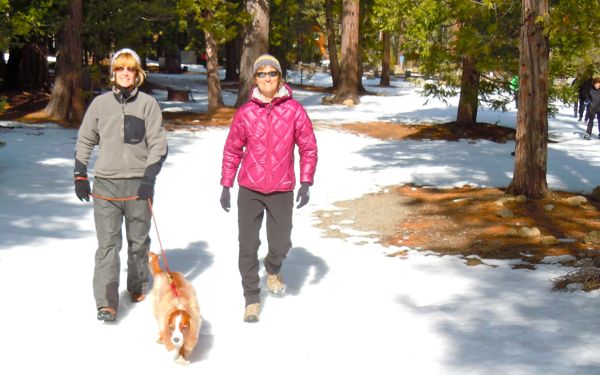
Pam and Darla don't need snowshoes at the 2012 event. Photo/LTN file

Pam and Darla don’t need snowshoes at the 2012 event. Photo/LTN file

Sign up by Feb. 16 to save $10 over race day registration and be sure to reserve a pair of snowshoes if you need them or bring your own. Register by Feb. 16 for $30. This includes a sweat shirt, snowshoe rental if needed, post-race refreshments, and continued day use of groomed Camp Richardson trails. Sweat shirts for the first 50 registrants. Day of race registration is $40. Register online.

The Tahoe Mountain Milers Running Club is hosting the event at Camp Richardson Resort.

The beneficiary is the Eric Nageotte-Lowe Scholarship Fund for the Heavenly Freestyle Team.