Lahontan board OKs changes to water quality plan

By Kathryn Reed

In order for elements of the Tahoe Regional Planning Agency’s Regional Plan to be effective, what’s known as the 208 Plan needs approval from Nevada and California.

The Nevada Environmental Protection Agency signed off on the water quality management plan in January. Now it’s up to California’s Water Board to do the same. The first step in getting that done happened Thursday morning with the recommendation by the Lahontan Regional Board to approve the 208 Plan Amendment.

Not everyone agrees how to regulate water quality at Tahoe. Photo/LTN file

“The existing 208 Plan is a product of its time,” Bob Larsen with Lahontan told the board of the nearly 30-year-old document. This means it does not have total maximum daily load (aka sediment content reaching Lake Tahoe) regulations in it. Plus, there are other inconsistencies based on the TRPA Regional Plan adopted in December.

Laurel Ames with the Tahoe Sierra Club and Jennifer Quashnick with the Friends of the West Shore spoke Feb. 14 in favor of delaying a vote on the 208 Plan Amendment. These are the two groups that earlier this week sued to invalidate the Regional Plan.

Lahontan staff refuted their contention that adopting the changes to the Clean Water Act would negatively impact water quality and land coverage.

TRPA attorney John Marshal said, “The Sierra Club and the Friends of the West Shore are just dead wrong when they say there is not enough environmental analysis.”

The Lahontan Water Quality Control Board voted unanimously in favor of the amendment.


Eagles & Agriculture annual dinner tickets available

Most of the tours for the Feb. 22-24 Eagles & Agriculture event are fully booked, but seats are available for the Friday Night Welcome Dinner in Carson Valley.

Honorary event chairman state Sen. James Settelmeyer will open the evening with remarks on ranching in 201. His brief talk will be followed by the recognition of this year’s Eagle award winners, Robin Wilson and Andy Aldax. Wilson is the former Nevada director of Bird Conservation for the Audubon Society. Aldax is well known in the Carson Valley for his work on the watershed and agriculture and among the many accomplishments on his list.

The program then will present Tom and Cheryl Milham, the founders and operators of Lake Tahoe Wildlife Care.

The Welcome Dinner has featured falconers and their birds for a number of years and this year is no exception.

The cost $35 per person. Reserve a spot by calling (775) 782.8144. More info is online.


North Shore controlled burn to continue

North Lake Tahoe Fire Protection District’s fuels crew will continue the hazardous fuels reduction project in the Galena and Davis Creek through Feb. 26, weather permitting.

This project is a cooperative effort between North Lake Tahoe Fire Protection District, Truckee Meadows Fire Protection District, Washoe County Parks Department and Nevada Division of Forestry. The debris or slash piles were created as a result of a hazardous fuels reduction and defensible space project over the last year, to help minimize the risk of wildland fires in the area.

The project’s safety plan calls for cancellation of the controlled burning based on weather conditions each day, such as significant wind activity or precipitation. The burning piles are expected to produce smoke that may be visible throughout the area. Smoke resulting from the pile burns will affect the surrounding areas for approximately 24 to 36 hours.

People who are smoke sensitive are advised to stay inside and close their windows and doors as much as possible until the smoke dissipates.


Poland pleads not guilty to federal charges

South Lake Tahoe police Officer Johnny Poland pleaded not guilty Thursday to four counts of witness and evidence tampering.

Johnny Poland

The 44-year-old was arraigned Feb. 14. He was arrested on the federal charges in January, with an indictment being handed down earlier this month.

At the hearing in Sacramento, Poland asked for a jury trial.

“The government asked for modifications to the terms of his release because there are several firearms unaccounted for and there are rumors that he has had contact with a witness,” Lauren Horwood with the Department of Justice told Lake Tahoe News. “The magistrate judge felt there was not enough evidence to modify conditions and admonished Poland to account for his guns.”

Poland’s next scheduled court date is at the end of March. For now he is out on bail. He is on unpaid leave from the police department.

 — Lake Tahoe News staff report


El Dorado County education board appoints leader

The El Dorado County Office of Education’s board of trustees appointed Jeremy Meyers superintendent effective July 1.

He is currently deputy superintendent.

Jeremy Meyers

Meyers will fill the unexpired term left by the retirement of Vicki Barber. The position will be on the June 2014 primary ballot.


Experts: California housing market gaining momentum

By Alejandro Lazo, Los Angeles Times

New foreclosures in California fell sharply in January as state rules for banks took effect, signaling that repossessions may finally settle in at levels not seen since before the housing bust.

The resulting decline in bank-owned properties listed for sale on the market — as well as record numbers of investors prowling for bargains — should give the state’s housing recovery momentum this year, experts said.

In the Southland, the new year kicked off with a sharp annual gain in sales, the highest volume for a January in six years. The region’s median home price notched a sharp 23.5 percent gain over the same month last year. And new foreclosure actions plummeted statewide.

“The recovery is for real, that is what I think is happening,” said Esmael Adibi, director of Chapman University’s A. Gary Anderson Center for Economic Research. “It is being driven by real demand, and fundamentals are favorable.”

The price gains reflect a shift in the market away from foreclosures and toward regular sales, indicating a recovery on solid ground, said Christopher Thornberg, founding principal at Beacon Economics.

“The question is, is it the real deal?” Thornberg said. “Sure it is. It is driven of course by a very tight market … about as tight as it gets, and ultimately inventory drives prices.”

Although prices may be gaining, the healthiest contributors to housing strength — employment gains and consumer confidence — appear to be playing less of a factor than investor activity and low mortgage interest rates. That’s cause for some concern, but the housing market still has a long way to go to recover from its peak summer 2007 levels, DataQuick President John Walsh said.

“This fledgling housing recovery has momentum,” Walsh said in a statement. “Already, price hikes have caused some to question whether it’s sustainable, whether it’s a ‘bubble.’ Let’s not forget, though, that we’re still climbing out of a deep hole from the housing downturn.”

The home price and sales gains came as foreclosure starts in California took a massive tumble last month as new state laws aimed at prohibiting certain aggressive bank repossession practices went into effect. The real estate website ForeclosureRadar.com reported a 60.5 percent decline in California default notices in January from December.

The number of default notices — the first formal step in the state’s foreclosure process — fell 77.7 percent from January 2012. A total of 4,500 such filings were logged last month — the lowest number of default no-

tices since at least September 2006, when the website’s records begin.

The website noted that the foreclosure drop came in January, when a package of tough new laws protecting California homeowners went into effect. Most notably, the Homeowner Bill of Rights bans the practice of “dual tracking,” in which a lender seizes a home while the owner is negotiating to lower mortgage payments.

The laws also outlawed so-called robo-signing — the improper or faulty processing of foreclosure documents — and would allow state agencies and private citizens to sue financial institutions, under limited conditions, for economic compensation and for additional civil damages of up to $50,000. Passed last year, the legislative package was sponsored by California Atty. Gen. Kamala D. Harris and written by 10 Democratic lawmakers.

While dramatic, the drop is part of a general decline in foreclosure actions over the last year as banks look toward short sales and loan modifications as alternatives to seizing homes.

“You will see a continued decline in defaults from regulator activity, new laws and from the economy,” said Dustin Hobbs, a spokesman for the California Mortgage Bankers Assn. “As long as the economy, and especially the housing market, continues to slowly heal itself, you will see fewer and fewer defaults.”

Katherine Porter, a UC Irvine law professor who is monitoring the state’s accord with the nation’s five largest mortgage servicers over foreclosure abuses, said that it was not clear to her whether the dramatic drop in foreclosures resulted directly from new laws. The decrease could be temporary, she said, as mortgage servicers adjust their foreclosure processing systems.

Madeline Schnapp, director of economic research for ForeclosureRadar, believes the low levels of foreclosures will continue.

“The plethora of anti-foreclosure laws have been very effective in reducing foreclosure activity to what you are seeing today,” she said.

Foreclosed homes made up just 15 percent of the Southern California resale market last month, down dramatically from the worst of the crash, when they hit a high of 56.7 percent in February 2009, according to DataQuick. Short sales made up an estimated 25.9 percent of January’s resale market.

Fewer foreclosures will probably lead to more gains in home prices, because foreclosures have been the main supply of cheap housing. But rising prices also will lift more underwater homeowners out of a negative equity position, helping them sell their homes, which could also loosen up supply.

Buyers paid a median $321,000 last month in Southern California, a reflection of rising prices and a shift in the buying mix from lower-end starter homes to pricier digs.

Sales of homes in the region’s move-up market have continued to gain. Sales of homes priced from $300,000 to $800,000 soared 49.6% year-over-year in January, while sales of homes costing more than $500,000 jumped 74 percent from a year earlier.

Meanwhile, sales of homes costing less than $200,000 fell 23.5 percent from the previous January, an indication of tight inventory levels in those markets as investors look to snap up houses and rent them out.



Barbera Festival tickets about to be released

Tickets for the June 8 3rd annual Barbera Festival at Cooper Ranch in Plymouth go on sale March 1.

The first two years were sellouts, with more than 2,000 attendees taking part each year.

This summer’s alfresco event, scheduled from 11am to 4pm, will include more than 80 wineries from the Sierra Foothills, Paso Robles, Napa, Sonoma, Lake County, the Santa Cruz Mountains, Santa Barbara County, Ventura County, Lodi, Livermore and the Bay Area, as well as many of the region’s top restaurants and catering companies.

Also consistent with the first two events will be the works of artists and artisans, including jewelry, paintings, pottery and metal work – all displayed in tents throughout the festival and adjacent to participating wineries.

Today, nearly 200 California wineries produce Barbera wines.

Tickets will be available March 1 and are $40/person in advance. Ticket price includes admittance, wine tasting, commemorative wine glass and free on-site parking. Food is sold separately. This is a non-smoking event and can accommodate service pets only at this time. There is also a special Designated Drive ticket for $20/person in advance, which includes event admittance and free non-alcoholic beverages.

For more information about the event or to buy tickets, go online.


Ski report: Go find some love

Happy Valentine’s Day and Lake Tahoe Discovery Day.

It was this day in 1844 that John C. Fremont with scout Kit Carson discovered Lake Tahoe (Big Mountain Lake) from high atop a peak near Carson Pass.

Here is the Feb. 14 ski report.

— Curtis Fong


History of Valentine’s Day dates back many centuries

Expressing ones love to another is a celebrated custom on Valentine’s Day; whereby sweethearts and family members present gifts to one another, such as cards, candy, flowers and other symbols of affection.

Opinions differ as to who was the original Valentine, but the most popular theory is that he was a clergyman who was executed for secretly marrying couples in ancient Rome. In A.D. 496, Pope Gelasius I declared Feb. 14 as Valentine Day. Esther Howland, a native of Massachusetts, is given credit for selling the first mass-produced valentine cards in the 1840s. The spirit continues today with even young children exchanging Valentine’s cards with their fellow classmates.

Those looking for love might want to try one of the 393 dating service establishments nationwide as of 2007. These establishments, which include Internet dating services, employed 3,125 people and pulled in $928 million in revenue, according to the U.S. Census Bureau.

Lots of locations in the U.S. have something romantic about their name – from Loveland, Colo., to Romeo, Mich., to Lovelock, Nev., to Valentine, Texas.


Meyers concentrates on what residents want

By Kathryn Reed

MEYERS – Get rid of the bug station, put in a crosswalk on Highway 50 and have a welcome sign.

Those are just the basics that people in Meyers want.

But when it came to free form discussion Wednesday night of what else they want, the ideas ranged from the immediate – create an app that includes all things Meyers – to the more ambitious – build a direct link to the Pacific Crest Trail.

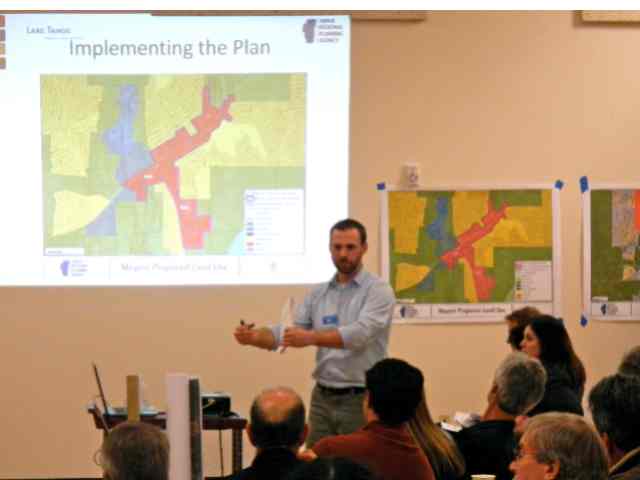
Adam Lewandowski with TRPA explains the area plan process Feb. 13 to Meyers residents and business owners. Photo/Kathryn Reed

Some of the other ideas include restoring the Meyers Creek which once ran through town, erect wayfinding signs, establish a recreation hub, build a sign that involves recreation like bouldering and/or a slide, have parking lots that connect to trails, make the Old Meyers Grade more welcoming, have Tahoe Paradise Park be more prominent, provide public transit that goes to Reno, put a bridge across the Upper Truckee River.

This South Shore enclave at the base of Echo Summit embarked on a path starting last April to capitalize on assets instead of reinventing itself. An advisory panel of seven (three representing recreation, two residents, two business people) has been meeting since August to fine-tune elements from community meetings.

Facilitator and Meyers resident Michael Ward said locals, not tourists have been the focus — which he said is the way planning should be done.

The priorities of this group were outlined Feb. 13:

• Maintain Meyers’ unique character – this in part means focusing on what locals want, not how to attract tourists; as well as embracing heritage.

• On the ground improvements – do things, don’t just talk.

• Simplify permitting – potentially streamlining how special events can take place.

• Recreation – connect trails, make Washoe Meadows State Park more integral.

• Bike-pedestrian friendly – have businesses along routes so people can easily stop.

• Clustered parking – so people don’t have to drive from one business to the next.

• Decrease Caltrans right of way – so the frontage paralleling Highway 50 is put to better use.

All of the information is being gathered to be put into an area plan that will eventually have to be approved by the El Dorado County Board of Supervisors and Tahoe Regional Planning Agency Governing Board. It then becomes the planning bible for Meyers. Area plans replaced community plans in the new Regional Plan. (Despite a lawsuit filed this week, the Regional Plan passed in December is the law of the land today.)

The draft area plan for Meyers will be developed between now and May. Another community meeting will be called in May to go over it. The final area plan should be done in June.