
1-day training to become certified lead safe worker
South Lake Tahoe and Lake Tahoe Community College Connect Community Education are sponsoring the Renovator, Repair, Painter course for local construction workers on Feb. 23.
 The Lead Safe Worker eight-hour training for Renovators, Repair and Painters is being offered at LTCC from 8am-5pm. The cost to attend the training is $50. Up to two workers from each local company are welcome to participate.
This one-day class explains how to comply with the Environmental Protection Agency’s RRP rule. Subjects covered include: health effects, regulations, lead safe work practices, containment, cleaning and record keeping. After passing an end-of-class exam, students will receive their RRP certificate.
To register, call (530) 416-0057, ext. 717.
Tahoe Trail Bar goes gluten free, vegan
By Kathryn Reed
Eating one won’t necessarily have you skiing like Julia Mancuso, climbing like Todd Offenbacher, or even paddling the circumference of Lake Tahoe in a day, or setting cycling records on the Flume Trail – but it could give you a little more oomph to finish the athletic endeavor you set out on.
Offenbacher, Tahoe’s legendary climbing guru, was munching on Tahoe Trail Bars on several expeditions last year.
 “Why I do what I do is so people will have food they enjoy while enjoying the outdoors,” Wes King told Lake Tahoe News.
But the Tahoe Trail Bar isn’t just for athletic types. King, who owns the company, says they are ideal to throw into kids’ lunches or have for an afternoon pick-me-up.
And they are bigger than most bars. The Tahoe Trail Bar is almost 4 ounces, while a Clif Bar is a little more than 2 ounces. (And the price is not double.)
While the brand has been around for 10 years, King has owned the company for the last three years. On Friday, he debuted a revamped bar that is now gluten free and vegan. Plus, the packaging is all new.
“I tried as much as I could to maintain the profile flavor,” King said of the change to the recipe. “Everyone who has tasted it says it tastes better. Most people think it’s not as dry as a lot of bars.”

Tahoe Trail Bar’s package as of Feb. 15.
One thing he uses that other bars don’t is brown rice syrup. This, King says, means energy levels will not spike. The milk chocolate was replaced with dark chocolate to make it vegan.
The high caloric value – about 400 – is designed to keep people active. But these are the good calories compared to eating just chocolate, which would be the bad calories.
The bars are manufactured in Northern California – but beyond that, King would not reveal specifics.
The Mylar paper the bar is in will allow it to have a longer shelf life. This in turn means the big grocery stores will entertain carrying it. The goal is for the bar to be sold outside of the Lake Tahoe Basin.
With the packaging behind him, now it’s time to focus on growing distribution and creating more flavors.
Within two months he anticipates Whole Foods and Raley’s will carry the Tahoe Trail Bar. Right now the only flavor is peanut butter.
More info about the Tahoe Trail Bar may be found online.
V&T rail offers glimpse into Nevada’s past
Nevada’s window into the Old West is wide-open with tickets available aboard the historic Comstock-era Virginia & Truckee Railroad.
 The 2013 season starts in May with runs from Carson City to Gold Hill and Virginia City.
The V&T Railroad offers two options with steam or diesel locomotives that pull Old West-era passenger cars through the rugged Nevada high desert.
Retracing the famous Comstock-era right-of-away, rides feature scenic vistas of the Carson River and Sierra Nevada, with engines passing through two tunnels, abandoned mine shafts, old cemeteries along country-side where sightings of wild mustangs are routine. The historic train travels the same silver route paved by the miners of the Wild West 1860s silver boom.
The V&T offers a variety of ticket options and packages.
For Historic Route schedule and ticket prices, call (775) 847.0380.
Opinion: Watching out for signs of mental illness
Publisher’s note: The following column is the first of a two-part series that looks at the availability and impact of mental health services in Northern Nevada and across the nation.
By Kristin Hestdalen
As Nevada and the Lake Tahoe Basin greet 2013 with a mix of optimism and concern, we have great issues facing our nation, including looming debates on the state of mental health services, gun control, and protecting Second Amendment rights.
 We continue to collectively mourn the devastating loss of life in Connecticut, as 27 people were killed (mostly first-graders). As unbelievable as this tragedy was (and many recently like it), we still face multiple questions: What are we as a nation prepared to change? How can we prevent this from happening again? And what exactly are the possible causes of these horrific acts?
Many commentators and politicians, say it is our “broken mental health system” that needs to be fixed. I am certain that something needs to be fixed, particularly our access to mental health services. But to declare there is a system, broken or otherwise, is naïve. In Nevada, the legislative body has cut 38.1 percent from the total general fund mental health budget over the past three years, making it the state with the fifth highest cut to mental health funding in the U.S. (Statistic from the National Alliance on Mental Health.)
And while legislators and mental health professionals continue to debate next steps, the question remains, “What leads a person to commit such a horrendous act?” I’m not sure there is an easy answer to this question.
Given that hurdle, we do have some ideas about what might predispose someone to consider mass homicide. In a detailed case study done on five mass murderers it was found they all shared some common characteristics and background history. First, the individuals in the study were all bullied as children and often experienced painful loneliness, leading to despair and feelings of social alienation. These were loners who eventually developed extreme anger at their perceived injustice by others, externalized blame, became suspicious and paranoid of others’ intentions and lacked the capacity to look inward in order to create real change. Instead they tended to be rigid, inflexible and narcissistic, unable to see the world except through their narrow lens. Addition of a mental illness (i.e. schizophrenia) exacerbates all of this and further distorts already flawed perceptions of others and their world.
Here are some possible signs that someone needs urgent mental health treatment:
1. An increase in isolative behaviors, such as staying in one’s room, not wanting to interact with family or friends.
2. Changes in mood or personality, especially development of hostility and anger.
3. Changes in interests, particularly an unusual and obsessive interest in guns and violence.
4. Onset of paranoia or suspiciousness.
5. Development of unusual thoughts or ideas and other distortions of reality.
6. Development of frank delusions or hallucinations.
These behavior changes often occur in adolescence or early adulthood and are sometimes the warning signs of very serious mental illness, such as bipolar disorder or schizophrenia. Families or the educational system (high schools, colleges and universities) are often left with the responsibility of finding help for someone who doesn’t want it.
In the next article we will discuss where this help may come from, and look at some examples of how residential treatment, counseling or medications can make a positive impact. So, as debate continues on many fronts and we see continuing acts of seemingly random and unexplained violence, perhaps real change, advocacy, and prevention can come from each of us as we bring the issue of adequate mental health services to the forefront.
Kristin Hestdalen is a board certified child and adolescent psychiatrist for Tahoe Family Solutions in Incline Village where she is a staff psychiatrist as well as chief psychiatrist for Sierra Mental Health Associates.
Minimum wage not keeping up with productivity
By Caroline Fairchild, Huffington Post
President Obama’s call to increase the federal minimum wage to $9 an hour was one of the more significant proposals he laid out in his State of the Union address Tuesday night. But $9 an hour is still a far cry from what workers really deserve, a 2012 study finds.
 The minimum wage should have reached $21.72 an hour in 2012 if it kept up with increases in worker productivity, according to a study by the Center for Economic and Policy Research. While advancements in technology have increased the amount of goods and services that can be produced in a set amount of time, wages have remained relatively flat, the study points out.
Even if the minimum wage kept up with inflation since it peaked in real value in the late 1960s, low-wage workers should be earning a minimum of $10.52 an hour, according to the study.
Between the end of World War II and the late 1960s, productivity and wages grew steadily. Since the minimum wage peaked in 1968, increases in productivity have outpaced the minimum wage growth.
The current minimum wage stands at $7.25 an hour. In 2011, more than 66 percent of Americans surveyed by the Public Religion Research Institute supported raising this figure to $10.
The last time the federal minimum wage increased was in 2009. Currently observed in 31 states, the federal minimum wage translates to an annual income of about $15,000 a year for someone working 40 hours per week.
Vikings basketball teams lose to Elko
 South Tahoe High School’s girls and boys basketball teams’ seasons are over after losing Friday night in the second round of postseason play.
The Viking girls took to the floor first Feb. 15 at Wooster. They lost 49-34 to Elko.
Kayla Griffiths and Ally King fouled out. Bailey David returned to action after having to sit out earlier this week with a concussion. Melanie Grady was out because she sustained a broken nose in the Feb. 13 game.
The boys also played Elko. The Vikings lost 80-42 to the No. 1 seed. Elko will go the championship round being undefeated throughout the season.
— Lake Tahoe News staff report
K’s Kitchen: Grasshopper pie keeps you jumping for more
By Kathryn Reed
I’m not sure if it’s good or bad that Sue and I both love mint desserts. On the one hand it means being able to make something you know the other person will like. But it also means having to share. Considering we are both the youngest in our families, sharing is not our strong suit.
 While I really like dessert, I don’t like many at restaurants. I’m a definite pie snob. So one of the best parts about making a dessert is I can have seconds, thirds and it allows for breakfast to be a repeat of dessert.
One of my favorite desserts is grasshopper pie. It’s a refreshing finish to a meal on a warm night – even if the warmth is from a hot fire. With it being so rich, I tend to cut smaller pieces compared to a fruit pie – which is good when serving to a group or wanting it to last in the freezer for more than a night or two.
My sister, Pam, shared the recipe with me eons ago. She spent the summer of 1981 in Alaska with her boyfriend at the time. One stop was Gustavus, where he had relatives. Pam picked up a copy of “The Gustavus Inn Recipe Book”, which was published in 1977. Sally McLaughlin followed in her mom’s footsteps with making family style meals and publishing a book of recipes. At the time this was published, McLaughlin said the grasshopper pie had been the inn’s most popular dessert since it opened in 1965.
I use Oreo cookies or a cheaper version (two rows from a normal, regular package) and omit the butter and sugar. I put them in a plastic bag to crush – and a wine bottle works just as well as a rolling pin. I don’t have a double boiler, so I put water into the pot I cook pasta in and the ingredients into a medium sauce pan that floats in the water. I also sprinkle some of the fine crumbled chocolate on top of the mixture before freezing it – just to jazz it up a bit.
Grasshopper Pie
The crust: With a rolling pin, crush about two-thirds of a package of plain chocolate wafers until they are fine crumbs. Measure the crumbs – there should be 1 cup. Put them in a small bowl and add 1 tablespoon of sugar and 3 tablespoons of butter. With a pastry blender, work these ingredients together until no trace of butter remains. Press the crumbs firmly onto the bottom and sides of a 9-inch pie pan. Bake the crust for 7 minutes in a 350-degree oven and cool it on a wire rack.
The filling: In the top of a double boiler melt 24 marshmallows with one-quarter cup of milk. Do not let the water under the pot boil and stir the marshmallows occasionally. When they are melted, set the pot aside to cool slightly.
In a small bowl whip 1 cup heavy cream until stiff. When the marshmallow mixture is a little cooler, stir in 2 tablespoons of white creme de cacao and 3 tablespoons of green creme de menthe. Pour this mixture into the whipped cream and gently but quickly fold the two mixtures together. Pour into the cooled chocolate crust and put the pie in the freezer. When it is frozen hard, cover the pie with plastic wrap and tin foil folded tightly over the edges.
If the pie is frozen very hard, it is sometimes better to let it sit at room temperature for 15 minutes before serving. Cut into very small pieces as it is very rich. Will keep in freezer for up to two weeks.
S. Tahoe man to face charges involving brother’s death
A 22-year-old South Lake Tahoe man has been charged with vehicular manslaughter in the death of his brother.
Roberto Olazaba was reportedly intoxicated as he was driving Dec. 15 on Pioneer Trail at Ski Run Boulevard when his Honda accord broadsided a GMC Yukon.
William Olazaba, 26, was a passenger in the Honda. He died at Barton Memorial Hospital.
— Lake Tahoe News staff report
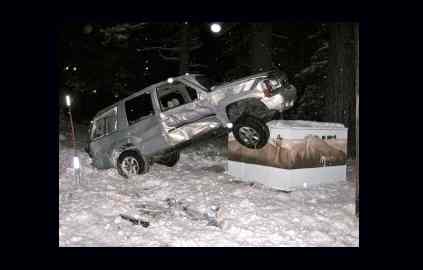
The passenger in the Yukon required treatment at Barton Memorial Hospital. Photo/Provided
Employee accused of stealing from Incline women’s center
By Kathryn Reed
An employee of Tahoe Safe Alliance has been accused of embezzling about $15,000 from the nonprofit.
The woman, whose name has not been released, was fired from the North Shore organization in December. A criminal complaint was filed Feb. 15 with the Washoe County Sheriff’s Office.
 The woman had worked in the Incline Village office. The 28-year-old organization also has offices in Kings Beach and Truckee to help people with domestic violence, sexual assault, and child abuse issues.
“None of our programs are or will be affected by this loss,” Executive Director Karen Carey told Lake Tahoe News.
She also said based on the internal investigation that no one else is believed to be involved. The alleged theft occurred for about the last six months of 2012.
“We have a $1.4 million budget. Even one dollar stolen from us we take very seriously,” Carey said.
The goal is to get the stolen money repaid by the woman who had been a longtime employee.
“It was fundraising and donor dollars. We respect them and value them. That is one of the reasons why we are going to make every effort to get the money back,” Carey said. No grant money was taken.
A letter has been sent to donors explaining the situation and Carey has met individually with more than two dozen people to answer questions.
“A positive outcome of these events is that we know that our current financial safeguards worked — allowing us to uncover this theft. With that said, a forensic accounting team will review our financial records to gain deeper understanding of the situation. We commit to review and strengthen our internal policies, procedures and processes as needed,” the letter says.
While Tahoe Safe Alliance thought it had enough protocols in place for something like this not to happen, the holes that were uncovered have been sealed.
When the matter is behind the group, Carey hopes to be able to share Tahoe Safe Alliance’s experience with other nonprofits in hopes they don’t have to go through the same thing.