Nevada Division of State Parks is accepting applications to help fund eligible projects that include new construction, maintenance, trail related facilities or education projects.
Parks has approximately $1.25 million in grant funds from the Federal Highway Administration trails assistance program. A minimum of 30 percent of funds will go to motorized projects. A maximum of 5 percent will be awarded to environmental education trail training projects.
Federal, state, city and county governments, special governmental districts, trail organizations and private individuals are potentially eligible for the grants.
The 2013 Grants Manual and Application packages are available online. Applications are due April 5 by 5pm.
For further information or questions, contact Jenny Scanland at (775) 684.2787 or email jscanland@parks.nv.gov.
Film festival coming to Stateline
The silver screen meets glittering Lake Tahoe at the 8th annual Wild and Scenic Film Festival on March 8.
The event at the MontBleu showroom in Stateline is a benefit for the Sierra Nevada Alliance.
The festival combines award-winning environmental and adventure films with the energy of local activism. Featured films at the event will cover outdoor adventures, battles to save the environment and inspirational stories of people making a difference.
Filmmaker Mike Wier will be presenting films at the event and participating in fhe Filmmaker Q&A session. The Film Festival will also include an Activism Area where attendees can learn more about the issues affecting the Sierra Nevada. It will be a zero waste event.
Advance tickets are $12 for Sierra Nevada Alliance members, $15 for non-members and $10 for students. Advance tickets may be purchased online and at Patagonia South Lake Tahoe. Tickets will be available at MontBleu the night of the show for $20. Doors open at 6 pm; films start at 7 pm.
Kings Beach face-lift set to begin in summer
By Barbara Barte Osborn, Sacramento Bee
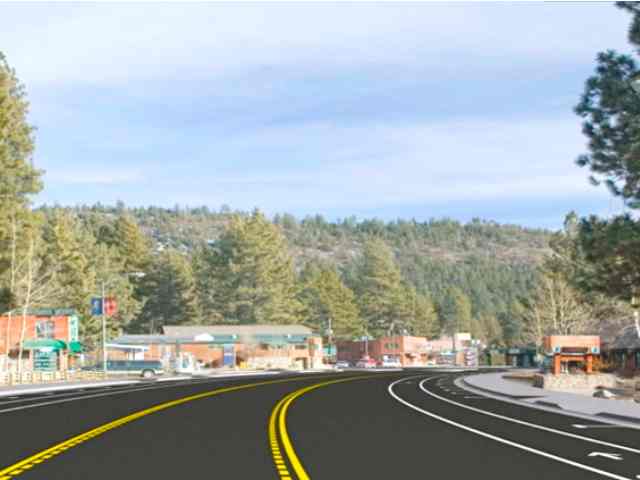
Construction on a long-awaited project to revitalize a popular north Lake Tahoe community’s downtown and make it safer for pedestrians is expected to begin this summer.
The Kings Beach Commercial Core Improvement Project, estimated to cost $48 million, is aimed at improving pedestrian access, water quality and aesthetics for residents and visitors.
Last week, Placer County supervisors approved a financing and construction plan for the project’s first phase, which will begin the reconfiguration of Highway 28 through the downtown core.
Improvements to Kings Beach are set to begin in May.
It also will address traffic management in neighborhoods north of the highway. Other downtown improvements will be detailed in a second, final phase.
A Feb. 19 open house from 5:30-8pm at the North Tahoe Event Center has been scheduled to answer questions from the public, said county spokesman Robert Miller.
In the planning stages for decades, the project will reconfigure 1.1 miles of Highway 28 into three lanes with two roundabouts. It currently is a four-lane highway with a traffic signal at Coon Street.
The wide road is flanked by very few sidewalks, making pedestrian access to shops, restaurants and beaches difficult and sometimes dangerous.
Sidewalks, bike lanes, bus shelters, water-quality improvements and landscaping in the downtown area are included in the project.
The stretch of highway through Kings Beach is one of the last remaining four-lane sections of road on Lake Tahoe’s North Shore, said Dan LaPlante, a county associate engineer and the project’s manager.
Because concerns have been expressed that some drivers may cut through neighborhoods once the highway is narrowed, sidewalks and traffic-calming devices, including 29 speed humps, will be installed in neighborhoods north of downtown.
Eight humps already have been installed. Speed-radar signs and neighborhood entrance features will also be used to slow traffic.
County supervisors in January approved the formation of a benefit assessment district to maintain the improvements, saying the district was favored by a majority of ballots from affected property owners.
The $166,000 annual assessment will be divided among 296 property owners whose property is fronted by the planned improvements, based on the amount of frontage, lot size, square footage and zoning, LaPlante said.
Most of the assessment will be used for the removal, hauling and storage of snow. The remainder will go toward the repair, replacement and power washing of sidewalks, emptying trash receptacles and maintaining landscaping.
LaPlante said the project’s $48 million cost will come from a combination of federal, state and local funding. Still needed is about $10 million, he said.
The first phase of the two-phase project is expected to take up to three construction seasons, Miller said, noting that “in the Tahoe basin, construction can take place only between May and October.”
No estimate is available for completion of the second, final phase.
“It’s funding-dependent,” LaPlante said. “We don’t know where the remaining $10 million will come from, but we’re committed to doing the entire project and are working on finding funding sources every day.”
U.S. shines at World Ski Championships
By USSA
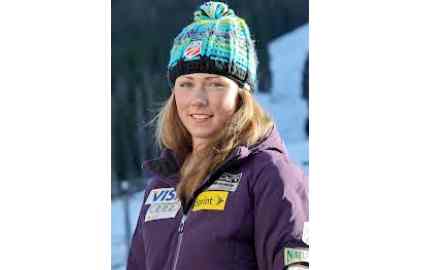
SCHLADMING, Austria — Teen Mikaela Shiffrin (Eagle-Vail, Colo.) skied a powerful, aggressive second run to come from behind Saturday to win gold in slalom at the FIS Alpine World Ski Championships in Schladming.
Third after the first run, Shiffrin overcame a 0.18 lead by Sweden’s Frida Hansdotter who took bronze. Austria’s Michaela Kirchgasser took silver.
Mikaela Shiffrin
It was the first World Championship medal of their careers for each of the medalists.
Shiffrin became the third youngest woman to ever win a slalom World Championship and youngest American to win any title since 17 year old Diann Roffe won gold in giant slalom in 1985.
It was the fifth medal for the United States and fourth gold. Ted Ligety (Park City) won in super G, super combined and giant slalom. Julia Mancuso (Squaw Valley) won in giant slalom.
A sold out stadium of over 30,000 was on hand in Schladming for the final weekend of the Championships.
Tahoe area freeskiers in back of the pack
By USSA
ROSA KHUTOR, Russia — Torin Yater-Wallace (Aspen) and Gus Kenworthy (Telluride, Colo.) battled through fog and rain Feb. 16 to go one-two for U.S. Freeskiing in the pre-Olympic test event of the halfpipe at Rosa Khutor outside Sochi. It was the first opportunity for the top athletes in the Olympics’ newest event to visit Sochi and test the new pipe.
Torin Yater-Wallace
Yater-Wallace soared to his first win of the season.
David Wise (Reno) was unable to impress the judges as he has through the Visa U.S. Freeskiing Grand Prix and X Games events recently and was fifth.
Top American woman was Jamie Crane-Mauzy (Park City) in ninth.
South Lake Tahoe’s Maddie Bowman said, “I’m really disappointed with myself. I just couldn’t get my trick dialed on this pipe. It’s been a great experience to check out Russia and where the Olympics will be.”
One Billion Rising South Lake Tahoe
On Feb. 14, 2013, South Lake Tahoe was part of worldwide movement called One Billion Rising. One Billion Rising began as a call to action based on the staggering statistic that 1 in 3 women on the planet will be beaten or raped during her lifetime. With the world population at 7 billion, this adds up to more than 1 billion women and girls.
Video is courtesy of Tahoe Production House.
UNR hosting diversity leadership conference
The Associated Students of the University of Nevada Unity Department will host the third annual diversity leadership conference, entitled “Power of Diversity” on March 2 from 10am-4pm in the Joe Crowley Student Union.
The conference is free and open to the public and university students. Early registration is encouraged.
This year the conference will feature keynote speaker Coach Herman Boone, who inspired the film “Remember the Titans”. Boone will discuss leadership, team building and his experiences with his football team. Attendees can also participate in a meet and greet with Boone.
The diversity leadership conference will also feature a variety of workshops including “The Effects of the Great Recession on People of Color” and “LGBTA-Q Awareness and Education.” A student lead panel focused on topics regarding diversity and leadership will also take place.
As part of the event, participants will receive a free lunch and a conference T-shirt. Registration for the conference will take place in front of the JCSU Theater. Students and community members are encouraged to register for the conference online.
Ice sculptors take over Northstar Village
By Nathan Hurst, Wired
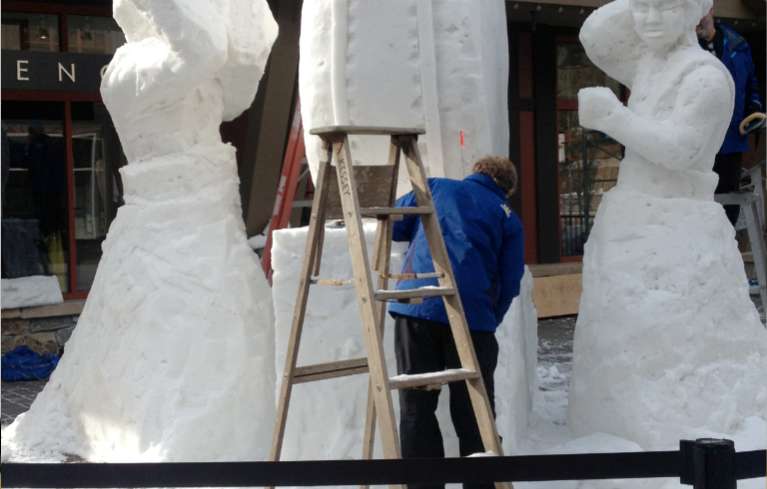
Last weekend at Northstar was beautiful, sunny, and in the 30s. For eight teams of snow carvers from around the world, though, it’s terrible — the melty snow is sloppy, hard to carve, and even dangerous.
Teams of three from Finland, Japan, Germany, Canada, and the U.S. were selected from more than 40 applicants for the inaugural Carve Tahoe, a five-day competition to hew works of art from 14-foot-high, 20-ton blocks of snow. But despite the bad snow, the teams rely on decades of experience, handcrafted tools, and creative techniques to fashion their massive sculptures. The team members are sculptors and artists and designers, but also doctors and lawyers. Though they spend weeks each year carving, nobody makes a living doing it.
“Everyone seems to have their own method of doing things,” says Team Wisconsin’s Mark Hargarten. “It’s amazing how different they are.”
Sculpting at Northstar. Photo/Kathleen Jay
The Wisconsin team uses a grid system for their carving — a Native American wearing an eagle costume, its feathers turning to flames, called “Dance of the Firebird.” The polyurethane model they built is scaled so one-half inch equals one foot on the finished snow sculpture. They cut a copy of the model in four, and covered each section with clay, sectioned in half-inch increments. They etch corresponding lines in the snow, one foot to a side, and they peel off one piece of clay, carve the part of the sculpture they can see, and move on to the next.
“You never get lost using the method,” says Dan Ingebrigtson, a professional sculptor from Milwaukee. “Three or four guys can work from different angles, and meet in the middle.”
Wisconsin’s got several other strategies behind their carving as well. From the south, it looks like they haven’t even started; they left the southern side of the block intact to protect the rest of it from the sun, and the wall has been decimated by the heat. More than 20 percent of its thickness has melted by Sunday night, three days in. After the sun goes down, the team is hollowing out the interior of the structure, so it will freeze faster overnight.
Other teams are relying on nighttime freezing as well. A team partly from the U.S. and partly from Canada carves spires from blocks they removed from the sculpture, and plans to attach them to the top of their sculpture, “The Stand,” which incorporates four interwoven trees. They’ll use melty snow pulled from the middle of the block right when the sun goes down to cement the tops onto the trees, says team member Bob Fulks from the top of a stepladder as he cuts away at the sculpture with an ice chisel.
Fulks’ team is leaving Tahoe after the competition to go straight to Whitehorse, in the Yukon, for another competition, where he anticipates no problems with warm weather.
“It’s a good gig, you can travel all over the world doing it,” he says. “You go around and see the same people.”
Many of the carvers know each other from previous competitions.
“We’ve sculpted with almost everybody here before,” says Team Idaho-Dunham’s Mariah Dunham, who is working on “Sweet House (of Madness)” with her mother, Barb. The creation is a beehive, with the south side as the exterior, and the north side (intentionally placed out of the sun) as a representation of the comb, including hexagonal holds that perforate all the way to the hollow interior.
Though Carve Tahoe is new, snow carving is not. Many of the sculptors have been at it for more than 20 years, traveling around the world and meeting and competing against many of the same people — though each competition demands unique new designs from all the sculptors. Kathryn Keown discovered snow carving while Googling something completely different, and decided she wanted to host an international event.
“First we fell in love with the sculptures, then we fell in love with the sculptors,” says Keown, who founded the competition with Hub Strategy, the ad agency where she works.
Keown contacted several ski areas before Northstar, but the resort was on board right away; its owner, Vail Resorts also owns Breckenridge, where one of the biggest and most prestigious snow carving competitions is held.
But Keown wanted to commit to the design of the competition, not just the sculptures. Applicants submitted their designs last summer, and Keown enlisted Lawrence Noble, chair of the School of Fine Art at the Academy of Art University to help choose modern, complex, realist designs. She wanted no artsy, kitschy snowmen.
Then she chose a design-friendly logo and judges. In addition to Noble, the panel of judges features a sushi chef from Northstar, two interior designers, a photographer from nearby Squaw Valley, and Bryan Hyneck, vice president of design at Speck, which makes cases for mobile devices and was one of the event’s sponsors.
“The level of complexity and sophistication in this type of sculpture is just amazing,” says Hyneck, who has judged industrial and graphic design competitions, but never snow carving. “It’s amazing how organic some of the shapes can be.”
As a judge, Hyneck says he’ll focus on the craft and the execution of the sculptures, and how the sculptors use particular techniques to take advantage of the snow’s properties. But he adds that subject matter, point of view, message, and relationship to a theme are all important points as well.
“Anybody that is really going to push the limits of the capabilities of the media is going to get a lot of my attention,” he says.
For some, like the Germans, that means suspending massive structures made completely of snow. Their sculpture, titled “Four Elements”, features four large spires encircled by a tilted disc. Despite a trickle of melted snow dripping off the bottom edge, one — or even two — of the German carvers frequently stand atop the sculpture, using saws or chisels to shape the towers.
Sunday evening, after the sun has gone down and the temperature dropped, Josh Knaggs, bearded, with a cigarette in his mouth, is sitting in the curve made by the largest bear from the Team Idaho-Bonner’s Ferry sculpture, “Endangered Bears.” Wearing a blue event-issued jacket, he’s brushing out the hollow loop made by mama and papa bear.
Three days later, the judges award Knaggs and his team third prize, with Japan’s modern work, “Heart to Heart” coming in second and Germany’s gravity-defying “Four Elements” taking first. The teams disperse, and after a few more sunny days, Northstar tears down the structures before they get too soft and fall — all except the German piece, which can’t bear its own weight and collapses after judging is complete. But the ephemeral nature of the snow is part of what attracts the competitors.
“It’s for the moment, and it’s a beauty all in itself, creating something that’s gonna be disappearing, you know, it’s okay that it disappears,” says Team Truckee’s Ira Kessler. “We are making it for the moment.”
Flash in night sky a meteor in Bay Area
By San Jose Mercury News
It may not have been as spectacular as the space rock that streaked across the skies above Russia late Thursday, but the Bay Area’s close encounter with a meteor Friday night was drawing its own attention on social networks.
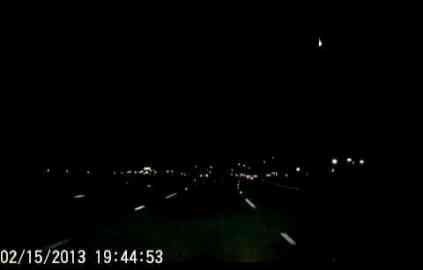
Comments on Twitter indicated the object that flashed across the horizon about 7:45pm was blue in color and visible throughout the Bay Area and large areas of the West Coast, with at least one reported sighting in Washington state.
Amateur video footage broadcast on KTVU-2 showed a bright streak lasting approximately five seconds that appeared to head downward. Some viewers described it as a firework in the night sky.
One commenter on Twitter, who said they saw the meteor while driving in a car in Cupertino, said the object appeared to be headed west.
Scanner traffic at the Contra Costa County Sheriff’s Office indicated that they were aware of the event, but a dispatcher said they had not received any emergency calls related to it.
Gerald McKeegan, an astronomer with the Chabot Space and Science Center in Oakland, was at the center Friday evening for its weekend stargazing sessions with free access to the center’s large telescopes, but he said they did not spot the meteor there.
He said that the center received phone calls from people who reported seeing the meteor. Based on their reports, McKeegan said it may have been what astronomers call a “sporadic meteor,” an event that can happen several times a day but most of the time happens over the ocean, away from human eyes, and brings as much as 15,000 tons of space debris to Earth each year.
Meteors, hunks of rock and metal from space that fall to Earth, burn up as they go through the atmosphere, which is what apparently caused Friday night’s bright flash of light, McKeegan said.
It was likely smaller than another meteor that landed in the Bay Area in October, which caused a loud sonic boom as it fell, breaking apart and spreading rocks, called meteorites, in the North Bay, McKeegan said.
There were no reports of damage from Friday’s event, unlike the object that crashed down in the Ural Mountains of Russia less than 24 hours earlier shattering windows, scattering debris and injuring an estimated 1,100 people.
NASA scientists said that object, described as a “tiny asteroid,” measured about 45 feet across, weighed about 10,000 tons and was traveling about 40,000 mph before it exploded 15 miles above the Earth’s surface with a force equivalent to a small nuclear bomb.
Astronomers at the Chabot observatory said Friday night’s light show was not connected to the fly-by of a small asteroid earlier in the day. The asteroid, which NASA dubbed 2012 DA14, came within 17,200 miles of the Earth before continuing on its cosmic journey.
Meteorite in the Bay Area
On a day that had a lot of people talking about meteorites and asteroids, a fireball of some sort was seen Feb. 16 streaking across the Bay Area skies.
 Parks has approximately $1.25 million in grant funds from the Federal Highway Administration trails assistance program. A minimum of 30 percent of funds will go to motorized projects. A maximum of 5 percent will be awarded to environmental education trail training projects.