‘Buddy system’ — the legacy of Alyssa Byrne

By Mary Callahan, Press Democrat

Friends and relatives of a young Petaluma woman who perished in the snow after attending an outdoor New Year’s Eve concert in South Lake Tahoe are trying to use their grief to help others avert tragedy.

Using funds donated in memory of their daughter, Alyssa Marie Byrne, 19, Kim and Kevin Byrne and others have launched a public service campaign promoting the buddy system to help keep teens and young people out of danger.
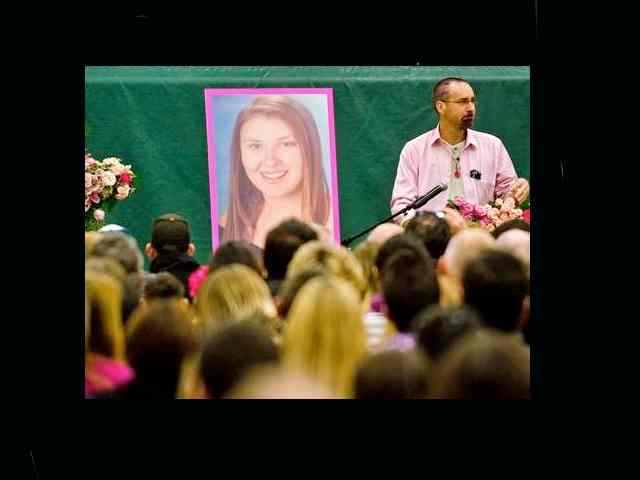

Kevin Byrne, Alyssa Byrne’s father, welcomes family, friends and supporters to a memorial service for Alyssa in January. Photo/Alvin Jornada/Press Democrat

They’re targeting middle and high school children, asking them to pledge to seek safety in numbers, and encouraging them to call a trusted adult at the first sign of trouble.

Assigning buddies is a tradition for outings involving young children, who customarily double up and holds hands so all can be accounted for in a group.

But even older children need to stick together, and beyond that know to get help and who to call if a buddy is at risk, Kevin Byrne said.

A key piece of advice offered through the campaign, dubbed “Always Buddy,” is that kids whose cellphones are packed with friends’ phone numbers should make sure they also have contact numbers for their friends’ parents or other family members.

“It’s your responsibility to reach out, talk to your buddy, have a contact list of who to go to if you think something is going wrong,” Kevin Byrne said. “They need to buddy more than just being there.”

The effort is born of lessons learned from Alyssa Byrne’s death and a desire for something positive to come out of it. But it’s also steeped in the love the Byrnes have both received and cultivated in its wake.

“Kevin and I and Greg (their son) count ourselves so fortunate to live in this town that has been nothing but loving and supportive,” Kim Miller-Byrne said. “We definitely want to pay it forward in any way we can.”

The Byrnes’ daughter, a 2011 Casa Grande High School graduate, disappeared New Year’s Eve and died alone — her body frozen in the snow for three days before a utility worker peered over a snow bank and discovered it.

Byrne had gone to Tahoe with three friends, shared a room with them at a hotel in Stateline, and attended the three-day SnowGlobe Music Festival in their company, as well as hanging out with many other friends from Petaluma who drove up for the event.

But the last night of the concert, Byrne was walking ahead of her friends when she apparently decided to go back to the hotel before the last show was over. She left without a word, though she later told one of them by phone that she was on a shuttle bus heading back to Stateline. Authorities now believe Byrne decided to walk to the hotel, frustrated like many other concertgoers by the long wait for a bus.

They presume from the location of her body that she turned the wrong way on a main road back to Stateline. The temperature dropped below freezing that night, and friends said she had been drinking.

Kevin Byrne has been leading the buddy campaign in conjunction with several younger friends, including one who decided at Alyssa’s memorial service that those in attendance should take a pledge to stay together when they’re out and about in an unfamiliar place.

Taylor Derby, 19, one of those who initiated the pledge, said she was inspired in part by her recollection of a 2-year-old Rohnert Park girl who was struck and killed by a texting college student in December 2010. In the aftermath, some students signed pledges never to text behind the wheel.

“Alyssa was one of my best friends,” Derby said last week, “and I don’t ever want to lose somebody so close to me again.”

Kevin Byrne said he and his wife decided the pledge would be a good way to use donations supporters began making when their daughter disappeared.

Derby ordered 300 hot-pink bracelets printed in memory of her friend and sold them for $3 apiece while she, the Byrnes and others worked out ideas for a larger campaign.

Casa Grande senior Sara Frazier is working with Kevin Byrne to develop a program for middle school students as part of her senior project. “I knew I wanted to do something for Alyssa,” she said.

Frazier plans to visit schools and deliver bracelets and pamphlets that extol the virtues of staying safe in numbers. The pamphlets have a section where kids can fill in their friends’ phone numbers or others they could call for help.

Friends have organized a benefit hip-hop concert Feb. 23 at The Phoenix Theater in Petaluma to raise funds toward the program.

“I know the word is all over the place,” said concert promoter Jay Donnellan. “We’re hoping for a sellout.”

“It gives me a great feeling to see these kids and talk to them and (see) how they’ve rallied around this,” Kevin Byrne said. “It’s a shame it takes this kind of tragic situation, but the kids are all responding to it in a very positive way, and they’re trying to learn something from it.

“And, again, they’re trying to make sure this doesn’t happen to anybody else.”



Tahoe cops arrest 3 men on drug, weapons charges

Three men spent Presidents Day in the El Dorado County Jail in South Lake Tahoe after being pulled over on a routine traffic stop.

Officer Travis Cabral pulled Brian Morris of Sacramento over about 4pm Feb. 18 when he saw the vehicle going the wrong way on Pioneer Trail. Jeremy Watkins and Michaelann Campbell, also from Sacramento, were passengers in the vehicle.

The combination of the smell of marijuana coming from the car and Morris saying he had no ID and then giving a false date of birth led to all three men being told to keep their hands in view. By this time Officers Jake Herminghaus and Matt Morrison, with his K9 partner Quatro, were on the scene.

“Suddenly, Morris dropped his hands out of view and began reaching under his seat. Officer Cabral drew his handgun and ordered Morris to show his hands, but Morris refused and continued reaching under his seat,” a press release from the SLTPD reads. “Officer Herminghaus also drew his weapon as Officer Morrison opened the front passenger door and presented his K9, Quatro. It was only then that Morris complied with the orders given by the officers and brought his hands back into view.”

A search of the vehicle turned up a loaded handgun under Morris’ seat next to 27.9 grams of suspected methamphetamine. An additional 5.2 grams of marijuana was found under the drivers’ seat and center console of the vehicle, according to officers.

Morris was booked on charges of possession of a controlled substance with a loaded firearm, possession of a firearm with a prior violent offense, prohibited person possessing ammunition, concealed weapon inside a vehicle, transporting a controlled substance, driving while under the influence, providing false information to a peace officer, resisting arrest and conspiracy to commit a felony. Watkins and Campbell were arrested on charges of conspiracy to commit a felony and transporting a controlled substance.

— Lake Tahoe News staff report


Ski report: The weather has changed

A winter weather advisory in effect through 10 this evening.

Wind could be a problem for lifts at the top of the mountain.

Here is the Feb. 19 ski report.

— Curtis Fong


Snippets about Lake Tahoe

• Paris Hilton was on the South Shore to celebrate her 31st birthday and open the new nightclub at Harrah’s Lake Tahoe. She spent part of the weekend at Barton Memorial Hospital after boyfriend River Viiperi sliced open his leg on a jump at Heavenly Mountain Resort.

• Michael Holcomb has been promoted to vice president, financial adviser for Morgan Stanley’s Lake Tahoe office.

• South Lake Tahoe firefighter Kenin Fairley has been promoted to shift commander.

• In honor of Bill Foster, a 30-year veteran ski patroller who died in December while on duty at Alpine Meadows, Alpine and Squaw Valley are dedicating the Bill Foster dog adoption room that will be built as part of the Truckee-Tahoe Humane Society this fall.


USFS reissues Camp Rich upgrade proposal

By Kathryn Reed

Parking on the road leading to the Beacon restaurant is no longer part of the U.S. Forest Service’s plans when it overhauls the Camp Richardson area.

A group of homeowners along Jameson Road had protested the original proposal, which brought a halt to the process, withdrawal of the earlier decision and forced the Forest Service to reconvene.

Alleviating congestion at Camp Rich is a goal of the Forest Service. Photo/LTN file

The houses are beyond the marina, but the way to access them is via the same road one uses for the restaurant. There is also a question as to who owns that road.

Another environmental analysis is back on the street for a 30-day comment period that ends March 15.

“Based on subsequent discussions and analysis, the Forest Service has concluded that resolving concerns surrounding day use parking along Jameson Beach Road is important and that these actions need to be considered in more detail and in a broader scope. Appropriately addressing the retrofit of these resort areas and the 75 parking spaces for day use beach users will need to consider the reconfiguration of the area west of Jameson Beach Road,” Daniel Cressy, USFS landscape architect and recreation planner, told Lake Tahoe News. “The retrofit of circulation and day use parking along Jameson Beach Road is outside of the scope of the current project and is not considered in detail at this time.”

The residents are not completely thrilled with what the Forest Service is doing by not including Jameson Road in the revised plan.

“In a message to me, a USFS representative indicated that the U.S. Forest Service has ‘scaled back’ the project to only address BMP campground issues thereby ‘allowing further time to discuss residents’ concerns regarding Jameson Beach Road.’ This too overlooks that the residents have been not only willing, but trying to engage the USFS in discussions for at least three years in hopes of amicably resolving the issues, yet to date the USFS has failed to engage in any meaningful discussions,” Jacqueline Mittelstadt, attorney for the Jameson Beach Association, told Lake Tahoe News. “We will scrutinize carefully the new proposed project and EA. Hopefully, their second try is a better try.”

The project’s goals for these three South Shore campgrounds that are on both sides of Highway 89 include substantial upgrades for overnight guests, improved traffic flow for all motorists, installation of erosion control measures, and better access for those with disabilities.

Improvements include replacing the four bathrooms with seven ADA accessible facilities, adding bear-proof dumpsters and food lockers, upgrading utilities, installing barbecues at all campsites, and adding fire hydrants for the area.

The total area to be addressed is 79 acres.

Other proposed improvements include more paved bike trails, a restroom near the beach, and replacing fencing between Camp Richardson Resort and Pope Beach Road.

Four alternatives are in the environmental document. The preferred alternative includes the possible remove of 40 trees with a 30-inch diameter and 910 trees smaller than that.

Work could be begin this building season. All the work is estimated to take five years. As work is being done, the public won’t have access to certain areas.

Comments may be submitted electronically to comments-pacificsouthwest-ltbmu@fs.fed.us. For more information, contact Daniel Cressy or Matt Dickinson at (530) 543.2694, or go online.


4-week class to focus on gay-lesbian poets

Homopoetica is a four-week class that will be taught at Bona Fide Books in Meyers starting March 7.

Each session is from 6-8pm.

Join Sara Wiseman for a discussion about the work of gay and lesbian poets throughout history. The class is free, although donations are accepted.

To sign up or for more information, email homopoetica.lit@gmail.com.


Letter: Commending Barton for excellent care

To the community,

I was awakened the other morning morning with a bad belly pain.

I have been a patient of GI problems most of my life and do not hesitate when problems arrive. I went to the Barton emergency room where I was diagnosed with gallstone problems. A couple of days later I was released.

Two days later I was back and my gallbladder was removed.

I have been treated for GI problems my whole life and I do have the background and experience to judge proper care. We are very lucky to have a hospital where everyone I had contact with gave proper professional care. I will not attempt to identify all the staff I had contact with because it was for most part a blur of time and people.

I know it is hard to provide care of all types of problems.

From a small hospital I must say I was treated well by everyone there. We are very lucky to have the Barton hospital and their staff in our community. As an 80-year-old patient, I am really glad they are part of my community.

David DeWitt, South Lake Tahoe


California’s quest to recover fire fees questioned

By Kevin Yamamura, Sacramento Bee

The fire started with an anchor bolt on a hot October day at a Ventura County reservoir.

A laborer took his chop saw to the half-inch-thick piece of metal, creating a spark that landed on dry brush.

“This thing just took off like a bomb,” recalled Manuel Mendez, whose family concrete business worked on a boat ramp that day at Lake Piru.

No one has been found culpable for the 2007 Angora Fire in Lake Tahoe.

All told, 63,000 acres burned in the 2003 Piru Fire. In 2009 and 2010, Mendez spent more than $2 million compensating federal and state firefighting agencies for the damage, an amount he says left his business “hanging by a thread.”

“We admitted guilt, that one of my guys did start it,” he said. “But I thought it was crazy the amounts they were charging.”

For the last eight years, the state has more aggressively gone after businesses and individuals it blames for starting wildfires. Now those it has targeted are pushing back, arguing that fire officials are overreaching in an effort to secure more money for the state.

At first, fire officials established an off-the-books account in 2005 that paid for specialized training and technical equipment, funded by a portion of wildfire settlements. That only became widely known this year.

In 2008, the state created a squadron of lawyers, fire accountants and investigators now known as the Civil Cost Recovery Program. In state budget circles, the unit is considered a financial success for its high return on investment – so much so that Gov. Jerry Brown is asking lawmakers in his new budget to expand the permanent staff from 14 to 24.

Sen. Jim Nielsen, R-Gerber, who represents a vast section of forestland in Northern California, said the state should limit its recovery to situations where it is “irrefutable beyond a reasonable doubt” that someone caused a fire.

“It’s clearly being abused,” he said. “The state is going to try to identify as many sources of revenue for government as it possibly can, and that’s what’s driving it.”

Officials of CalFire say the special unit is sticking up for taxpayers by demanding money from people who carelessly sparked wildfires that required tens of millions of dollars to extinguish. They also say cost-sharing agreements with federal and local agencies require the state to pursue money from those who start fires.

The state pays its share of emergency firefighting out of its general fund, and annual costs over the last decade averaged $249 million.

Not all of that money can be recovered. Fire officials like to say you can’t bill God for lightning strikes.

But the department recovered less than $2 million annually from 2001 through 2003.

As the state faced a deep budget deficit, the unit recouped a record $35.6 million in 2010-11. The state at the time spent less than $3 million annually on the 14-person program.

“Our ultimate goal is to return the most money to the taxpayers who paid to suppress these fires,” said Cal Fire spokeswoman Janet Upton.

Timber industry resists

Environmentalists who battle with timber companies on a range of issues support CalFire’s drive to collect money.

“If they cause forest fires, they bear the burden of the cost of those fires, and not the public, especially if they are doing activities that increase the chance of fires,” said Susan Robinson, an activist with Ebbets Pass Forest Watch.

But the aggressive approach has drawn criticism from defendants, especially those in the timber industry fighting the state in court.

The state and California’s largest landowner, Sierra Pacific Industries, are facing off in Plumas Superior Court over the 2007 Moonlight Fire, which burned 65,000 acres.

In that case, Sierra Pacific and its subcontractors argue that the state manipulated evidence and targeted deep-pocketed businesses able to pay tens of millions of dollars. The state is seeking $15 million from Sierra Pacific and other defendants for firefighting costs, legal fees and interest.

The company settled last year with the federal government over the same blaze for $122.5 million in cash and land, but disputes that it was responsible.

“The defense contends that the explanation for the blatant and intentional failure of CalFire to fully investigate other potential causes of the Moonlight Fire is that its investigators were driven to place blame on Sierra Pacific, a ‘deep pocket,'” summarizes Richard Linkert, an attorney for another defendant, in a Jan. 31 court filing.

Sierra Pacific lead attorney William Warne declined to comment on the case last month, and Linkert was unavailable Friday. One of their central arguments is that CalFire investigators were driven to pursue big judgments because they were directing a portion of the money to an account that financed conference travel and expensive digital cameras.

Chris Parker, a former CalFire administrator who oversaw investigations before retiring in 2006, says his old department is taking an unfair beating.

It was Parker’s idea to create the Wildland Fire Investigation Training and Equipment Fund in 2005 after years of seeing his own investigators struggling to build credible cases that would stand up in court against top-shelf lawyers. Before the investigation fund and Civil Cost Recovery Program, CalFire officials had little formal training and treated investigative work as a secondary concern behind their other duties, Parker and Upton said.

“We felt there was an overwhelming amount not being recovered,” Parker recalled.

“I said, ‘Wait a minute, we need more help,'” he said. “‘It’d be a lot less work if I had top-notch investigations, if people had all the equipment they needed. The cameras, the GPS stuff, the training – state-of-the-art training.'”

Parker said his idea for the account came from seeing other agencies use settlement money to pay for training and future investigations. The California District Attorneys Association agreed to manage the fund in exchange for fees that totaled $373,565 over eight years.

The prosecutors group also manages settlement accounts for other state enforcement purposes, such as a training fund for consumer-related prosecutors, as well as funds for environmental prosecutors to work in rural counties, said CDAA assistant CEO Martin Vranicar. Those accounts have the imprimatur of state statutes or court dictates.

Parker said he believed the CalFire account was completely aboveboard, too. A draft audit from 2009 said otherwise.

New audit launched

CalFire auditors found the department had not obtained Department of Finance approval to keep the fund outside state coffers. But the audit also warned that if CalFire went to Finance officials four years after starting the fund, the department might have to repay the money to the state general fund, or its budget could be reduced.

The department removed that finding from a final audit that appeared later on a state website.

CalFire continued using the fund, under new guidelines, ultimately collecting $3.66 million.

The account is being dissolved this month at the request of the District Attorneys Association, in part because the organization faced legal scrutiny last year as part of the Moonlight fire suit. The Finance Department has launched a new audit.

Parker said he didn’t consider asking lawmakers for more money directly.

“What’s the quickest way to do it? If you want to ask for increased staffing, three years minimum. If you want to increase equipment, you’re talking three years. Here you have courts saying, ‘We want to help you improve investigations.’ I didn’t see that as a violation.”

After creating the investigation fund, CalFire doubled its wildfire recoveries from $2.8 million in 2004 to $5.6 million in 2005.

And the department saw an opportunity to collect more money. In 2007, when CalFire proposed the special cost recovery unit, it said in its formal request, “For about the last two years, CalFire has embarked on a self-initiated aggressive civil cost recovery effort. Initial indications are that this effort has paid off handsomely. … Unfortunately, CalFire has reached the limits of its capabilities.”

The proposal did not mention the investigation account.

The Civil Cost Recovery Program reaped bigger returns for the state after dedicating 14 staff members to the task. In its first year, 2008-09, it recovered $11.8 million. Then $16.6 million in 2009-10, $35.6 million in 2010-11 and $25.9 million in 2011-12.

In his latest budget, Brown asks the Legislature for $1.7 million for 10 more permanent positions, which he says would result in a return of $6.8 million. The governor wants to fund the program using a new fire fee on mostly rural property owners.

CalFire requested more time to produce a list of all parties who have paid the state for firefighting costs. But a list of those who paid settlement money into the fund includes the state’s major utility companies – Sempra Energy, Pacific Gas & Electric and Southern California Edison. Upton and Parker said power lines have been among the biggest wildfire risks in the past.

Also on the list: Mendez Concrete, which paid $557,454 into the investigation fund, the third-highest total.

Unlike timber defendants in the Moonlight case, Mendez acknowledges his company’s role in sparking the 2003 Piru Fire. But he contends that the state inflated costs and wasn’t concerned about saving money when it housed firefighters in hotels on standby.

At 10 employees, his Santa Paula-based firm has one-fifth the staff it once did, thanks to the lawsuit and the recession, Mendez said.

He said he never before considered how much financial risk his company faced from wildfire liability.

“This was a learning experience for me. Believe me, it turned my world upside down.”


Dispute over road at Northstar leads to lawsuit

A group of Northstar homeowners has filed a lawsuit against Placer County, the developers of Martis Camp and others.

The TRUST – Tahoe Residents United for Safe Transit – is seeking to overturn a November decision by Placer County and its Community Development Resource Agency to convert an emergency vehicle access-only road to one for non-emergency use by any vehicle traveling to and from Martis Camp and Northstar ski resort. This road goes through The Retreat-at-Northstar, an exclusive subdivision with 18 lots – one of which has been built on.

“The approvals and environmental reviews for both the 650-lot Martis Camp and the 18-lot Retreat projects provide solely for an EVA connection between the two subdivisions. No one has submitted a plan to open the road connection for non-emergency vehicles,” Chris Carr with the law firm Morrison & Foerster said in a statement. “In contrast to the very public, collaborative and time-consuming process to develop, review and approve the Martis Camp and The Retreat projects, the county’s attempt to change the status of the road had no public input or environmental analysis, violating the public trust and flouting CEQA and California’s planning and land use laws.”

Placer County supervisors discussed the case in closed session on Feb. 5.

— Lake Tahoe News staff report


Proper treatment of burns important

Immediate treatment of burns is crucial. Cool a burn within seconds after the burn occurs under cool, not cold water for at least 10 to15 minutes.

Cool with water, a burn that is red, blistered, white, or charred, and immediately seek emergency medical treatment. Ice should not be used because it can damage the skin.

Butter, ointments, or toothpaste should not be used because they will seal in the heat and can cause further burn damage to the area.

— Sallie Ross-Filgo, South Lake Tahoe Fire Department