S. Tahoe man arrested after allegedly crashing into parked cars

A South Lake Tahoe man was arrested Thursday night after the vehicle he was driving plowed into two parked cars.

Christopher Catterson, 27, told officers he was not the driver of the vehicle that hit two cars parked in a driveway at 2592 Fountain Drive.

Witnesses told officers Catterson was in the driver’s seat of the Volvo on Feb. 22 after the 8:20pm accident. Catterson, whose driver’s license was suspended for a prior DUI conviction, was arrested on charges of driving under the influence, and hit and run.

Officers said it appeared from Catterson’s cell phone that he was in the process of sending a text message at the time of the crash.

Catterson received minor injuries.

— Lake Tahoe News staff report


Jamie Anderson and friends at Sierra

Is there anything better than a having a bunch of your friends come to your home mountain to shred while there’s perfect spring weather? In spring 2012, Jamie Anderson invited some her friends to Sierra-at-Tahoe to ride.


Ski report: Packed powder

Machine groomed corduroy and packed powder conditions.

Here is the Feb. 22 ski report.

— Curtis Fong


Truckee Veterans Building may be sold

The Truckee Donner Recreation & Park District is considering a public sale of the Truckee Veterans Building.

The board of directors of the recreation district is having a meeting March 5 at 6:30pm to receive public input on the potential sale. It will be at the vet building.

The district is considering selling the building to Tahoe Forest Church.

The board is also considering splitting off the Rocking Stone and the grass area and making it a public park. The district offered the building for sale to public entities, receiving no inquiries.

For more info, contact Steve Randall at steve@tdrpd.org or the board of directors at board@tdrpd.org.


Tahoe Sierra Club chapter wants wilderness protected

By Kathryn Reed

Peace, beauty, quiet, serenity, creatures, no machines, watershed.

Those are some of the reasons people at the Feb. 20 Tahoe Area Sierra Club meeting said they walk in the forest. And it is for those sentiments and others that this group wants to protect the wilderness.

Wilderness has a loose definition of being out in the woods, whereas wilderness area is a distinct region. In those regions – like Desolation Wilderness, Mount Rose, Granite Chief and Mokelumne – mountain bikes and snowmobiles are not allowed.

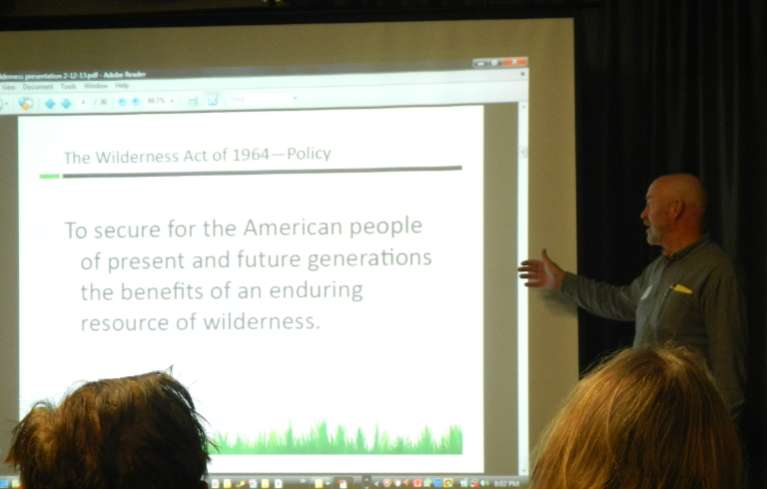
Bob Anderson with the Tahoe Area Sierra Club talks Feb. 20 about wilderness areas. Photo/Kathryn Reed

The Wednesday night meeting in South Lake Tahoe was supposed to feature Steve Evans, conservation director of the Friends of the River. He came down ill and in his place Fred Roberts and Bob Anderson, both members of the local Sierra Club chapter, spoke.

Roberts, who used to teach biology at Lake Tahoe Community College, said fewer people are experiencing their natural environment.

“We are losing every day to asphalt and social media and whatever forces there are that disconnect us from nature,” he said.

He also said how nature is disappearing and changing in various locations because of the bark beetle infestation, as well as because of climate change.

Roberts said it’s time to have a national conversation about the environment, adding, “We went through a presidential election and there was no mention of the environment.”

Locally, he advocated for the starting point of the Upper Truckee River getting a scenic designation.

“If we come together, we can leverage our power,” Roberts said.

Anderson, who is the group’s president and a member of the Tahoe Institute for Natural Sciences, picked up where Roberts left off. His talk focused on how the Lake Tahoe Basin Management Unit of the U.S. Forest Service is in the midst of reviewing comments to the Forest Plan update.

The Sierra Club actively lobbied for and still touts the desire that the Meiss Meadow area to become a wilderness area. This is the headwater of the Upper Truckee River.

“The U.S. Forest Service failed to identify and include in the alternatives an analysis of all of the wilderness-eligible land in the basin,” Anderson said. “There should also be a backcountry zone for mountain bikers.”

Alternative D in the Forest Plan would create 29,000 acres in the Meiss-Dardanelles area as a wilderness area. While the Sierra Club supported that idea, members also thought that alternative did not go far enough.

(The plan by the Forest Service should be released soon.)

The other designation the Sierra Club would like is to make the Upper Truckee River a wild and scenic river. This would take an act of Congress.


Opinion: Lawsuit against TRPA absolutely necessary

By Roger Patching, Dave McClure, Ellie Waller and Ann Nichols

That a lawsuit has been filed by the Sierra Club and Friends of the West Shore against the Tahoe Regional Planning Agency’s Regional Plan update should come as no surprise to conservationists, politicians and governmental officials involved with it, as well as citizens who have been following the process and ignored the propaganda that duped many. Quite simply, serving as a blueprint for both urban sprawl and densification in the decades to come, while a dream come true to developers, the RPU is an environmental and economic disaster for the Tahoe basin.

Efforts to politically mitigate the damage having failed, the only remedy remaining to save the lake and the bulk of its inhabitants and nonresident property owners is the court system. It is as simple as that. No entity is ever eager to file a lawsuit; it is done when there is no other recourse.

Politics at Lake Tahoe can be a rough ride. Photo/LTN

While the specific reasons regarding why the RPU is a disaster are addressed in the legal complaint, the general reasons are neither complicated nor difficult to understand.

First, the RPU is badly flawed. Supposedly founded on principles of “smart growth” that foster “sustainable communities,” the RPU is premised on conditions that don’t and won’t ever exist in the basin. Still, the environmental language of such development is so pleasing that it allows public relations image makers to “greenwash” such planning with lofty rhetoric about science and prosperity. The unvarnished facts specified in the lawsuit explain that the RPU will actually retard the attainment of the environmental thresholds that the TRPA is chartered to achieve. The new type and magnitude of corporate resort development that the RPU will allow, in addition to the monumental increase in the authority of counties to permit bigger, higher, and denser growth, represent not a minor tweaking of existing regulations but a return to the 1950s. In addition to environmental deterioration, small businesses will suffer from the invasion of corporate giants in both states.

Secondly, the RPU was drafted in an environment of political duress prompted by a threat from Nevada known as SB271. Passed in 2011, this statute threatens Nevada’s withdrawal from the bistate Compact that established the TRPA in the late ’60s if it doesn’t 1) draft a RPU favorable to massive development, and 2) change the voting procedures of its governing board which it views as restrictive of Nevada’s economic freedom. Its withdrawal would dissolve the Compact and therefore the TRPA. And, while many astute political analysts see it as a bluff due to the current political landscape in Nevada coupled with the problems of both governance and wrath that would accompany TRPA’s demise, others have shuddered at the threat, including a heretofore leading environmental organization, and acquiesced to the deterioration of the lake and Basin in exchange for keeping the Compact. In reality, Nevada already dominates the TRPA’s Governing Board and has more to lose than gain by withdrawing.

Thirdly, having succeeded with the SB271 bluff in terms of obtaining a RPU that will increase harm to the lake in exchange for high profits for Wall Street financed corporations with grand development ambitions throughout the basin, the bluff was extended to include withdrawal due to any litigation. Well, we shall see. Currently, regardless of the threat regarding litigation, all or portions of SB271 will need to be rescinded because its mandate about a change in TRPA voting procedures locked Nevada on a collision course with California when it became law. And, since the change requires the approval of both states and Congress, which won’t happen, Nevada must withdraw or change the law. Many in Nevada are embarrassed by both the threat and the hubris that created it.

Lastly, it is clear to those who have not been duped by the pro-development propaganda spun by the TRPA, which has become, according to California Senate Pro Tempore Darrell Steinberg, a captive of the special interests that it is supposed to regulate, the demise of the TRPA might not really be a bad thing. That is to say, we know that the RPU is guaranteed to damage both the environment and locally owned economy of the lake, so it must be opposed. In addition, California’s stake in the lake financially, demographically, and environmentally is much greater than that of Nevada and having its own California TRPA, which can negotiate problems directly with Nevada, could actually be an improvement over the status quo.

Consequently, with or without the TRPA, the lake is best protected by the abolition of the current RPU. And, remember: the TRPA caused the lawsuit when they approved the pro-development RPU, not the Sierra Club and its supporters. It is neither the governing agencies nor their corporate benefactors that are protecting the lake and private and public property from harm; that responsibility has been taken over by our colleagues who filed the lawsuit.

Roger Patching is president-CEO of Friends of Lake Tahoe, Dave McClure is president of North Tahoe Citizen Action Alliance, Ellie Waller is executive director of Friends of Tahoe Vista, and Ann Nichols is president of North Tahoe Preservation Alliance.


More antioxidants may not mean better health

By Nancy Shute, NPR

Antioxidants in foods are good for you, so more should be better, right?

Evidently not.

In a new study, people who ate more antioxidants overall didn’t lower their risk of stroke and dementia in old age. That flies in the face of earlier research that found that the antioxidants in fruits and vegetables reduce stroke and dementia risk.

“We’re seeing strong and clear benefits with specific antioxidants, but not overall,” says Elizabeth Devore, an epidemiologist at Brigham and Women’s Hospital who led the new study, which was published online in the journal Neurology.

Last year, Devore found that eating lots of berries delayed cognitive decline among women in the big, ongoing Nurses Health Study. Berries have lots of chemicals called flavonoids, which researchers think probably have protective powers much like those of better-known antioxidants like beta-carotene, vitamin C and vitamin E.

Before that, Devore had looked at data from a long-term study of more than 5,000 people ages 55 and older in Rotterdam, The Netherlands. The people were followed for about 14 years. She found that people who ate foods with more vitamin E were less likely to suffer dementia, and people who ate foods with more vitamin C were less likely to have a stroke.

But now she’s looking at the same people, and finds that having lots of antioxidants in the diet overall don’t help with stroke and dementia. What gives?

Devore tells NPR that she re-ran the numbers from the earlier Rotterdam study, just to make sure she hadn’t made a mistake, and it still showed that vitamins C and E were doing good things for the brain.

In the new study, the people with the highest levels of antioxidant intake were getting most of those antioxidants from coffee and tea. Evidently, the Dutch drink a lot of coffee!

Coffee and tea are “actually chock-full of antioxidants,” Devore says, in the form of flavonoids.

And other studies on people in Europe have found that drinking a lot of coffee, say five cups a day, does help protect against Alzheimer’s. But similar benefits didn’t appear in the coffee-loving Dutch group in Devore’s study, which leads her to suspect that total levels of antioxidant intake isn’t the whole story. “It’s nuance,” she says.

An Italian study from 2011 also showed less stroke risk in people who had a high-antioxidant diet overall. But in that case, the people were getting their antioxidants from wine, fruits and vegetables, Devore says. That’s very different than the diet of the Dutch study participants, who ate a lot of meat and dairy, and fewer vegetables and fruit.

Scientists have just started to really dig into the relationship between flavonoids and health, thanks to a big new USDA database on the still largely mysterious chemicals.

That should help resolve the confusion over the merits of antioxidants, Devore says. “As we’re able to move into these more nontraditional antioxidant foods, we’ll be able to tease out more specific information for people.”


Sierra Club and wilderness areas

Bob Anderson with the Tahoe Area Sierra Club speaks Feb. 20 about wilderness areas.


Nevada law would allow smokers to be discriminated against

By Andrew Doughman, Las Vegas Sun

CARSON CITY — A smoking habit could cost you a job opportunity at a hospital or other medical facility under legislation proposed by state Sen. Joe Hardy, R-Boulder City.

It’s currently illegal for an employer to discriminate against employees who use a product — such as tobacco — outside of work that does not affect job performance or the safety of other employees. Hardy’s measure, Senate Bill 87, would repeal that law.

“It would appear that this would allow an employer to not hire an employee who smokes or drinks,” the Nevada Taxpayer’s Association said in a recent newsletter.

At a legislative hearing Wednesday, Hardy introduced an amendment that would allow hospitals, nursing homes, hospice, home health and other medical facilities to specifically factor someone’s smoking habit into hiring decisions made after June 30.

Under the amendment, other employers would remain prohibited from basing decisions on an employee’s smoking habit.

“The theory is that when you’re in the hospital, you don’t want someone next to you who is smoking while you’re sick,” said Hardy, who is one of two physicians in the Legislature. (The other is Assemblyman Andy Eisen.) “Patients who smell smoke many times have problems with the reaction to it.”

Renown Health, a Nevada-based health care company, is working with Hardy on the bill. The company wants to factor smoking into its future hiring decisions but does not want any current employee to be fired for smoking, said Fred Hillerby, lobbyist for Renown.

“We just want to be able, if we choose, to not hire smokers,” he said. “We think it’s better for the health of our employees and our patients.”

Smoking cigarettes at home or outside during a break may be the personal choice of an employee, but being exposed to the lingering odor of cigarette smoke clinging to a medical employee’s clothing is not a choice for the sick and injured.

“It is their personal decision,” Hardy said. “It’s also a personal decision to quit smoking or risk some adverse employment activity.”

The comfort of the patient may be a noble idea, but it’s also now tied to payments hospitals receive from the federal government.

Under the Affordable Care Act, how patients score a hospital on such measurements as communication with nurses and doctors, cleanliness and quietness of the hospital environment factor into federal reimbursements paid to hospitals.

Hillerby, however, said “that was not the reason we started down this path.”


Locally sourced food hard for restaurants in winter

By Dan Saltzstein, New York Times

Locally grown. Market-sourced. Farm to table: These phrases have become the mantras of the American menu, promising ingredients that are supremely fresh, in season and produced within a tight radius of the restaurant.

But what can they possibly mean in the dead of winter, in northerly climes where farms are battened down and the earth is as hard as a raw cabbage?

In some restaurant kitchens, they mean a larder full of root vegetables, grains, dried beans and cellared fruits, as well as a lot of curing, pickling and preserving. Other, more ambitious restaurants turn to greenhouses or new vegetable hybrids.

Farmers markets are seasonal in Lake Tahoe. Photo/LTN file

And many inevitably resort to a certain amount of well-intentioned cheating.

“At some point, you’re inherently a hypocrite,” said Marc Meyer, the chef at Cookshop, in New York City. “You can’t make a menu of turnips, rutabagas and potatoes.”

Even chefs like him who are devoted to local and seasonal foods have to make exceptions, including the occasional FedEx package. Meyer’s winter menus include dishes that straddle the indigenous and the imported, like line-caught Long Island swordfish with cauliflower (also from Long Island) and chicory (from Florida), dressed with Meyer lemon (California) and topped with wedges of blood orange (California again).

Total purity, Meyer said, is a nice idea, yet all but impossible: “What about chocolate? What about olive oil? Spices?”

“Go for it if you can,” he added. “I just can’t with a 100-seat restaurant.”

At Rouge Tomate, an Upper East Side shrine to fresh local produce, the executive chef, Jeremy Bearman, admits to using the occasional nonlocal winter ingredient, particularly tropical fruits (bananas, mangoes, pineapples) in desserts. “I don’t think you can be one of those restaurants here in the Northeast saying, only things from 50 miles away,” he said.

Certainly, there are outliers who go to extreme lengths to keep the faith. At Willows Inn, on Lummi Island in Washington state, Blaine Wetzel uses only ingredients grown on the restaurant’s farm and surrounding farms.

“We are as purist as it gets,” Wetzel said. This means that “if I want lemon juice in something, I have to find an alternative” — underripe gooseberries are a common solution — “or maybe it’s not the right dish to be on the menu.” He forages for wild winter mushrooms and stores hundreds of onions bought from a neighboring farm. Yet despite the relatively moderate winter microclimate, in a shallow bay protected from cold ocean winds by the Olympic Mountains, Wetzel shuts down his restaurant in December and January. “We close when we can’t do what we do,” he said.

Dan Barber’s kitchen at Blue Hill at Stone Barns, in Pocantico Hills, N.Y., buys many of its ingredients from the Stone Barns Center for Food and Agriculture, an independent nonprofit organization on the same grounds that operates 80 acres of farmland (6.5 of them for vegetables), a 22,000-square-foot greenhouse and outdoor rows of plants shielded by a protective covering.

In addition, he and his team (as well as a full-time vegetable farm manager, Jack Algiere, and his crew) work with agricultural scientists at Cornell University on breeding winter-friendly vegetables, including a small, intensely sweet butternut squash they call the honeynut.

Barber pointed out that many of the strategies that chefs employ in winter, like fermentation or cold storage, are nothing new. “A lot of these techniques are ancient and brilliant, and evolved out of desperation,” he said.

Perhaps buoyed by the more modern technologies involved in breeding, he said that in some ways he preferred cooking in the winter months. “At what point can I make the greatest impression?” he said. “People’s expectations are lower, and it’s easier to exceed them.”

Barber isn’t the only chef who welcomes the cold-weather challenge. “We sort of look at winter the way an old-school chef looks at frugality,” said Jonathon Sawyer of the Greenhouse Tavern, in Cleveland. “We take more time with dishes because we have less to put on the plate.”

Sawyer, whose restaurant’s website includes a manifesto on “Sustainability Initiatives,” bottles his own line of vinegars, including ones made from craft beer and rosé wine, and has a running stock of preserved items. He said relationships with local farmers become all the more important in winter, for securing ingredients like grains (in particular, farro, an Ohio specialty), shelled beans and legumes.

But even the word “local” can fall prey to some fudging.

“There’s a very famous farmer who, when I met him years ago, had a 20-mile radius” of restaurants he’d sell to, Barber said. “And last year when I talked to him, he said he was delivering to a restaurant 28 miles away.”

What happened to 20? “All purists have their negotiables,” Barber said.

Iliana Regan, whose Chicago restaurant, Elizabeth, has won attention for its emphasis on local ingredients, many of them foraged by Regan, has a somewhat broader definition. Almost everything on her menu “is Midwestern, though perhaps out of state lines,” she said. “We’re probably breaking the 200-mile rule.”

Whence 200? “I believe I read it somewhere,” Regan said.

Thanks in part to her restaurant’s small scale (there are three set seatings for eight people each), Regan can quickly adapt whatever ingredients come her way. Raccoon from a Wisconsin hunter became a pâté, which she paired with pickled cranberries. Mushrooms foraged on her cousin’s Indiana farm were partly frozen, and thus unsuitable for serving conventionally, so she dehydrated them and made a tea.

But Regan has her limits: she supplements her menu with items from Whole Foods — “everything from squash to parsnips to dairy,” she said, adding, “at least that way I can see if it’s organic and where it’s from.” And like many chefs, she imports specialty items from around the world, like matsutake mushrooms from Japan and truffles from Europe.

If there’s one thing about winter cooking that chefs seem to agree on, it’s that the toughest time isn’t the middle of the season, but the end. “For me, the hardest months are March and April,” Barber said. “Storage starts to run out and you’re sick of the root vegetables.”

The result, for some, is chef-envy. “I went down to San Francisco a couple of weeks ago,” Wetzel said. “It was making me jealous. Things I don’t see until June or May, they have on their plates in December.”

For Bearman of Rouge Tomate, flying in an item or two is particularly tempting in late winter, when customers expect early-spring all-stars like ramps and asparagus. “There’s definitely times where, if we see great fava beans or great peas coming out of Iacopi Farm in California, we probably cheat a little bit,” he said. “But then we switch when it comes into season here.”

By some measures, circumstances for Northern chefs are improving. Meyer noted the increased vibrancy of farmers’ markets, including the Greenmarket initiative in New York. “A few years ago, there was no radicchio, no treviso,” he said. “You’re seeing more variety.”

Others even see a benefit from global warming. “I hate to say it, but it’s true,” Sawyer said. “We got artichokes in Ohio all the way into November this year. Maybe December.”

Then again, restraints are sometimes a good thing. Bearman said the bounty of late summer could be overwhelming: “You find yourself thinking, ‘What am I going to do on my menu?’”