Opinion: Gather emergency supplies before they are needed

By Tracy Franklin

This is the second of a series of articles highlighting emergency preparedness. Use these tools to prepare yourself for an emergency. More information is available in the city’s website.

Storing emergency supplies

Chances are you will have to rely upon supplies you have available in your home for at least the first three days following any major disaster.

Store these items in something that is portable and can easily be carried, like a plastic tub with a tight-fitting lid. In the event of fire or rapid evacuation, you’ll appreciate having more than just the clothes on your back.

The container should be able to withstand moisture, insects, and some abuse when the emergency occurs. If you have a large family, several smaller tubs may be easier to carry than one large container.

Place items in reusable bags to protect against condensation, which causes mildew and rust.

Locate these supplies as close to your primary house exit as possible. You may have to find it in the dark or after the upheaval of an emergency.

Preparing for emergencies is a long-term goal. To make this task manageable, choose just two or three items that you will get each month.

Water: Keep at least a three-day supply of water for each person in your household. Two-liter soda pop bottles work great. That means six 2-liter bottles per person.

Food: Store at least a three-day supply of non-perishable food. Select foods that require no refrigeration or cooking and little or no water.

• Canned meats, fruits and vegetables

• Canned juices and soups

• High energy foods — peanut butter, granola bars, trail mix, beef jerky

• Comfort foods — cookies, hard candy, etc.

First aid supplies:

• Bandages and adhesive tape

• Scissors and tweezers

• Moistened towelettes

• Bar soap

• Latex gloves

• Aspirin and non-aspirin pain reliever

• Antacid

• Anti-diarrhea medication

• Insect repellent

• Hydrogen peroxide to disinfect wounds

• Antibiotic ointment to dress wounds

• Sunscreen

• Safety pins

• Needle and thread

• Reusable bags

• Instant cold packs

• Pocket knife

Tools and supplies: Paper cups, plates and plastic utensils, battery operated AM radio, extra batteries, flashlight, non-electric can opener, ABC fire extinguisher, whistle, toilet paper and towelettes, liquid soap, roll of plastic and duct tape to seal broken windows.

Special items: Extra eyeglasses, prescription medications, family pictures, games and books, copies of insurance policies, bank account numbers, inventory of valuables, family record.

Clothing and bedding: One complete change of clothes, blankets or sleeping bags, blankets, sturdy shoes, warm socks, hat and gloves.

Tracy Franklin is the public information officer for South Lake Tahoe.


Tahoe Fund receives national grant

The Tahoe Fund, an environmental nonprofit raising funds for environmental improvement projects in the Lake Tahoe Basin, received an Every Day Capacity Building Grant from the National Environmental Education Foundation.

The grant program is made possible through support of Toyota Motor Sales USA, Inc.

This grant will provide resources to help the Tahoe Fund expand its online fundraising capacity and donor management capabilities. The Tahoe Fund was one of 29 grantees selected from a pool of 160 applicants.

Founded in 2010, the Tahoe Fund is a bistate nonprofit dedicated to raising money for environmental improvement projects that will improve lake clarity, enhance recreation and build a stronger sense of environmental stewardship in the basin.


USFS, Heavenly offering ranger program in Spanish

The U.S. Forest Service Lake Tahoe Basin and Heavenly Mountain Resort are offering Ski with a Ranger en Español.

Spanish Ski with a Ranger brings awareness of environmental issues to the local and visiting Latino community. The program will be offered March 13, March 27 and April 10, weather permitting. Tours are offered twice a day at 10am and 1pm.

The tour lasts approximately one hour and is open to Heavenly Mountain Resort guests who are intermediate level and above skiers and snowboarders. The tour begins near the bottom of the stairs at the top of the Heavenly Gondola. No reservations are required.

Participants will learn about the mission and role of the Forest Service in ski area management, improve their understanding of natural resource processes and issues, and learn about environmental literacy and stewardship.

For more information, contact Megan Dee at (530) 543.2618 or email mldee@fs.fed.us.


Tech industry zeroing in on gambling

By David Streitfeld, New York Times

SAN FRANCISCO — Look out Las Vegas, here comes FarmVille.

Silicon Valley is betting that online gambling is its next billion-dollar business, with developers across the industry turning casual games into occasions for adults to wager.

At the moment these games are aimed overseas, where attitudes toward gambling are more relaxed and online betting is generally legal, and extremely lucrative. But game companies, from small teams to Facebook and Zynga, have their eye on the ultimate prize: the rich American market, where most types of real-money online wagers have been cleared by the Justice Department.

Two states, Nevada and Delaware, are already laying the groundwork for virtual gambling. Within months they will most likely be joined by New Jersey.

Bills have also been introduced in Mississippi, Iowa, California and other states, driven by the realization that online gambling could bring in streams of tax revenue. In Iowa alone, online gambling proponents estimated that 150,000 residents were playing poker illegally.

Legislative progress, though, is slow. Opponents include an influential casino industry wary of competition and the traditional antigambling factions, who oppose it on moral grounds.

Silicon Valley is hardly discouraged. Companies here believe that online gambling will soon become as simple as buying an e-book or streaming a movie, and that the convenience of being able to bet from your couch, surrounded by virtual friends, will offset the lack of glittering ambience found in a real-world casino. Think you can get a field of corn in FarmVille, the popular Facebook game, to grow faster than your brother-in-law’s? Five bucks says you cannot.

“Gambling in the U.S. is controlled by a few land-based casinos and some powerful Indian casinos,” said Chris Griffin, chief executive of Betable, a London gambling start-up that handles the gaming licenses and betting mechanics of the business for developers. “What potentially becomes an interesting counterweight is all of a sudden thousands of developers in Silicon Valley making money overseas and wanting to turn their efforts inward and make money in the U.S.”

Betable has set up shop in San Francisco, where 15 studios are now using its back-end platform. “This is the next evolution in games, and kind of ground zero for the developer community,” Griffin said.

Overseas, online betting is generating an estimated $32 billion in annual revenue — nearly the size of the United States casino market. Juniper Research estimates that betting on mobile devices alone will be a $100 billion worldwide industry by 2017.

“Everyone is really anticipating this becoming a huge business,” said Chris DeWolfe, a co-founder of the pioneering social site Myspace, who is throwing his energies into a gaming studio with a gambling component backed by, among others, the personal investment funds of Jeff Bezos, Amazon’s founder, and Eric E. Schmidt, Google’s executive chairman.

As companies eagerly wait for the American market to open up, they are introducing betting games in Britain, where Apple has tweaked the iPhone software to accommodate them. Facebook began allowing online gambling for British users last summer with Jackpotjoy, a bingo site; deals with other developers followed in December and this month.

Zynga, the company that developed FarmVille, Mafia Wars, Words With Friends and many other popular casual games, is advertising the imminent release of its first betting games in Britain. “All your favorite Zynga game characters will be there, except this time they’ll have real money prizes to offer you,” an ad says. “Play online casino games for pennies and live the dream!”

DeWolfe’s studio, SGN, is also on the verge of starting its first real-money games in Britain. “Those companies that have a critical mass of users that are interested in playing real-money games are going to be incredibly valuable,” he said.

Mark Pincus, the chief executive of Zynga, said the company was just following the market. “There is no question there is great interest from all kinds of people in games of chance, whether it is for real money or virtual rewards,” he said. Zynga, which has missed revenue expectations in the last year, is making gambling a centerpiece of its new strategy. It has just applied to Nevada for a gambling license.

Casual gaming first blossomed on Facebook’s Web site, where players could readily corral friends into their games. It is now being rethought for mobile devices, so people can play in brief snippets as they wait for a bus or a sandwich.

Some games mimic the slots and poker found in casinos; others emphasize considerably more creativity. The vast majority of casual game players play at no charge. A small number buy virtual objects in the game to speed their play or increase their status.

Tech executives expect an equally small number to play for real money but believe they will bet heavily, making them much more valuable to the gaming companies. By Betable’s estimate, the lifetime value of a casual player is $2 versus $1,800 for a real-money player.

Big Fish Studios, a Seattle developer, introduced Big Fish Casino, an iPhone app, in Britain last fall. “We started with a one-pence slot machine,” little more than a penny, said Paul Thelen, Big Fish’s founder and chief executive. “Now it is up to a maximum of about $50 a bet.” Average revenue per player is exceeding $20 a day, whereas in virtual currency it was 30 or 40 cents.

“Like in Vegas, some people get lucky and some don’t,” he added.

The powerful Las Vegas and Indian casinos have mixed attitudes toward online gambling. Caesars Entertainment in 2011 acquired the Israeli start-up Playtika, developer of the popular Facebook game Slotomania, for about $180 million, offering it a springboard into the digital world. But Sheldon Adelson, the Las Vegas magnate and major Republican Party donor, is opposed to online betting because he thinks children will end up gambling.

In New Jersey, Gov. Chris Christie has had different qualms. He has vetoed two online gambling bills, the second earlier this month. One concern: the state’s take, a proposed 10 percent tax, was not large enough.

The measure, which is likely to be refined and successfully resubmitted in the next few months, followed the state Constitution, which mandates that Atlantic City is the only spot in the state where gambling can take place. And so only the casinos were allowed to offer online games, although they could partner with tech companies; the actual computers allowing the gambling would have to be housed in the casinos. And of course players had to be over 21 and physically located in New Jersey.

Meeting those last two requirements seems a tall order to Doug Creutz, an analyst at Cowen & Company who follows online gambling closely. “The Internet isn’t bound geographically,” he said. “There are other problems too, like preventing money laundering. Online gambling is going to be a complex issue that will take a while to sort out.”

In the meantime, though, he notes that games themselves are sometimes changing to incorporate elements akin to gambling. Diablo III, the latest version of the popular role-playing series from Blizzard, was released last year with an in-game auction house where players could buy and sell loot that they had found. If they chose, they could literally take the profits out of the game.

Since the loot was randomly generated, like the numbers on a slot machine, Blizzard had to remove the auction house game from the South Korean version of the game to satisfy the country’s strict antigambling provisions.

Cesar and Edgar Miranda are two young developers who have won hackathons, where the goal is to build a game in a weekend. The brothers, who rent rooms from their parents in San Jose, have spent the last few weeks refining their game, Claw Crane.

It is a simple variation of the grabbing game found in amusement arcades for decades: successfully secure a toy from a pile and you win. If Apple approves, the game, offering cash prizes, will be available in Britain later this month. A virtual money version will be available in the United States.

“We saw the opportunity here,” said Cesar Miranda, 24. “Anyone can jump in and try and grab a piece of this market while it is still fresh. There’s a low entry to failure.”

Neither he nor his brother, born in Mexico and raised in California, have even been near Britain. “I think the closest I’ve gotten is Las Vegas,” Cesar Miranda said.


More California wine being consumed throughout the world

By AP

SAN FRANCISCO — New figures show U.S. wine exports grew for the third consecutive year in 2012, setting a record of $1.43 billion in revenue, the San Francisco-based Wine Institute said this week.

Ninety percent of those exports were from California. Volume shipments reached 424.6 million liters or 112.2 million cases.

The European Union remained the top market for California wines, accounting for about 34 percent of all sales. The state’s wineries also saw significant growth in Canada and Asia.

Sales in China reached $74 million in 2012, up 18 percent from the previous year. South Korea, at $16 million, was up 26 percent. And Vietnam, at $27 million, was up 22 percent.

Exports to Mexico also grew for a second consecutive year, to $20 million, an amount that was double the 2009 figure.

In Canada, the second-largest market for California wines, sales reached $434 million, up 14 percent.

The increase came despite a highly competitive global market, significant trade barriers and a recovering economy, according to institute president Robert P. Koch.

The institute, which serves as the administrator of an export-promotion program managed by the USDA, promotes California wines through a video campaign, website and social media campaigns across the globe.

California winemakers say they’ve seen increased demand from overseas but still face some barriers to exporting wine.

“We’ve seen a big demand,” said David Gates, vice president of vineyard operations at Ridge Vineyards in Cupertino. “And as demand has picked up, we pushed a little harder into the more developing markets, the biggest one being China.”

The winery exports 25 percent of its production, Gates said. Its top export destinations are Canada, United Kingdom, Japan, Mexico and China.

As exports pick up, the main barrier for a smaller winery is production, Gates said. The company has to allocate its wine carefully in order to meet demand from the growing export market.

Another barrier is price, said Skylar Stuck, general manager at Halter Ranch in Paso Robles. Land and labor in places such as Chile and Australia are cheaper than in the Napa or Sonoma valleys. Even French and Italian wines can cost less to make, he said. The result is that iconic California wines that have cachet sell well at high prices, but lesser-known wineries have a harder time competing.

Despite the barriers, Stuck said, California winemakers are focusing on overseas markets to bring more exposure to their growing region.

The best way to promote California wines?

“I’ve traveled a lot, going store by store, doing tastings,” Stuck said.


Rate increase creates more profit for NV Energy

By Eli Segall, Las Vegas Sun

Helped by a rate increase and lower expenses, NV Energy had a jump in fourth-quarter earnings and nearly doubled its profit in 2012.

The power company, which serves about 90 percent of Nevada’s population, said Friday it earned $17.2 million of net income, or a gain of 7 cents per share, in the three months ending Dec. 31.

That compares to a loss of $25.2 million, or a loss of 11 cents per share, in the same period a year earlier.

The Las Vegas-based utility also reported earning $322 million in profit in 2012, up from $163.4 million in profit in 2011.

Company executives attributed the fourth-quarter earnings jump in part to a rate increase that took effect Jan. 1, 2012. As part of the hike, single-family homes in Southern Nevada were expected to face a 3.5 percent bump in their power bills.

NV Energy had $2.98 billion in operating revenue last year and $2.19 billion in operating expenses. In 2011, it had $2.94 billion in such revenue and $2.33 billion in expenses.


Longtime chronicler of science news keeping writing at 94

By Maria L. La Ganga, Los Angeles Times

SAN FRANCISCO — David Perlman had two deadlines on his mind as he elbowed his way through the Exploratorium, cane in one hand, notebook in the other.

As the San Francisco Chronicle’s veteran science writer, Perlman has been covering the granddaddy of hands-on science museums since it was just a glimmer of an idea in the fertile mind of physicist Frank Oppenheimer, the “uncle of the atom bomb.”

Now, after 43 years in the elegant but drafty Palace of Fine Arts, the museum was getting ready to close before moving to new digs on the Embarcadero, and it was Perlman’s job to chronicle the last day in its original home.
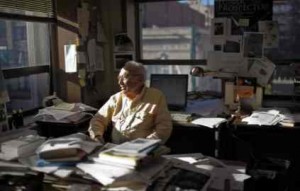
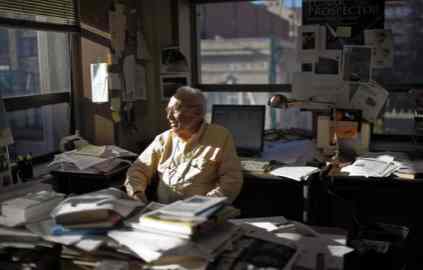
David Perlman sits at his desk at the San Francisco Chronicle, where he has been a reporter for 63 years. Photo/Peter DaSilva /Los Angeles Times

So the first deadline was his own — 6pm to make the next day’s paper with a front-page story. The second belonged to the woman tagging along behind him.

She’s “doing a story about the oldest living reporter — me,” Perlman told the amused museum staff. “She has to be done before I die.”

Science and journalism have come a long way since Perlman picked up a fountain pen and began to write.

He was born in 1918, a decade before the discovery of penicillin. Pluto had yet to be discovered, let alone demoted. The ballpoint pen was invented the year he got his first real newspaper gig, a 1938 summer job covering cops in upstate New York.

Perlman can’t remember the name of the now-defunct publication, but he sure can recall his first story, a jailhouse interview with a prostitute that began something like this: Pretty Kitty Kelly sobbed in her cell at Schenectady County Jail last night.

“It was atrocious, but it was the kind of thing you did,” said Perlman, who learned his craft in the glory days of the New York tabloids. “That kind of journalism no longer exists.”

Some might quibble with Perlman’s premise (think coverage of Lindsay Lohan, Casey Anthony, Kim Kardashian), but one thing cannot be denied: It is the rare journalist who has cranked out stories as long and as skillfully as the dapper dean of science writers.

Perlman turned 94 in December, closing out a year in which he wrote 111 stories. Although only 0.2 percent of America’s full-time workers are 80 or older, he has no plans to slow down.

He has shrunk a bit in recent years, but the cane is more for his three children’s peace of mind than his own safety or mobility. He’s about to turn in his outdated flip phone for a newer, smarter model. A Twitter lesson is in the offing. His driver’s license is up to date.

After all, he said over a burger at a South of Market dive near Chronicle headquarters, “I’m doing exactly what I wanted to do all my life, be a reporter.”

Perlman credits his mother for a journalism career that has spanned nearly eight decades and included stints at the Bismarck Capital and the European edition of the New York Herald Tribune and 63 years at the Chronicle.

Sara Perlman took her son to see “The Front Page” — probably the Broadway version, which premiered in 1928, but possibly the 1931 movie. Perlman the nonagenarian can’t remember which; Perlman the boy was smitten either way.

The motley crew of Chicago reporters portrayed in the comedy were waiting to view a public hanging. Perlman remembers them as “seedy, catatonic Paul Reveres, full of strange oaths and a touch of childhood. I thought, ‘What a romantic characterization.’ I wanted to be that.”

Shortly thereafter, he started his first newspaper. At summer camp.

He now bears the title of “Chronicle science editor.” Prizes for science and medical writing named in his honor are awarded each year. But writing about the physical world did not come naturally to the Columbia University graduate.

After six years covering everything from a shoe store opening to the obscenity trial over Allen Ginsberg’s “Howl,” Perlman broke his leg skiing at Squaw Valley in 1957, an injury that laid him up for months. A good friend gave him a copy of “The Nature of the Universe” by British cosmologist Fred Hoyle.

A detective story would have been more welcome, Perlman recalled thinking, but by the time he had finished the pioneering science tome and was back on his feet, he was itching to find out what astronomers did all night. So he headed up to Mt. Hamilton just east of San Jose, home to the University of California’s Lick Observatory and workplace of astronomer George Herbig.

“I said, ‘What do you do for a living?'” Perlman recounted. “And he said, ‘I’m interested in stars that are being born in the Orion nebula.’ I’ve never forgotten that…. Stars getting born? It was kind of an epiphany.”

In the 56 years that have followed, Perlman has written about the changing fields of astronomy, anthropology, archaeology and alternative energy. He’s done stories on microbes, meteors, mammoths, mad cow disease, the Milky Way, the missing link.

He has covered disasters natural and man-made (earthquakes, tsunamis, oil spills) and spacecraft of all shapes and sizes (Voyager I and 2, Mariner 9, Galileo, Viking 1 and 2, Pathfinder, Sojourner, Messenger, Phoenix, rovers, Kepler, Hubble).

There was no such thing as Acquired Immune Deficiency Syndrome when Perlman began covering science and medicine; he would go on to write more than 300 stories about the disease that broke his adopted city’s heart.

Somewhere in his messy cubicle at Fifth Street and Mission he keeps a copy of his first AIDS story — among the earliest published, penned before the disease even had a name.

On June 5, 1981, the Centers for Disease Control ran an item about an outbreak of a mysterious lung ailment.

“In the period October 1980-May 1981, 5 young men, all active homosexuals, were treated for biopsy-confirmed Pneumocystis carinii pneumonia at 3 different hospitals in Los Angeles, California,” the CDC’s Morbidity and Mortality Weekly Report began. “Two of the patients died.”

Perlman was a regular reader of the report. When he saw the piece, he immediately called Dr. Selma Dritz, assistant director of the communicable disease bureau at the San Francisco health department.

“Hey, is this happening here?” he asked. “Oh, yeah,” Dritz said. “We’ve had maybe five cases too, which have not yet been reported to the MMWR.”

The short article Perlman wrote was buried deep inside the June 6 paper: “A mysterious outbreak of a sometimes fatal pneumonia among gay men has occurred in San Francisco and several other major cities, it was revealed yesterday.”

He didn’t bother to put his byline on it. At the time, he said, the cases were “just a curiosity.”

Twenty years later, his anniversary story about the “worst pandemic in modern history” cataloged the damage — “nearly 22 million people are now dead worldwide, and the count grows higher every day; more than 36 million humans are infected with the deadly virus but still alive.”

In 2008, Perlman wrote Dritz’s obituary.

Perlman has outlived colleagues he has written with, scientists he has written about, Anne, his wife of 61 years, who died in 2002. He is dating again. (In fact, at a recent wedding, he caught the bouquet.)

“I’m so lucky still to be able to do something, to do what I do…. I’m still pretty OK,” he said. “Anyway, as long as they’ll have me [at the Chronicle], I’ll stick around.”

Dr. J. Michael Bishop, chancellor emeritus at UC San Francisco and a winner of the 1989 Nobel Prize in physiology or medicine, describes Perlman as “an iconic figure in American science writing.” His curiosity is “insatiable,” his energy “even at 94 is remarkable.” Perlman, he said, “knows how to get to the essence of the science problem and explain that in terms that are clear to the general public.”

Perlman’s favorite kind of story is equal parts physical adventure, scientific discovery and opportunity to watch brilliant researchers at work.

He embarked on one such journalistic jaunt in 1977, the only reporter on board when the Galapagos Hydrothermal Expedition discovered deep-sea geysers 8,250 feet below the ocean’s surface, 400 miles west of Ecuador.

Scientists on the research vessels Knorr and Lulu were pretty sure the vents would be surrounded by a barren, underwater desert. Instead, they found a wild habitat teeming with crabs, mussels and tall, white-stalked tube worms with bright red tops.

Perlman wrote his stories on a portable Olivetti typewriter. Using a Xerox telecopier scanner, the Knorr’s radio operator sent the exclusive dispatches using a single-sideband radio to the Woods Hole Oceanographic Institution. Staffers there forwarded them to the Chronicle via Western Union.

“They have pinpointed geysers of hot water venting from fissures in fresh lava and sending warm plumes of brine shimmering upward into the near-freezing lower levels of the sea,” Perlman wrote in a March 9, 1977, story whose headline boasted “Astounding Undersea Discoveries.”

Woods Hole would later call it a “scientific discovery that changed the world.”

On a much more recent adventure, Perlman camped in the Ethiopian desert with a team of fossil-hunting paleoanthropologists who would go on to discover and assemble the partial skeleton of a pre-human creature known as Ardipithecus ramidus — a.k.a. “Ardi” — who lived 4.4 million years ago.

The researchers were working in the Afar desert, the birthplace of humankind, a two-day drive from Addis Ababa. Daytime temperatures soared to triple digits. At night, tents were zipped against scorpions and venomous snakes.

The team was protected by guards toting AK-47s, Perlman wrote, “against whom or what was never clear — but huge lion paw prints spotted at one lunch site were clear hints of danger.”

He was 88.


Median home price in Tahoe going up

By Dan Spano

We have had a strong start to 2013 in Lake Tahoe real estate. Homes continue to sell at a strong pace and now the median price is starting to rise.

Even with the reducing inventory of homes on the market and the interest rates still at an all-time low, I believe we’ll continue to see strong sales. As of Feb. 20, on the Nevada side of the South Shore, there was just one foreclosure and one short sale on the market. The rest of Nevada is still seeing enough foreclosures to keep them as the No. 2 state in the U.S. in the number of foreclosed homes, but that isn’t the case in Lake Tahoe. The California side has seven foreclosures and four short sale homes for sale, a large drop from the last two years.

People want a piece of Tahoe real estate.

There has been more activity on the higher-end market of homes for sale. One home just sold in Cave Rock for almost $25 million and another in Skyland for $12 million. There is much more trust in the economy and it shows in these large purchases. Buyers are willing to pay for the kind of home they desire.

South Shore, Nevada market summary

On the Nevada side of South Lake Tahoe there were nine closed sales in January, and very interestingly, the exact same number as January 2012. With 30 homes currently in escrow, I expect to see a larger number when February’s figures are in. There were 167 homes sold on the Nevada side in the last 12 months, from Feb. 1, 2012, to Jn. 31, 2013. During the previous 12-month period there were 127 homes sold. There are currently 68 condos and 84 houses on the market, with almost 40 percent (60 properties) priced above $1 million.

Low inventory of homes for sale

The No. 1 conversation among Realtors nationwide is the low inventory of homes for sale, and it is no exception in Lake Tahoe. Larry Sabo, of Paradise Real Estate, says, “In the last six months, the median price of homes for sale in South Lake Tahoe has shown improvement every month, closed sales have been increasing since early in 2009 with a fast increase recently, and the time it takes to sell a home is at its lowest since March of 2007, long before the recession started. We are also seeing the percent of list price received has gone above a six-year high. The month’s supply of homes for sale, otherwise known as the inventory, is at a level lower than it’s been in more than six years. The number of homes for sale is also at a six-year low, with buyers out there frantically looking because they just can’t find the home they’re looking for. ”

With very low inventory left we really don’t know how sales figures will look in the next 12 months in Lake Tahoe.

I had been expecting a slow growth of recovery in Lake Tahoe but we’ve taken an accelerated pace, faster than ever expected. I’ll be keeping an eye on the situation and keep my readers updated.

Dan Spano is with Paradise Real Estate.


Forest Service: Pyroterrorism a threat in the U.S.

By Ed Ballam, Firehouse

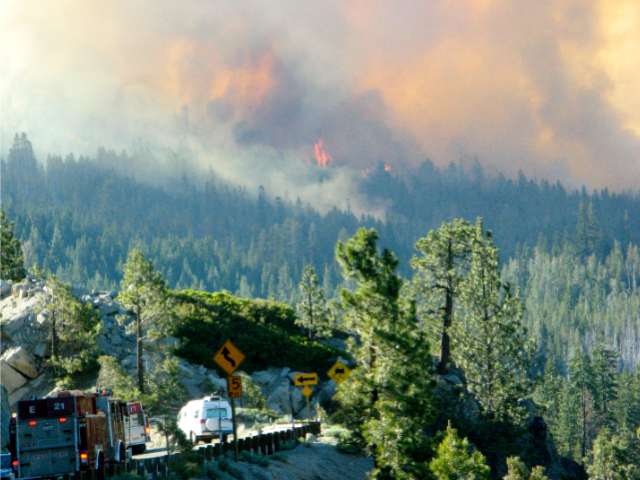
Fire has long been used as a weapon through history and continues to be an effective means of terrorism to this day.

In his keynote address at the Firehouse World conference in San Diego, Robert Baird, deputy national fire director of Fire and Aviation Management for the U.S. Forest Service, said pyroterrorism is something all responders need to be prepared to combat.

“Arson in the [wildland urban interface] is a real threat,” said Baird in his keynote comments. “Anything we can do to reduce it is a real accomplishment.”

The Lake Tahoe Angora Fire of 2007 was the result of a campfire gone bad. Photo/LVFPD

Baird gave a quick review of the use of arson and pyroterrorism throughout modern history, starting with the fire balloon bombs Japan launched on the mainland United States during World War II. Of the 9,000 launched, 300 hit the mainland.

It was also identified as a military weapon during the Vietnam War. The attacks on the World Trade Center were also a case of pyroterrorism in his mind, Baird said, noting that Osama Bin Laden was a civil engineer and knew the effect the fuel on the planes would have.

In 2002, federal authorities arrested José Padilla, an New York City native and declared enemy combatant, on suspicion that he was plotting with terrorist Khalid Sheikh Mohammed, the architect of the 911 attacks on the United States, to detonate a dirty bomb in Chicago.

During the investigation, Baird said authorities learned that Khalid figured out it would be too difficult to get a dirty bomb into the country and detonate it. So a plan was hatched to solicit volunteers to burn 20 apartment buildings in New York City simultaneously using gasoline.

In 2004, the FBI came upon intelligence and issued an alert to the National Interagency Fire Center (NIFC) suggesting that Al Queda had plans to start wildland fires in Montana, Wyoming, Utah and Colorado, Baird said, noting that all the material he was presenting was unclassified information and his interpretations and analysis were his own.

“I am not going to be some suit out of Washington, D.C., coming out here and telling you how to fight wildland fires,” said Baird, who added that his family in California was evacuated during the Camp Pendleton Fire.

And as recently as this past winter, a readily available Al Queda magazine called Inspire published an article and photos declaring people have the freedom to light fire bombs against the American enemies, Baird said.

“Terrorists have assessed us and they look for our weaknesses,” Baird said.

The threat, however, is not just from outside of the United States borders, Baird said, noting there are plenty of domestic groups who might use pyroterrorism as a method to advance their goals.

Baird pointed to the bombings of domestic terrorist Daniel Andreas San Diego, targeting firefighters and responders in 2003, as evidence of domestic pyroterrorism.

Raymond Lee Oyler, the man charged and convicted for setting the deadly Esperanza Fire in 2006 that claimed the lives of five firefighters, is yet another example of arson as a form of terrorism. Oyler was also suspected of starting as many as 25 other fires.

Even the recent fatal shooting of firefighters in Webster, N.Y., on Christmas Eve, is an example of someone using fire to create terror and kill firefighters, and a stark example of pyroterrorism, Baird said.

The best way to combat pyroterrorism, according to Baird, is to have a “cohesive wildland fire strategy” and to develop partnerships across all agencies to develop good tactical information.

While there may be many challenges to curbing pyroterrorism, Baird said developing “robust intelligence” on suspects and plots will go a long way toward achieving the goal.

It also helps to prevent fuel build-up that can contribute to the severity of wildland fires, Baird said, noting that fire officials need to know when to extinguish fires and when to let them burn to mitigate that potentially threatening fuel build-up.

Ultimately, the goal is to protect the public and responders from any harm pyroterrorists may be trying to inflict, Baird said, adding that watching out for each

other will help.

“When you roll into a fire, make sure everyone is protected and there are no easy targets,” Baird said. “Protect each other and bring everyone home.”


LTN working on glitches

How many of you are frustrated with Lake Tahoe News lately because it’s slow to load or you can’t even get on?

(Really, you don’t have to answer — we share your pain.)

With the redesign came a new server — one that clearly is not functioning well. We are hoping to have the problem corrected sooner rather than later, but it is likely to mean some intermittent problems through the weekend.

Thank you for your understanding and patience.

Kathryn Reed, LTN publisher