It takes time to plan for retirement

By Philip Rousseaux

The economy may be recovering, but some of the changes wrought by the Great Recession may be long-lasting. Anyone planning for retirement, no matter what their age, needs to take those changes into account.

People in their 40s and younger have some time to retool their plan, but Baby Boomers need to think with more urgency.

retirementA lot of boomers had all of their retirement investments in the stock market and, if they didn’t lose their principal, it will take some time for them to recoup their gains. Others moved their money to short-term savings, like CDs. But with interest rates so low, they’re actually losing money when you factor in inflation.

Those are the two most common mistakes people make in retirement planning – having everything in either stocks or short-term savings is a bad idea.

Space your investments so they’ll come due as they’re needed. Plan some that can be available in the short term, for emergencies, and others that will be available as you age.

Only 14 percent of Americans are very confident they’ll have the money to live comfortably in retirement, according to a 2012 survey by the Employee Benefit Research Institute.

Here are suggestions for ensuring you’re part of that 14 percent:

• Don’t take risks you can’t afford. This is another common mistake. Don’t put the bulk of your assets into anything that makes your principal vulnerable. Gambling that you’re going to win big on the market, or any other investment, means you also risk losing big. A portion of your investment should have a guaranteed return.

• Seek any guidance from independent financial advisors. This has two benefits: Advisors who aren’t marketing their own products have no conflicts of interest. You wouldn’t go to a commissioned salesman for advice on buying a high-tech product. Instead, you’d probably turn to a trusted friend or an independent expert source, like Consumer Reports. Take the same care with something as important as your retirement. The second benefit is that independent advisors can devise creative, innovative solutions to meet the needs of individual clients. Those working for companies like MetLife are not free to think outside the box. And that’s especially important In this new, post-recession economy.

• Consider alternatives to the stock market. One of the effects of the recession is that the public realizes Wall Street is not a safe retirement plan. Even if it can get you there, it’s not necessarily going to keep you there. There are a number of great, safer alternatives. One of those is fixed, indexed annuities. You loan an insurance company money and it guarantees you payments over a specified length of time. It’s a contract between you and the company. Fixed-rate indexed annuities have a minimum and maximum interest payment that’s linked to a common index, such as the Dow. When the Dow goes up or down, so does the interest rate, but it never go below the guaranteed minimum or above the guaranteed maximum. Your principal is safe and you can ride an up market without the risk.

With pension plans a luxury of the past and Social Security not a guarantee for the future, whatever your age, it’s important to start planning now for retirement by creating your own private pension.

The good news is, our life expectancy grows every year. It’s up to you to ensure that you have a great quality of life when you decide you no longer want to work.

Philip Rousseaux is the founder and president of Everest Wealth Management and Everest Investment Advisors money management firm.


Opinion: More to ‘husband’ and ‘wife’ than just words

By Nathaniel Frank

Earlier this month, the leak of an internal memo revealed that the Associated Press advised its writers “generally” to call legally married gay spouses “partner” instead of “husband” or “wife.”

The massive news agency, which sets the standard for many journalists worldwide, has it wrong; the default should be just what it is for straight married couples: “husband” and “wife.” There’s simply no rationale to use two different standards for gay and straight people who are legally married in their state.

AP has offered a wholly unsatisfying explanation for the usage distinction. Spokesman Paul Colford wrote last week that “husband” or “wife” “may be used in AP content if those involved have regularly used those terms.” Reached this week, he told me, “I expect we will have more to say on the subject before long. We’re listening and soliciting views.”

While AP has provided no clear rationale for its decision, presumably it believes that because same-sex marriage remains nationally contested, it is acceptable to call legally married gay spouses “partners.” Yet marriage is almost always governed at the state level.

True, the Defense of Marriage Act, passed by Congress in 1996, says the federal government does not recognize same-sex marriages. But no one seriously thinks that DOMA “unmarries” gay spouses; it simply denies them federal benefits. What’s more, the Justice Department, along with numerous legal experts, believe DOMA is unconstitutional, and the Supreme Court may shortly declare it so. At a minimum, AP‘s decision not to automatically use “husband” or “wife” for gay spouses in states where same-sex marriage is legal creates the perception that it is taking sides — and the losing side — in a culture war issue.

Nine states plus the District of Columbia allow same-sex marriage. AP‘s explanation suggests that it allows writers to use “husband” and “wife” if the parties involved make it clear that they use the terms, as though the editors are simply letting their subjects decide. But AP reporters probably don’t ask straight couples if they “regularly” use the terms; the agency, like the rest of the world, just employs the words without a second thought.

The point is, those who get married have already decided about terminology. They have chosen to become a husband or wife, and that’s what they deserve to be called. Failing to recognize this means failing to recognize what the gay marriage battle has been about: achieving equal dignity by accessing the same institutions and occupying the same symbolic spaces as everyone else.

Being “married” is, after all, a collective identity, in the same way “citizen” is. Both terms connote certain responsibilities, obligations and protections, as well as a sense of dignity and belonging for which there is no substitute. They confer equality on all those who occupy them. Using such a term fairly matters in the same way the front of the bus mattered to those banned from sitting there for no other reason than to designate them as second-class citizens.

Though AP‘s decision has not pleased gay advocates, it shouldn’t please opponents of same-sex marriage either. By suggesting that marriage is defined however each couple says it is, AP undercuts the power of the shared cultural definition of marriage, exactly what conservative opponents of same-sex marriage fear. It casts marriage as a subjective entity that could lose its power to delineate and help enforce our obligations to one another, a crucial part of its modern purpose.

Marriage used to function to regulate property (which included the women who were getting married), encourage and govern procreation and preserve religious and racial lines. But marriage today is far more about celebrating and enforcing people’s commitments to care for one another.

While many still cite procreation as the “reason” for marriage, law and society haven’t treated it that way for decades, as evidenced by granting marriage rights to those who don’t, can’t or won’t procreate. The power of the word “husband” or “wife” is that it can help guide people’s behavior during moments of weakness. Today, marriage is about personal responsibility, a cause conservatives ought to embrace.

If marriage matters at all, it should remain something that, despite its ever-evolving nature, also creates a collective identity with broadly embraced parameters. Yes, many Americans still want it defined to keep gay couples out. But with numerous polls showing majority support nationally for same-sex marriage, those Americans are losing the debate.

Equally important, the states that have legalized same-sex marriage have made their decision to make the one and only “marriage” — not some watered-down, back-of-the-bus version called “civil unions” — available to gay couples. And the individuals who have chosen to marry have made their decision to become husbands and wives. AP‘s job is to reflect this reality without hesitation. Anything else is editorializing.

Nathaniel Frank is visiting scholar at Columbia’s Center for Gender and Sexuality Law. This column first appeared in the Los Angeles Times.


Glenbrook area controlled burn to be reignited

U.S. Forest Service fuels management crews will continue prescribed fire operations above Glenbrook on Feb. 26.

usfsCrews expect to burn approximately 20 acres per day, weather permitting. Operations will continue through the week as conditions allow.

Residents and visitors of the Lake Tahoe Basin, Carson City and Reno can expect to see smoke from these prescribed fire project areas. Smoke may be visible on highways 50 and 28.

The Forest Service strives to minimize the impacts of smoke on local communities. Smoke-sensitive residents should consider staying indoors and keeping doors, windows and outside vents closed.

To directly receive prescribed fire updates, send an email to pa_ltbmu@fs.fed.us.

Forest Service staff will post road signs around areas affected by prescribed fire, and update the local fire information line at (530) 543.2600, No. 6.


Missing Gardnerville woman located, safe

Update Feb. 25 8:15pm:

Kathy Arlana Hammond of Gardnerville has returned home after being reported as a missing person on Feb. 15.

Hammond had traveled to Los Angeles on personal business, and was unaware she was reported as a missing person.

Hammond does not possess a cell phone, and had not contacted friends or family during her trip.

—-

A Douglas County woman has not been seen for several days. Kathy Arlana Hammand, 63, was reported missing by a friend on Feb. 17. She was last seen at approximately 1pm Feb. 15.

Kathy Arlana Hammand

Hammond is reported to be driving a teal green four-door 1993 Subaru Legacy sedan, with California license plate No. 3CKF797.

Hammond is 5-feet-2-inches tall, 135 pounds, medium build, fair colored skin, long straight brown hair and brown eyes. She was last seen wearing blue jeans, a brown colored ski jacket with blue trim, and carrying a black fanny pack.

Hammond is known to frequent hiking areas in the foothills along the Sierra Nevada Mountains.

Anyone with information regarding the whereabouts of Hammond or the vehicle is asked to call the sheriff’s department at (775) 782.9908 or (775) 782.5126.


California prosecutors launch criminal inquiry into parks ‘hidden funds’

By Kevin Yamamura, Sacramento Bee

The state attorney general’s office has launched a criminal investigation of California parks officials after the “hidden funds” case seemingly reached a dead end when state and local prosecutors did not pursue charges last month.

Peter Southworth, a supervising deputy at the attorney general’s office, disclosed to a joint legislative committee Wednesday the matter is “still under criminal review in my office.” He did not specify how long the inquiry would take.

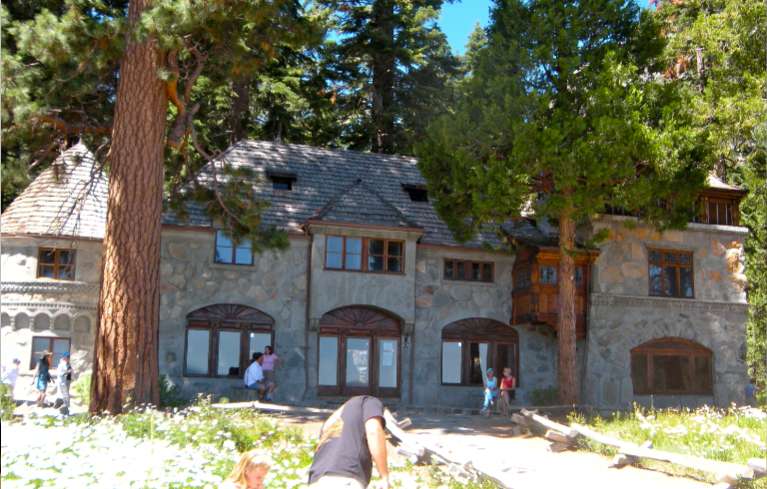
Vikingsholm at Emerald Bay State Park at Lake Tahoe. Photo/LTN file

Vikingsholm at Emerald Bay State Park at Lake Tahoe. Photo/LTN file

Three state agencies have found that California Department of Parks and Recreation officials hid funds for at least 13 years from state lawmakers and the Department of Finance. The Bee reported last year the parks department had cloaked a surplus beyond $20 million while Gov. Jerry Brown and lawmakers threatened to close 70 parks.

The revelations resulted in the resignation of state parks director Ruth Coleman and other disciplinary actions in the department last year.

Attorney General Kamala Harris’ office conducted a review that found “conscious and deliberate” acts to hide state parks fee revenue. It then transferred the file to Sacramento County District Attorney Jan Scully for review.

But the state office did not send the most damaging interview transcripts because it questioned employees using administrative, rather than criminal, procedures. The state office also did not identify who was to blame nor which laws were potentially broken.

Scully last month questioned why Harris had sent the case to her, saying that the attorney general’s office has “historic authority in the prosecution … of such cases.” The criminal pursuit was believed to be over at that point.

But Lynda Gledhill, spokeswoman for Harris, said her office decided to open a criminal investigation shortly after Scully declined to pursue charges, unbeknown to most until Southworth’s legislative testimony.

One curiosity in the state parks controversy is why department officials hid millions of dollars when they needed the Legislature’s approval to spend the funds.

State Auditor Elaine Howle in hearings this week referred to the hidden surplus as a “useless reserve” because parks officials in theory couldn’t spend the money without telling lawmakers of its existence. But that left some lawmakers unsatisfied.

“I can’t get my head around the nature of this,” said Assemblyman Bob Blumenfield, D-Woodland Hills, chairman of the Assembly Budget Committee, asking later Wednesday whether “sheer stupidity” was to blame. If officials couldn’t spend the money, Blumenfield wondered, what was their motive for willfully hiding the funds?

Howle acknowledged that after writing her 60-page audit last week, she and her colleagues were also scratching their heads.

But Howle later offered a credible, albeit complicated, hypothesis: The Legislature authorizes the parks department to spend a certain amount of self-generated fee revenue each year.

If the parks department had a down year for fee collection – say, receiving $15 million instead of $20 million that the Legislature projected – it’s possible the department could have tapped $5 million out of the hidden funds. The Legislature would have already given its approval for $20 million, so the department could spend the hidden $5 million rather than face cuts.

Howle said her office plans to further explore this possibility in the coming months.


Poll: Global warming a concern to Californians

By Jon Ortiz, Sacramento Bee

A new survey shows most California voters don’t like government’s response to global warming and still support the state’s greenhouse gas emissions law.

The Field Poll results released today show that 62 percent of voters are unhappy with the federal government’s actions and nearly half, 49 percent, give low marks to what the state is doing.

warmingOverall, about two-thirds of California voters think global warming is so serious that government needs to combat it and 70 percent support Assembly Bill 32, which aims to reduce greenhouse gas emissions by regulating industrial polluters.

Both support levels are down somewhat from 2007, one year after AB 32’s passage, when 79 percent of voters supported the law and 76 percent wanted something done about climate change.

Republicans, voters 65 and older, Central Valley residents and voters with no more than a high school education tend to believe that more research is needed or that concerns are unwarranted, the poll found.

They also tended to be “by far the people most opposed to AB 32,” said Field Poll Director Mark DiCamillo. “Any government action is misguided, from their standpoint.”

Luis Hernandez, a 26-year-old registered Democrat, said he’s a global-warming skeptic. He thinks government is overreacting.

“It’s what I hear on the news,” said the Merced resident, “but I’m not a scientist.”

On the other side, Democrats, independents, voters up to age 40, San Francisco Bay Area residents, Asian Americans and college graduates tended to think global warming is serious and merits more government action.

“The skeptics don’t think government has a role,” DiCamillo said. “People who do, view the federal government as dragging its feet.”

Sacramento catering business owner Rose Wallace, 63, said the weather has become “topsy-turvy” in her lifetime, and that government work to counter it.

“I think we’re going to wait on doing something until it’s too late,” Wallace said. “This is serious.”


Lack of approved software prevents Nevada from offering online poker

By Cy Ryan, Las Vegas Sun

CARSON CITY — Even though the Legislature rushed through a bill on Internet poker Thursday, the state has yet to approve the software to allow the game to be offered to the public.

The Assembly and the Senate gave unanimous approval to the emergency measure, and Gov. Brian Sandoval held a quick signing ceremony.

Gov. Brian Sandoval signed Internet poker legislation last week. Photo/LTN file

Gov. Brian Sandoval signed Internet poker legislation last week. Photo/LTN file

But A.G. Burnett, chairman of the Nevada Gaming Control Board, said Friday the computer systems to put the game online are still being tested.

“We have to certify that the software meets state standards,” Burnett said. “The technicians are moving full steam ahead.”

He had no estimate when the first system would be approved.

The state Gaming Commission has issued licenses to nine operators to enter the online poker market. The 2011 Legislature opened the door for companies to offer Internet poker within Nevada.

The bill approved Thursday allows Nevada to sign agreements with other states to offer Internet poker.

Sandoval asked the Legislature to approve the bill within 30 days of the start of the session so Nevada could be the first to enter the field. New Jersey is considering a similar bill.

Sandoval said the bill would “usher in the next frontier of gaming in Nevada. This bill is critical to our state’s economy and ensures that we will continue to be the gold standard of gaming regulation.”

A bill in Congress to permit Internet gambling on a national level has been bottled up.


Martis Valley trail route selected

By Barbara Barte Osborn, Sacramento Bee

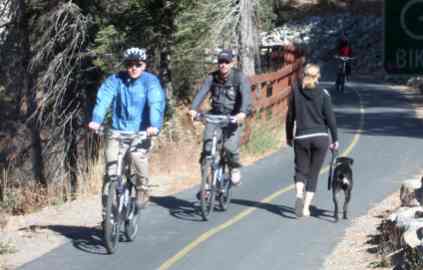
An alignment paralleling the south side of Highway 267 has been selected for a proposed 9. 5-mile multiuse trail through the Martis Valley near Truckee.

The Northstar Community Services District board voted for the alignment Wednesday after easements could not be obtained for an alternate route that would have followed an existing dirt road farther south through the valley.

trail“The Northstar Property Owners Association was not willing to grant easements for the valley alignment, and we respect that decision,” said Mike Staudenmayer, the district’s general manager.

The district is lead agency for the Martis Valley Trail, a controversial Placer County project.

“The highway alignment is also preferable to the Army Corps of Engineers and was found to be slightly environmentally superior in the CEQA (California Environmental Quality Act) analysis,” Staudenmayer said. “There are a lot of interested stakeholders, and we’re doing the best we can to do it right.”

The board also approved a design and consulting contract with Auerbach Engineering Corp. of Tahoe City for the first segment of the trail, from the Nevada/Placer county line to the wildlife viewing area.

Construction of that approximately 1-mile-long section is expected to begin next year.

Almost 3,000 feet of the initial section, within the wildlife viewing area owned by the Army Corps of Engineers, will not be paved initially but will have a packed surface, Staudenmayer said.

“We’re actively working with the Corps as (the trail project) progresses through National Environmental Policy Act review, hopefully within the next year,” he said.

The cost of the trail, from the county line to the Village at Northstar, is expected to be $12 million, of which the district currently has $4 million in grants – enough to build the first segment and design the rest, Staudenmayer said.

“We have more fundraising to do, but we hope to get it built as quickly as possible,” he said.

The plan is to extend the trail from Northstar’s Village to the ridge line overlooking the Tahoe basin, where it would connect at the Four Corners area with Forest Road 73, known locally as the “Fibreboard Freeway.”

The 10-foot-wide trail would be available to all pedestrian and non-motorized uses, with the exception of equestrians.

The only motorized use would be powered wheelchairs.


Ski report: Corduroy is calling

ski report logoTime to go carve corduroy.

Here is the Feb. 25 ski report.

— Curtis Fong


Douglas County starting work on Stateline plan

Douglas County is having a workshop March 1 about the area plan for Stateline.

Area plans are required in the Lake Tahoe Basin per the recently adopted Regional Plan of the Tahoe Regional Planning Agency.

The meeting will be in the TRPA board room (128 Market St., Stateline) from 1:30-5pm.

Comments may be submitted to Douglas County Community Development Department, P.O. Box 218, Minden, NV 89423.

For more info, call (775) 782.6215.